
If you're running an HVAC business, you know the drill. It's a constant juggle of dispatching techs, managing schedules, chasing invoices, and keeping customers happy. HVAC business management software is designed to be the central nervous system for your entire operation, pulling everything out of scattered spreadsheets and messy paper piles into one clean, digital workflow.
Think of it as the digital command center for your company.
Why HVAC Business Management Software Is Essential for Growth
Right now, your business might feel like an orchestra where everyone is playing from a different sheet of music. The dispatcher has one plan, the techs in the field have another, and the billing department is trying to piece it all together afterward. It’s a recipe for missed appointments, frustrated customers, and lost money.
Good HVAC software acts as the conductor, making sure every part of your operation is perfectly in sync.
This isn't just about going digital for the sake of it. It’s about transforming a series of disjointed, manual tasks into a single, smooth process. From the second a customer calls to the moment their payment hits your account, every single step is tracked and managed in one place. This isn't just for the big corporate players anymore; it’s a must-have for any small or mid-sized HVAC company serious about growing.
From Chaos to Cohesion
Let's be honest, without a central system, small problems bleed you dry. A tech calls the office three times for job details. Your dispatcher spends half the day erasing and rewriting a whiteboard schedule. An invoice gets misplaced and never sent. This kind of operational friction is what keeps you stuck, limiting how many jobs you can handle and chipping away at your reputation.
HVAC software cuts through that noise by creating one single source of truth for everything.
- Centralized Job Information: All customer history, service notes, and equipment details are right there for office staff and field techs to see. No more "let me call you back."
- Automated Communication: Your technicians get instant job updates on their phones, and customers automatically receive appointment reminders and "on-the-way" texts.
- Seamless Data Flow: The moment a job is marked complete, that information flows directly into an invoice, killing double-entry and slashing billing mistakes.
By tying everything together—from the initial customer call to the final schedule update—the software ensures no lead ever falls through the cracks.
Fueling Your Business Expansion
At the end of the day, you can't grow on a shaky foundation. Efficient operations are the bedrock of any scaling plan. The market for these tools is booming for a simple reason: they get results. The HVAC software market was valued at USD 1.65 billion in 2024 and is expected to climb, all driven by the need for smarter, more efficient ways to work.
When you automate the repetitive, day-to-day stuff, your team is freed up to focus on what really moves the needle: landing bigger contracts, upselling maintenance plans, and delivering the kind of service that gets you five-star reviews. This shift is what separates a business that’s just surviving from one that’s truly thriving.
Of course, a smooth operation is only half the battle. To really grow, you need a steady stream of new clients. Learning the top lead generation strategies for businesses will help you fill your pipeline and get the most out of your new software. Getting the right system in place is a massive step, and you can learn more about what comes next in our guide on how to scale a service business.
The Core Features That Drive Your Daily Operations
So, how does this software actually change things on the ground? Let's forget the jargon for a minute and walk through a real-world scenario. Imagine a frantic call from a new customer on the hottest day of the year—their AC just died.
Before software, this is where the chaos begins. A pen and a messy notepad are your command center. You're scribbling down details, hoping you don't miss anything vital while the phone keeps ringing. With a proper system, this first touchpoint is where you start winning.
This whole process is about moving from daily chaos to organized growth. It’s the bridge between just getting by and actually building a scalable business.
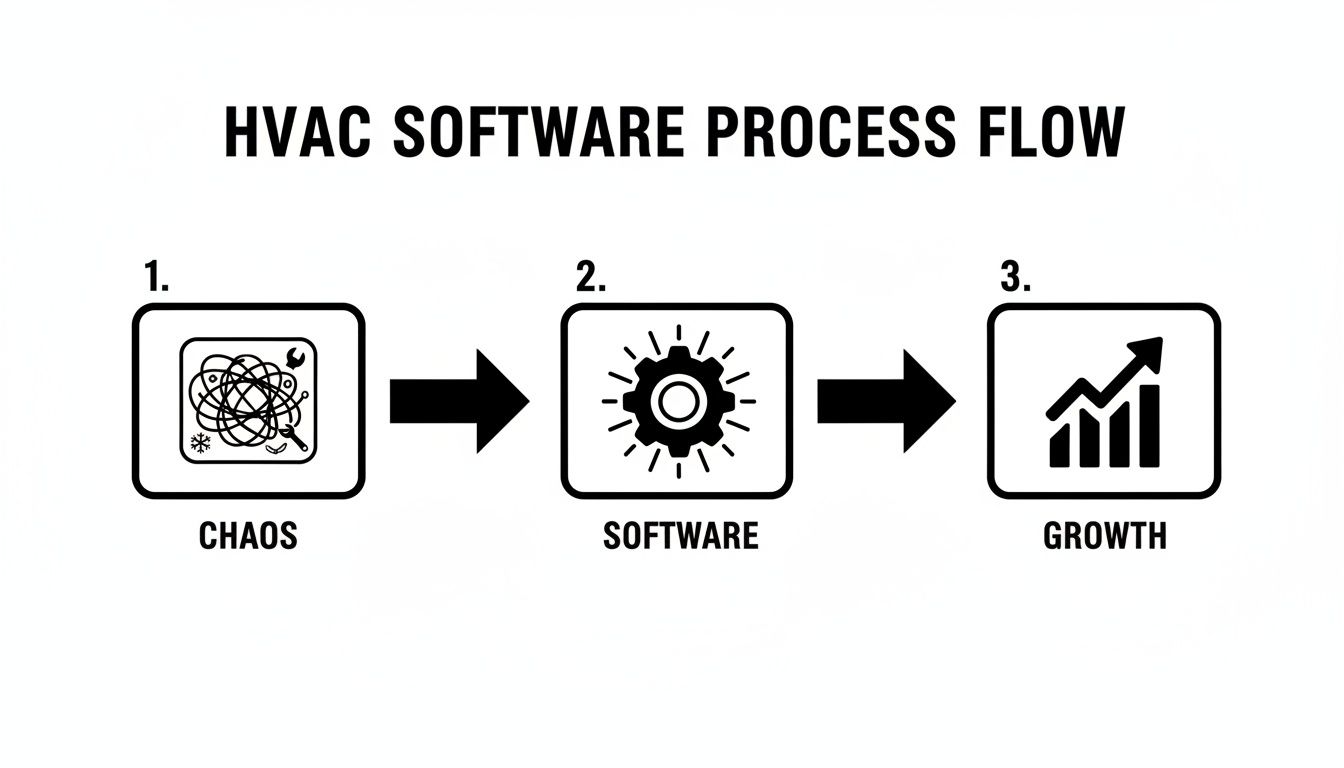
As you can see, a central software system isn't just a tool; it's the critical link that turns a tangled mess of daily tasks into a smooth path toward sustainable expansion.
To get a clearer picture of how each piece fits together, let's look at the essential modules and what they actually do for your business.
Essential HVAC Software Modules at a Glance
This table breaks down the core functions of HVAC software and the direct business problems they solve.
| Software Module | Primary Function | Key Business Benefit |
|---|---|---|
| CRM | Captures and organizes all customer data and interaction history. | Eliminates lost leads and provides a complete view of every customer relationship. |
| Scheduling & Dispatch | Visually manages technician schedules and assigns jobs intelligently. | Optimizes routes, reduces travel time, and prevents costly double-bookings. |
| Mobile Tech App | Equips field technicians with job details, history, quoting, and payment tools. | Increases first-time fix rates and improves on-site professionalism and cash flow. |
| Invoicing & Payments | Generates professional invoices and processes payments in the field or office. | Speeds up the billing cycle, reduces paperwork, and gets you paid faster. |
| Inventory Management | Tracks parts usage in real-time from the warehouse to the service van. | Prevents stockouts, reduces unnecessary trips, and ensures techs have the parts they need. |
These modules aren't just separate features; they're interconnected parts of a single engine designed to run your entire operation more efficiently. Let's break down how they work together during that emergency AC call.
Capturing Every Detail with a CRM
The first module to jump into action is the Customer Relationship Management (CRM) tool. As the call comes in, your dispatcher isn't grabbing a sticky note; they're creating a new customer profile right in the system.
All the critical data—name, address, phone number, and the nature of the problem—is captured cleanly in one spot. This immediately eliminates the risk of a lost lead or a tech showing up with the wrong information. The CRM becomes your company's digital memory, storing every service history, piece of equipment, and conversation for the future.
Intelligent Scheduling and Dispatching
With the customer's info locked in, the next puzzle is getting the right tech to the right place at the right time. This is where the Scheduling and Dispatch module becomes your air traffic controller. Forget the whiteboard that's always out of date; you now have a dynamic, color-coded calendar.
The system helps you make the smartest decision by suggesting the best technician based on:
- Proximity: It finds the tech closest to the job, slashing travel time and fuel costs.
- Skills: It matches the tech's certifications and experience to the specific AC unit.
- Availability: It shows you who's free in real-time, so you can stop double-booking jobs.
With a single click, the job is assigned, and all the details are pushed directly to the technician's phone. This isn't just about convenience; it's about efficiency. Studies show that optimized dispatching can boost technician productivity by over 25%. To see how this works in more detail, check out our complete guide on dispatch software for service companies.
Empowering Techs with a Mobile App
Your technician, now heading to the site, is no longer flying blind. The Mobile App is their most valuable tool in the field. From their tablet or phone, they can pull up the complete job history—every past repair, notes from other techs, and the exact equipment they're about to work on.
This instant access to information means they arrive prepared and can diagnose problems in a fraction of the time. Once they find the issue—say, a bad capacitor—the app keeps things moving. They can build a professional, multi-option quote right on the spot, get a digital signature from the customer, and even take a credit card payment right then and there.
Managing Parts with Real-Time Inventory
The moment that new capacitor is marked as "used" on the technician's app, the Inventory Management module automatically updates your stock levels back at the shop. This seamless link between the field and the warehouse is a total game-changer.
You're no longer guessing what's in the van or risking a second trip for a common part. The system can even be configured to automatically create a purchase order when stock for something like a capacitor drops below a set level. This simple automation prevents costly delays, improves your first-time fix rate, and keeps customers happy. Each module feeds the next, turning a once-hectic service call into a simple, repeatable, and far more profitable process.
How Key Integrations Unlock Peak Efficiency
Your HVAC business management software is powerful on its own, but it doesn't reach its full potential until it connects with the other tools you rely on every day. Think of it this way: your software is the engine of your business. Integrations are the transmission, connecting that raw power to the wheels and making everything move forward in perfect sync.
When you build this connected ecosystem, you tear down the walls between different parts of your business. Data flows freely, automating the tedious tasks that used to eat up your time and chip away at your profits. Your platform stops being just an organizational tool and becomes the true command center for your entire operation.
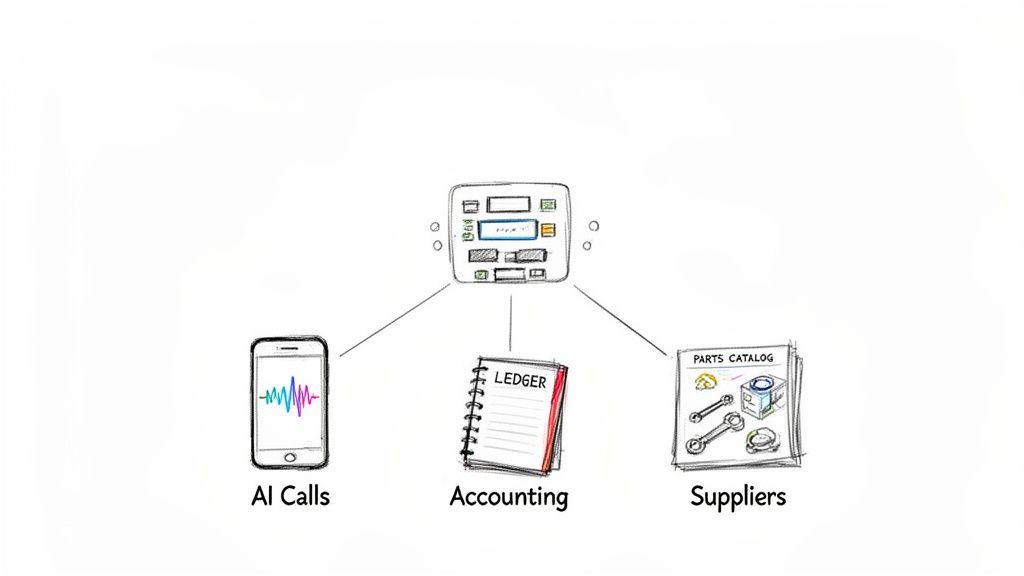
Never Miss a Lead with AI Phone Assistants
Every single missed call is a missed opportunity, plain and simple. When you hook up an AI phone assistant like Marlie.ai to your HVAC software, you make sure that never happens again.
Before, a ringing phone was a constant interruption. If you were on a job or your dispatcher was swamped, calls went to voicemail. Let's be honest—most customers just hang up and call the next company on the list. But with an AI assistant, every single call gets answered instantly, 24/7.
The AI handles the front lines for you:
- Answers basic questions about your services or service area.
- Books appointments that drop directly into your software's schedule.
- Gathers lead information and automatically creates a new customer profile.
This integration acts as a perfect receptionist for your business, capturing every lead without you or your team lifting a finger. Research shows that 60-80% of routine tasks, like scheduling and providing status updates, can be automated. This frees up your human staff for the complex problems only they can solve. You can learn more about AI’s role from this HVAC service management software market report.
Streamline Finances with Accounting Software
One of the biggest headaches for any HVAC owner is bridging the gap between field operations and the back office. Manually punching invoice details from your service software into an accounting program like QuickBooks is not just boring—it’s a recipe for mistakes.
An integration completely eliminates this bottleneck.
When your HVAC business management software syncs with your accounting platform, the data just flows. The second a tech closes out a job and generates an invoice in the field, that same invoice instantly appears in QuickBooks. When payment comes in, it's recorded in both places at once.
This connection gives you a crystal-clear, real-time view of your company's financial health. You get back hours of your week by killing double-entry, slash the risk of costly accounting errors, and know your books are always accurate. As a bonus, it dramatically speeds up your billing cycle, which does wonders for your cash flow.
Empower Technicians with Parts Supplier Catalogs
Here’s a classic scenario that kills a day's productivity: a tech gets to a job site, diagnoses the problem, and realizes they don't have the right part. That means a time-wasting trip to the supply house, pushing back every other appointment on the schedule.
Integrating your management software with your parts supplier's catalog solves this problem right from the field.
Imagine your tech finds a faulty compressor. Instead of making calls and hoping for the best, they can pull out their tablet and:
- Check real-time stock levels at the nearest supplier.
- See your company's actual pricing on the part.
- Place an order for pickup right from the customer's driveway.
This puts serious power in your technicians' hands, letting them solve problems on the spot. It cuts down on windshield time, prevents job delays, and allows them to give customers firm, accurate quotes for parts and labor instantly. Linking your operational platform with your supply chain is one of the smartest moves you can make. You can dig into more ways to connect your systems in our guide to the best workflow automation tools.
Your Checklist for Choosing the Right HVAC Software
Picking the right software for your HVAC business is a huge decision. Let's be honest, it's more than just a purchase—it's a massive investment in where your company is headed. To avoid that sinking feeling of buyer's remorse, you need a clear, methodical way to size up your options and find a real partner, not just another vendor.
Think of this checklist as your secret weapon for any software demo. It’s designed to help you cut through the flashy features and get straight to what actually matters for running and growing your business, day in and day out.
Assess Scalability and Future-Proofing
Your business isn't standing still, so why would you pick software that is? A platform that fits you like a glove today could feel like a straitjacket in two years. Scalability is all about making sure your software can keep up with your ambitions.
When you're in a demo, you need to dig into its potential for growth. Don't be shy about asking the tough questions:
- User and Technician Limits: Does their pricing punish you for success? Find out if you'll get hit with higher fees just for adding more techs or office staff as your team expands.
- Feature Tiers: Are the tools you'll need down the road—like multi-location management or custom reporting—actually available? Or are they locked behind an insanely expensive tier you'll never reach?
- Performance Under Load: Ask them how the system handles the load for a company with 20 or even 50 technicians. You want a platform that stays snappy and responsive, not one that grinds to a halt as you pile on more jobs and data.
A truly scalable hvac business management software should feel like it's helping you grow, not holding you back.
Evaluate Field Usability and Adoption
Here’s the hard truth: if your techs in the field hate using the mobile app, you've already lost. The single biggest factor for success is whether your team actually uses the tool, and that starts with an app that’s dead simple to use. A clunky, complicated app just leads to frustration, spotty data entry, and, ultimately, a failed investment.
The goal is to make your technicians' lives easier, not harder. A well-designed mobile app gives them everything they need to nail the job on the first visit, from a customer's complete service history to creating an invoice on the spot.
During the demo, insist on seeing the mobile app in action. This isn't optional. Here's what to ask:
- Offline Functionality: What happens when a tech is in a basement or a rural area with no cell service? Can they still see job details, build an invoice, and get a signature?
- Ease of Use: How many taps does it take to do a common task, like adding a part to an invoice or marking a job as complete? The fewer, the better.
- Training Time: How fast can a new hire get up to speed? A great app should be so intuitive that someone can learn the basics in under an hour.
Question the Quality of Customer Support
When your system goes down on a sweltering Monday morning in July, you need help now, not in a few days. The quality of customer support can absolutely make or break your experience. Don’t just take the salesperson’s word for it; you need to find out what kind of support you’ll actually get when things go wrong.
Ask for the specifics:
- Support Channels: Can you get a live person on the phone, or are you stuck sending emails into a black hole and arguing with chatbots?
- Response Times: What’s their guaranteed response time for critical issues? Look for a clear service-level agreement (SLA) that puts it in writing.
- Onboarding and Training: What does the setup and training process actually look like? Having a dedicated person to guide you through the rollout is a huge plus and can prevent a lot of headaches.
Your software provider should be a partner who’s as invested in your success as you are. A powerful CRM is also a huge piece of this puzzle; you can learn more by checking out our guide on the best CRM for contractors. Ultimately, choosing the right platform is about building a solid foundation for years of efficient, profitable growth.
All the features and integrations are great on paper, but let's get down to brass tacks: what does this software actually do for your bottom line? When you move from theory to the real world, the right platform delivers tangible returns. It solves the expensive, everyday headaches that keep HVAC businesses stuck in neutral.
This is about turning the friction in your daily operations into measurable financial gains.
Think about it. When you automate the tedious administrative tasks and optimize what your techs are doing in the field, your team can finally focus on what makes money—finishing jobs and taking care of customers. They stop getting bogged down by endless paperwork and chaotic scheduling.
From Solo Operator to Growth Engine
Picture a solo owner-operator who feels like they're permanently hitting a ceiling. They can't possibly take on more work without the massive step of hiring another person. But by bringing in hvac business management software with automated scheduling, they can suddenly see their entire week at a glance and intelligently slot in more jobs.
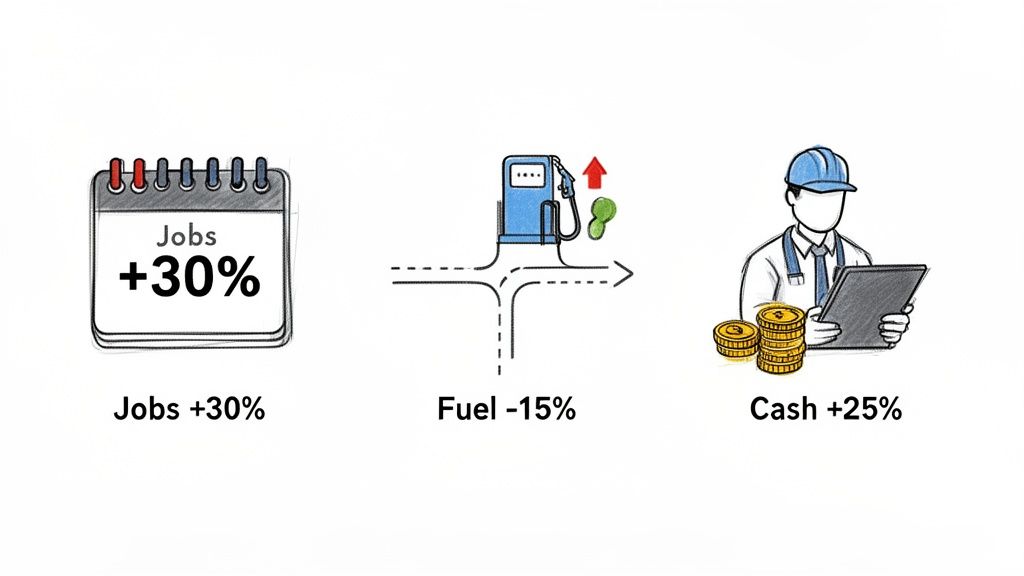
The result? They manage to boost their total job capacity by 30% without adding a single dollar to payroll. This isn't just a tool for big teams; it’s a force multiplier for a small shop trying to grow. Better lead management is another huge piece of this puzzle. For a deeper dive, you might check out a growth playbook for generating leads online.
Slashing Costs for a Mid-Sized Team
Now, let's think about a growing business with five techs on the road. Before using software, their daily routes were a mess—wasted hours driving back and forth across town, leading to ridiculous fuel bills. After they adopted a platform with smart route optimization, their dispatcher could map out the most efficient path for each tech, every single morning.
The impact was immediate.
- They saw a 15% reduction in fuel costs across the entire fleet.
- Techs spent way more time on billable work instead of staring out a windshield.
- Customers were happier because they got tighter, more reliable appointment windows.
This is a perfect example of a direct line between a software feature and cold, hard cash savings. Every dollar not spent on gas goes straight to your profit margin. The system can literally pay for itself with just this one improvement.
Improving Cash Flow On-Site
Finally, consider a company that was always struggling with slow payments. Their invoicing process was clunky and old-school. Techs would finish a job, leave a paper invoice, and then someone back at the office had to spend weeks chasing down the money.
By equipping their team with a mobile app for on-the-spot invoicing and payment processing, they completely changed their financial cycle. That simple move led to a 25% improvement in cash flow because payments were collected the same day the service was done.
Outcomes like these are why the HVAC software market is growing so fast. Contractors can respond quicker, book more jobs, and stay focused on revenue. By 2030, it's predicted that over 70% of HVAC companies will depend on these tools, a huge jump from just 40% in 2020.
Of course, many of these great outcomes start by simply capturing every single sales opportunity. That's why a rock-solid HVAC technicians answering service is such a critical first step. These examples make it clear: the right software isn't just another tool. It's an investment that delivers clear, powerful, and profitable results.
A Few Common Questions About HVAC Management Software
Making a big change to how you run your business is a serious decision, so it's smart to have questions. Investing in new technology can feel like a huge leap, especially when you're just trying to keep up with the day-to-day chaos of running an HVAC company. Let's tackle some of the most common concerns head-on.
A lot of owners worry that new software will disrupt their business more than it helps. The good news? Modern platforms are built to get you up and running fast, so you start seeing the benefits almost immediately.
How Long Does It Take to Get My Team Trained?
One of the biggest things holding owners back is the fear of a long, painful training process. You can't afford to have your technicians or office staff sidelined for weeks just to learn a new system.
Thankfully, the best HVAC business management software is designed with real people in mind—especially field techs who need something they can learn on the go.
Most companies roll it out in phases:
- Initial Onboarding: Getting the core system set up and training the office staff usually takes just a few focused sessions over the first week.
- Technician Training: The mobile apps are often so intuitive that most techs get the hang of the important stuff—like viewing jobs and building invoices—in a single afternoon.
- Full Adoption: Within 2-4 weeks, most teams are completely comfortable using the software for all their daily tasks. The learning curve is behind them, and they're settling into a much more efficient rhythm.
The whole thing hinges on finding a system with a simple mobile app and great customer support to walk you through the setup.
Is This Software Affordable for a Small Business?
It’s easy to look at powerful software and assume it comes with a price tag only the big guys can afford. But the industry has changed. The game is no longer rigged in favor of massive corporations.
You don't need a huge upfront investment anymore. Most modern platforms run on a monthly subscription, often priced per user. This approach lets you scale your costs as you grow, turning what used to be a crippling capital expense into a manageable operating cost.
Think of it less as a cost and more as an investment in pure efficiency. When you add up the money saved from less wasted fuel, fewer missed appointments, and getting paid faster, the software often pays for itself in just a few months.
Can This Really Help Me Compete with Bigger Companies?
Absolutely. In fact, this is one of the biggest advantages this kind of software gives you. Larger competitors often win jobs simply because their operations are buttoned up—they answer every call, schedule appointments instantly, and present a more professional image.
HVAC business management software completely levels that playing field. It gives your small team the same operational firepower, letting you perform with the speed and polish of a much larger organization.
By automating the tedious work of scheduling, dispatching, and billing, you free up your crew to focus on what you do best: delivering the high-quality, personal service that the big companies just can't match. That right there is your winning edge.
Ready to see how an AI-powered assistant can make sure you never miss another customer call? Marlie Ai provides 24/7 coverage, books jobs for you automatically, and plugs right into your workflow to help you grow. Learn more and get started at https://www.marlie.ai.
