
Scaling your service business is a game-changer. It’s about making the leap from doing everything yourself to building a machine that delivers consistent, quality results—with or without you.
To get there, you’ve got to document your repeatable processes, zero in on your most profitable services, and build a team that can carry out your vision. This is the critical shift from being an operator to an owner, and it’s the only path to sustainable growth.
Building Your Foundation for Scalable Growth
Before you dream of more clients, new hires, or a second location, you need a rock-solid foundation. So many business owners get stuck on the hamster wheel, working in their business—running calls, juggling schedules, chasing invoices. There's no time left to work on it.
The very first move is a mental one. You have to stop being the primary "doer" and start becoming the chief architect of your operation.
This isn't just about getting bigger; it's about survival. A business that depends entirely on your personal effort has a very low ceiling. Trying to grow without a solid foundation just leads to burnout, spotty service, and unhappy customers. It’s a recipe for disaster.
From Operator to Architect
So, how do you make that transition from operator to architect? It all starts with one deceptively simple habit: documentation. Think of it as creating the official playbook for your company. Every single process, no matter how small or obvious it seems to you, needs to be written down.
What does this look like in the real world?
- For a Towing Company: This means scripting the exact words for answering an emergency call, creating a step-by-step safety checklist for hooking up a vehicle, and outlining the procedure for taking payment on-site.
- For an HVAC Business: You'd create a detailed guide for the annual maintenance visit. It would include a checklist of all inspection points, a template for customer emails, and clear instructions for upselling filter replacements.
- For a Marketing Agency: You could map out the entire client onboarding process, from the questions you ask on the discovery call to the project kickoff email and the template for weekly reports.
The real test is this: could you go on a two-week vacation, completely unplugged, and the business would run smoothly? If your daily presence is a requirement for success, your business isn't scalable. Not yet.
This painstaking documentation does two crucial things. First, it locks in consistency and quality control. Every customer gets the same great experience. Second, it becomes the training manual for every new person you hire, letting them replicate your high standards from their very first day.
Identify Your Most Profitable Services
Here’s a hard truth: not all revenue is good revenue. A massive part of building that scalable foundation is digging into your service offerings to figure out where the real money is made. It’s the old 80/20 rule—most businesses find that 20% of their services generate 80% of their profits.
You need to track your numbers with ruthless honesty. For every service you offer, calculate the true cost of delivery. That includes labor, materials, gas, and a portion of your overhead. You might be surprised to find that those high-ticket, custom jobs you love are actually less profitable than the standardized, high-volume services you can turn into a system.
To really build a strong foundation, you have to implement proven lead generation strategies for service businesses that consistently bring in your ideal, most profitable clients.
Once you have this data, you can start making smart, strategic decisions. This might mean:
- Focusing all your marketing dollars on your most profitable services.
- Creating tiered packages to gently upsell clients to higher-margin offerings.
- Getting rid of the low-margin services that are just a drain on your time and resources.
Understanding these numbers is non-negotiable for smart growth. If you aren't already tracking them, a great place to start is by defining the key performance indicators for your small business and checking in on them every single week. That clarity is what allows you to build a business model that isn't just bigger, but fundamentally healthier and more resilient.
Creating Repeatable Systems and Processes
If you ever want to scale your business—or just take a vacation—it can't depend entirely on you. True growth happens when your business delivers consistent, high-quality service without you having to personally intervene in every single task.
This is where repeatable systems and documented processes become your best friends. They're what transform your business from a one-person show into a well-oiled machine that can grow without collapsing under its own weight. It’s the difference between owning a job and owning a true business asset.
Think of it as moving from keeping everything in your head to creating a clear playbook that anyone on your team can follow. The goal is simple: make sure the tenth customer gets the exact same excellent experience as the first, no matter who's on the job.
This simple flow is the foundation of it all.
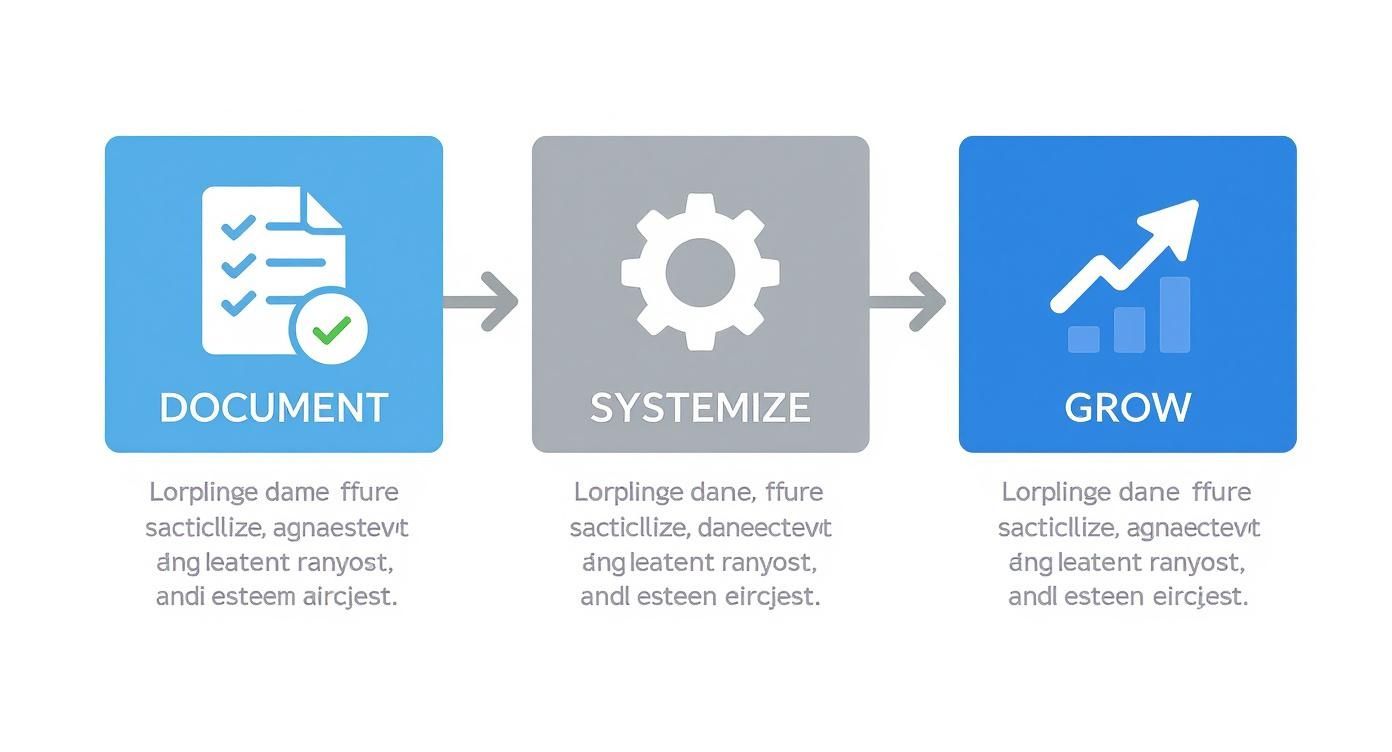
It’s a clear progression. You start by documenting what you're already doing, then you systemize it for consistency, which is the key that finally unlocks sustainable growth.
Map the Entire Customer Journey
Before you can build any effective systems, you have to understand every single touchpoint a customer has with your business. I mean every single one.
Start at the very beginning and walk through their entire journey. From the moment they first hear about you to the final follow-up call, what happens?
Let's make this real:
- For a Locksmith: The journey often starts with a frantic late-night call. Your process needs to script the initial questions (e.g., "What is the year, make, and model of the vehicle?"), detail how you dispatch the nearest tech, and standardize the on-site payment process. No ambiguity.
- For an HVAC Company: It might begin with a lead form on your website. Your system map should include the automated confirmation email, the script for the initial scheduling call, the pre-appointment reminder text, the technician's arrival checklist, and the process for collecting a review afterward.
Mapping this out is an eye-opening exercise. You’ll immediately spot the bottlenecks, the dropped balls, and the places where a lack of a clear process is costing you time and money. This map is the skeleton for your Standard Operating Procedures (SOPs).
Turn Your Map into Actionable SOPs
With your journey map in hand, the next step is to create simple, actionable SOPs. Forget hundred-page manuals nobody will ever read.
The best SOPs are often just simple checklists, clear flowcharts, or short "how-to" videos. Clarity and ease of use are everything. Your only goal here is to eliminate guesswork for your team.
A business without documented systems isn't really a business—it's just a job. When you create repeatable processes, you build an asset that has value completely independent of your daily efforts.
For example, a plumbing company could have a laminated, one-page checklist for a standard water heater installation. This would detail every step, from the initial safety check to the final system test and site cleanup. This simple tool ensures that even a newer technician doesn't miss a critical step, keeping quality high and callbacks low.
In fact, over 40% of businesses report that process automation improves work quality—a direct result of this kind of simple systemization.
To give you a better idea of where to start, here are some of the most critical functions to document.
Key Business Functions to Systematize for Scaling
| Business Function | Key Processes to Document | Example Application (for a Plumbing Business) |
|---|---|---|
| Sales & Lead Management | Lead intake script, qualification criteria, proposal template, follow-up sequence. | A script for the office manager to handle new service calls, a checklist to qualify leads (e.g., location, issue type), and a standardized estimate template in the quoting software. |
| Customer Service | Answering the phone, handling complaints, scheduling appointments, collecting feedback. | A 3-ring phone script, an escalation path for unhappy customers, and an automated text message asking for a review 24 hours after a job is completed. |
| Operations & Service Delivery | Pre-job checklist, on-site service protocol, post-job cleanup, parts ordering process. | A "truck stock" checklist for each vehicle, a step-by-step digital form for a drain cleaning service, and a clear procedure for ordering non-stock parts from suppliers. |
| Finance & Admin | Invoicing, payment collection, expense tracking, payroll procedures. | A policy to invoice customers immediately upon job completion via a mobile app, instructions for technicians to photograph and submit receipts for expenses, and a bi-weekly payroll checklist. |
| Hiring & Onboarding | Job description templates, interview question bank, new hire training checklist. | A standardized job ad for a journeyman plumber, a set of 10 core interview questions, and a 2-week onboarding schedule that pairs new hires with senior technicians. |
Documenting these areas turns tribal knowledge into a company asset, making it far easier to hire, train, and grow your team effectively.
Get Team Buy-In and Foster Improvement
Creating a binder full of SOPs is the easy part. The real work is getting your team to actually use—and help improve—these systems. Without their buy-in, your SOPs will just collect dust.
The secret? Involve your team from the start.
Ask your top performers how they get such great results and document their methods. They're on the front lines and have insights you'll never get from the office. This isn't just about building processes; it's about building a culture of continuous improvement.
Make it clear that your SOPs are living documents, not rules set in stone.
- Hold monthly "process improvement" meetings: Get together and talk about what’s working, what’s frustrating, and how you can make things smoother.
- Create a simple feedback loop: Give team members an easy way to suggest changes. A shared Google Doc or a dedicated Slack channel works wonders.
- Celebrate efficiency wins: When a new process saves time or cuts down on errors, give a shout-out to the people who helped make it happen.
When you empower your team to co-own the processes, you create a business that's always getting smarter and more efficient. To go even deeper, you can explore various business process improvement methods to find a framework that fits your company. This collaborative approach is what truly prepares your business to scale.
Designing Your Pricing for Profitability and Scale
So many service businesses get stuck in a pricing model built for survival, not for scale.
Charging by the hour or just matching what the other guy down the street charges might keep the lights on today, but it puts a hard ceiling on how far you can grow. If you're serious about scaling, your pricing has to become more than a simple calculation—it needs to be a strategic weapon.
This means you’ve got to move beyond just covering your costs and your time. Your price tag needs to reflect the true value you're delivering. It needs to fund your future growth. And it needs to position you as a premium choice, not just another commodity. It’s a huge shift from trading time for money to selling real solutions and outcomes.
Moving Beyond Hourly Rates
The first step is usually the toughest: letting go of the hourly rate.
It’s easy to calculate, sure, but hourly billing actively punishes you for being good at your job. The faster and more efficient you become, the less you earn. Think about that for a second. That model is completely backward if you’re trying to scale a service business.
Instead, start thinking in packages and value. This means bundling your services into clear, tiered offerings that solve specific problems for your customers at different price points.
- An HVAC company could stop charging for a simple service call and instead offer "Good," "Better," and "Best" annual maintenance plans. The basic plan covers the essentials, but the premium tiers could throw in priority service, repair discounts, and advanced diagnostics.
- A marketing agency could ditch hourly consulting and offer a "Starter SEO Package," a "Growth SEO Package," and a "Dominator SEO Package." Each has a fixed monthly price and a crystal-clear set of deliverables and expected results.
This approach makes it way easier for clients to understand what they're buying. More importantly, it creates predictable, recurring revenue—the absolute lifeblood of any scalable business.
Calculating Your True Cost of Service
To price these new packages without losing your shirt, you have to know your numbers cold.
Your real cost to deliver a service is so much more than just the technician's time and the cost of parts. It has to include a slice of every single expense your business has.
Pricing shouldn't just cover your expenses; it should fund your ambition. If your prices can't support hiring, marketing, and new technology, you're not pricing for scale—you're pricing for stagnation.
You need to factor in all your overhead: rent, insurance, truck maintenance, software subscriptions, marketing campaigns, and administrative salaries. Once you have a total overhead cost, you can figure out an hourly overhead rate and bake that into every service package you sell. This makes sure every single job you do is actually profitable. It's a key part of effective revenue optimization and gives you the confidence to reinvest back into the business.
Communicating Value and Handling Price Discussions
Your price is a direct reflection of the value you provide, so your ability to communicate that value is everything.
When you switch to a value-based model, you're no longer justifying your hours. You're explaining the client’s return on investment.
This ties right back to the customer experience. Over 50% of businesses now recognize how critical great customer service is and are investing heavily to improve it. For service businesses, this is non-negotiable if you want to justify premium rates and keep clients coming back—both of which are essential for scaling. You can dig into more stats about the growing customer service software market at AnswerConnect.
When you're talking price, shift the conversation to their pain points and the results you deliver. Instead of saying, "This will take about five hours," try something like, "This solution will solve your problem and prevent it from happening again, saving you from future costly emergencies."
That kind of confident communication, backed by transparent, value-first packages, is how you build a pricing structure that doesn’t just support your business—it actively fuels its growth.
Building Your Team: The Hire vs. Outsource Playbook
You can’t scale a service business by doing everything yourself. That's a lesson every owner learns, usually the hard way.
Growth demands leverage, and leverage comes from people. The moment you shift from being the top technician to the business owner, your most important job becomes building a team that can execute your vision with the same quality and care that you do.
But this journey doesn't start with a job post. It begins with a hard look in the mirror. Are you drowning in paperwork that keeps you from quoting new jobs? Or are you turning down profitable work because you just don't have enough hands on deck?
Your answer to that question is the fork in the road. It dictates your next move: hiring an employee versus outsourcing a function.
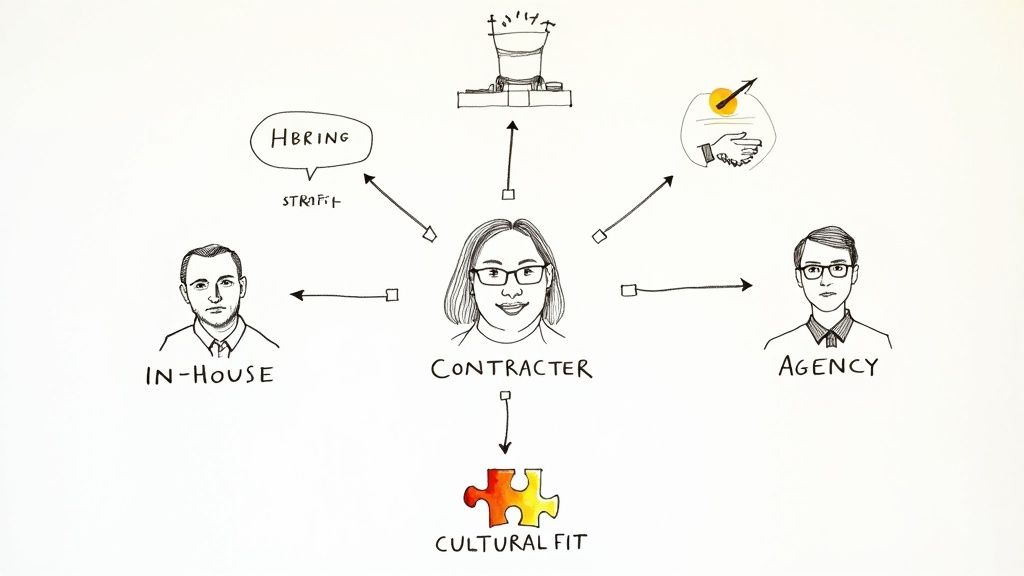
Hire or Outsource: Making the Right Call
This is one of the most critical decisions you'll make when you decide to grow. The wrong choice can torch your cash flow and kill your momentum. It’s not just about getting work done; it’s about smart, sustainable growth.
Let's break it down.
You should hire an employee when:
- The role is core to your business. If you run a plumbing company, you hire plumbers. This is the work that directly generates your revenue and defines your customer experience. You don't outsource your core.
- You need deep company knowledge and cultural fit. An in-house operations manager needs to live and breathe your business to be effective. They need to understand the nuances, the history, and the people.
- The workload is consistent and full-time. If you have 40+ hours of essential work piling up every single week, an employee is almost always more cost-effective than a contractor.
You should outsource a function when:
- The task requires specialized expertise you don’t have. Think about your bookkeeping, advanced SEO, or IT support. It’s far cheaper and more effective to "rent" a top-tier expert than to try and hire one full-time.
- The work is critical but not a core competency. Answering the phone is non-negotiable, but it doesn't require a master locksmith to do it well. This is a perfect task to delegate to a specialized service.
- The need fluctuates or is project-based. Need a website redesign? That happens once every few years. You hire an agency for that, not a full-time web developer.
Outsourcing non-core tasks is a battle-tested scaling strategy. The market for these services is exploding, set to hit USD 158.2 billion by 2032, because smart businesses are realizing the massive efficiency gains. Big companies figured this out a long time ago—outsourcing frees them up to focus on what they do best. You can see more insights on the Business Process-as-a-Service market here.
Finding and Vetting the Right Partners
When you decide to outsource, your goal isn't to find a vendor. It's to find a partner who feels like a true extension of your team.
Whether it’s a freelance bookkeeper or a 24/7 call-answering service, your vetting process should be just as tough as if you were hiring an employee.
Start by asking for referrals from other business owners you trust, especially those in your industry. A recommendation from someone who gets your challenges is worth its weight in gold. Then, dig into their case studies and testimonials—are they helping businesses like yours solve problems like yours?
During your calls, zero in on these areas:
- Communication: How fast do they respond? Is their communication clear? A partner who’s slow during the sales process will be even slower once they have your business.
- Process: Ask them to walk you through how they work. How do they onboard new clients? How do they report back on results? A great partner will have a well-oiled machine.
- Alignment: Do they actually understand your goals? A good marketing agency won't just sell you ads; they'll first ask about your revenue targets and who your ideal customer is.
The point of outsourcing isn't just to get tasks off your plate. It's to bring in expertise that elevates your entire business, freeing you up to work on the business, not just in it.
Attracting Top Talent for In-House Roles
When you’re ready to hire, remember this: your job description is your most important marketing tool. Don’t just throw a list of tasks and requirements on a page. Write a compelling ad that sells your vision and culture.
A great job description for a service business should:
- Lead with the opportunity, not the requirements. Start with what the candidate will achieve and how they’ll grow with you.
- Clearly define what success looks like. Instead of "must be a team player," try "Success in this role means maintaining a 4.8-star customer rating and cutting job callbacks by 15%." See the difference?
- Reflect your company culture. Use the kind of language you use every day. Let them get a feel for what it's really like to work for you.
In the interview, dig deeper than technical skills. Ask behavioral questions that reveal how a candidate handles pressure, solves problems, and deals with that one-in-a-hundred difficult customer. Their stories will tell you more about their fit than any resume ever could.
As you build out your team, it’s also the perfect time to explore how to reduce labor costs with smart strategies and technology. This ensures that as you grow, your profitability grows right along with you.
Using Technology and Automation to Fuel Growth
Trying to scale a service business without the right tech is like trying to build a house with just a hammer. Sure, you can make some progress, but you’ll be slow, inefficient, and you'll hit a ceiling pretty damn fast.
Technology isn't some fancy add-on for when you're "big enough." It's the engine.
Smart automation is how you break the brutal, linear connection between adding more clients and hiring more staff. It lets you handle a bigger workload, deliver a consistently great customer experience, and free up your team—all without your payroll spiraling out of control.
This is the strategic advantage that separates the businesses that scale from the ones that get stuck in the mud.
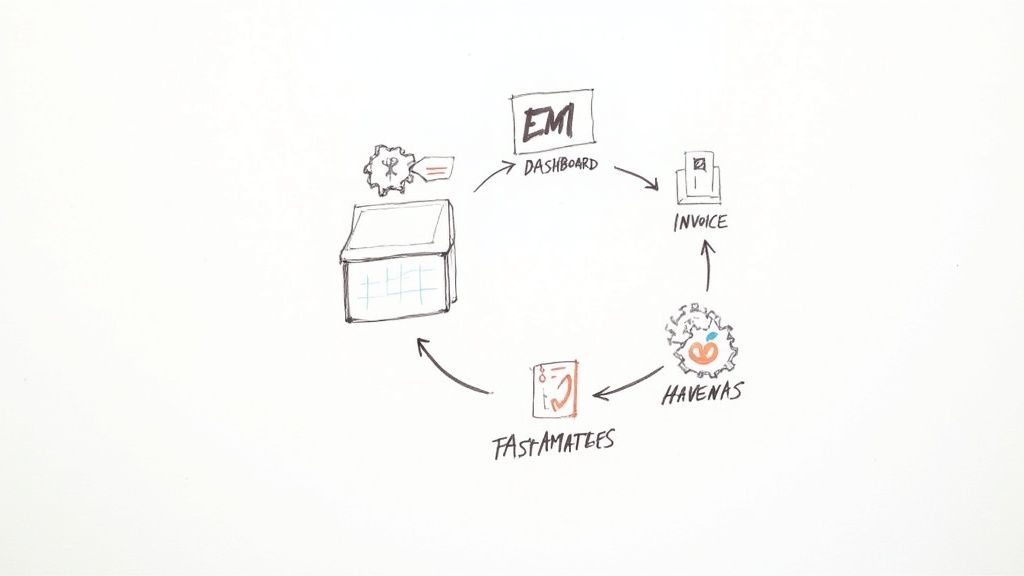
This diagram gets it right—every part of your business is connected. Tech is what makes that connection seamless and smooth instead of clunky and manual.
Building Your Foundational Tech Stack
Your "tech stack" sounds intimidating, but it's just the handful of digital tools you use to run your business day-to-day. For any service business looking to grow, a few pieces are absolutely non-negotiable.
These tools form the backbone of your operations, putting all that repetitive, soul-crushing work on autopilot. The whole point is to kill manual data entry, slash human error, and give you a crystal-clear, real-time view of what's actually happening in your business.
Just think about the biggest time-sucks you deal with:
- Juggling Leads: A Customer Relationship Management (CRM) system is your command center. It tracks every single interaction with every lead and customer, from the first phone call to the final payment. Nothing falls through the cracks.
- Scheduling Nightmares: How many hours do you burn playing phone tag just to book a job? Online scheduling software lets clients see your availability and book themselves, automatically sending reminders that cut down on no-shows.
- Chasing Payments: Modern invoicing platforms don't just send invoices; they send automated follow-ups. They let clients pay online instantly, which completely changes your cash flow game.
The global business software market was valued at USD 584.03 billion in 2024 and is expected to hit USD 1,153.75 billion by 2030. That’s not just a big number—it's proof that businesses are leaning on software to get ahead. You need to be one of them.
The Power of AI in Customer Communication
Here’s the biggest bottleneck for nearly every service business I've ever worked with: the phone.
A missed call is missed revenue. Period. But you can't be crawling through an attic and answering your phone at the same time. This is where AI assistants become a total game-changer.
An AI phone assistant like Marlie.ai is your 24/7 receptionist. It answers every call on the first ring, handles common questions, qualifies new leads, and can even book appointments right into your calendar.
For a scaling business, every missed call isn't just a lost job—it's a lost customer for life. AI ensures you capture every single opportunity, turning your phone from a source of stress into a reliable revenue-generating machine.
This isn't about replacing your people. It's about making them superhuman. When an AI handles 60-80% of the routine calls—"Are you open?" "Can I confirm my appointment?"—your skilled staff are freed up to focus on the complex, high-value conversations that actually land the big jobs.
It’s the ultimate form of leverage.
Connecting Your Tools for Maximum Efficiency
Okay, so you've got the tools. That's only half the battle. The real magic happens when you make them talk to each other.
This creates an automated workflow where one action triggers a whole chain of events, all without you lifting a finger.
Imagine this:
- A new lead calls your business.
- Your AI assistant answers, qualifies them, and books the job.
- That new appointment automatically creates a new client file in your CRM.
- The CRM then tells your invoicing software to draft an invoice for that new job.
This seamless flow kills duplicate work and keeps your data consistent across every platform. This is what efficient scaling actually looks like.
To make it happen, look for tools with built-in integrations or use a connector like Zapier to bridge the gaps. For a deeper look at this, check out our guide on the best workflow automation tools for your business.
And if you want to streamline your marketing, exploring the best marketing automation tools for small business is a crucial next step. By getting the right tech and making it all work together, you build a system that handles growth without creating chaos, letting you finally step back and work on your business instead of being stuck in it.
Common Questions About Scaling Your Business
As you start plotting out how to grow your service business, you’re going to hit questions and roadblocks. It’s just part of the game. Navigating these moments with clear, actionable answers is what separates the businesses that scale smoothly from the ones that get stuck spinning their wheels.
Here are a few of the most common hurdles I see owners run into, along with some straight-up advice to help you push forward.
What Is the First Step I Should Take to Scale My Service Business?
Before you do anything else, you absolutely have to systemize and document your core processes. I can’t stress this enough. Before you even think about hiring more people or dropping another dime on marketing, you need a repeatable blueprint for how your business delivers its magic.
Start by mapping out your most common job, from the moment a customer calls to the final payment. Write down every single step. This document becomes your playbook—your training manual and quality control guide all in one. It’s what ensures every new hire can deliver the same quality you do.
Without this foundation, growth almost always leads to chaos and a nosedive in quality.
Your real goal is to build a business that can run without you. If you're essential for day-to-day operations, you don't own a business—you own a job. Systemization is how you make that critical leap from operator to owner.
How Do I Know When It Is the Right Time to Hire?
The signals are usually pretty clear. It’s time to hire when you’re consistently turning down profitable work because you just don't have the bandwidth. Another big sign is when you're spending more than 30% of your time on admin tasks that keep you from doing the core, revenue-generating work only you can do.
But before you pull the trigger and make an offer, make sure you have two things locked down:
- Documented Processes: A new person needs a clear role and a set of instructions to follow. Don't just throw them in the deep end.
- Financial Stability: You need enough cash in the bank to cover their salary for at least three to six months, even if things get slow.
Hiring out of desperation almost always ends in a bad fit. The smart move is to hire strategically, when you have a well-defined need and the systems in place to actually support a new team member.
Which Technology Gives the Biggest ROI for a Small Service Business?
For most service businesses, the tech with the highest immediate return is usually a combination of a good CRM and an automated scheduling system. A CRM like Jobber helps you keep track of every lead and customer interaction, so opportunities stop falling through the cracks. Automated scheduling cuts out all that painful back-and-forth when booking appointments.
But there's another tool that offers even more leverage: an AI phone answering service.
Think of it as a 24/7 receptionist that captures leads, answers common questions, and books jobs directly into your calendar. It immediately plugs the holes in your revenue and boosts your customer service without the hefty price tag of a full-time employee. For a scaling business, it's one of the most impactful tech investments you can make.
Ready to capture every lead and free up your team with a serious tech advantage? Marlie.ai provides a 24/7 AI phone assistant that answers every call, qualifies leads, and books jobs, ensuring you never miss an opportunity again. Discover how Marlie can transform your business today.
