
So, what exactly is a virtual medical reception?
Think of it as an intelligent, automated system that’s always on, managing all your clinic's incoming patient communications, 24/7. It’s essentially an AI-powered front desk that answers calls the moment they come in, schedules appointments, and handles all the routine questions that used to tie up your staff. The goal is to free up your team for more hands-on patient care.
Beyond The Answering Machine: What This Technology Really Does
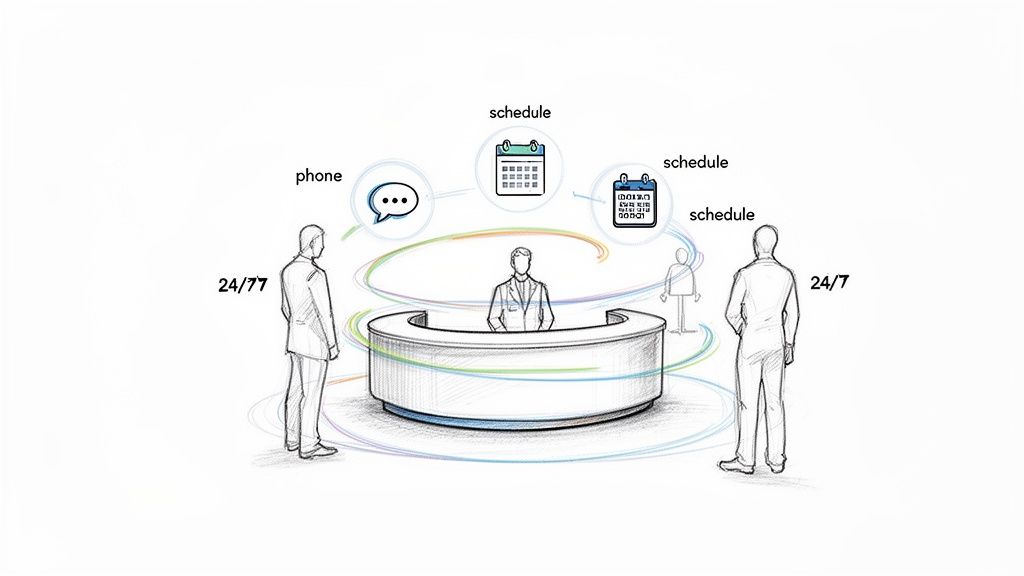
When you hear the word "virtual," your mind might jump to a basic call forwarding service or one of those frustrating, old-school automated menus. But a modern virtual medical reception is a completely different animal.
This isn’t just about answering the phone. It’s about resolving a patient’s need on the very first try, often without any human involvement at all for the common stuff.
The technology acts as your clinic's intelligent first point of contact. It uses conversational AI to actually understand why a patient is calling—whether they need to book a new appointment, reschedule an existing one, or just ask for clinic hours. If you want to get into the nuts and bolts, you can learn more about the components of a virtual front desk and see how it boosts a practice's efficiency.
More Than Just A Robot On The Phone
The real magic of a virtual reception is its ability to triage and automate. It intelligently sorts all incoming requests, taking care of the predictable, high-volume tasks that constantly interrupt your front-desk staff. This gets your team off the phone-go-round, letting them focus on the patients standing right in front of them or those with more complex medical needs.
Basically, this system is built to handle a huge chunk of those daily administrative chores. We're talking about things like:
- 24/7 Appointment Scheduling: Patients can book, cancel, or move appointments whenever it's convenient for them, even if your office has been closed for hours.
- Instant FAQ Answering: It provides immediate, accurate answers to common questions about your location, which insurance you accept, and office hours.
- New Patient Intake: It can gather all the initial information from new patients before they even set foot in the clinic, making that first visit so much smoother.
- Smart Call Routing: For calls that do need a human touch, it knows exactly who to transfer them to. Urgent calls get to the right person right away.
Don’t think of this as a replacement for your staff. See it as a powerful assistant that absorbs the repetitive work, empowering your team to operate at the top of their game and focus on high-value patient interactions.
Today's patients expect communication to be fast and easy. Making them wait on hold is a major source of frustration—in fact, studies show that up to 74% of callers will just hang up.
A virtual medical reception wipes out that problem completely. Every call gets answered instantly, and every patient feels heard. This isn't just an operational upgrade; it’s a fundamental improvement to the patient experience from the very first interaction.
Traditional Front Desk vs Virtual Reception
To see the difference in black and white, let's break down how a traditional setup compares to a modern virtual reception. The contrast in availability, cost, and overall patient experience is pretty stark.
| Feature | Traditional Reception | Virtual Medical Reception |
|---|---|---|
| Availability | Limited to office hours (e.g., 9 AM – 5 PM) | 24/7/365, never takes a break or calls in sick |
| Call Handling | One call at a time; others go to voicemail or hold | Can handle unlimited simultaneous calls instantly |
| Patient Experience | Risk of long hold times, missed calls, human error | No hold times, immediate answers, consistent service |
| Staff Focus | Constantly interrupted by calls, juggling multiple tasks | Staff can focus on in-person patients and complex needs |
| Cost Structure | Salary, benefits, training, overhead (typically $40k+/year) | Subscription-based, scalable, and significantly lower cost |
| Data & Analytics | Manual tracking, limited insights | Automated reporting on call volume, trends, outcomes |
Ultimately, the table highlights a shift from a reactive, limited system to a proactive, infinitely scalable one. The virtual model isn't just about saving money—it's about creating a more efficient, patient-friendly clinic from the ground up.
The Core Benefits for Your Clinic
Bringing a virtual medical reception into your practice isn't just about getting a new phone system. It’s a strategic move that pays real dividends across your entire operation. When you let an intelligent system handle the routine calls, you start seeing huge improvements in efficiency, your bottom line, and the experience you give your patients.
Let's break down the three biggest wins this technology brings to your front desk.
Supercharge Your Operational Efficiency
Picture your front desk team, finally free from the tyranny of the constantly ringing phone. That's what a virtual medical reception delivers. It automates the flood of simple, repetitive calls that eat up so much of your staff's day.
These systems can field up to 80% of common questions—things like scheduling appointments, handling refill requests, or giving out clinic hours and directions.
The impact is immediate. Your skilled admin team can now focus on the patients standing right in front of them, tackle complex billing issues, and give their full attention to sensitive cases that truly need a human touch. The result? A more productive, less frazzled team.
This shift helps head off administrative burnout, which is a real worry for 53% of practice managers. When you offload the tedious stuff, you empower your staff to do their best work, which is great for both morale and retention.
Unlock Significant Financial Savings
The return on investment (ROI) here is incredibly strong and simple to see. Sticking with traditional staff or live answering services means shelling out for salaries, benefits, and per-minute charges that can sneak up on you. An AI-powered system does the same job for a fraction of the cost and can handle way more volume.
Think about what a single missed call costs you. Research shows a shocking 74% of patients will just hang up if they're put on hold. Every one of those calls is lost revenue walking out the door. A virtual receptionist solves this problem for good by making sure every call gets answered instantly, day or night.
Here’s a quick look at the cost difference:
- Traditional Answering Services: These can easily run you $2.00 per minute or more, and the price often jumps after hours or during busy periods.
- AI Virtual Reception: Can handle calls for as little as $0.25 per minute, giving you a consistent, predictable cost.
That difference alone adds up to massive savings. Better yet, by catching all those calls you would have otherwise missed, the system is actively bringing money in. To really get into the numbers, check out our guide on after-hours answering services and how they stack up.
Elevate the Patient Experience
In health care today, the patient experience doesn't start when they walk in for their appointment. It starts with that first phone call. A virtual medical reception provides the kind of quick, easy service that people have come to expect everywhere else.
This system guarantees:
- Zero Hold Times: Every call is picked up right away, getting rid of one of the biggest frustrations for patients.
- 24/7 Availability: Patients can book an appointment or get info whenever it works for them, not just during your 9-to-5.
- Consistent, Accurate Information: The AI gives the right answer every single time, cutting down on the risk of human error.
By giving patients this kind of seamless, on-demand access to your clinic, you start building loyalty and trust from the very first interaction. A better experience doesn't just make patients happier—it keeps them coming back, building a stronger, more successful practice.
How a Virtual Reception Overhauls Key Workflows
A virtual medical reception does a lot more than just answer the phone. It fundamentally re-engineers how your clinic operates, automating the repetitive but essential tasks that keep your practice running. This isn't just about handing off work; it's about creating a much smoother, more responsive experience for patients from the moment they decide to contact you.
Instead of your staff having to manually field every single call, message, and request, the system acts as an intelligent first point of contact. It takes care of the high-volume, predictable stuff, which frees up your team to apply their expertise where it's truly needed—handling complex patient issues and delivering fantastic in-person care.
Streamlining Appointment Management
Let's be honest: appointment scheduling is the lifeblood of any clinic, but it's also a massive administrative headache. A virtual reception takes this entire workflow and turns it into a simple, self-service operation that patients can use anytime they want.
It's designed to handle the full spectrum of scheduling tasks without anyone on your team needing to lift a finger:
- Booking New Appointments: Patients can see your real-time availability and book a slot 24/7, directly from their phone or computer. Everything syncs instantly with your clinic's calendar.
- Cancellations and Rescheduling: Plans change. The system lets patients modify their appointments on their own, which automatically updates the schedule and opens that slot for someone else.
- Automated Reminders: This is a big one. It sends out appointment reminders via text or a friendly call, which goes a long way in cutting down no-shows. Missed appointments can account for 5-10% of all bookings, so this feature alone is a game-changer.
This kind of automation doesn't just save your staff countless hours. It meets the modern patient's expectation for convenient, on-demand service. For a closer look at how this all comes together, check out our guide on building a modern patient appointment scheduler.
Performing Intelligent Patient Triage
Not every call is created equal. One of the most powerful things a virtual medical reception can do is perform intelligent triage, sorting incoming calls to make sure urgent matters get immediate attention while routine questions are handled on the spot.
Think of it as a digital front-desk nurse. The system uses a series of smart, pre-programmed questions to figure out what the caller needs. It can easily tell the difference between a patient asking for directions and one describing symptoms that need a clinician's ear.
This intelligent sorting is critical. It ensures that callers with genuinely urgent needs are immediately routed to a live person, completely bypassing any automated menus. This simple function guarantees that a critical call is never, ever missed or left waiting in a queue.
This process moves your call management from a basic "first-come, first-served" model to a much smarter, needs-based system that prioritizes patient care and makes the best use of your team's valuable time.
This flow chart below gives you a clear picture of how these benefits stack up, starting with efficiency and leading to real cost savings and a better patient experience.
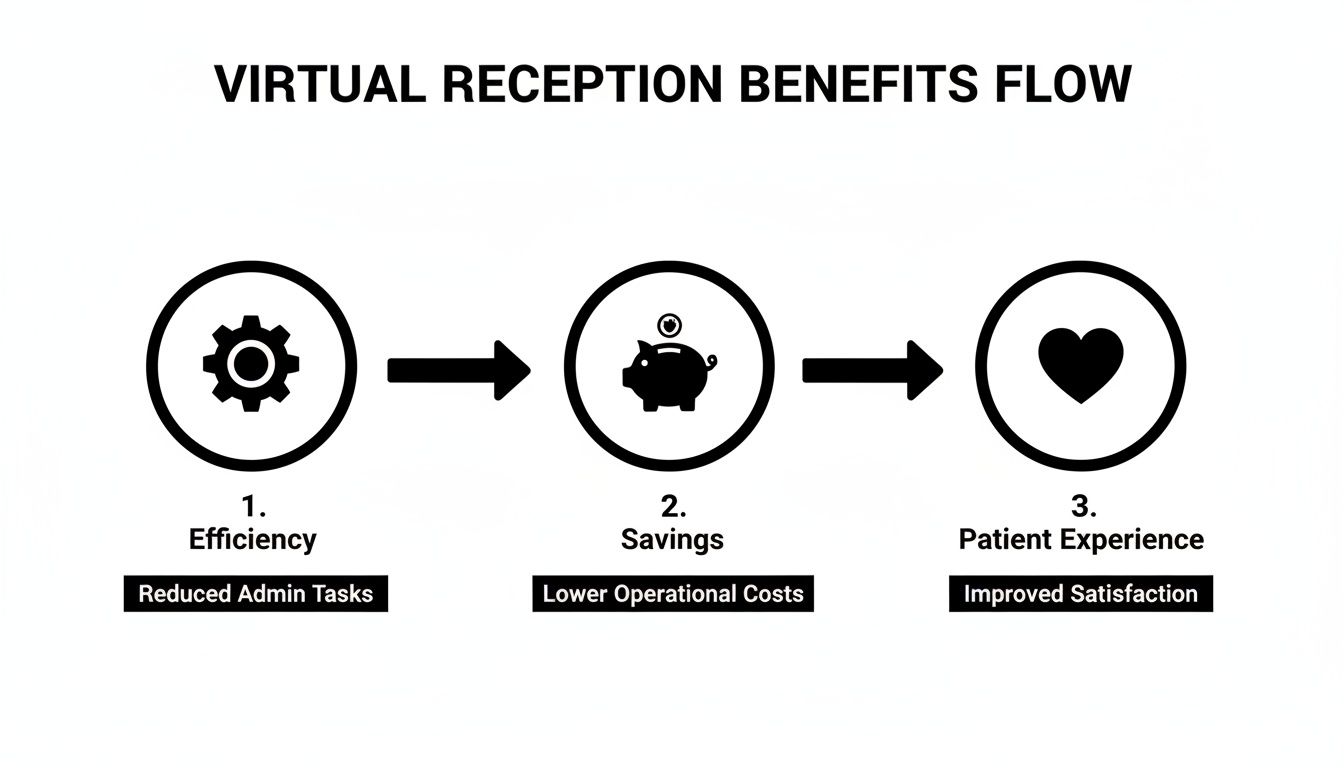
As you can see, automating those day-to-day tasks creates a ripple effect, directly impacting your bottom line and the overall journey for your patients.
Handling FAQs and Prescription Refills
A huge chunk of incoming calls are for simple, repetitive questions that honestly don't require the time of a trained medical professional. A virtual reception can field these instantly, freeing up your phone lines for more complex conversations.
Common tasks that can be completely automated include:
- Answering FAQs: Giving callers immediate answers about your clinic's hours, location, parking details, and which insurance plans you accept.
- Automating Refill Requests: Guiding patients through the first steps of a prescription refill. It collects the necessary info—like name, date of birth, and medication—before routing the request to the right pharmacy or staff member for approval.
This kind of front-end automation is becoming more important every day. Just look at mental health, where telehealth now accounts for a massive 38% of visits. Experts project that up to 30% of all medical appointments in the U.S. could eventually become virtual, which underscores the growing need for smart, automated systems to manage that first point of contact.
By taking these basic workflows off your team's plate, you make your clinic more accessible, more efficient, and better equipped to let your staff focus on what they do best: caring for patients.
Navigating HIPAA Compliance and Data Security
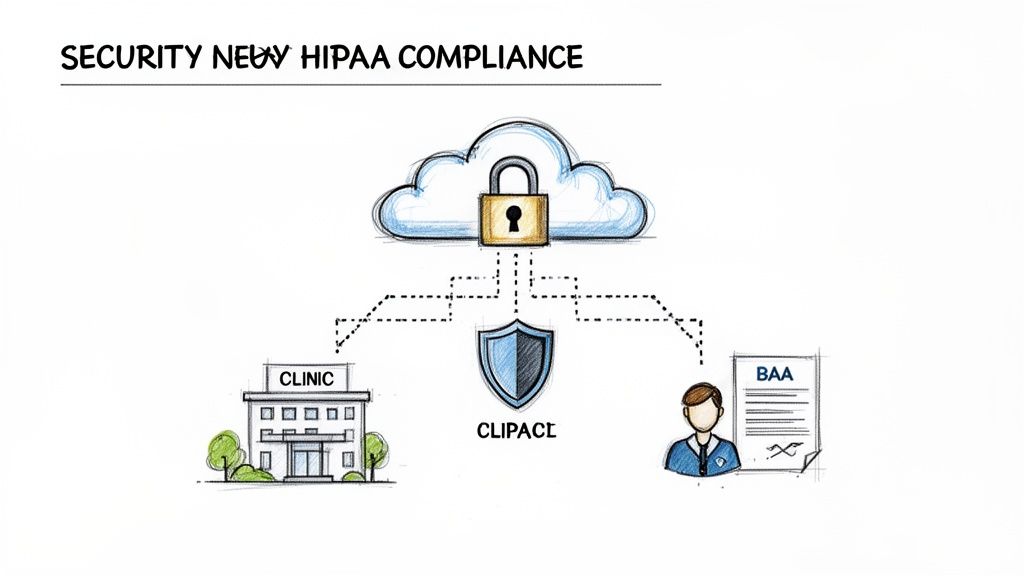
When you're dealing with patient information, security isn't just a feature—it's the absolute foundation of everything. Bringing a virtual medical reception service into your practice means you're entrusting a partner with Protected Health Information (PHI). This makes HIPAA compliance a non-negotiable, must-have requirement for any system you even consider.
The stakes are incredibly high. In 2023 alone, data breaches exposed over 133 million healthcare records. It's a sobering reminder of the devastating financial and reputational damage that can follow a security lapse.
Your virtual reception vendor needs to be a fortress for your patient data. Every single interaction, from a simple appointment reminder to a new patient intake call, has to be shielded by robust security protocols. Knowing what those protocols are is the first step toward making a safe choice for your clinic.
The Cornerstone of Compliance: A Business Associate Agreement
Before you even glance at a features list, there's one critical document you need to ask about: the Business Associate Agreement (BAA). A BAA is a legally binding contract that requires your virtual reception provider to protect PHI with the same rigor you do.
Operating without one isn't just risky; it's a direct HIPAA violation. This agreement spells out exactly how the vendor will handle, transmit, and store sensitive data, ensuring they share the responsibility for compliance right alongside your own clinic.
A strong BAA is your first line of defense. It should clearly define permitted uses of PHI, detail breach notification procedures, and establish liability. It creates a clear framework of responsibility between your practice and your vendor.
A trustworthy partner will hand over a comprehensive BAA without a moment's hesitation. If a potential vendor downplays its importance or can't produce one, that’s a giant red flag. They simply aren't equipped to operate in the healthcare space.
Essential Security Layers for Data Protection
Beyond the legal framework of a BAA, your virtual medical reception service must have specific technical safeguards in place. Think of these as a multi-layered defense system that protects patient data at every turn.
Here are the key security features you need to verify:
- End-to-End Encryption: This is fundamental. Encryption scrambles data, making it unreadable to anyone without authorization. It needs to be applied both when data is in transit (during a call or message) and at rest (when stored in a database).
- Strict Access Controls: Not everyone on the team needs access to all patient data. Role-based access control ensures individuals can only view the information necessary for their specific job, which drastically minimizes the risk of internal breaches.
- Secure Data Storage: The vendor absolutely must use HIPAA-compliant servers and infrastructure to store all information, including any call recordings and transcripts. You can learn more about the security required for AI call recording and transcription in our dedicated guide.
- Regular Security Audits: The provider should be conducting routine audits and vulnerability scans. This is about proactively finding and fixing potential security weaknesses before they can ever be exploited.
For a deeper dive into securely managing patient information, check out this guide on ensuring HIPAA compliant data transfer.
By prioritizing these security essentials, you can confidently adopt a virtual reception solution that boosts your efficiency without ever compromising the patient trust you've worked so hard to build.
Choosing the Right Virtual Medical Reception Partner
Picking a virtual medical reception partner is one of those decisions that can quietly shape the future of your practice. This isn't just about outsourcing your phones; it’s about bringing on a technology ally that needs to plug right into your daily operations, safeguard patient data, and keep up as you grow.
Get it right, and you can truly transform your front desk. Get it wrong, and you’ve just created a new layer of headaches for your staff and patients alike.
To make the right call, you need to look past the slick marketing and really dig into the core capabilities that will make a difference. That means getting into the technical weeds, figuring out how smart the AI really is, and making sure the provider understands the unique pressures of a healthcare environment.
Evaluate Core Integration Capabilities
Here's the thing: a virtual receptionist that doesn't talk to your other systems is basically useless. Its real power comes from connecting with the tools your team already lives in every single day. If it can't, you're just creating more manual data entry, which defeats the entire purpose.
The absolute must-have is a solid integration with your Electronic Health Record (EHR) or Practice Management System (PMS). A virtual reception that's deeply connected can see your real-time schedule to book appointments, instantly pull up patient files, and automatically log every conversation. This kills double-entry and ensures your whole team is working from the same, up-to-the-minute information.
When you're talking to vendors, ask them point-blank which EHRs they've successfully integrated with before. A provider with a long list of proven connections is a much safer bet than one promising to build you a custom solution from scratch.
Assess AI Quality and Conversational Fluency
Not all AI is created equal—not by a long shot. The intelligence and natural flow of the virtual receptionist's conversation will make or break the patient experience. A clunky, robotic system will just frustrate callers. But a truly sophisticated AI can handle requests so smoothly that patients might not even notice they aren't talking to a person.
Here’s what you should be testing for:
- Natural Language Understanding (NLU): Can the AI actually understand what a patient means, even if they use slang, have an accent, or ask a complicated, multi-part question?
- Contextual Awareness: Does the AI remember what was said earlier in the conversation? For instance, if a patient asks to reschedule, does it recall the details of their original appointment without making them repeat everything?
- Graceful Failure: What happens when the AI gets stuck? The best systems don't just loop "I don't understand." They have a clear, immediate path to hand the call off to a live person on your team.
The goal isn't to trick patients. It's to solve their problems so quickly and efficiently that the distinction between human and AI doesn't even matter. A high-quality AI delivers instant action, which is almost always better than waiting on hold for a human.
The telehealth market is set to blow past $175 billion by 2026, a clear signal that patients are demanding more digital-first ways to connect with their doctors. With nearly 79% of U.S. hospitals already using telehealth systems, the need for a smart, dependable virtual reception to manage this firehose of communication is becoming non-negotiable. You can read more about the rise of telehealth and its impact on healthcare.
Verify Customization and Support
Finally, your practice isn’t a cookie-cutter operation, and your virtual reception partner shouldn't treat it like one. You need a provider that lets you customize call flows and triage protocols. You have to be able to set the rules for how urgent calls get handled, which keywords trigger an immediate transfer to a nurse, and how different appointment types are scheduled.
Transparent pricing is also a huge deal. Stay away from partners with complicated per-minute billing that leaves you with a surprise bill at the end of the month. Look for clear, predictable plans that make sense for your call volume. For a deeper dive, check out our guide to virtual receptionist cost structures.
And don't forget about support. When you need to tweak a script or fix a glitch, you need a responsive team that actually knows what they're doing. A great partner gives you more than just software; they provide the human expertise to help you get the most out of it.
Real-World Impact and Patient Acceptance
The theory is great, but what happens when this technology hits the floor of a busy clinic? How do virtual receptionists hold up in practice, and maybe more importantly, how do patients feel about talking to one?
Turns out, the real-world evidence is overwhelmingly positive. We're seeing huge jumps in both efficiency and patient satisfaction.
Imagine a multi-location practice where call handling is a mixed bag—some offices are great, others… not so much. By bringing in a central virtual reception, they create a single, high standard of service for every patient, no matter which number they dial. The system books appointments, answers routine questions, and flags complex cases for the team. This isn't about replacing people; it's about unclogging the frustrating bottlenecks that keep them from doing their best work.
Is This What Patients Really Want?
The big question is always: will patients actually talk to an AI about their health? For routine tasks, the data shows they don't just accept it—they often prefer it.
Patients value speed and convenience. They want their problem solved without sitting on hold. A well-built virtual reception offers an immediate solution, building a sense of trust and confidence right from that first interaction.
This lines up with what we're seeing across healthcare. Patient satisfaction with virtual care is sky-high, with 89% of telehealth users saying they were satisfied with their experience. In fact, about 75% of patients feel that telemedicine is either on par with or even better than an in-person visit. We've come a long way, fast—dissatisfaction rates plunged from 31% in 2020 down to just 19% by 2023. You can dig into more of these telemedicine trends on getstream.io.
The key isn't that a virtual reception removes the human touch. It actually enhances it. By instantly handling the simple stuff, it frees up your skilled team to give their full, empathetic attention to patients who really need it.
Proof in Practice: Case Studies
The real impact comes to life when you see it in action. Practices using systems like Marlie.ai are seeing pretty dramatic turnarounds just by automating their front-desk workflows.
- SoHo Driving School (a service-based business, but a great example of call automation) managed to cut its human-handled call volume by 70%. The AI now manages all rescheduling, and new leads get forwarded automatically so the team can focus on growing the business.
- A Multi-State Medical Group used it to streamline appointment booking across dozens of its locations. Their virtual reception now handles thousands of calls every month, making sure a new patient never hits a busy signal or gets dumped into voicemail.
These examples show that a virtual reception is way more than just a tool to cut costs. It's a strategic move that recovers lost revenue, makes it easier for patients to get care, and builds a more responsive, efficient clinic for everyone involved.
Still Have Questions About Virtual Reception? Let's Clear Them Up.
Even when the benefits are crystal clear, bringing any new technology into your practice is a big decision. It’s natural to have questions. This is where we tackle the most common concerns we hear from practice managers, giving you straight, honest answers to help you feel confident about your next move.
Getting these final details sorted is what ensures you pick a solution that doesn’t just make your front desk more efficient, but actually builds patient trust from the moment they call.
Will Patients Get Annoyed Talking to an AI?
Honestly, what frustrates patients more? An efficient, natural-sounding AI that answers instantly, or sitting on hold, listening to bad music, waiting for a human? For simple tasks, most people today just want speed and convenience.
And for anything more complex, a good system always has an escape hatch. Callers can instantly transfer to a live person just by saying a key phrase or pressing a button. You get the best of both worlds: immediate help for common requests and a direct line to your team for everything else.
The reality is, patients get far more frustrated by busy signals and long hold times than by interacting with an efficient AI. Immediate service shows you respect their time, and that builds satisfaction fast.
How Hard Is It to Get Started?
Top-tier virtual reception services are designed to be up and running in minutes, not weeks. The process is usually as simple as forwarding your main phone line and tweaking a few settings on a straightforward online dashboard.
You won’t need any special hardware or technical skills from your team. The whole point is to make it a "plug-and-play" experience that slips right into your existing phone setup without disrupting your day-to-day operations.
What If the AI Can't Understand Someone?
This is a critical point. Advanced AI systems have built-in safety nets for exactly this scenario. If the AI struggles to understand a patient's request after a try or two, it’s programmed to automatically offer a transfer to a live staff member.
This feature is non-negotiable. It guarantees no patient ever gets stuck in a frustrating loop. Every single call gets resolved, either through the AI or by seamlessly connecting the caller to the right person on your team.
How Does the System Handle Emergencies?
Making sure emergencies are handled properly is priority number one. You can set specific keywords like "emergency" or "urgent" to act as triggers.
When the system detects one of these words, it immediately bypasses all the standard scripts and routes the call directly to a designated emergency line or person. This customization is a crucial safety feature for any healthcare provider, ensuring critical situations get the attention they need without a second's delay.
Ready to see how an AI-powered assistant can transform your clinic's front desk? With Marlie Ai, you can ensure every call is answered instantly, 24/7, freeing your staff to focus on patient care. Discover how Marlie.ai can cut costs and improve patient satisfaction today.
