

An after-hours answering service is your secret weapon for making sure your business never truly closes. It's a strategic move to get 24/7 phone coverage, catching leads, handling urgent calls, and offering support long after your team has gone home for the day. Think of it as your virtual frontline, making sure every single opportunity is captured.
Why Missed Calls Are Costing You More Than You Think
Let's be honest, the classic 9-to-5 workday is a relic. Your customers' needs don't neatly fit into a business-hour box. For a lot of businesses, a single missed call after 5 PM isn't just a missed call—it's a lost customer, a forfeited sale, and a direct hit to your bottom line. That late-night ring isn't an interruption; it's opportunity knocking, loudly.
Imagine a homeowner who walks into their basement at midnight to find it flooded. They're not waiting until morning. They’re frantically Googling plumbers and dialing one number after another. The very first person to pick up the phone gets the job—a high-value emergency that could be worth hundreds, if not thousands, of dollars. If your phone rings to voicemail, they're already dialing the next name on the list.
This scenario isn't an outlier; it's the reality for countless service businesses. A missed call directly translates to handing a paying customer—and their money—to your competition.
The Modern Solution to an Age-Old Problem
To solve this, businesses generally go down one of two paths when setting up an after-hours answering service. Each approach offers a different way to ensure you're always there when a customer needs you:
- Traditional Human Call Centers: These services use live agents to field calls on your behalf. They offer a human touch, which can be great, but they also come with higher costs and the quality can be a mixed bag.
- Modern AI Phone Assistants: These assistants use artificial intelligence to answer calls instantly. They can handle routine tasks like booking appointments or answering common questions, all at a fraction of the cost of a live agent.
The need for constant availability has completely changed the game. The market for these services was valued at $2,397.5 million and is expected to hit $4,500 million by 2035. This isn't just random growth; it's driven by the urgent need for round-the-clock support without the massive overhead of hiring an in-house team. This trend points to a fundamental shift in how businesses operate.
For many small businesses, just managing the phone is a constant headache. Having an effective strategy is absolutely critical. Our guide on small business phone answering dives deeper into how to get your communication just right. Your first real decision—choosing between a human touch and AI efficiency—is the first step toward reclaiming that lost revenue and building a business that never sleeps.
Human Agents Versus AI Answering Services
Choosing between a human touch and artificial intelligence for your after-hours calls is a huge decision. This isn't just about technology; it's about your customer experience, your budget, and your ability to grow. The right move comes from really understanding what each option brings to the table—and what it leaves behind.
Here’s a simple way to think about it: a traditional human answering service is like hiring a single, dedicated receptionist for the night shift. They bring empathy, which is great for tricky conversations, but they can only handle one call at a time, and their time doesn't come cheap. An AI phone assistant, on the other hand, is like deploying an entire team of perfectly trained receptionists who can all work at once, for just a fraction of the cost.
It’s clear that 24/7 availability isn't a luxury anymore; it's a core business need. The market for these services is exploding for a reason.
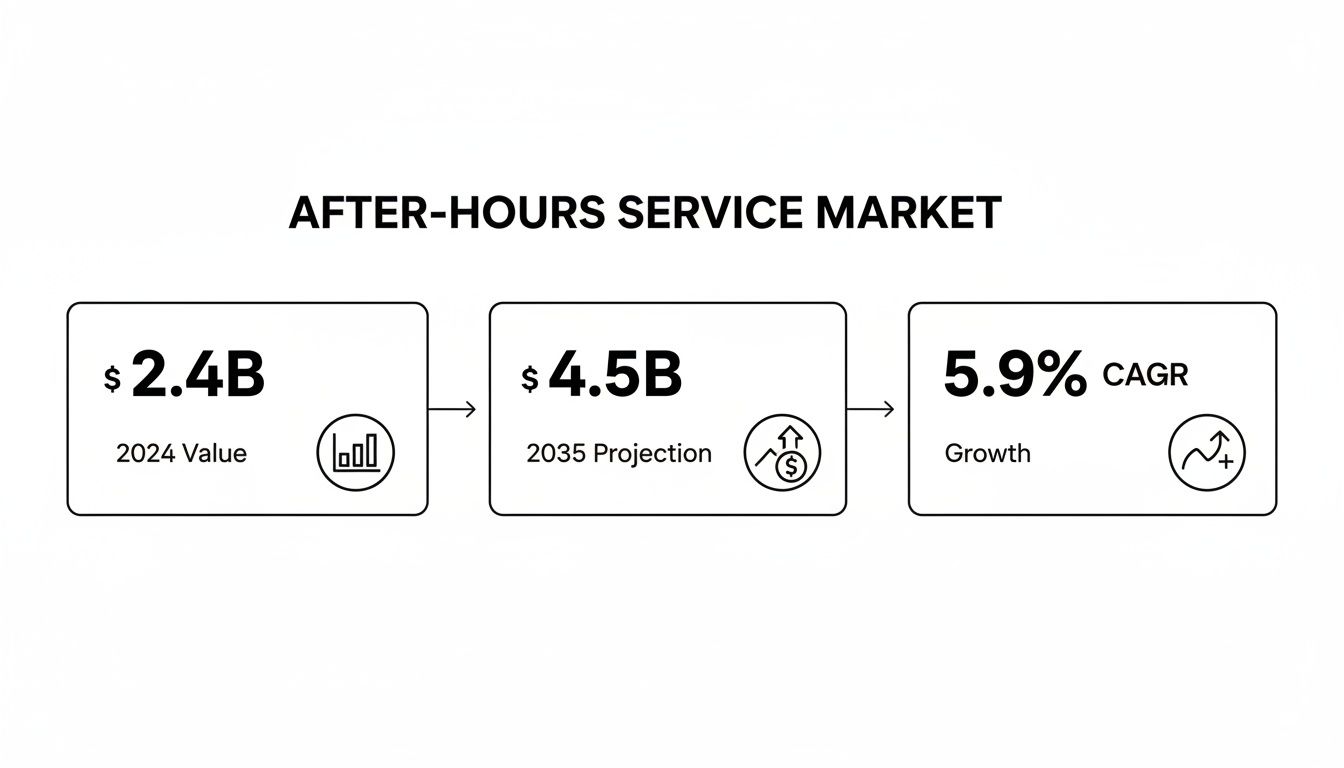
The market is projected to nearly double, jumping from $2.4 billion today to $4.5 billion by 2035. This tells us one thing loud and clear: businesses are serious about never missing a customer again.
To help you see the differences more clearly, let's break down how these two approaches stack up side-by-side.
Comparing Human Answering Services and AI Phone Assistants
| Feature | Traditional Human Service | AI Phone Assistant |
|---|---|---|
| Availability | Limited by the number of agents on duty. Can lead to hold times. | Instantly scalable. Handles unlimited simultaneous calls with no hold time. |
| Cost | High. Typically $2 per minute due to labor and overhead. | Low. Costs drop to $0.25-$0.35 per minute for an 80% saving. |
| Consistency | Varies by agent. Tone, accuracy, and mood can be inconsistent. | Flawless consistency. Every call is handled exactly as scripted. |
| Capabilities | Excels at complex, emotional issues requiring deep empathy. | Perfect for handling 60-80% of routine calls (bookings, hours, FAQs). |
| Scalability | Slow and expensive. Requires hiring and training more agents. | Instant and automatic. Scales up or down with call volume at no extra cost. |
| 24/7 Operation | Yes, but at a premium cost for overnight and holiday shifts. | Yes, with no extra charges for nights, weekends, or holidays. |
| Data & Analytics | Basic call logs, often requiring manual review. | Rich, real-time data on call volume, outcomes, and customer sentiment. |
As you can see, the choice isn't just about replacing a person with a machine. It’s about re-engineering how you handle customer communication for maximum efficiency and impact.
The Cost and Efficiency Divide
Let's talk money, because it's the most glaring difference. Traditional services have hefty operational costs—salaries, benefits, call center rent—and all of that gets passed on to you.
AI assistants run on a much leaner model. With no human labor costs in the loop, the price per call plummets. But this isn't just about saving a few bucks; it’s about freeing up your budget to invest in things that actually grow your business.
For many businesses, a staggering 60-80% of incoming calls are for simple things: "What are your hours?" "Can I book an appointment?" "Where's my order?" AI is built to handle this stuff perfectly, every single time.
This lets your actual team stop answering the same questions all day and focus on the complex, high-value conversations that really need a human mind. For a deeper look at the different players in this space, you can explore our guide to the top virtual receptionist companies and see how they compare.
Response Time and Scalability
When a customer calls your business after 5 PM, they want an answer now. A human call center will always have a physical limit. If all the agents are busy, the next caller gets put on hold or dumped into voicemail. That completely defeats the purpose of having an after-hours service in the first place.
AI completely removes that bottleneck. It can handle one call, a hundred calls, or a thousand calls simultaneously. Every single customer gets an instant answer. No hold music, no busy signals.
This kind of built-in scalability is a game-changer for businesses with fluctuating call volumes, like an HVAC company during a heatwave or any business running a big marketing campaign. An AI system adapts on the fly without you having to hire, train, or spend more.
Capabilities and The Human Touch
So, where do humans still win? Complex problem-solving and true emotional connection. A live agent can navigate a really unusual customer issue or provide a level of empathy that AI is still figuring out. No question about it.
But modern AI is a far cry from the robotic voices of the past. It understands natural conversation, picks up on urgency, and knows exactly when a situation needs to be handed off to a live person. The smartest setup is often a hybrid one: let AI be the first line of defense for the majority of calls and have it intelligently escalate the critical ones to a human.
You get the best of both worlds—unbeatable efficiency and expert human support right when it matters most.
What a 24/7 Answering Service Really Does for Your Business
Putting an after-hours answering service in place does way more than just stop your phone from ringing off the hook and sending customers to voicemail. It’s a ground-up shift in how you operate, one that creates real, measurable results you can see across the entire business. This isn't just about tacking on a new feature; it's about building a company that’s more resilient, profitable, and genuinely focused on its customers.
When someone calls you at 10 PM, they aren't just looking for information. They need a solution, and they need it now. Being there in that critical moment is what separates a business that’s thriving from one that’s leaving money on the table.
Let's break down the five core ways that being available 24/7 can truly change your business.
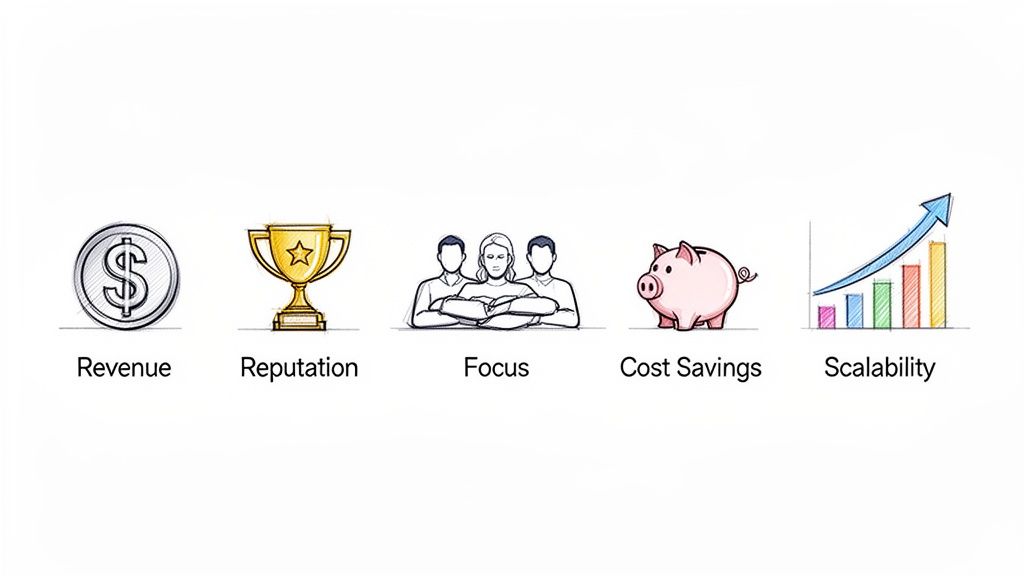
1. You Stop Losing Money to Missed Calls
The most immediate thing you’ll notice is the impact on your bottom line. Every single missed call is a potential sale walking out the door. A huge chunk of customers simply won't leave a voicemail—they'll just hang up and call your competitor. An after-hours answering service is your safety net, making sure every lead gets caught.
Think about an HVAC company. A call about a broken air conditioner on a boiling Saturday night isn’t some casual question; it’s an emergency. Answering that call on the spot and booking the job could mean locking in $500 or more in immediate revenue. When you multiply that over weeks and months, you're talking about a serious amount of income that used to just disappear.
2. You Build a Reputation for Reliability
Your brand’s reputation is built on one thing: trust. When you answer every call quickly and professionally, no matter the time, you’re sending a powerful message. It says you’re dependable, you actually care, and you’re ready to help. That’s how you build fierce customer loyalty.
A professional, instant response at any hour shows a level of commitment that makes you stand out. It tells clients they're your priority, which is the bedrock of a five-star reputation.
On the flip side, a phone that rings endlessly or a full voicemail box tells customers you're overwhelmed or just don't care. That can kill your credibility, especially in industries where a fast response is everything. And it's not just about picking up the phone; the quality of that interaction is key. Bad audio quality, for instance, can seriously undermine the professional image you're trying to build, which speaks to the impact of background noise on business credibility.
3. Your Team Can Finally Focus on What Matters
Your team’s time is their most valuable asset. When they're constantly pulled away to answer the phone—often for routine questions—they can't focus on the high-value work that actually drives revenue. Handing off after-hours and even overflow daytime calls gets them out of that reactive loop.
Instead of fielding the same questions about business hours or appointment times, your staff can finally concentrate on:
- Completing complex projects that demand their full attention.
- Giving top-notch support to your existing, high-value clients.
- Developing new strategies to actually grow the business.
This shift lets your skilled people use their expertise where it truly counts, which boosts both productivity and morale.
4. You Cut Down on Major Overhead Costs
Hiring your own people to cover the phones 24/7 is wildly expensive. You’ve got to factor in salaries, benefits, training, and the cost of keeping an office running around the clock. Just one additional full-time employee can easily cost you tens of thousands of dollars a year.
Answering services, especially the AI-powered ones, give you that same 24/7 coverage for a tiny fraction of the price. You get complete availability for nights, weekends, and holidays without the massive financial headache of more staff. It turns a huge operational expense into a predictable, low monthly payment.
5. Your Business Can Grow Without Breaking
As your business gets bigger, so does your call volume. If you don't have a system that can handle it, growth can quickly turn into chaos, with more dropped calls and a burned-out team. An answering service is the perfect solution for handling that surge without any friction.
Whether you're launching a marketing campaign that doubles your leads or expanding to a new city, the service can absorb the extra calls instantly. You can scale up or down whenever you need to without hiring, training, or buying new equipment. This kind of agility means you’re always ready for growth, never held back by it.
Choosing and Implementing Your Answering Service
Making the leap to an after-hours answering service can feel like a big decision. But when you break it down, it’s a pretty straightforward, data-driven choice. It’s less about just "picking a provider" and more about finding a partner that actually fits your business, your budget, and where you want to go.
This isn’t as complicated as it sounds. We can walk through this with a clear framework that takes you from the initial "I think I need this" to a smooth, successful launch.
The first step has nothing to do with looking at providers. It’s about looking inward at your own business to figure out what job this new tool actually needs to do.
Assess Your Call Volume and Needs
Before anything else, you need a real handle on your call patterns. How many calls are you actually missing after hours, on weekends, or during holidays? A lot of phone systems have basic analytics that can tell you this. If not, a simple week-long manual audit will give you a solid baseline.
Knowing your volume is the key to budgeting properly.
Next, you have to define the purpose of these calls. Are they mostly new leads looking for a quote? Existing customers who need help? Or just simple questions about your hours? Sorting your calls into categories helps you figure out what kind of muscle you need from a service.
- Lead Capture: You’ll want a service that can grab key details (name, number, what they need) and, ideally, push that info right into your CRM.
- Appointment Booking: This requires a service that can see and write to your calendar in real-time. No exceptions.
- Basic FAQs: If it's just common questions, a simpler, more affordable solution might be all you need.
Once you have this data, you can build a profile of your ideal service. You’ve moved from a vague idea of “needing help” to a concrete checklist, which makes comparing your options so much easier.
Define Your Budget and Calculate Potential ROI
With your needs clearly defined, you can set a realistic budget. Traditional human-powered services often charge by the call or by the minute, and those costs can get out of hand fast, especially if your call volume spikes. In contrast, modern AI assistants usually offer a more predictable flat-rate or a much lower per-minute model.
To really see the value, a quick ROI calculation is incredibly powerful. This isn’t guesswork; it’s a data-backed look at the financial impact.
Here's a simple breakdown of what that could look like for a few different businesses.
Projected ROI From an AI Answering Service
| Business Type | Missed Calls Per Week (After Hours) | Average Job Value | Potential Lost Revenue (Monthly) | Monthly AI Service Cost | Net Monthly Gain |
|---|---|---|---|---|---|
| Locksmith | 10 | $250 | $10,000 | $200 | $9,800 |
| HVAC Contractor | 5 | $450 | $9,000 | $150 | $8,850 |
| Towing Company | 15 | $175 | $10,500 | $250 | $10,250 |
As you can see, the cost of the service is often just a tiny slice of the revenue it helps you bring in. This simple math reframes the expense from an operational cost into a high-return investment in your company's growth.
Key Questions to Ask Potential Providers
When you start talking to different after-hours answering services, you need to have your questions ready. This protects your investment and ensures you land on the right fit. Don’t be shy—dig in and get specific answers.
- What does the setup process look like? (A modern AI service should be configurable in minutes with simple call forwarding, no new hardware needed.)
- How do you handle call escalation? (Can a caller easily reach a live person in a true emergency by pressing a number or saying a keyword?)
- What integrations do you offer? (Look for connections to your CRM, calendar, and scheduling software to automate as much as possible.)
- How do you ensure service quality? (For human services, ask about their training. For AI, ask about the language models they use.)
For any service to deliver, it's crucial to understand and use effective call center quality assurance strategies to monitor performance. This is true whether the "agent" is human or AI.
Getting straight answers to these questions will tell you a lot about a provider’s technology, their reliability, and how invested they are in your success. For a wider look at how different services stack up, our detailed comparison of call answering service options can give you more context.
By following this approach—assessing your needs, calculating your ROI, and asking the right questions—you can confidently pick a service that not only captures every call but actually becomes a powerful engine for your business.
How Different Industries Win With 24/7 Service
The real power of an after-hours answering service comes alive when you see it solving specific, real-world problems for businesses on the ground. These benefits we’ve been talking about aren't just abstract ideas; they directly translate into more booked jobs, calmer on-call staff, and much happier customers.
Let's dig into how different industries turn 24/7 availability into a serious competitive advantage.
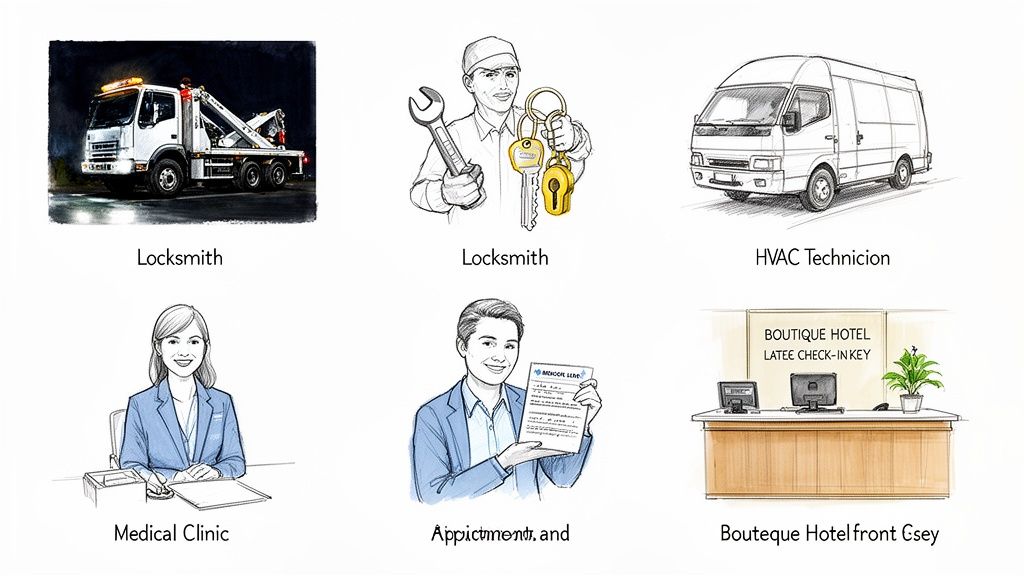
These mini-stories show how the right service becomes much more than just a call handler—it becomes a core part of the business's operational engine.
Towing and Locksmiths: Where Every Second Counts
For emergency responders like towing companies and locksmiths, a missed call is a lost job. Full stop. Customers are usually stranded, stressed out, and will just call the next name on the list if you don’t pick up right away.
Imagine a towing company using an AI assistant to instantly grab critical details from an accident scene: the caller's name, their exact location, vehicle type, and what happened. This info is automatically fired off to the nearest driver, cutting dispatch time in half and getting help on the way faster.
A locksmith can automate their intake process just as effectively.
- Job Details Captured: The AI asks for the year, make, and model for a car lockout or the type of lock for a home service call.
- Instant Dispatch: The system texts the complete job details straight to the on-call technician's phone.
- Faster Service: The locksmith shows up with the right tools, already briefed on the specifics of the job.
This kind of automation turns a chaotic, high-pressure phone call into a smooth, efficient dispatch, making sure no revenue is left stranded on the side of the road.
By capturing every single call and automating data collection, emergency service providers often see 20-60% more booked jobs. It’s a direct line from answering the phone to growing your bottom line.
HVAC and Home Services: Turning Emergencies into Revenue
When a furnace quits on a freezing winter night or an AC unit gives up during a brutal heatwave, homeowners need help now. But waking up an on-call technician for every single inquiry is a recipe for burnout and costly mistakes.
This is exactly where an intelligent after-hours service shines. You can learn more about how a home services answering service filters these calls to protect your team's sanity.
An HVAC contractor can set up their system to know the difference between a true emergency and a routine question. The AI can book non-urgent maintenance for the next business day while gathering all the necessary info for a critical repair. It confirms the problem, collects the address, and then alerts the on-call tech with a single, comprehensive text message.
This protects the technician’s time, guarantees they only get woken up for legitimate emergencies, and secures those high-value jobs that would otherwise go to a competitor.
Healthcare and Hospitality: Improving the Patient and Guest Experience
The need for 24/7 availability goes far beyond emergency trades. In healthcare, a busy medical clinic can use an after-hours service to slash staff burnout by automating appointment reminders and fielding common questions about office hours or insurance. This frees up the front desk to focus on the patients standing right in front of them.
In the hospitality world, a boutique hotel can handle late check-ins and guest requests without needing to staff the front desk all night. An AI assistant can give guests their access codes, answer questions about the Wi-Fi, and route urgent maintenance requests to the right person. This delivers a seamless guest experience while dramatically cutting overhead.
Across every industry, the goal is always the same: to be there for your customer in their moment of need.
Why AI Is the Future of Business Communication
In a world that never sleeps, being “closed” is a competitive disadvantage you just can’t afford anymore. Traditional answering services got us part of the way there, opening the door to 24/7 availability, but they represent the past.
The future—the smarter, more scalable, and frankly, more affordable way to communicate—is undeniably powered by artificial intelligence.
The argument is pretty simple: AI-powered assistants are just a better way to manage your phones. They give you that instant pickup customers now expect, answering every single call in under two seconds. This completely eliminates the voicemail black hole where so many good leads and urgent service calls used to go to die.
The New Standard for Customer Interaction
Intelligent call handling isn't a luxury anymore; it’s the new baseline. Modern AI doesn't just parrot a script. It understands, assists, and takes action. It can book appointments right into your calendar, gather critical details for a job, and even process payments over the phone, all without needing a human to step in.
This kind of automation leads to massive cost savings that traditional call centers just can't touch. By fielding the 60-80% of routine calls that bog down most businesses, AI frees up your skilled team members to focus on the high-value conversations that actually need a human touch.
The choice is no longer between being available and being efficient. With AI-powered after hours answering services, you get both—capturing every single opportunity while simultaneously driving down your operational costs.
This isn't just a minor tweak; it's a fundamental shift in how modern businesses grow. If you want to go a bit deeper on this, we've written more about using AI for customer service and how it’s changing the game.
At the end of the day, every call you miss is money left on the table. It's time to stop letting opportunity walk out the door after 5 PM. By bringing on an AI phone assistant, you're not just buying a tool; you're getting a strategic partner that's always on, always working for your growth, and ensuring you never miss the chance to help a customer again.
Common Questions About Answering Services
Bringing in any new tech, especially something that talks directly to your customers, is bound to raise a few questions. And they’re good questions. Will it sound like a robot? Is it a nightmare to set up? What if a real emergency comes through?
Let’s tackle the most common questions and clear the air.
Will an AI Assistant Sound Robotic?
This is usually the first thing people ask. We’ve all been trapped in those awful phone menus, shouting "representative" at a clunky, robotic voice. Nobody wants to put their customers through that.
Fortunately, that’s not what we’re talking about here. The technology has come a long, long way. Today’s systems use advanced conversational AI that sounds incredibly human. They understand slang, get the context of a conversation, and respond naturally. The interaction is so smooth, most callers won't even guess they're not speaking with a person.
The goal isn't to trick anyone. It's to give your callers a fast, helpful answer the moment they need it—something most people appreciate, regardless of who (or what) is on the other end.
How Is the Setup Process?
The next worry is usually about a complicated, time-sucking implementation. Good news: setting up a modern after hours answering service is surprisingly painless.
You don't need new hardware or complex software. The whole thing usually boils down to three quick steps:
- Tell it what to say: You map out how the AI should answer common questions and what info it needs to grab.
- Forward your calls: You just forward your existing business number to the service when you clock out.
- Connect your tools: With a few clicks, you can link it to your calendar or CRM.
Most businesses are up and running in under an hour.
Here's a good rule of thumb: The best systems are built for simplicity. If a solution requires a technical team and weeks of configuration, it’s not the right fit for a busy small business owner.
What Happens in a Real Emergency?
This one is critical. What if a customer has a burst pipe, is locked out of their house, or has an urgent medical issue? You can't risk that call getting lost in an automated system.
This is where smart escalation comes in. You can program the system to listen for keywords like "emergency" or "urgent." You can also give callers the option to press a number (like '0') to bypass the AI and ring you or your on-call tech directly.
This gives you the best of both worlds: AI handles all the routine calls efficiently, but you never, ever miss a critical one.
