
A small business phone answering strategy isn’t an expense—it's a critical tool for survival and growth. Think of a ringing phone as a customer walking through your front door. If no one's there to greet them, they’ll just turn around and find a competitor who is.
Why Every Missed Call Is a Lost Opportunity

For any small business, a single phone call can be a new sale, a crucial service request, or a chance to build a loyal customer for life. The hard reality, though, is that most of these opportunities are slipping through the cracks. When you're busy serving current clients, managing day-to-day operations, and handling paperwork, the phone often rings unanswered.
This isn’t just a minor inconvenience; it's a direct leak in your revenue stream.
Every time a call goes to voicemail—or worse, just rings endlessly—you're sending a clear message: their business isn't a priority. In today's market, that customer won't wait around. They'll hang up and dial the very next number on their search results page.
The True Cost of a Missed Call
The consequences of an unanswered call ripple through your entire business, causing damage that goes far beyond a single lost sale. It’s a compounding problem with both immediate and long-term effects.
| Area of Impact | Immediate Consequence | Long-Term Damage |
|---|---|---|
| Revenue | Loss of the immediate sale or job. | Erosion of customer lifetime value and future referrals. |
| Reputation | A frustrating customer experience. | Negative online reviews and poor word-of-mouth. |
| Growth | Missed lead capture opportunity. | A shrinking sales pipeline and stagnant growth. |
| Competitive Edge | The customer immediately calls a competitor. | Competitors gain market share and build loyalty with your prospects. |
Failing to connect is a cycle that slowly drains a business of its most valuable assets: its customers and its reputation.
The Staggering Reality of Unanswered Calls
The scale of this problem is much larger than most owners realize. Hard data shows a massive gap in customer engagement, with startling statistics revealing that only about 38% of inbound calls to small businesses are ever answered by a live person.
That means the vast majority of callers are hitting a voicemail they'll never leave a message on or getting no response at all. It's a huge, unintentional gift to your competitors.
When a customer calls, they have an immediate need. Failing to answer isn't just a missed connection—it's a direct signal that you're unavailable to solve their problem, pushing them straight to someone who is.
From Missed Call to Missed Revenue
Capturing that first call is the essential first step. It's where the customer journey begins. But answering the phone is only half the battle. Once you secure that lead, you need a solid plan to turn it into a paying customer. Implementing effective lead follow-up strategies ensures every conversation has the best possible chance of conversion.
Ultimately, a reliable small business phone answering system is fundamental to your financial health. It’s a direct lever you can pull to stop revenue leaks and discover new ways to increase profit margins by making sure every single opportunity is captured.
Your Guide to Phone Answering Solutions
Once you realize just how much a single missed call can cost, the next question is obvious: How do I make sure I answer every time? For small businesses, there are a handful of distinct small business phone answering solutions out there, each with its own pros and cons. Getting a feel for these options is the key to picking the right fit for your budget, your call volume, and what you want your customer experience to be.
Think of these solutions as different ways to staff a retail store. Each plays a specific role, from the owner who does everything to a hyper-efficient automated assistant. Let’s break them down.
Handling Calls Yourself
This is the default for most solo entrepreneurs and brand-new businesses. You are the business, so you answer the phone. It’s the most direct and personal way to do things, guaranteeing every caller talks to the person in charge.
The problem, of course, is that this approach doesn't scale. Not even a little. The moment you're on a job, in a client meeting, or just trying to grab lunch, calls go straight to voicemail. It’s like a shop owner trying to greet customers, stock shelves, and run the cash register all at once—sooner or later, you're going to drop a ball.
Hiring an In-House Receptionist
Bringing a dedicated receptionist onto the payroll is a major step up. This person becomes the professional voice of your company, managing calls, filtering out spam, and getting inquiries to the right person.
This solution creates a consistent, branded experience during business hours. The big downside is the cost. The salary, benefits, and training for a full-time employee are a serious expense, often landing somewhere between $30,000 to $50,000 annually. And it still doesn't solve the problem of after-hours or weekend calls.
Using a Live Answering Service
A live answering service is essentially an outsourced team of receptionists who answer calls on your behalf. It’s a popular choice because it offers 24/7 coverage without the massive overhead of an in-house hire.
These services can take messages, qualify new leads, and follow a script you provide, giving you a flexible and professional front desk. For a lot of businesses, this is a fantastic way to make sure every call gets picked up, day or night.
A live answering service acts like an on-demand team. They step in when you can't, ensuring your storefront is always attended, even when you're not physically there. This guarantees no customer is ever left waiting.
Automated IVR Systems
You’ve definitely run into an Interactive Voice Response (IVR) system before. It’s that automated menu that says, “Press 1 for sales, Press 2 for support.” IVR can be a great tool for routing a high volume of calls and handling basic questions without needing a human.
While they're cost-effective, IVR systems can be incredibly frustrating for customers who have a complex or urgent problem. In fact, research shows that a staggering 85% of consumers have hung up on a call after hitting an auto attendant. These systems are usually best for simple routing, but you can dig deeper into how they work in our guide on what IVR is and how it functions.
For businesses looking to upgrade to a more modern setup, this detailed guide to migrating to a cloud-hosted IP-PBX system can be a huge help, as these systems often include IVR features.
AI Virtual Receptionists
The latest evolution in phone answering is the AI virtual receptionist. This technology blends the 24/7 availability of an automated system with the conversational intelligence you'd expect from a human.
Unlike a rigid IVR menu, an AI receptionist like Marlie.ai can understand natural language, book appointments on your calendar, answer detailed questions, and even process payments. It delivers a sophisticated, responsive experience for a fraction of what live agents cost, making sure every caller gets immediate, intelligent help. It's the brilliant AI assistant who not only greets every customer perfectly but also runs your whole schedule without ever taking a day off.
Comparing Costs And ROI Of Answering Services
When you're choosing a phone answering solution, it's tempting to just glance at the monthly price tag and call it a day. But the real cost—and the real value—goes so much deeper than that initial number. To make a smart decision, you have to look past the sticker price and start thinking in terms of investment, not expense.
Let's get practical. Hiring an in-house receptionist seems straightforward, but the costs pile up fast. It's not just the hourly wage. You've got payroll taxes, benefits, vacation time, and the hours spent on training. That seemingly simple $15 per hour wage can easily balloon into a $40,000+ annual commitment.
Outsourced options, like live answering services or an AI receptionist, offer much more predictable pricing. But even then, you need to know what you're signing up for. Is it per minute, per call, or a flat monthly fee? Getting a handle on these details is the first step to a real cost-benefit analysis. For a closer look, our guide on answering service costs breaks down the numbers even further.
The Hidden Costs Of In-House Staffing
Having a dedicated employee on-site gives you a lot of control, but for a small business, the associated expenses can be a quiet budget killer. Beyond the salary, there are plenty of other costs that aren't so obvious.
- Benefits and Taxes: Think health insurance, retirement contributions, and payroll taxes. These can easily add another 20-30% on top of the base salary.
- Recruitment and Training: Finding, interviewing, and training a new hire costs both time and money—a serious upfront investment.
- Equipment and Space: Your new employee needs a desk, computer, phone, and the office space to put it all in. None of that is free.
- Downtime: When your receptionist takes a vacation, calls in sick, or even just goes on a lunch break, you're paying for hours when the phones are dead silent.
Add it all up, and the true cost of an in-house receptionist is almost always far higher than business owners think.
Phone Answering Solutions Cost And Feature Comparison
To really understand the options, it helps to see them side-by-side. Each solution has its own sweet spot, depending on your call volume, budget, and what you need them to do.
| Solution | Estimated Monthly Cost | Key Features | Best For |
|---|---|---|---|
| In-House Receptionist | $3,000+ | Full-time availability (during work hours), handles in-office tasks, deep company knowledge. | Businesses that need an on-site presence and have a high, steady call volume to justify the cost. |
| Traditional Answering Service | $150 – $1,500+ | Live human agents, 24/7 availability options, basic message taking and call forwarding. | Companies needing after-hours or overflow coverage with simple call-handling requirements. |
| Virtual Receptionist | $250 – $2,000+ | Live agents, appointment scheduling, lead qualification, CRM integration, more advanced tasks. | Service-based businesses that need more than just messages taken—they need action and integration. |
| AI Receptionist (like Marlie.ai) | $99 – $500+ | Instant 24/7 responses, appointment booking, lead capture, call routing, CRM integration, highly scalable. | Startups, solo entrepreneurs, and SMBs looking for a cost-effective, highly efficient way to capture every lead. |
This table shows the huge range in both cost and capability. An AI receptionist can deliver many of the same high-value features as a premium virtual service but at a fraction of the cost, making it an incredibly powerful tool for growing businesses.
Shifting From Cost To Return On Investment
Here's the most important mindset shift: a great small business phone answering strategy isn't an expense. It's a revenue generator. This is where we stop talking about cost and start talking about Return on Investment (ROI).
Don't ask, "How much does it cost?" Ask, "How much business will it bring in?"
Every missed call has a real, quantifiable impact on your bottom line. Think about a contractor who misses just 10 calls a day. That could easily translate to thousands in lost profit every single month. An investment in a service that turns those missed calls into booked jobs can pay for itself many times over.
The infographic below really drives this point home, showing how the numbers stack up when you compare an in-house team to a smart, outsourced solution.
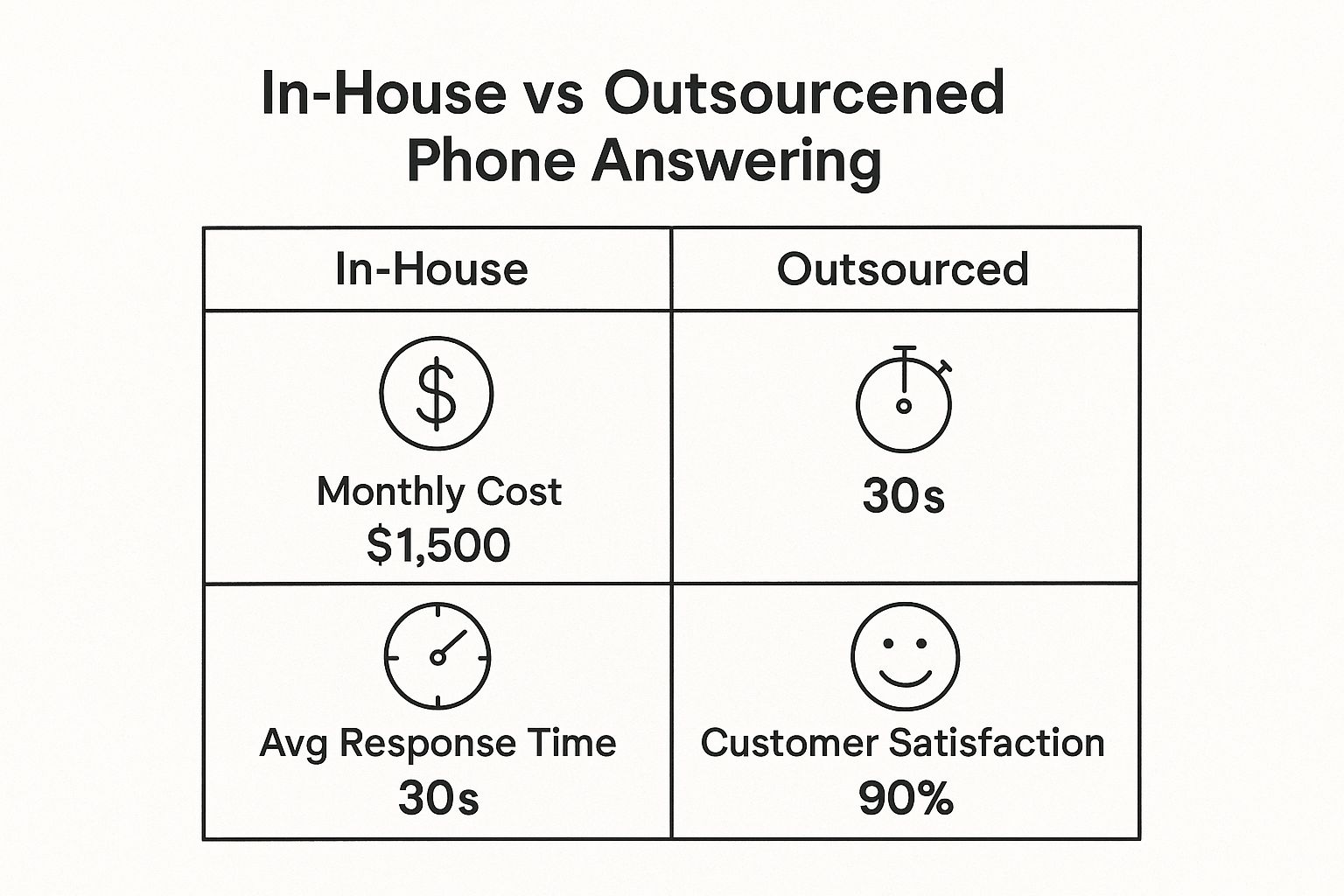
As you can see, outsourcing isn't just about cutting monthly expenses. It's about boosting performance—faster response times and happier customers—which feeds directly into your ROI.
The most expensive answering service is the one that lets a valuable lead slip away. The right solution pays for itself by capturing revenue that would otherwise be lost forever.
When you frame it this way, you realize a reliable phone system isn't just a line item. It's a growth engine. It transforms a potential loss into a guaranteed opportunity, making it one of the smartest investments a small business can make.
How VoIP and AI Are Changing the Game
The traditional phone line is quickly going the way of the dinosaur. Today, two powerful forces are completely reshaping how small businesses handle calls: Voice over Internet Protocol (VoIP) and Artificial Intelligence (AI).
These aren't just minor upgrades. We're talking about a fundamental shift in how you connect with customers, unlocking a level of flexibility and power that used to be reserved for massive corporations with deep pockets.
Think of an old landline as a single, fixed path for your calls. VoIP, on the other hand, is like a dynamic, multi-lane superhighway built right on the internet. It turns your business phone from a simple device into a flexible communication hub you can access anywhere—your office, your home, or even your smartphone on a job site.
This technology is no longer some niche solution; it's rapidly becoming the standard. The VoIP market is projected to grow by about 15% between 2019 and 2025, with businesses slashing their communication costs by up to 75%. You can dive deeper into this trend toward modern phone systems at Cloudtalk.io.
The Advantages of a VoIP Phone System
Switching to VoIP is more than just a tech update—it’s a strategic business move. The benefits go far beyond just making calls over the internet.
Here’s what you stand to gain:
- Serious Cost Savings: VoIP plans are often drastically cheaper than traditional phone services. You can forget about expensive hardware and paying for separate line installations.
- Unmatched Flexibility: Your business number is no longer chained to a physical location. Take calls on your business line from your cell phone, laptop, or any device with an internet connection.
- Advanced Calling Features: Most VoIP services are packed with features like call forwarding, voicemail-to-email transcription, and detailed call analytics that used to be pricey add-ons.
- Effortless Scalability: Need a new line for a new hire? It’s as simple as a few clicks in a dashboard. No more waiting around for a technician to install new wiring.
The Rise of the AI Receptionist
If VoIP modernizes the plumbing of your phone system, AI revolutionizes the experience on the front lines. An AI-powered virtual receptionist is so much more than a simple call forwarder or an automated menu. It’s an intelligent, tireless team member that works around the clock to make sure no opportunity ever slips through the cracks.
An AI receptionist acts as the ultimate gatekeeper and personal assistant. It can understand what a caller wants, provide instant answers, and manage complex tasks without ever needing a coffee break. Every single caller gets an immediate, professional, and helpful response, 24/7.
Unlike a rigid IVR system that traps callers in a frustrating loop of button-pushing, an AI receptionist can have a natural, human-like conversation. It figures out what the caller needs and takes direct action. For a full breakdown of how it all works, check out our guide to the AI phone answering service.
This intelligence brings a whole new level of efficiency to any small business phone answering setup.
What an AI-Powered System Can Do
An AI assistant like Marlie.ai gives you the best of both worlds: the instant, 24/7 availability of automation and the smart, helpful nature of a highly trained human receptionist.
Here’s just a snapshot of what these systems can handle:
- Intelligent Call Routing: The AI determines the urgency and nature of a call, sending true emergencies to a specific person while handling routine stuff on its own.
- Automated Appointment Scheduling: It can sync with your calendar in real-time to book, reschedule, or cancel appointments based on your actual availability.
- Instant FAQ Answering: It can field common questions about your hours, services, location, or pricing, freeing you up for more important work.
- Lead Qualification and Data Capture: The AI can gather critical info from new leads—like their name, contact details, and what they need—and log it straight into your CRM.
By pairing a flexible VoIP backbone with an intelligent AI front end, small businesses can now build a powerful, professional, and affordable communication system that captures every lead and delights every customer. This potent combination is truly changing the game.
Best Practices for a Flawless Setup
Picking the right small business phone answering system is a big deal, but the real magic happens when you set it up. A little thought here can turn a simple tool into a powerhouse for keeping customers happy and building your brand. It’s like getting a new smart thermostat—the device has potential, but its real value comes out only after you customize the schedule to fit how you actually live.
A successful rollout needs a clear strategy. This means you have to go beyond the default settings and consciously design an experience that feels professional, consistent, and genuinely like your business. Every single piece, from the first word a caller hears to the data you look at later, has a role to play.
Craft Professional Greetings and Messages
That initial greeting is your digital handshake. It’s the very first impression, so it needs to be warm, professional, and on-brand. A generic, robotic "hello" just won't do. Your greeting should instantly let callers know they’ve reached the right place and that you value their time.
And don't forget about your on-hold messages—that's a captive marketing opportunity right there. Instead of playing generic elevator music, use that time to share something useful:
- Promote a special offer: "While you wait, feel free to ask about our 15% discount for new customers this month."
- Answer a common question: "Did you know we offer 24/7 emergency services? We're always here to help."
- Send them to your website: "For more details on everything we do, check out our website at YourBusiness.com."
These small touches make your brand feel more solid and can turn what would be dead air into a positive, productive moment for the customer.
Develop Clear Call Flow Instructions
A call flow is basically a roadmap that guides every caller to where they need to go. Whether it's a live agent or an AI on the other end, that map needs to be logical and efficient. A confusing or poorly planned call flow is one of the fastest ways to frustrate a potential customer—in fact, 91% of consumers get frustrated when they have to call a company multiple times for the same problem.
Start by mapping out the most common reasons people call you. Are they trying to book an appointment? Get a quote? Or is it an emergency? Each of these situations should have its own clear, predetermined path. For an AI system like Marlie.ai, this means setting up specific rules for how to route calls and what information to gather.
A well-designed call flow anticipates what the caller needs. Think of it like a perfectly organized storefront where every aisle is clearly marked, helping customers find exactly what they're looking for without getting lost.
This planning stage is also when you should create scripts or guidelines for responses. Even with an AI, giving it key phrases and answers ensures every conversation hits the right tone and stays consistent with your company’s policies. For a deeper dive, exploring detailed call handling best practices can give you some great frameworks to work with.
Train Your System and Your Team
If you went with a solution that uses live agents, solid training is non-negotiable. Your team has to really understand your brand, your services, and the scripts you’ve put together. Role-playing different call scenarios is a surprisingly effective way to build confidence and keep everyone on the same page.
When you're setting up an AI receptionist, the "training" is all about careful configuration. This usually involves:
- Customizing the AI’s voice and tone so it matches your brand's personality.
- Feeding it detailed answers to frequently asked questions so it can respond accurately.
- Integrating it with your calendar and CRM to make booking appointments and capturing data seamless.
The more information you give the system right out of the gate, the smarter and more effective it will be from day one.
Regularly Review and Optimize
Your phone answering setup isn't something you can just "set and forget." It's a living system that should grow and change with your business. Most modern tools give you a ton of analytics—things like call volume, peak call times, how long calls last, and what people are calling about most often.
Put that data to work. If you see a lot of calls about one specific service, maybe you create a dedicated option for it in your call flow. If your analytics show long hold times, it might be time to tweak your staffing or adjust the AI's response patterns. This constant cycle of review and refinement is what keeps your small business phone answering system perfectly tuned to meet your customers' needs and capture every single opportunity.
Okay, you’ve seen the options, weighed the costs, and you get the tech. Now for the important part: pulling it all together and picking the right small business phone answering setup for your business. This isn't just about operations; it's a strategic call that can make or break your customer relationships and, frankly, your revenue.
Every single call is a potential job. A new client. A chance to show you’re the real deal. Answering each one with a professional touch isn't some nice-to-have luxury—it's the engine that powers your growth. The right system is what turns your phone line from a nagging problem into your single most powerful tool for getting ahead.
A Simple Checklist to Guide Your Decision
Figuring this out doesn’t have to be a headache. You just need to ask yourself a few honest questions about how your business actually works, day in and day out. Get real about your daily grind, and the best choice will become obvious pretty fast.
Use this checklist to find your perfect fit:
-
How many calls am I really getting each day? If it's just a handful, a basic setup might be fine. But if your phone rings off the hook—or the volume is all over the place—you need something that can scale up without drowning you. An AI receptionist is built for exactly that.
-
What's my budget? Let's be realistic about what you can spend. An in-house receptionist is a massive commitment, easily topping $30,000+ per year when you factor in everything. Modern tools like AI give you almost all the same power for a tiny fraction of that cost.
-
Do I need to be available 24/7? If you're a plumber or a locksmith, this isn't even a question. Emergencies happen after 5 PM. A system that works around the clock is the only way to grab those lucrative after-hours jobs that your competition is sleeping through.
-
Is booking appointments the main goal? If the whole point of a call is to get a job on the calendar, you need a system that plugs directly into your schedule. Just taking messages is a recipe for delays, phone tag, and costly mistakes.
Answering these questions honestly will light up the path forward. The decision will feel less like a guess and more like a confident step.
The point isn't just to answer more calls—it's to convert more opportunities. The solution you choose should be an active partner in booking more jobs, capturing more leads, and making sure every customer has a great experience, every single time.
Stop Letting Missed Calls Limit Your Potential
Every time your phone rings and goes unanswered, that's a customer who's gone forever. That's revenue you'll never see. In a world this competitive, you just can't afford to let good business slip away because you were on another job, driving the truck, or just trying to grab lunch.
It's time for a solution that works as hard as you do. Maybe that's the 24/7 power of an AI assistant like Marlie.ai, or maybe it's another system that fits your specific needs. The key is to take action. Stop leaving money on the table and start building a business that's always open, always responsive, and always ready for what's next.
Frequently Asked Questions
Jumping into the world of phone answering solutions can feel a bit overwhelming. You've got questions, and getting straight answers is the only way to feel good about the decision you make for your business, your customers, and your wallet. Let's tackle the most common ones.
How Much Does a Phone Answering Service Cost?
The price tag can swing wildly depending on what you're actually getting. A basic automated menu (think "press 1 for sales") might just be a small add-on to your existing VoIP plan. But if you're looking at live virtual receptionists, you'll typically see plans ranging from $50 to over $500 a month, usually priced by how many calls you get or the total minutes they spend on the phone.
AI-powered services like Marlie.ai flip the script on pricing. Instead of paying for a person to just sit there waiting for the phone to ring, you're only paying for the time the AI is actively engaged on a call. This makes getting 24/7 coverage surprisingly affordable and predictable, without the massive overhead of traditional options. The real trick is to look past the monthly fee and think about the return—how many new jobs or appointments will this service capture for you?
Can an Answering Service Really Sound Like My Business?
Absolutely. The whole point of a quality answering solution—whether it's a person or an AI—is to blend in so perfectly that your callers think they're talking to someone in your office. For a live service, you achieve this by giving them detailed scripts, a solid FAQ, and clear notes on your brand's tone.
The goal is to create a seamless experience where the caller feels they are speaking directly with your company, not an outsourced service. This consistency builds trust and reinforces your professional image on every single call.
With a modern AI receptionist, you can dial this in even further. You get to hand-pick a voice and tone that perfectly matches your brand's personality. That first setup is everything; spend a little time upfront programming the right responses and information, and you guarantee every caller gets an on-brand experience that feels completely authentic.
What Is the Difference Between a Virtual Receptionist and an Answering Service?
People mix these terms up all the time, but there’s a huge difference in what they actually do.
A traditional "answering service" does one main thing: take a message when you can't get to the phone. They're basically a human voicemail, passively jotting down notes for you to deal with later.
A "virtual receptionist," on the other hand, is an active part of your team. It doesn't matter if it's a human or an AI; a virtual receptionist is there to handle real tasks and move things forward. Things like:
- Screening and routing calls to the right person or department.
- Answering frequently asked questions to give callers immediate help.
- Scheduling appointments right on your calendar.
- Qualifying new leads by asking the right questions upfront.
In short, a virtual receptionist doesn't just take messages; it takes action. That proactive approach is what makes it such a powerful tool for a growing business trying to capture every single opportunity that comes its way.
Ready to stop missing calls and start booking more jobs? Marlie.ai provides a 24/7 AI phone assistant that captures every lead, schedules appointments, and saves you hours each week—all for a fraction of the cost of a traditional service. Discover how it works at https://www.marlie.ai.
