
Ever felt the silent tension at a hotel check-in desk? You know, that moment where you're not sure if it'll be a seamless 90-second affair or a ten-minute ordeal of frantic typing, phone calls, and shuffling papers. That entire experience is dictated by one thing: the hotel's front desk software.
This isn't just another tool; it's the operational heart of the property. Think of it as the air traffic controller for the entire hotel, managing everything from reservations and room assignments to guest requests and billing, all from a single screen. It’s what turns the potential chaos of daily operations into a smooth, predictable workflow.
What Exactly Is Hotel Front Desk Software?
At its core, hotel front desk software is the technology that manages the entire guest journey, from the moment they book to the second they check out. It’s the digital replacement for the old world of manual ledgers, sticky notes, and endless phone calls between departments.
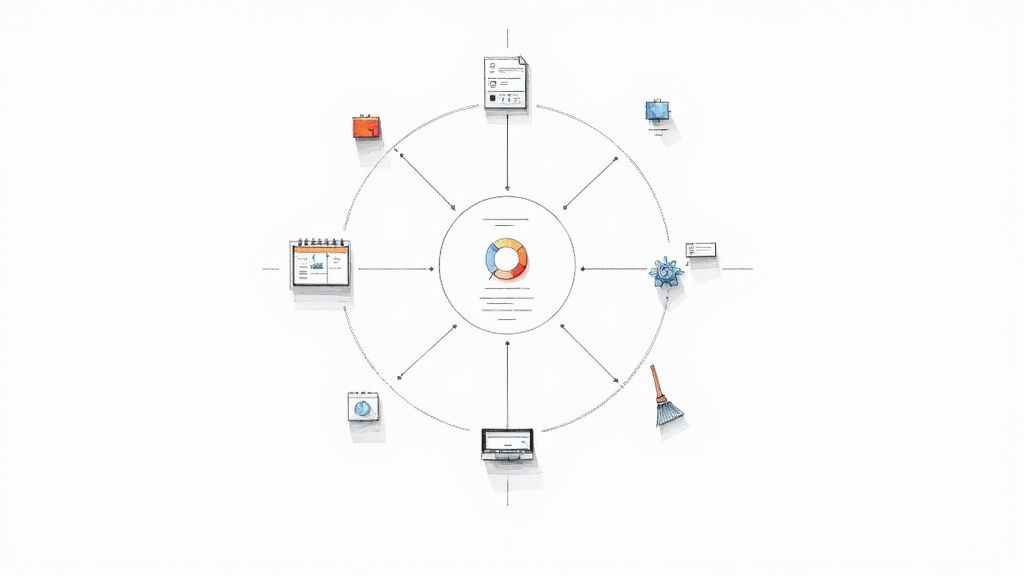
This software acts as the central hub, connecting otherwise separate departments—like reservations, housekeeping, and billing—into one functional unit. When a guest checks out, the system instantly notifies housekeeping. Once the room is clean, its status updates in real-time, letting the front desk know it's ready for the next arrival. No more guesswork or "let me call and check" delays.
The Shift From Manual To Automated Operations
It wasn't that long ago that a front desk ran on a fragile mix of spreadsheets, logbooks, and a perpetually ringing phone. This manual system wasn't just slow; it was a breeding ground for human error. Double bookings, incorrect charges, and lost messages were just part of the daily grind.
To see just how much things have changed, here’s a quick comparison:
Manual Front Desk vs Automated Software
| Operational Task | Manual Process (Without Software) | Automated Process (With Software) |
|---|---|---|
| Reservations | Phone calls, emails, and a physical reservation book or spreadsheet. | Real-time availability shown online; bookings auto-populate the system. |
| Check-In | Find the name on a printed list, call housekeeping, manually enter guest details, and use a separate credit card terminal. | Pull up the reservation instantly, see room status, click to check in, and process payment via an integrated system. |
| Housekeeping | Front desk calls housekeeping with a list of check-outs; housekeeping calls back when rooms are ready. | System automatically generates a list of rooms to be cleaned; status updates are made via a mobile app. |
| Guest Billing | Manually add charges from the restaurant or gift shop to a paper folio. | Point-of-sale systems automatically post charges to the guest's digital folio in real-time. |
| Reporting | Staff spends hours manually compiling daily occupancy reports and revenue summaries from different sources. | Generate detailed, accurate reports with a few clicks. |
This shift isn't just about convenience—it’s about survival and growth in a competitive market. Modern software automates these critical tasks, ensuring accuracy and freeing up your team to focus on what really moves the needle: providing an exceptional guest experience. We dive deeper into these strategies in our guide to modern hotel front desk management.
The market data tells the same story. The global hotel front desk software market is on track to hit around USD 3.2 billion by 2025, with a steady growth rate of 12.5% expected through 2033. It's clear that automation is no longer an option; it's the standard. You can explore the full projections for hospitality technology to see where the industry is headed.
Core Features That Run Your Hotel
Modern hotel front desk software is much more than a digital guestbook. It's the engine room, the central nervous system that powers your entire operation. While feature lists can seem endless, a handful of core capabilities are what really matter. They all need to work together to create a smooth, profitable, and guest-centric experience.
Figuring out these core functions is the first step toward choosing a system that genuinely works for you, rather than just adding another layer of complexity.
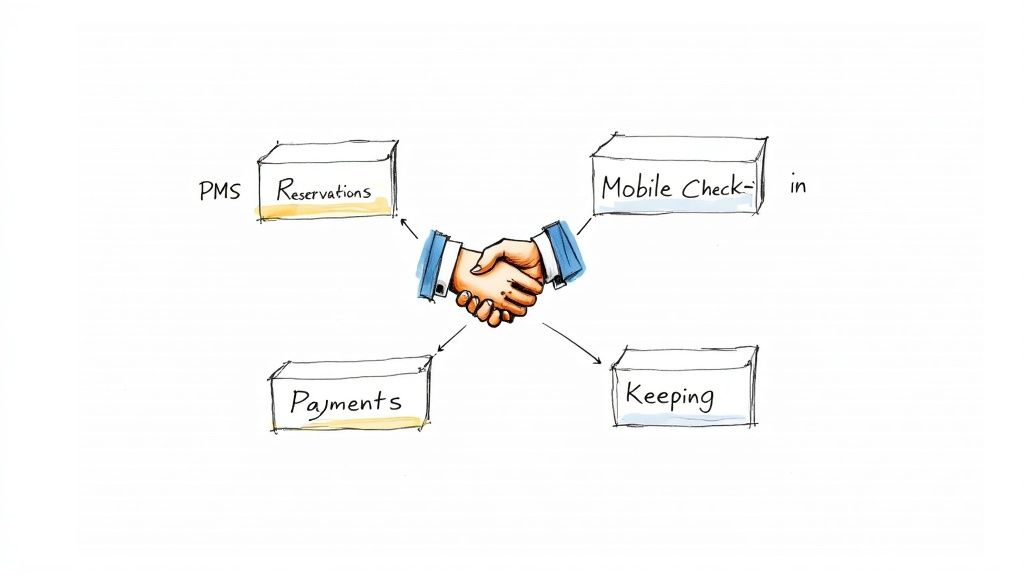
Think of these features less like separate tools and more like interconnected gears in a finely tuned machine. When one turns—say, a new booking comes in—the others respond instantly. This ensures every department, from housekeeping to accounting, is working from the same real-time information.
Let's break down the components you can't live without.
The PMS Integration Handshake
At the absolute foundation of any front desk system is its ability to integrate with your Property Management System (PMS). This isn't just a feature; it's a non-negotiable, must-have requirement. Your PMS is the single source of truth for the entire property, holding every critical piece of data on room inventory, rates, guest profiles, and billing.
Your front desk software has to "shake hands" with the PMS, creating a seamless, two-way flow of information. When a receptionist checks a guest in, the PMS instantly updates that room's status, which in turn alerts housekeeping and blocks the room from being sold again online. This is what prevents costly errors and keeps the whole operation in sync.
Without it, you're right back to manual data entry, which completely defeats the purpose of having modern software in the first place.
Centralized Reservation Management
A hotel's revenue lives and dies by its reservation system. A powerful hotel front desk software brings all your bookings—whether they come from Online Travel Agencies (OTAs) like Expedia, your own website, or a walk-in—into a single, unified dashboard.
This real-time synchronization is what stops one of the most damaging mistakes a hotel can make: overbooking. When a room gets booked on one channel, it should instantly become unavailable on all the others. No exceptions.
Key Takeaway: A centralized reservation system eliminates the tedious manual work of updating multiple channels, cuts the risk of double bookings down to nearly zero, and gives you a precise, up-to-the-minute view of your occupancy.
Streamlined Check-In and Check-Out Workflows
The first and last impressions you make on a guest happen during check-in and check-out. Good software transforms these moments from potential bottlenecks into frictionless, even pleasant, experiences.
Essential workflow features you'll see include:
- Mobile Check-In: This lets guests check in from their phones before they even set foot in the lobby, cutting down on queues and freeing up your staff.
- Real-Time Room Status: Your front desk team needs to see instantly which rooms are clean, dirty, or under maintenance. No more assigning guests to rooms that aren't ready.
- Express Check-Out: Guests can review their bill on their phone or a lobby kiosk, settle up, and be on their way without ever waiting for a receptionist.
These features don't just make guests happier; they make your operation faster. A quicker turnover between guests means rooms become available for new arrivals sooner, which directly impacts your bottom line.
Integrated Guest Communication and Payment Processing
Great hospitality is built on effective communication. Today’s systems integrate messaging tools that allow you to send out automated confirmation emails, welcome texts with useful info, and post-stay surveys to gather feedback. This keeps guests in the loop and feeling cared for throughout their entire journey with you.
At the same time, integrated payment processing is another must-have. Instead of fumbling with a separate credit card terminal, the software securely handles every transaction—from the room charges to that late-night room service order—and posts it directly to the guest's folio. This automation guarantees accuracy, makes check-out a breeze, and provides a crystal-clear, itemized bill for the guest.
These interconnected features are what separate a basic tool from a true operational platform. By taking care of the mundane, they empower your staff to focus on what really matters: delivering an unforgettable guest experience.
How to Choose the Right Software for Your Hotel
Picking the right front desk software is one of those decisions that will echo through your hotel’s operations for years. This isn't just about buying a new tool; you're choosing the central nervous system for your entire property. What works for a cozy 15-room inn is going to be completely different from what a 200-room resort with multiple restaurants needs. So, where do you start? You start with an honest look in the mirror at your own operational needs.
Before you even glance at a product demo, take some time to map out your daily life at the hotel. Where do things get stuck? Is your team burning hours manually updating rates on different booking sites? Are long lines at check-in a familiar sight? Identifying your biggest headaches is the first, most critical step to finding a solution that actually makes things better.
Evaluate Your Property’s Unique Needs
Every hotel has its own rhythm, its own personality. A small, independent property might be laser-focused on simplicity and a predictable monthly cost. A larger hotel group, on the other hand, is probably looking for powerful multi-property reporting and deep integrations with other systems.
Start by getting clear on the fundamentals:
- Property Size and Type: Are you managing a single boutique hotel, a sprawling resort with a spa and restaurant, or a whole chain of properties?
- Guest Profile: Do you cater to business travelers who just want to get to their room as fast as possible, or are your guests on vacation, looking for a more personal, high-touch experience?
- Technical Resources: Do you have an IT person on staff, or do you need a system that’s completely managed and supported by the vendor so you never have to touch a server?
Thinking through these questions helps you build a shortlist of software that genuinely fits your business. For a more detailed breakdown of what to look for, it's worth reviewing a list of essential property management software features that can really move the needle on both your operations and the guest experience.
Cloud-Based Versus On-Premise Solutions
One of the first forks in the road you'll encounter is choosing between a cloud-based or an on-premise system. The difference is pretty straightforward.
A cloud-based system, often called SaaS (Software as a Service), lives on the vendor’s servers and you access it through the internet. This has become the go-to for most hotels today. Why? It's flexible, has lower upfront costs, and you never have to worry about updates. You pay a subscription fee, and the provider handles all the tricky stuff like maintenance, security, and backups.
An on-premise solution is the old-school approach. You buy the software license outright and host it on your own servers at the hotel. This gives you direct control over your data, but it comes with a hefty initial price tag for hardware and the ongoing cost of having an IT team to keep it running. For the vast majority of modern hotels, the agility and lower overhead of a cloud platform is the clear winner.
Before settling on any software, it's wise to run through a checklist to make sure you're covering all your bases. This helps you compare different options objectively and ensures you're asking the right questions.
Software Selection Criteria Checklist
| Evaluation Criteria | Question to Ask Vendor | Importance (High/Medium/Low) |
|---|---|---|
| PMS Integration | Does your software offer real-time, two-way integration with our existing PMS? | High |
| Ease of Use | Can we get a live demo to see the user interface? How much training is required for new staff? | High |
| Scalability | Can the software grow with us if we add more rooms or properties? | Medium |
| Core Features | Does it handle reservations, check-in/out, guest messaging, and payment processing seamlessly? | High |
| Customer Support | What are your support hours? Do you offer phone, email, and live chat support? | High |
| Pricing Model | Is it a flat monthly fee, per-room pricing, or commission-based? Are there hidden setup fees? | High |
| Security & Compliance | How do you ensure our guest data is secure and PCI compliant? | High |
| Reporting & Analytics | What kind of reports can we generate? Can we see occupancy, RevPAR, and booking trends? | Medium |
| Third-Party Integrations | Does it connect with our channel manager, POS system, and other key tools? | High |
| Mobile Access | Is there a mobile app or mobile-friendly web version for managing on the go? | Medium |
Using a structured checklist like this forces you to look beyond the slick marketing and focus on what truly matters for your hotel's day-to-day success.
The Non-Negotiable Integration Checklist
Your front desk software can't be an island. It has to talk to all the other technology you rely on. If your systems don't connect, your team will be stuck in the past, manually copying information from one screen to another—which is exactly the kind of time-wasting, error-prone work you're trying to eliminate.
Critical Insight: Think of integrations like a digital handshake between your systems. When it's a firm, confident handshake, data flows automatically, errors disappear, and your team saves a ton of time. When it's a weak or non-existent one, you get confusion, manual work, and operational chaos.
Before you even think about signing a contract, get confirmation that the software integrates perfectly with your:
- Channel Manager: This is essential for syncing your room availability and rates across all your online travel agencies (OTAs) and your own website in real time.
- Point-of-Sale (POS) Systems: You need charges from the restaurant, spa, or gift shop to post automatically to a guest's bill. No more manual entry.
- Payment Gateway: This ensures you can process payments securely, quickly, and without headaches.
- Guest Communication Tools: The system should connect to your tools for sending automated pre-arrival emails, check-in texts, and post-stay feedback requests.
The demand for these tightly connected systems is fueling huge growth in the market. The hotel management software industry is projected to jump from USD 5.28 billion in 2025 to USD 9.41 billion by 2032, largely because hotels need a single, unified platform to run their business. As you upgrade, it's also worth thinking about how a modern system can work alongside a virtual front desk to automate even more of your guest-facing tasks.
The Human Touch, Supercharged by AI
The front desk of the future? It’s already here, and it’s powered by artificial intelligence.
But let's get one thing straight: this isn't about replacing hospitality professionals. Far from it. Think of AI as a tireless assistant, the one who handles all the repetitive, predictable tasks that used to eat up your team's day. This frees up your staff to focus on what humans do best: solving complex problems and delivering those memorable, high-touch moments that define a great stay.
This shift is more than just a trend; it's a fundamental change in how modern hotels operate. The global market for hotel and hospitality management software is booming, driven by the need for digital solutions that meet today's guest expectations. It's all about using technology for smarter personalization and seamless, contactless experiences—the very things that boost revenue and secure a competitive edge. The financial scale of this shift is massive; you can explore the full market report here to see the numbers.
AI Phone Assistants: Your 24/7 First Responder
One of the most immediate and practical ways to bring AI to the front desk is with an AI-powered phone assistant. Picture a virtual receptionist that never sleeps, never gets overwhelmed, and never misses a call. It’s a game-changer when you consider that a whopping 60-80% of calls to a hotel are for routine questions—things like booking a room, checking a reservation, asking for directions, or confirming pool hours.
An AI assistant fields these common queries instantly and accurately, 24/7. This means a lean team can suddenly operate with the efficiency of one twice its size. Your night auditor isn't pulled away from critical closing duties to answer a simple question, and your daytime staff can give their undivided attention to the guests standing right in front of them.
Key Insight: By automating routine calls, AI frees your team from low-value, repetitive work. They can then reinvest that energy into high-value activities: personalizing a guest's stay, resolving a tricky issue, or helping coordinate a special event.
For a deeper dive into how this technology fits into the bigger picture, our guide on AI in hospitality breaks down how these systems can be integrated seamlessly.
Beyond Voice: Predictive Analytics and Smart Personalization
While AI phone assistants offer immediate relief, the true impact of AI runs much deeper. The best hotel front desk software now uses artificial intelligence for more strategic work that was once the stuff of science fiction.
- Predictive Demand Forecasting: AI algorithms can chew through historical booking data, local event calendars, flight schedules, and even weather patterns to predict future demand with startling accuracy. This gives revenue managers a powerful tool to proactively optimize pricing and staffing.
- Personalized Guest Recommendations: Good AI can analyze a guest's past stays and current behavior to offer suggestions they’ll actually want. Imagine a system that knows a guest prefers a quiet room and automatically offers a spa package because they’ve booked one on their last two visits.
- Proactive Service Intervention: Smart systems can spot potential problems before they ever become complaints. For instance, if three separate guests on the same floor call about spotty Wi-Fi, the AI can flag it as a priority for maintenance—often before anyone has to formally complain.
These features are changing the guest experience from reactive to predictive. Instead of waiting for a guest to ask for something, modern hotels can anticipate their needs. This delivers a level of personalized service that was once impossible to scale, boosting guest satisfaction and opening up new doors for upselling.
The automated front desk isn't about removing the human touch; it's about empowering your team to deliver it more thoughtfully and effectively than ever before.
Your Go-Live Implementation Plan
Picking out your new hotel front desk software is just the start of the journey. A successful launch hinges entirely on a smart, well-structured plan. Think of this not as flipping a switch, but as a carefully managed process that takes you from purchase to proficiency. A rushed rollout is a recipe for disaster—it creates chaos at the front desk, disrupts guest service, and can kill your team's confidence before the new system even gets a chance to shine.
A methodical approach means every detail gets handled, from securely migrating sensitive guest data to getting your team comfortable and effective with the new tools. This roadmap will break it all down into clear, manageable stages.
Stage 1: Data Migration And System Configuration
The first big technical hurdle is getting all your existing data into the new system. This is far more delicate than a simple copy-and-paste job. We're talking about the secure and flawless transfer of your hotel's most critical information.
- Guest Profiles: Every bit of historical guest data—contact info, stay history, personal preferences—has to move over without a single error.
- Reservation Data: Upcoming and future bookings are the lifeblood of your operation. Getting this migration right is non-negotiable if you want to avoid lost revenue or infuriating double-booking scenarios.
- Financial Records: Past folios and payment histories need to be either transferred or archived, all while sticking to compliance standards.
At the same time, your implementation partner will be tailoring the software to fit your hotel's unique operational DNA. This means setting up your specific room types and rate codes, creating user accounts with the right permission levels, and building out the custom report templates you'll rely on every day.
Stage 2: Hardware Setup And Integration Testing
Once the software is configured, the focus shifts to the physical hardware at your front desk. This is where you'll install and test any new equipment—think credit card terminals, receipt printers, or check-in kiosks—to make sure they communicate perfectly with the new software.
This is also the moment for rigorous integration testing. Does a charge from your restaurant's POS instantly appear on a guest's folio? When a new booking comes in from your channel manager, does it block out room availability in real-time? Finding and squashing these connection bugs now prevents massive headaches down the road.
Stage 3: Staff Training And Team Buy-In
A tool is only as good as the people using it. This is, without a doubt, the most critical stage of the entire process. Your software's success lives or dies based on comprehensive training and genuine buy-in from your team.
A study on technology adoption found that projects with solid change management and training are six times more likely to meet or exceed their goals. If your team isn't confident using the new system, even the best software on the market will fall flat.
To make sure the transition is a smooth one, lean on these proven strategies:
- Appoint a ‘Super-User’: Pick one or two tech-savvy team members to be your internal champions. Give them advanced training so they can become the go-to resource for their colleagues, which drastically reduces your reliance on external support.
- Run Systems in Parallel: For a short, defined period—maybe a week—run your old system right alongside the new one. This creates a valuable safety net, letting staff build confidence without the fear of making an irreversible mistake.
- Focus on the "Why": Don't just show your team how to click the buttons. Explain why this new system is a step up. Frame it around how it will slash manual work, prevent common errors, and ultimately free them up for more meaningful, high-touch interactions with guests.
A thoughtful implementation is a cornerstone of optimizing your entire operation. For more on this, you can explore various business process improvement methods that go hand-in-hand with a major tech upgrade.
This simple flow shows how an AI can become a powerful front-line support tool, handling routine inquiries so your staff can focus on more complex issues.
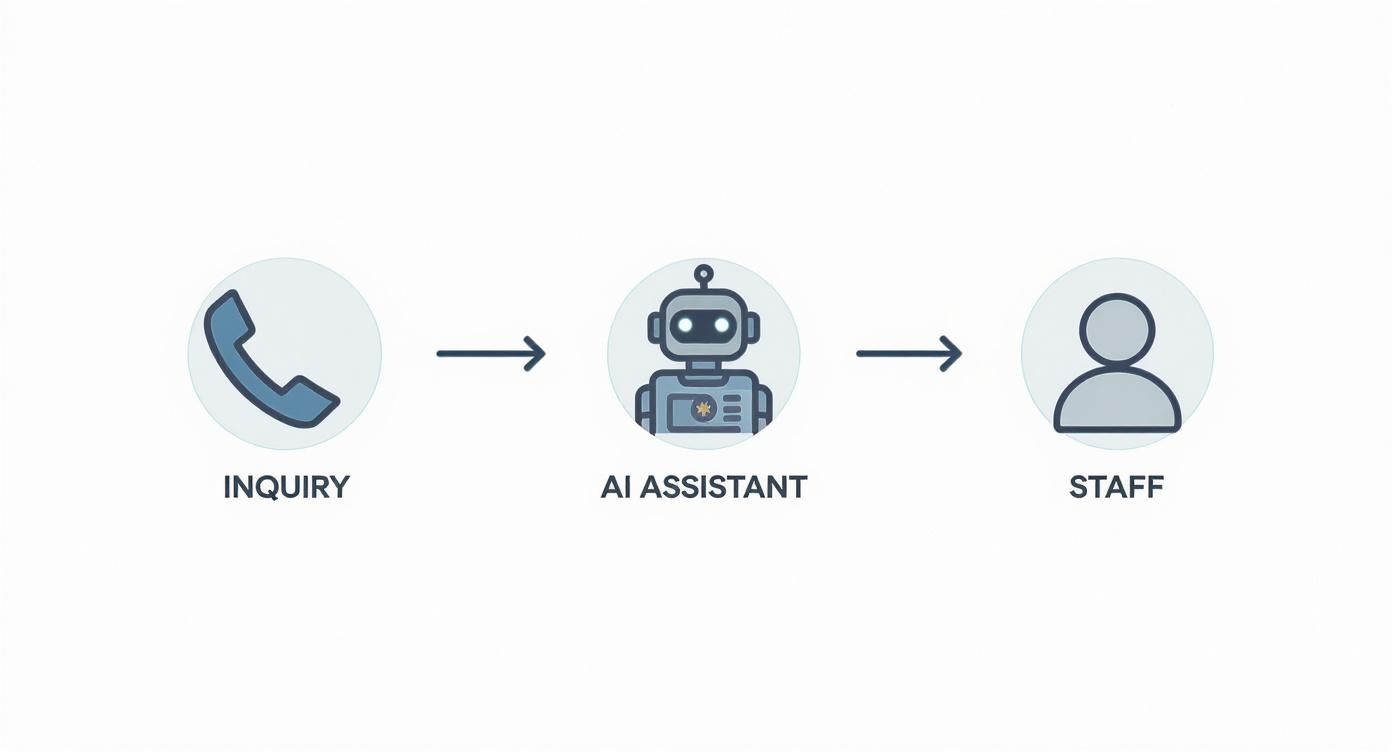
This kind of tiered support system frees up your human agents to pour their energy into the high-value guest interactions that truly require a personal touch.
Measuring the ROI of Your New System
Investing in new hotel front desk software is a big decision. But once the slick feature list has been pitched and the contract is signed, how do you know if it's actually paying off? The real value isn’t just about what the software does; it's about the tangible results it delivers to your business. Measuring your return on investment (ROI) isn’t just an accounting exercise—it’s about seeing how that technology translates directly into a healthier bottom line and a stronger brand.
To really get the full picture, you need to think beyond the initial price tag. Smart operators look for ways to reduce the total cost of ownership over the long haul. This includes things like training, maintenance, and the operational efficiencies you gain day in and day out.
Hard ROI: The Financial Metrics to Track
The most direct way to measure success is to look at the numbers. These are the key performance indicators (KPIs) that show clear, undeniable financial improvement. These "hard ROI" metrics tell you point-blank if your software is working.
Here are the critical KPIs to keep an eye on:
- Increased Occupancy Rates: A great system with solid channel management stops overbookings cold and keeps your availability perfectly synced across every OTA and your direct booking site. The result? More rooms filled.
- Higher RevPAR (Revenue Per Available Room): With smart tools like dynamic pricing and automated upsells, you can squeeze the maximum revenue out of every single room, every single night.
- Direct Booking Growth: When your software integrates seamlessly with your website's booking engine, you'll see a jump in commission-free direct reservations. That’s pure profit going straight back into your pocket.
- Reduced Labor Costs: Think about all the routine tasks—check-ins, night audits, report generation. By automating these, you can run a tighter ship, operating more efficiently with the same team, or even a leaner one.
These metrics tell a clear, numbers-based story of your software’s performance. If you want to dive deeper into the formulas, our article on how to calculate ROI for business investments is a good place to start.
Soft ROI: The Value of a Better Guest Experience
Not every benefit shows up neatly on a spreadsheet. "Soft ROI" is about the valuable, though less direct, returns that come from happier guests and a stellar reputation. You might not be able to quantify them easily, but their long-term impact on your business is huge.
A study found that a 1-star increase in a hotel's online rating can let you raise your prices by up to 11%. This shows a direct line between guest happiness and your revenue.
Here’s where you'll see the soft ROI:
- Improved Guest Satisfaction Scores: Faster check-ins, personalized messages, and fewer slip-ups at the front desk lead to happy guests. Happy guests leave glowing reviews.
- Stronger Brand Loyalty: A smooth, tech-forward experience makes people want to come back. It also makes them tell their friends about you, building a loyal customer base that money can't buy.
- Enhanced Staff Morale: When your team isn't drowning in tedious manual work or fighting with a clunky system, they're more engaged. They're more productive. And they're free to do what they do best: provide outstanding service.
Tying It All Together: The Bottom Line
Ultimately, the best hotel front desk software pays for itself through a powerful combination of both hard and soft returns. The operational cost savings you get from fewer errors and automated workflows give you an immediate financial lift.
At the same time, the improvements in guest satisfaction create a positive feedback loop of fantastic reviews, stronger loyalty, and the ability to command higher rates. When you measure both sides of the ROI coin, you get the complete picture of how the right technology isn't just another expense—it's a powerful engine for real, sustainable growth.
Got Questions? We've Got Answers.
Diving into the world of hotel front desk software can definitely stir up a lot of questions. Think of this section as a conversation with a seasoned hotelier—we’re here to give you clear, straight-ahead answers to the things most people wonder about. Our goal is to help you feel confident and fully informed as you make this big decision for your property.
How Much Does Hotel Front Desk Software Typically Cost?
This is the big one, and the honest answer is: it really depends. The price tag on hotel front desk software can swing wildly based on a few key things. The size of your property, the specific features you absolutely need, and whether you go for a cloud-based or on-premise system are all going to move the needle.
For most smaller hotels, you're likely looking at a cloud-based subscription, which often starts in the ballpark of a few hundred dollars a month. Larger properties might be weighing a bigger upfront license fee for an on-premise solution, and that comes with ongoing costs for maintenance and support you'll have to factor in.
Pro Tip: Before you sign anything, demand a complete pricing breakdown. This isn’t just the subscription fee; you need to see any one-time setup costs, data migration fees, staff training expenses, and ongoing support charges. Getting this upfront is the only way to avoid nasty surprises down the road.
This kind of transparency is crucial. It lets you budget for the full investment, not just the sticker price. Understanding the total cost of ownership is the only way to accurately figure out your long-term ROI.
Is Cloud-Based Software Better Than On-Premise Software?
For the vast majority of modern hotels—especially small to mid-sized independent properties—the answer is a resounding yes. Cloud-based software is almost always the smarter choice because it just fits the rhythm of today's hospitality world.
The advantages are pretty clear:
- Lower Initial Costs: You get to skip the massive upfront expense of buying servers and other hardware.
- Automatic Updates: The vendor takes care of all the software updates and security patches for you. No headaches.
- Remote Accessibility: Your team can log in and manage the front desk from literally anywhere with an internet connection. This is a game-changer.
- Effortless Scalability: Need to add rooms or even a new property? It's typically far simpler and more cost-effective with a cloud system.
On-premise solutions give you more direct control over your data, sure, but they come with a hefty price tag in both hardware and the dedicated IT staff needed to manage it all. The "better" option really boils down to your specific budget, your technical resources, and where you see your operations going in the long run.
How Long Does It Take to Implement New Front Desk Software?
The timeline for getting new software up and running can be anywhere from a few weeks to several months. It really hinges on how complex the software is and the unique quirks of your hotel's operation.
A few things will influence how long it takes: how much guest and reservation data needs to be moved from your old system, how many other tools you need to connect (like your POS or channel manager), and how much training your staff will need. One thing is for sure: a well-organized rollout, led by a dedicated project manager and with your whole team on board, will always be faster and smoother, causing the least amount of disruption for your guests.
Ready to see how an AI-powered assistant can completely transform your front desk? Marlie Ai handles all those routine calls 24/7, freeing up your staff to create the kind of guest experiences people talk about. Find out how Marlie can slash your missed calls and make your team incredibly efficient at https://www.marlie.ai.
