

First impressions are critical, and for many businesses, the first point of contact is still the telephone. A single inbound call can be the difference between a booked appointment and a lost customer, a resolved issue and a negative review. This is where a well-crafted call in script becomes more than just a guide; it’s a strategic tool that ensures every interaction is consistent, professional, and effective. Whether handled by a seasoned receptionist, a busy technician in the field, or an advanced AI phone assistant, a great script provides the framework for success.
This article moves beyond generic templates. We will dissect a comprehensive collection of ready-to-use call in scripts tailored for specific, high-stakes industries, from emergency towing and HVAC services to multi-location clinics and hotel front desks. You won't just get a list of examples; you'll gain a deep understanding of the strategy behind each one.
For every script, we provide:
- A full, ready-to-use template you can adapt immediately.
- Strategic breakdown explaining why certain phrases and questions are used.
- Actionable takeaways for customizing the script for your unique business needs.
- AI optimization tips on how to translate these scripts into effective prompts for a voice AI assistant, including defining transfer keywords, payment capture protocols, and scheduling logic.
Our goal is to equip you with the tools to transform your phone interactions from a potential liability into your most powerful asset for customer acquisition and retention. You will learn how to build a call in script that not only answers questions but also drives business outcomes, ensuring every caller receives the best possible experience, every single time.
1. Cold Calling Sales Script
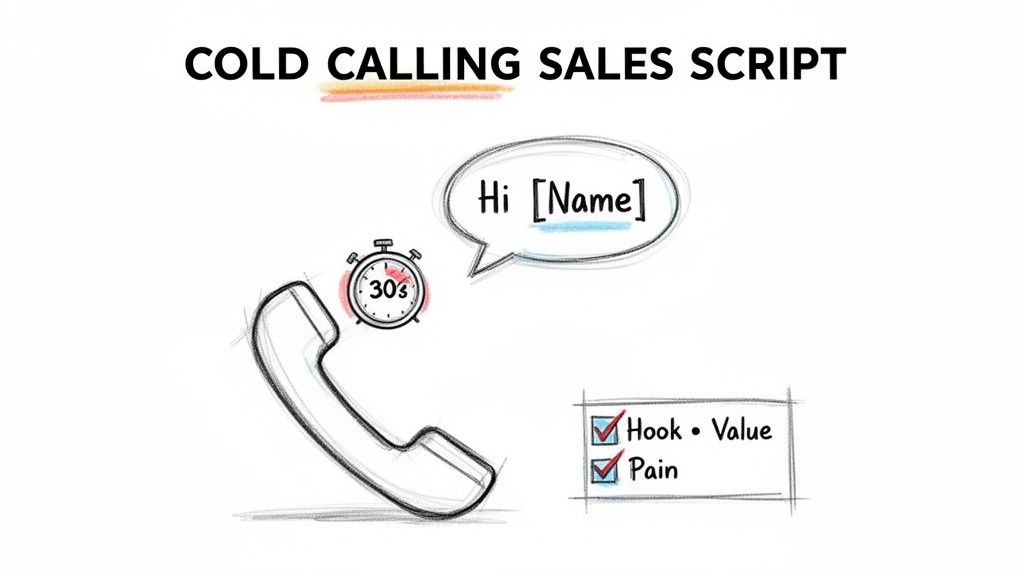
A cold calling sales script is a meticulously structured guide designed for initiating contact with potential customers who have no prior relationship with your company. Far from being a rigid monologue, this type of call in script acts as a strategic roadmap. It helps sales representatives navigate conversations with confidence, ensuring they cover key points efficiently while maintaining a natural, conversational flow. The primary goals are to quickly build rapport, establish credibility, and uncover a prospect's challenges to demonstrate immediate value.
This method is crucial for any business focused on proactive lead generation. It systematizes the outreach process, making it scalable and measurable. Renowned sales methodologies, such as Grant Cardone’s 10X Sales Method and Jeb Blount’s framework in Fanatical Prospecting, heavily rely on disciplined scripting to overcome the high rejection rates inherent in cold calling.
Strategic Breakdown and Implementation
A successful cold call script contains several key components executed in under 30 seconds to capture attention before the prospect disengages.
- The Opener: Start by stating your name, your company, and using the prospect’s name. A proven opener analyzed by Gong.io is asking, "How have you been?" which has a 6.6x higher success rate than baseline cold calls.
- The Value Proposition: Immediately state the reason for your call in a way that benefits the prospect. For example, instead of saying "I sell HVAC software," try "I'm calling because I saw your company is expanding in Austin, and I help multi-location HVAC businesses reduce fuel costs by 15% through optimized dispatching."
- The Pain Point Question: Ask an open-ended question to identify a potential problem you can solve. An example is, "How are you currently managing technician dispatch across your new service areas?" This transitions the call from a pitch to a diagnostic conversation.
For those developing specialized sales scripts, exploring broader actionable sales enablement best practices can provide valuable insights to boost overall team performance. This approach complements a well-structured script by ensuring the entire sales ecosystem supports the representative's efforts. Furthermore, integrating these scripts into automated outbound calling systems can significantly increase call volume and initial contact rates, allowing your team to focus on qualified conversations.
2. Customer Service Support Script
A customer service support script is a standardized framework for handling incoming customer inquiries and issues. More than just a list of things to say, this type of call in script provides a consistent structure for agents to follow, ensuring every customer receives the same high level of care. Its purpose is to guide representatives through greeting, issue identification, troubleshooting, and resolution, which helps reduce call times and improve first-call resolution rates. This structured approach empowers agents to manage conversations effectively, even when dealing with complex or emotionally charged situations.
This method is fundamental for any business aiming to deliver reliable and scalable customer support. It turns a potentially chaotic process into a predictable and measurable system. Frameworks popularized by customer-centric companies like Zappos, and organizations like COPC (Customer Operations Performance Center), emphasize using scripts not to sound robotic, but to ensure empathy and efficiency are built into every interaction. The goal is to solve the customer's problem while reinforcing a positive brand image.
Strategic Breakdown and Implementation
A highly effective customer service script is designed for clarity, empathy, and swift problem-solving, creating a positive experience from start to finish.
- The Empathetic Opening: Begin by greeting the customer warmly, stating your name, and immediately offering help. An example is, "Thank you for calling [Company Name], my name is [Agent Name]. I understand you're having an issue with [product/service], and I'm here to help you get this sorted out."
- Active Listening and Diagnosis: Before offering solutions, use the script to ask clarifying questions. For instance, "To make sure I understand correctly, could you walk me through the steps you've already taken?" This shows you value their effort and prevents redundant suggestions.
- Guided Resolution: Provide clear, step-by-step instructions. Frame them positively: "Great, let's try this next step together," rather than a passive "You need to do this." Confirm understanding at each stage to keep the customer engaged and confident in the process.
To further enhance support operations, businesses can explore how using AI for customer service can automate initial triage and answer common questions, freeing up human agents to handle more complex escalations. This integration allows the principles of a great script to be applied at scale, 24/7.
3. Debt Collection Call Script
A debt collection call script is a legally compliant and strategically structured guide used to contact individuals about outstanding debts. Unlike a sales pitch, this type of call in script is heavily regulated, requiring agents to navigate sensitive conversations with a balance of empathy and assertiveness. Its primary purpose is to recover funds while strictly adhering to regulations like the Fair Debt Collection Practices Act (FDCPA), which protects consumers from abusive, unfair, or deceptive collection practices. The goal is to establish a constructive dialogue, verify information, and secure a payment arrangement.

This method is essential for any business or third-party agency involved in accounts receivable management. It standardizes communication to minimize legal risk and improve recovery rates. Frameworks developed by organizations like ACA International and guidelines from the National Creditors Bar Association provide the foundational principles for these scripts, emphasizing documentation, consumer rights, and professional conduct.
Strategic Breakdown and Implementation
An effective debt collection script is built on a foundation of legal compliance and clear communication, moving methodically from verification to resolution.
- The FDCPA Mini-Miranda: The call must begin with a federally required disclosure. For example: "This is [Collector's Name] from [Collection Agency]. This is an attempt to collect a debt, and any information obtained will be used for that purpose." This statement sets a legal and transparent tone from the start.
- Identity Verification: Before discussing any debt details, you must confirm you are speaking to the correct person. A compliant approach is to ask, "For verification purposes, can you please confirm your full name and mailing address?" This protects consumer privacy and prevents unauthorized disclosure.
- The Resolution Offer: After verifying the debt, transition to a solution-focused conversation. Instead of demanding payment in full, offer options: "We can resolve this account today for [Amount]. We also have payment plan options available. Which approach would work best for you?" This empowers the consumer and increases the likelihood of a positive outcome.
For businesses managing overdue accounts, automating initial outreach can improve efficiency. Integrating this type of script into a system for generating and sending payment reminders can handle routine follow-ups, freeing up staff to manage more complex negotiations. This systematized approach ensures every communication is documented and compliant from the first contact.
4. Telemarketing Promotional Script
A telemarketing promotional script is a persuasive communication framework designed to promote products, services, or special offers directly to a targeted list of consumers. Unlike a sales script focused on immediate closure, this call in script aims to generate interest, create brand awareness, and qualify leads for a future sale. It is carefully crafted to grab attention quickly, highlight compelling benefits, and guide the conversation toward a specific call to action, such as accepting an offer or scheduling a follow-up.
This method is a staple for B2C campaigns, particularly in sectors like insurance, subscriptions, and utilities, where mass outreach is necessary to identify interested parties. The effectiveness of this script is heavily influenced by strict adherence to regulations like the TCPA (Telephone Consumer Protection Act) and by leveraging data for personalization. It systemizes high-volume campaigns, ensuring brand messaging remains consistent while allowing for performance tracking and A/B testing.
Strategic Breakdown and Implementation
A successful telemarketing script must be concise, engaging, and compliant. It focuses on creating a positive interaction even when faced with rejection.
- The Compliant Opener: Begin by clearly identifying yourself, your company, and the call's purpose. For example: "Hello, this is [Your Name] from [Company Name]. I'm calling today with a special promotional offer for our energy-saving services. Is this [Prospect Name]?" This transparent start builds trust and adheres to TCPA guidelines.
- The Urgency-Driven Benefit: Immediately present the core offer with a sense of scarcity or a time limit. Instead of just listing features, frame them as exclusive benefits. For example, "For a limited time, residents in your area are eligible for a free smart thermostat installation, which can lower your energy bills by up to 20% this winter."
- The Soft Close and Objection Handling: Guide the prospect toward the next step with a low-commitment question, and be prepared for "no." An effective line is, "If I could show you how to lock in those savings with just a 5-minute call next week, would that be worth your time?" If they decline, respond gracefully: "I understand. Thank you for your time." This preserves a positive brand image.
5. Bill Collection/Payment Reminder Script
A bill collection or payment reminder script is a carefully designed communication tool used to prompt customers about upcoming or recently overdue payments. This type of call in script is fundamentally different from aggressive debt collection; its purpose is to maintain a positive customer relationship while securing timely payment. The script provides a clear, courteous, and firm framework that guides agents in reminding customers of their obligations, clarifying amounts due, and offering convenient payment solutions.
This proactive approach is essential for businesses with recurring revenue models, such as utility companies, insurance providers, and medical clinics. It helps reduce accounts receivable, improve cash flow, and prevent minor payment oversights from escalating into significant debt. Best practices promoted by organizations like the National Association of Credit Management (NACM) emphasize using non-threatening language and a helpful tone to preserve customer loyalty while effectively managing credit.
Strategic Breakdown and Implementation
A successful payment reminder call is respectful, efficient, and solution-oriented. The goal is to make payment as easy as possible.
- The Courteous Opening: Begin by verifying the customer's identity politely. Then, clearly state your name, company, and the call's purpose. For example: "Hi [Customer Name], this is [Agent Name] calling from [Company Name]. I'm calling today with a friendly reminder about your upcoming payment for account number [Account #], due on [Date]."
- The Clear Information Statement: State the outstanding amount and due date without ambiguity. Immediately transition to offering help. "The total amount due is [Amount]. We offer several ways to pay. Would you like to take care of that now over the phone?"
- The Solution-Focused Offer: If the customer expresses difficulty, proactively offer alternatives. "I understand that things can be tight sometimes. We have options like setting up a payment plan or a partial payment today to keep your account in good standing. Would you be open to discussing one of those?"
This strategy shifts the conversation from a demand to a collaborative effort to resolve the balance. For businesses looking to streamline this process, modern solutions can automate these crucial customer touchpoints. You can explore how an AI-powered payment collection service can handle initial reminders, allowing your team to focus on more complex cases. By automating the first wave of reminder calls, businesses ensure consistency and timeliness without straining human resources.
6. Appointment Setting/Scheduling Script
An appointment setting or scheduling script is a streamlined framework designed to efficiently convert an interested prospect into a confirmed meeting or consultation. Unlike scripts focused purely on information gathering, this call in script has one clear objective: secure a spot on the calendar. It guides the conversation by quickly qualifying the caller's intent, articulating the value of the meeting, and seamlessly navigating the logistics of scheduling. The goal is to minimize friction and make booking a logical and easy next step.
This approach is indispensable for B2B sales teams, service-based businesses, and healthcare clinics where the primary conversion goal is a scheduled interaction. Methodologies popularized by platforms like Calendly and best practices from Salesforce emphasize reducing the back-and-forth typically associated with scheduling. The script ensures the agent or AI assistant remains in control, guiding the caller toward a decisive action rather than leaving the next step ambiguous.
Strategic Breakdown and Implementation
A highly effective appointment scheduling script is built on clarity, efficiency, and preparedness. It anticipates potential hurdles and provides the agent with tools to overcome them.
- Confirm Intent and Value: Immediately verify the reason for the call and briefly restate the value of the appointment. For example, "Great, I can definitely get that 15-minute demo scheduled for you. In that call, our specialist will show you exactly how to reduce dispatch costs."
- Offer Specific Options: Instead of asking, "When are you free?" provide two or three specific time slots. This psychological technique, known as a "forced choice," simplifies decision-making. Say, "Does tomorrow at 10:00 AM or 2:30 PM work better for you?"
- Capture Key Information and Confirm: Once a time is agreed upon, gather the necessary details like name and email address. Conclude by confirming the appointment details and stating the next step: "Perfect, I have you down for Thursday at 10:00 AM. You’ll receive a calendar invitation with a video link to that email in just a moment."
For businesses looking to automate this crucial function, implementing the right tools is key. Integrating this type of script with the best appointment scheduling software for small business can dramatically increase booking rates and reduce administrative overhead. This synergy allows an AI or human agent to follow a proven process backed by technology that handles invites, reminders, and calendar management automatically.
7. Technical Support Troubleshooting Script
A technical support troubleshooting script is a diagnostic-focused framework designed to guide support agents through resolving customer issues systematically. Rather than a rigid set of lines, this type of call in script acts as a logical flowchart. It helps technicians gather information, test common solutions, and escalate complex problems efficiently, all while keeping the customer informed and calm. The primary goals are to accurately diagnose the root cause, provide a timely resolution, and document the incident for future reference.

This method is indispensable for any company offering technical products or services, from SaaS platforms to internet service providers. It standardizes the support process, ensuring consistent service quality and reducing resolution times. Frameworks like ITIL (Information Technology Infrastructure Library) and CompTIA's support standards heavily influence these scripts, promoting a structured approach to incident management used by major tech companies like Microsoft and Apple.
Strategic Breakdown and Implementation
An effective troubleshooting script balances a systematic process with conversational flexibility to manage customer frustration and technical complexity.
- Initial Diagnosis: Begin by confirming the customer's identity and gathering basic information about the issue. Ask clarifying questions like, "Can you walk me through the steps you took before the error occurred?" and "What is the exact error message you are seeing?"
- Tiered Solutions: Structure the script to address the most common and simplest solutions first. For an ISP, this would mean starting with "Have you tried restarting your modem and router?" before moving to more complex diagnostics like checking IP configurations.
- Empathetic Guidance: Use simple, jargon-free language to guide the customer through troubleshooting steps. Acknowledge their frustration by saying, "I understand this is frustrating, but we'll work through it together step-by-step." This maintains rapport and patience.
- Clear Escalation Path: Define a clear point when the issue must be escalated. The script should prompt the agent to summarize the steps already taken and gather detailed notes before transferring the call to a senior technician or different department.
8. Insurance Claims Processing Script
An insurance claims processing script is a structured framework for handling incoming calls from policyholders reporting a loss or damage. This type of call in script is critical for guiding representatives through the initial information gathering, documentation, and process explanation with both efficiency and compassion. Given that callers are often in a state of distress following an incident, the script acts as a vital tool for ensuring accuracy while providing a reassuring, professional experience. Its primary goals are to capture all necessary details, initiate the claim, and clearly outline the next steps for the policyholder.
This methodical approach is the backbone of claims intake for major carriers like State Farm and Geico, and its principles are reinforced by regulatory bodies like the National Association of Insurance Commissioners (NAIC) to ensure fair and consistent claims handling. A well-designed script minimizes errors, manages customer emotions, and sets the foundation for a smooth claims journey, which is crucial for customer retention and satisfaction.
Strategic Breakdown and Implementation
A successful claims processing script must balance methodical data collection with genuine human empathy. Each stage is designed to move the process forward while making the policyholder feel supported.
- The Empathetic Opener: Begin by acknowledging the caller's situation. Instead of a generic greeting, start with, "Thank you for calling [Insurance Company]. My name is [Agent Name], and I understand you're calling to report a claim. I'm here to help you through this." This immediately establishes a supportive tone.
- The Fact-Finding Sequence: Use clear, specific questions to gather incident details systematically. Ask, "To get started, can you confirm the date and approximate time the incident occurred?" followed by questions about the location, a description of the event, and any other parties involved. This structured questioning prevents missing key information needed for the initial loss report.
- The Next-Steps Summary: Conclude by providing a clear summary and managing expectations. State, "Your claim has been filed, and your claim number is [Number]. You can expect a call from your assigned adjuster within the next 24 to 48 hours to discuss the inspection and next steps. Is there anything else I can assist you with today?" This provides a tangible reference point and a clear timeline, reducing customer anxiety.
9. Donor Solicitation/Fundraising Script
A donor solicitation or fundraising script is a persuasive framework crafted for nonprofit organizations to inspire financial contributions. More than just a request for money, this call in script is a tool for storytelling, designed to forge an emotional connection between a potential donor and the organization's mission. Its purpose is to clearly articulate the cause's impact, establish the organization's credibility, and make the act of giving simple and meaningful. The goal is to convert passive interest into active support by balancing a compelling appeal with profound respect for the donor.
This script is fundamental for any nonprofit that relies on individual giving, from global NGOs to local community projects. It provides fundraisers, whether they are volunteers or professional staff, with a consistent and effective way to communicate their message. Leading organizations like the Red Cross and major university alumni associations use highly refined scripts to power their annual giving campaigns and emergency disaster appeals, ensuring their outreach is both empathetic and impactful.
Strategic Breakdown and Implementation
An effective fundraising script moves a potential donor from awareness to action by focusing on connection and impact.
- The Mission-First Opener: Begin by connecting with the donor and reinforcing their link to the mission before making an ask. For example, "Hi [Donor Name], this is [Your Name] from [University Name]. As a fellow alum, I'm calling to thank you for your past support and share some incredible news about how our student scholarship fund is changing lives." This approach, championed by The Fundraising Authority, builds rapport first.
- The Impact Story: Transition from a general mission statement to a specific, emotional story. Instead of saying, "We help homeless pets," describe a tangible outcome: "Last month, because of donors like you, we were able to provide emergency surgery for a stray dog named Buddy, who is now thriving in a loving adoptive home."
- The Clear and Easy Ask: Present specific giving options and make the process frictionless. For instance, "Would you be willing to help another student succeed by making a gift of $100 today? I can securely take your information over the phone, or I can text you a direct link to our giving page." Offering multiple methods removes barriers to donating.
10. Compliance and Quality Assurance Call Script
A compliance and quality assurance call script is a systematic framework used by supervisors and QA specialists to monitor, evaluate, and coach call center representatives. Rather than being a script for the agent, this is a call in script for the evaluator. It provides a structured rubric to ensure agents adhere to company policies, deliver high-quality service, and maintain strict regulatory compliance during customer interactions. The core objective is to standardize the evaluation process, making it fair, objective, and focused on constructive coaching.
This approach is critical for industries with heavy regulatory oversight, such as finance and healthcare, where non-compliance can lead to severe penalties. It systematizes performance management, turning subjective feedback into actionable data. Frameworks from organizations like COPC (Customer Operations Performance Center) and standards from the Compliance Officer Association have popularized this disciplined approach, emphasizing continuous improvement over punitive measures.
Strategic Breakdown and Implementation
A robust quality assurance script centers on objective metrics and clear, coachable components. The evaluation process is designed to be a tool for agent development.
- Greeting and Verification: Did the agent open the call according to brand standards and correctly complete any required identity verification steps? For example, in healthcare, this includes HIPAA compliance verification.
- Problem Diagnosis and Resolution: Evaluate if the agent used active listening skills to understand the customer's issue, followed the correct troubleshooting or resolution pathways, and accurately documented the interaction. This section often uses a standardized scoring rubric.
- Compliance Adherence: This is a non-negotiable component. Did the agent provide all necessary disclosures? For financial services, this could mean reading a mini-Miranda warning or, for payment processing, adhering to data security standards. For comprehensive guidance on current and upcoming regulations specifically affecting telephone payments, consider reviewing the PCI DSS 4.0.1 Telephone Payments Compliance Requirements.
- Closing and Follow-Up: Confirm the agent summarized the resolution, checked for any remaining questions, and clearly outlined the next steps, if any, before professionally ending the call.
This evaluation framework is a cornerstone of effective management. For a deeper look into implementing these systems, you can learn more about quality control for call center operations. The goal is to create a feedback loop that balances positive reinforcement with specific, actionable plans for improvement, ultimately elevating both agent performance and customer satisfaction.
Comparison of 10 Call-In Scripts
| Script Type | Implementation Complexity 🔄 | Resources & Training ⚡ | Expected Outcomes ⭐ / 📊 | Ideal Use Cases 💡 | Key Advantages ⭐ |
|---|---|---|---|---|---|
| Cold Calling Sales Script | 🔄 Medium — structured script + personalization | ⚡ Moderate — trained reps, CRM access | ⭐⭐ — lower response vs warm leads; 📊 builds pipeline consistency | 💡 New prospect outreach; lead generation campaigns | ⭐ Consistency, objection framework, reduces rep anxiety |
| Customer Service Support Script | 🔄 Low–Medium — standardized flows | ⚡ Moderate — product knowledge, regular updates | ⭐⭐⭐ — higher CSAT & faster handling; 📊 reduces AHT | 💡 Inbound support centers; routine troubleshooting | ⭐ Improves FCR, brand consistency, cost savings |
| Debt Collection Call Script | 🔄 High — legal constraints and careful wording | ⚡ High — compliance training, documentation systems | ⭐⭐ — better recovery; 📊 reduces legal risk when compliant | 💡 Recovering delinquent accounts; legally sensitive outreach | ⭐ FDCPA compliance, audit trail, higher recovery rates |
| Telemarketing Promotional Script | 🔄 Medium — persuasive but regulated | ⚡ Moderate — campaign data, high dial volume | ⭐ — immediate sales spikes; 📊 scalable lead generation | 💡 Short-term promotions; large-scale sales drives | ⭐ Scalable, quick feedback on offers |
| Bill Collection / Payment Reminder Script | 🔄 Low — polite, recurring cadence | ⚡ Low–Moderate — billing integration, automation | ⭐⭐ — improves payment timeliness; 📊 lowers DSO | 💡 Existing customers with upcoming/overdue payments | ⭐ Preserves relationships, predictable cash flow |
| Appointment Setting / Scheduling Script | 🔄 Low — focused qualification + slots | ⚡ Low — calendar tools, short training | ⭐⭐ — increases booked meetings; 📊 improves pipeline visibility | 💡 B2B outreach, service consultations, medical bookings | ⭐ Reduces no-shows, saves time via pre-qualification |
| Technical Support Troubleshooting Script | 🔄 High — branching diagnostics and escalation | ⚡ High — skilled technicians, remote tools | ⭐⭐⭐ — high FCR for common issues; 📊 fewer escalations | 💡 Product/IT support; complex technical issue resolution | ⭐ Systematic diagnosis, knowledge capture, reduces rework |
| Insurance Claims Processing Script | 🔄 High — complex policies + empathy needs | ⚡ High — specialized training, documentation systems | ⭐⭐ — accurate intake; 📊 faster processing with fewer errors | 💡 Claims intake in insurance after incidents | ⭐ Improves accuracy, manages expectations, reduces follow-ups |
| Donor Solicitation / Fundraising Script | 🔄 Medium — storytelling + ethical persuasion | ⚡ Moderate — donor data, emotional training | ⭐⭐ — higher conversion when personalized; 📊 builds recurring gifts | 💡 Nonprofit campaigns, major donor outreach | ⭐ Builds long-term donor relationships, recurring revenue |
| Compliance & Quality Assurance Script | 🔄 Medium — standardized evaluation frameworks | ⚡ Moderate — QA team, monitoring tools, calibration | ⭐⭐ — improved compliance & agent performance; 📊 reduces risk | 💡 Supervisory QA, regulatory industries, training programs | ⭐ Ensures compliance, enables data-driven coaching |
From Script to System: Turning Words into a Revenue Engine
Throughout this guide, we have explored a diverse range of industry-specific call scripts, moving far beyond generic templates. From the high-stakes urgency of a towing company dispatch to the compassionate efficiency required in a pharmacy, we have seen how a well-structured call in script is more than just a dialogue guide; it's the operational blueprint for excellent customer interaction.
We’ve deconstructed what makes these scripts effective, uncovering the strategic layers that transform a simple phone call into a positive, productive, and often profitable experience. The core lesson is clear: the best scripts are not rigid mandates but flexible frameworks. They empower your team, whether human or AI, to navigate conversations with confidence, consistency, and a clear purpose.
Recapping the Core Principles of an Effective Call In Script
The examples we analyzed, from HVAC scheduling to multi-location hotel bookings, share a common DNA. Mastering these foundational elements is the key to elevating your own call handling processes.
- Clarity and Conciseness: Every successful script gets straight to the point. It eliminates jargon and uses simple, direct language to gather essential information and guide the caller toward a resolution. This respects the caller's time and reduces the chance of miscommunication.
- Empathy and Tone: The way something is said is just as important as what is said. Effective scripts strategically incorporate phrases that convey empathy and understanding, de-escalating frustration and building trust, especially in customer service or debt collection scenarios.
- Strategic Questioning: We saw how scripts use a mix of open-ended and closed-ended questions to control the flow of the conversation. This isn't about interrogation; it's about efficiently diagnosing a need and presenting the right solution, whether that's scheduling an appointment or processing an insurance claim.
- Adaptability for AI: A modern call in script must be designed for both human agents and AI assistants. This means building clear pathways for intent recognition, defining specific keywords for transfers, and structuring dialogues that AI can process logically to handle tasks like payment capture or scheduling.
Actionable Next Steps: Putting Your Scripts to Work
Knowledge without action is just trivia. To truly transform your customer communications, you need to implement, test, and refine. Here are the immediate steps you should take to turn the insights from this article into tangible results.
- Audit Your Current Calls: Before writing a single new line, listen to your existing call recordings (if available). Where do customers get confused? Where do agents struggle? This real-world data is the most valuable resource you have for identifying weaknesses and opportunities.
- Choose One Script to Build or Revise: Don't try to overhaul everything at once. Pick one high-impact area, like appointment setting or handling refill requests, and apply the principles we've discussed. Build a new call in script based on the templates and strategic breakdowns in this guide.
- Define Your AI Integration Points: As you build your script, think like a system architect. Identify the exact moments where an AI can add value. Mark down potential keywords for call transfers (
"speak with a pharmacist") and specific data points required for automated tasks ("date of birth,""prescription number"). - Role-Play and Refine: Practice the script with your team. If you're implementing an AI, use its testing or sandbox environment. This practice run will immediately reveal awkward phrasing, confusing questions, or gaps in logic that you can fix before it ever reaches a live customer.
- Launch, Measure, and Iterate: Deploy your new script and track its performance. Are calls shorter? Is first-call resolution higher? Are more appointments being booked? Use this feedback to make continuous improvements. A great script is never truly "finished"; it evolves with your business and your customers' needs.
By moving from a static document to a dynamic system, your call in script becomes a powerful engine for efficiency, customer satisfaction, and revenue growth. It ensures every caller receives the same high standard of service, capturing opportunities that might otherwise be lost and building a reputation for professionalism and reliability. This systematic approach is no longer a luxury; in today's competitive landscape, it's a necessity.
Ready to transform your scripts into a fully automated, 24/7 customer service powerhouse? Marlie Ai builds on these principles, turning your best call flows into an intelligent AI voice assistant that can schedule appointments, answer FAQs, and capture leads flawlessly. Stop missing calls and start growing your business by visiting Marlie Ai to see how an AI-powered system can implement your perfect call in script.
