

When you hear "call center quality control," you might picture a supervisor in a back room, listening in on calls with a clipboard and a checklist. That's the old way. It's time to throw that image out.
Quality control isn't about catching agents making mistakes. It's the engine that drives your entire support operation. Think of it as a systematic process for listening, learning, and improving—not just for individual agents, but for the whole business. It’s how you make sure the service you promise is the service you actually deliver, every single time.
What Modern Call Center Quality Control Looks Like
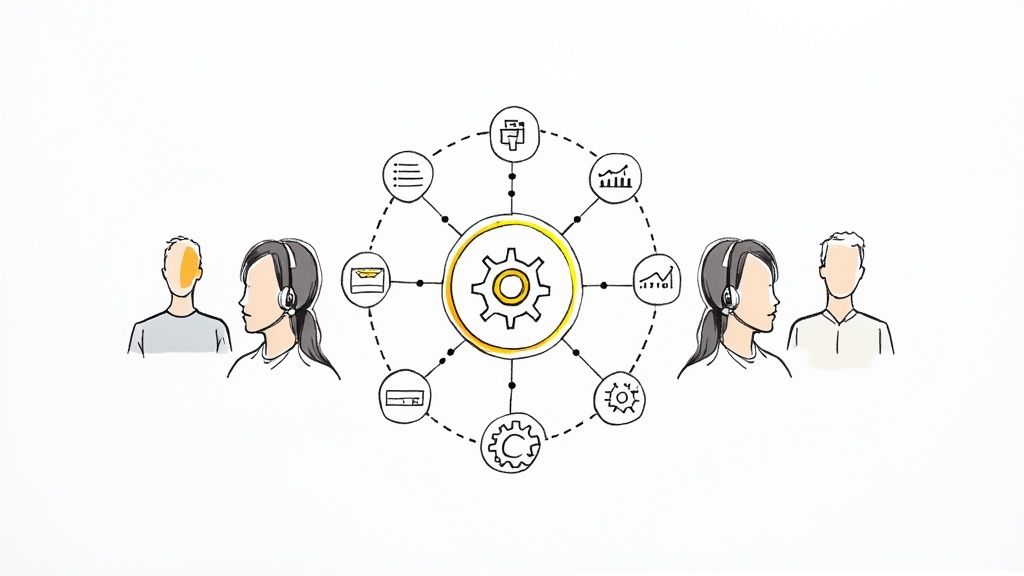
Today, quality control is a dynamic, data-rich system built for one thing: continuous improvement. It’s less about policing conversations and more about building a high-performance coaching culture. This system is the strategic core of your entire call center, turning raw interaction data into fuel for growth.
The goal isn't just to score calls. It's to analyze performance, spot weaknesses in your processes, and systematically build your agents' skills. A proactive quality program transforms your call center from a necessary expense into a powerful driver of customer loyalty and real business results.
A System for Consistent Excellence
At its heart, a modern quality program creates a reliable framework for consistency. It ensures that every agent, on every call, embodies your company's brand promise. Your customers get the same amazing level of care whether they talk to a seasoned veteran or a new hire. Grasping what operational efficiency is is key here, because every QA effort should make things smoother for everyone involved.
This framework stands on a few core pillars:
- Performance Analysis: We're talking about using real metrics to measure how effective an agent is and pinpointing specific skills that need work.
- Process Refinement: This is about finding and fixing the broken workflows or inefficient steps that frustrate both customers and your agents.
- Skill Development: Instead of generic feedback, you deliver targeted coaching and training that’s based on actual interaction data.
To bring this all together, here’s a look at the core components of a modern quality control program and what each part is meant to accomplish.
Core Components of a Modern Quality Control Program
| Component | Primary Goal | Key Activities |
|---|---|---|
| Clear Standards & Scorecards | Define what "good" looks like for every interaction. | Creating detailed, objective evaluation forms; setting clear performance benchmarks. |
| Systematic Sampling | Ensure a fair and representative view of performance. | Random and targeted call sampling; reviewing interactions across all channels (voice, chat, email). |
| Agent Scoring & Calibration | Maintain consistency and fairness in evaluations. | Scoring agent interactions against the scorecard; holding calibration sessions with QA specialists. |
| Actionable Coaching | Drive measurable performance improvement. | Providing specific, data-backed feedback; creating personalized development plans for agents. |
| Reporting & Analytics | Uncover trends and insights to inform business strategy. | Tracking quality scores over time; identifying root causes of customer issues and agent errors. |
As you can see, each piece of the puzzle works together to create a cycle of continuous improvement, moving beyond simple call monitoring to become a strategic asset for the entire organization.
Expanding Beyond Voice
Quality control has also exploded beyond just phone calls. Your program has to cover every channel where you talk to customers—voice, email, live chat, social media, you name it. A leading practice for 2025 is to build unified evaluation systems. These use weighted metrics that directly connect agent performance to your most important business goals.
A well-executed quality program is the difference between a call center that reacts to problems and one that anticipates them. It transforms raw data from customer interactions into actionable intelligence that drives smarter decisions across the organization.
Ultimately, this modern view of quality control is a crucial part of the much larger discipline of call center management. It gives leaders the tools and insights they need to guide their teams toward excellence, turning every customer interaction into a chance to build a stronger relationship.
The Essential Metrics That Drive Call Center Quality
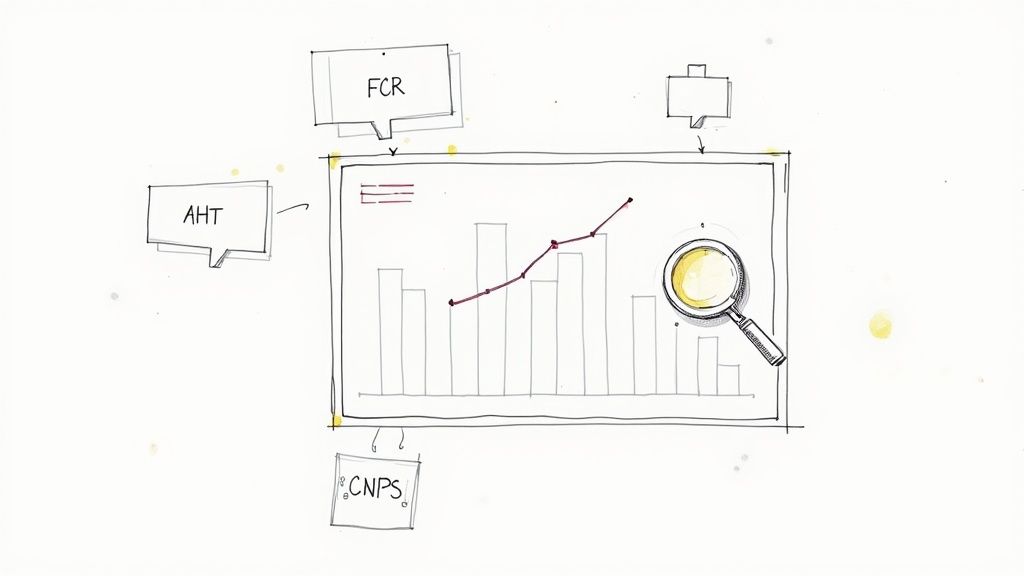
Great quality control for call center teams isn't about guesswork. It’s about listening to the stories your data is trying to tell you. While the sea of acronyms can feel overwhelming, a handful of core metrics really form the foundation of any strong quality program. These aren't just numbers on a dashboard; they're interconnected signals that reveal the true health of your customer journey.
Think of these metrics as your call center's vital signs. A doctor wouldn’t diagnose a patient based on their temperature alone. They look at blood pressure, heart rate, and other indicators to get the full picture. In the same way, relying on a single metric can give you a dangerously incomplete view of your performance.
First Call Resolution: The Ultimate Benchmark
First Call Resolution, or FCR, is arguably the king of all metrics. It measures the percentage of customer issues you resolve in a single interaction, with no need for follow-up calls or painful transfers. A high FCR is a powerful sign of both efficiency and genuine customer happiness.
When you solve a customer's problem on the first try, you save them time and frustration, which directly boosts how they feel about your brand. Internally, it means your agents know their stuff, your processes work, and your operational costs stay in check.
Industry benchmarks for 2025 place a typical FCR between 70% and 79%. Hitting a world-class FCR of 80% or higher is an elite accomplishment, achieved by only about 5% of call centers.
Average Handle Time: Efficiency in Context
Average Handle Time (AHT) tracks the average length of a customer interaction, from the moment an agent answers to the end of any after-call work. While a low AHT might look like a win for efficiency, you have to read between the lines.
Pushing agents to slash their AHT at all costs often leads to rushed, sloppy service that tanks your FCR and leaves customers fuming. The goal isn't the shortest calls; it's the most effective ones. A low AHT is only a good thing when it's paired with high FCR and strong satisfaction scores.
Customer Satisfaction and Net Promoter Score: Gauging Loyalty
Customer Satisfaction (CSAT) and Net Promoter Score (NPS) give you a direct line into how customers are feeling. To really measure call center quality, you have to understand core customer metrics like CSAT and NPS.
- CSAT usually asks, "How satisfied were you with this interaction?" on a simple scale, giving you immediate feedback on a specific experience.
- NPS asks, "How likely are you to recommend our company to a friend?" which measures broader, long-term brand loyalty.
These metrics are essential, but they can be misleading on their own. For example, an agent might be incredibly friendly and get a great CSAT score, but if they failed to actually solve the problem (a low FCR), the customer still has to call back. You can dive deeper into the various customer satisfaction measurement methods to learn more.
A high CSAT score hiding a low FCR is a classic red flag. It points to a team that is friendly but ultimately ineffective, creating a frustrating cycle of repeat calls that erodes customer trust and drives up costs.
By analyzing these metrics together, you start to see a multi-dimensional picture of your performance. This connected approach helps you spot the hidden problems and celebrate the real wins, turning your quality program from a simple scoring exercise into a strategic engine for growth.
Building Your Quality Assurance Scorecard and Workflow
A solid call center quality program isn’t some vague, feel-good idea. It runs on two things: a well-defined workflow and a scorecard that spells out exactly what “good” looks like. This is where you connect the high-level goals to the day-to-day grind.
Think of it like building a house. Your scorecard is the blueprint, detailing every single specification. Your workflow is the construction process, ensuring everything gets built correctly and in the right order. Without both, you’re just winging it, and the final product will be shaky at best.
A structured workflow makes sure every agent is evaluated by the same standard. It gives your quality specialists a common playbook, creating a repeatable process for turning raw customer interactions into powerful coaching moments.
Choosing Your Samples Wisely
The first step is deciding which interactions to actually review. Let’s be honest, not all calls are created equal, and your sampling strategy needs to reflect that. There are really two ways to go about this, and you need both.
-
Random Sampling: This is your baseline. Pulling a few interactions for each agent every week gives you an unbiased, bird's-eye view of how things are going. It’s like a spot-check on an assembly line—you’re just making sure everything is running smoothly.
-
Targeted Sampling: This is where you get surgical. You might zero in on interactions that tanked a CSAT score, calls that blew past your AHT goals, or conversations handled by new agents who are still finding their footing. This approach is perfect for diagnosing a known problem or honing a specific skill.
A healthy mix of random and targeted sampling gives you the most complete, actionable picture of your team's performance.
Designing a Scorecard That Drives Results
Your quality scorecard is the single most important tool in your QA arsenal. It’s what translates big company values and business goals into specific, measurable agent behaviors. A vague or bloated scorecard just creates confusion and makes consistent scoring impossible.
A great scorecard doesn't try to measure every little thing. It focuses on the 10-15 critical behaviors that truly move the needle on the customer experience and your bottom line. These behaviors should be bundled into logical categories.
A well-designed scorecard pulls subjectivity out of the equation. Instead of a fuzzy metric like, "Was the agent friendly?" it asks pointed, observable questions: "Did the agent use the customer's name?" and "Did the agent acknowledge the customer's frustration?" This shifts the focus to concrete actions, which makes scoring fair and coaching specific.
Here’s a practical template you can adapt. The real magic is in the details and the weighting, which tells your team what you value most.
Sample Call Center Quality Scorecard Template
This table shows a common structure for a quality scorecard. Notice how different categories are weighted to reflect their importance—critical skills like problem-solving have a much bigger impact on the final score than simpler process steps.
| Evaluation Category | Specific Behavior/Criteria | Points Possible | Weighting (%) |
|---|---|---|---|
| Opening & Compliance | Greeted customer per script and provided required disclosures. | 10 | 25% |
| Problem Resolution | Accurately identified the root cause of the issue. | 20 | 40% |
| Soft Skills | Demonstrated active listening and showed empathy. | 10 | 20% |
| Process Adherence | Followed correct procedures for documentation and after-call work. | 5 | 10% |
| Closing | Summarized the resolution and confirmed customer satisfaction. | 5 | 5% |
As you can see, Problem Resolution and Compliance carry the most weight because they are mission-critical. Getting this right manually is tough, which is why many teams look for ways to streamline the process. You can explore some of the best workflow automation tools to see how technology can bring more consistency to your QA program.
Keeping Your Team Aligned with Calibration
Once you’ve built your scorecard, you have to make sure everyone uses it the same way. That’s where calibration sessions come in.
In these meetings, your QA specialists, team leads, and even managers all listen to the same call and score it on their own. Afterward, they compare scores and talk through any disagreements. The goal isn't to argue over who's right, but to build a shared understanding of what each criterion actually means in a real conversation.
Holding regular calibration sessions is the only way to keep your quality control process fair, consistent, and truly effective.
How AI Is Transforming Call Center Quality Control
Manual quality control in a call center has always run up against a hard wall: you can’t listen to every single call. It's just not possible. Even with a dedicated team, you’re only ever sampling a tiny fraction of total interactions, which means you’re forced to make huge decisions with incomplete data.
Artificial intelligence doesn't just lower that wall; it completely shatters it.
Think of it like this: traditional QA is like trying to understand the entire ocean by looking at just a few buckets of water. AI, on the other hand, gives you the tools to analyze the whole ocean at once. Suddenly, you can spot trends, risks, and opportunities that were completely invisible before.
This is a fundamental shift. Quality assurance moves from being a reactive, sample-based function to a proactive, data-driven powerhouse. Instead of just catching mistakes after they happen, you can now get ahead of issues, pinpoint exact coaching moments, and understand the customer journey with a clarity that was previously unthinkable.
The Power of 100 Percent Interaction Analysis
The single biggest change AI brings to the table is the ability to analyze 100% of interactions—every call, every chat, every email. This isn't just a numbers game; it's a completely different way of operating. When you can see everything, you move from guessing to knowing.
With a complete picture of your operations, you can:
- Identify Silent Risks: Uncover compliance gaps or process flaws that random sampling would almost certainly miss.
- Spot Emerging Trends: Catch widespread customer issues or new competitor mentions the moment they start bubbling up.
- Personalize Coaching: Base feedback on an agent's entire performance history, not just a handful of cherry-picked conversations.
This total visibility is a game-changer. It's why, by 2025, AI is expected to be a standard tool for scrutinizing every customer touchpoint, massively improving both compliance and QA coverage. On top of that, tools with automated summaries can cut after-call work time by up to 35%, giving agents more time to focus on customers.
Key AI Technologies in Modern Quality Control
"AI" isn't one single thing; it's a collection of technologies working in concert. Speech analytics, for example, transcribes and dissects spoken conversations to flag keywords, track sentiment, and even identify long pauses that might signal customer confusion. Sentiment analysis takes this a step further, gauging the emotional temperature of a conversation and flagging interactions where a customer is getting frustrated, even if they never say the words "I'm upset."
These technologies feed into automated scoring systems that can evaluate every single interaction against your quality scorecard—without human bias. This frees up your QA specialists from the soul-crushing task of manual review.
Instead of spending 80% of their time listening to calls and just 20% coaching, AI allows your team to flip that ratio. They can now focus their energy on high-impact coaching and strategic improvements that actually move the needle.
The standard QA workflow isn't being replaced; it's being supercharged. What was once a manual, linear process is becoming an automated, continuous cycle.
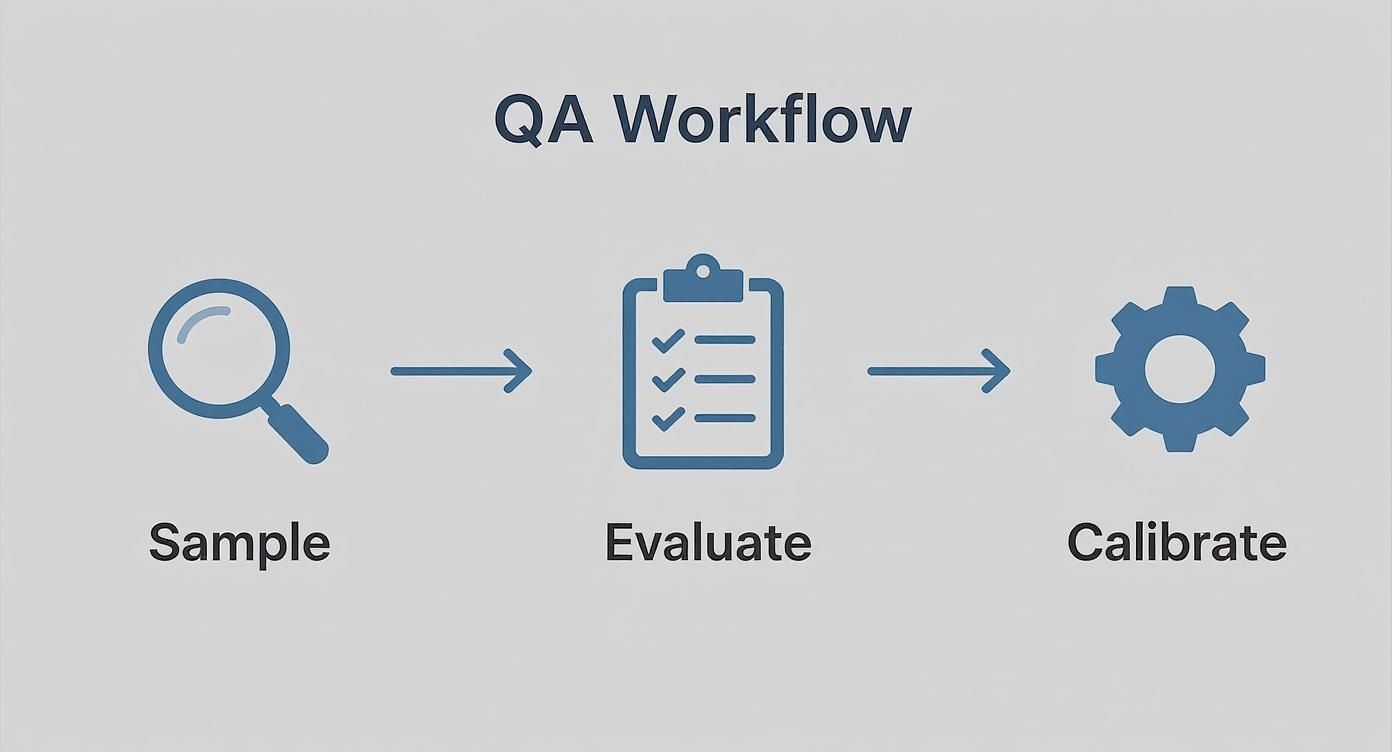
AI takes this simple loop—Sample, Evaluate, Calibrate—and puts it on steroids. It samples 100% of interactions, evaluates them instantly, and provides the data needed for razor-sharp calibration and coaching.
Platforms that bring these capabilities together are quickly becoming indispensable. If you're starting to explore what's out there, our guide on AI call center software offers a deep dive into the available tools. Assistants like Marlie.ai are pushing things even further, not just analyzing calls but also handling them, creating a rich source of performance data from the very first interaction.
Implementing Coaching That Actually Improves Performance
So you've got your quality scores. That's a great start, but it's only half the story. Without a clear plan to turn that data into action, your scorecards are just numbers collecting dust in a spreadsheet.
This is where great coaching comes in. It’s the critical link between evaluating performance and actually improving it.
The goal isn't to nitpick or point out every little mistake. It's about building skills and confidence. When you get this right, you transform quality control for call center operations from something that feels punishing into a tool for professional growth. Get your agents to see QA as a path to getting better, and you’ll kickstart a powerful cycle of continuous improvement.
This starts by changing the whole vibe of the coaching conversation. It needs to feel less like a stuffy performance review and more like a huddle between a player and their coach, both driving toward the same goal.
Preparing for a Productive Coaching Session
Impactful coaching doesn’t just happen. Winging it is a recipe for a defensive agent and a frustrated manager. Real improvement requires thoughtful preparation to make sure the session is focused, fair, and leads to a clear action plan.
Before you even sit down with an agent, you need to do your homework. This means digging up specific examples and organizing your thoughts so you can deliver feedback that’s both crystal clear and genuinely helpful.
Here’s a quick guide to effective prep:
- Gather Concrete Examples: Vague feedback like "show more empathy" doesn't help anyone. Instead, pull up a call recording and say, "Let's listen to the part where the customer mentioned their frustration. Right there, what could we have said to acknowledge how they were feeling?" This makes it real.
- Review Performance Trends: Is this a one-off slip-up or part of a bigger pattern? Looking beyond a single call helps you tackle the root cause, not just the symptom.
- Define a Clear Objective: What's the one thing you want the agent to walk away with? Keep it small and achievable. A great goal sounds like, "This week, I want you to try the new de-escalation script on one challenging call."
Structuring the Coaching Conversation
How you structure the conversation is everything. A well-organized chat keeps things on track and helps the agent feel supported and heard, not ambushed. You always want to keep the focus on future behavior, not past slip-ups.
A simple but incredibly effective model is the "Praise-Polish-Plan" framework. It creates a balanced conversation that recognizes what’s working while still addressing areas for growth.
- Start with Praise: Kick things off by pointing out something the agent did well. Maybe it was their positive tone, how they nailed a compliance script, or their quick thinking on another call. This builds trust and makes them much more open to what comes next.
- Polish a Specific Skill: Gently introduce the area for improvement using the examples you prepared. Frame it collaboratively with phrases like, "Let's work together on…" or "What are your thoughts on how we could have handled this part differently?" This invites them into the problem-solving process.
- Create an Actionable Plan: Never end a session without a clear, measurable next step. This is where you can build out a formal customer service improvement plan to track their journey. The goal needs to be specific, and you should book a follow-up right then and there to check in on their progress.
The best coaching is always about behavior, not personality. When you discuss specific actions and their direct impact on the customer, you keep the feedback objective and give the agent tangible things they can actually change.
Ultimately, turning those quality scores into better customer conversations comes down to this final piece of the puzzle. Fostering a culture of supportive, data-driven coaching empowers your agents to own their development. It’s what turns your QA program from a simple auditing function into a genuine engine for excellence.
Common Questions About Call Center Quality Control
Even with a killer strategy, the real world always throws a few curveballs when you're dialing in a quality control program. Let's tackle some of the most common questions and sticking points managers run into.
Think of this as the practical field guide for turning principles into a system that actually works—and helps your team win.
How Often Should We Conduct Quality Audits?
There’s no magic number here, but a great starting point for most teams is reviewing 3-5 interactions per agent, per week. This gives you enough data to spot trends and have meaningful coaching conversations without burying your QA team in reviews.
Of course, this isn't a one-size-fits-all rule. You have to adapt to the person.
- For new hires or agents who are struggling, you'll want to ramp that up. Daily or near-daily reviews for the first few weeks can make a massive difference in how quickly they get up to speed.
- For your seasoned, top-performing pros, you can ease off a bit. Dropping to 2-3 weekly evaluations is often enough to make sure they’re staying sharp and maintaining those high standards.
What Is the Biggest Mistake in Scorecard Design?
Hands down, the single most damaging mistake is making scorecards too complicated or filling them with vague, subjective fluff. If your scorecard has items like "showed empathy," you're setting yourself up for failure. How do you measure that consistently? You can't.
It just leads to inconsistent scores and agents who have no idea what you actually want from them.
The best scorecards are lean and focused. They zero in on 10-15 critical, observable behaviors that directly tie back to the customer experience and your business goals. Instead of a fuzzy concept like "empathy," score a specific action: "Acknowledged the customer's frustration using their name."
This simple shift makes your evaluations fair, objective, and—most importantly—gives your agents a clear roadmap for what "good" looks like.
How Do We Get Agent Buy-In for a New Program?
Getting your team on board with a new QA program is everything. If they see it as a "gotcha" tool designed to punish them, they’ll fight it every step of the way. The key is framing it correctly from day one.
This isn’t about catching people doing things wrong; it’s about helping them grow and succeed.
Start by bringing them into the process. Ask for their input when you're designing the scorecard—it builds a powerful sense of ownership. Be completely transparent about how fair, data-driven coaching will help them level up their skills and hit their targets.
And when you see wins, celebrate them publicly. When agents see their peers getting recognized for high quality scores, the program stops feeling like a threat and starts looking like a genuine path to career growth.
At Marlie Ai, we believe every call is an opportunity. Our 24/7 AI phone assistant makes sure you never miss a lead, handling routine calls so your team can focus on the conversations that matter most. Find out how businesses are cutting call-handling costs by up to 80% and booking more jobs at https://www.marlie.ai.
