
When we talk about "phone answering for a small business," we're really talking about how you handle inbound calls so you can capture leads, help customers, and just run your shop efficiently—all without the hefty price tag of a full-time receptionist. For most small businesses, this usually means leaning on a live answering service, a call center, or a modern AI phone assistant. The goal is simple: make sure no call goes unanswered and no opportunity slips through your fingers.
Why Every Missed Call Is a Vanished Customer
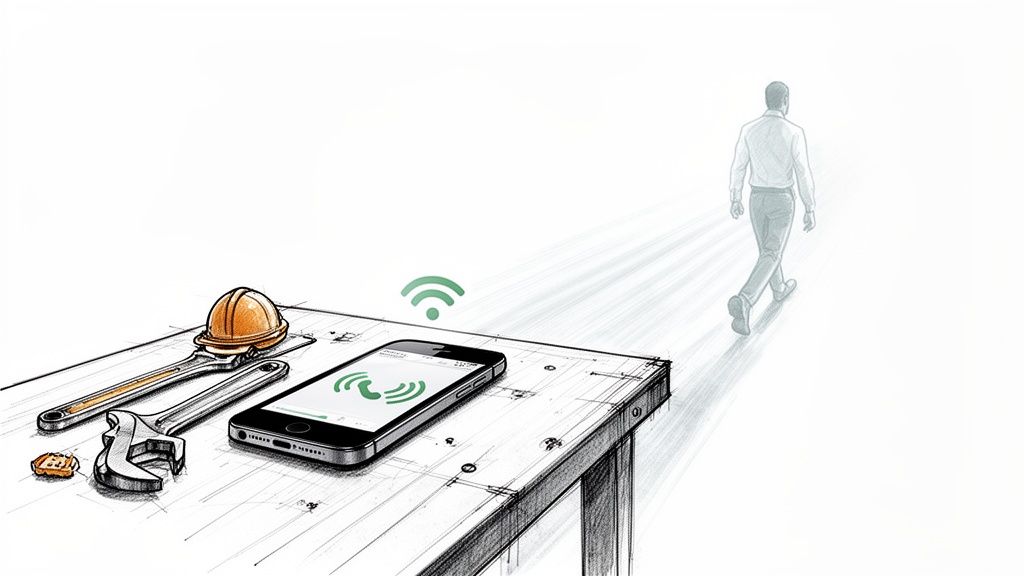
Picture this: you're a plumber, deep under a sink fixing a burst pipe. Your hands are full, and your phone starts buzzing with a new lead. By the time you wipe your hands and call back, they've already hired the next person on their list. That wasn't just a missed call. It was a lost job, vanished revenue, and a potential long-term customer who now belongs to your competitor.
For a small business owner, the phone is your most critical sales channel, but it’s also your most vulnerable. It’s the direct line to new business, but it has a knack for ringing at the worst possible times—when you're on another job, meeting with a client, or long after you've closed up for the day.
The Staggering Reality of Unanswered Calls
The numbers here don't lie. A shocking 62% of all calls to small and mid-sized businesses go unanswered. It’s not for lack of trying; it’s because a limited staff is constantly juggling on-site work, admin tasks, and unexpected emergencies.
To break it down, only 37.8% of calls get picked up by a real person. Another 37.8% are sent to voicemail, and a stunning 24.3% get no answer at all.
When a potential customer calls and gets silence, they don’t patiently wait for a callback. In almost every case, they just hang up and dial the next business on their list. That cycle repeats until someone, anyone, finally picks up the phone.
The True Cost of a Single Missed Call
Every time your phone rings without an answer, it costs you more than just one sale. The impact ripples through your business, hitting both your bottom line and your brand's reputation.
Let's look at the real-world consequences.
The True Cost of a Single Missed Call
| Scenario | Immediate Impact for Your Business |
|---|---|
| A New Lead Calls | You lose the sale instantly as they move on to a competitor who answered. |
| An Existing Customer Needs Help | Their frustration grows, damaging loyalty and increasing the risk of a negative review. |
| A Supplier Has an Urgent Update | Your operations get delayed, leading to project setbacks and wasted time. |
Finding a reliable phone answering solution isn't just a "nice-to-have." It’s essential for survival and growth. Whether it's during a busy workday or after hours, making sure every single call is handled professionally is paramount. If you're wrestling with calls outside of the 9-to-5, our guide on after-hours answering services can help. And for a broader look at capturing every opportunity, check out this essential guide on marketing for a small business.
Navigating Your Phone Answering Options
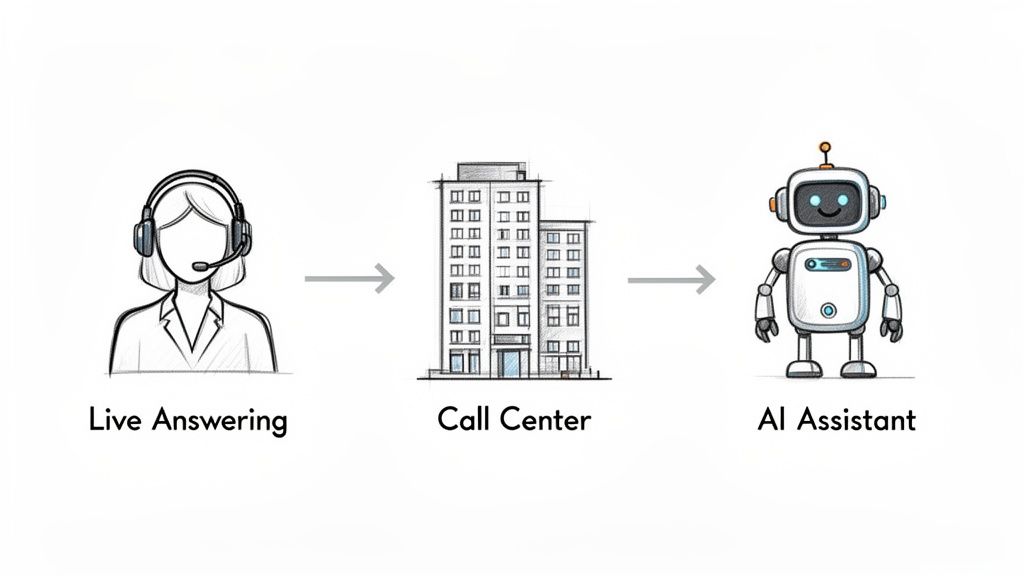
Deciding how to handle your incoming calls is one of the most critical choices you'll make as a small business owner. This isn't just about logistics; it hits your customer experience, your team's sanity, and your bottom line.
To help you get it right, let's walk through the three main solutions out there. We'll look at how they work, who they're really for, and the good, the bad, and the ugly of each. Think of it as your field guide to modern phone answering for a small business.
Traditional Live Answering Services
A live answering service is basically a remote receptionist. When someone calls your business, the call gets forwarded to a live person who answers with your business name, following a script you provide. They can take a message, patch through urgent calls, and answer basic questions.
This is the classic approach for a reason. It guarantees a human touch for every caller, which is a big deal for businesses built on personal relationships. It’s a huge leap from just letting every call roll to voicemail.
- Ideal For: Businesses that need a personal, human connection but don't have the call volume to justify a full-time, in-house receptionist. Think solo law practices, boutique consulting firms, or high-end service providers where that first impression is everything.
- Pros: It delivers a professional, human-first experience. A good agent can handle nuanced conversations in a way automated systems can't.
- Cons: It gets expensive fast, since you’re usually paying by the minute or by the call. Coverage is often limited to standard business hours unless you pay a steep premium for 24/7 service, and you're rolling the dice on agent quality. You can dig deeper into how live answering services operate to see how those costs add up.
Outsourced Call Centers
If a live answering service is like a single receptionist, an outsourced call center is like an entire administrative department on standby. These are large-scale operations built to handle a massive volume of calls—everything from customer support and tech helpdesks to inbound sales and order processing.
Call centers are all about volume and efficiency. They use large teams of agents, often spread across the globe, to make sure calls get picked up quickly. It's less about a personalized touch and more about high-capacity call management.
- Ideal For: Larger businesses or those with intense call spikes, like e-commerce companies during the holidays, national service chains, or any business needing around-the-clock technical support.
- Pros: They can handle a huge number of calls at once and usually offer 24/7 coverage as part of the standard package. They scale up or down with your needs.
- Cons: The experience can feel cold and impersonal. Callers might talk to a different agent every time, and complex problems can get lost in translation if the agents don't have deep knowledge of your business.
Call centers excel at quantity, but the quality of individual interactions can sometimes suffer. For a small business focused on building strong local relationships, this approach can feel disconnected from your brand identity.
Modern AI Phone Assistants
The newest player on the field is the AI phone assistant. Think of it as a smart, automated front desk that never sleeps. Using conversational AI, these systems answer calls instantly with a surprisingly natural, friendly voice. They can handle a whole range of tasks without ever needing a human to step in.
This isn't your parents' "press one for sales" phone menu. A modern AI assistant understands what callers are saying in plain English.
Common tasks an AI can handle:
- Answering frequently asked questions ("Are you open on Saturdays?")
- Booking, canceling, or rescheduling appointments right on your calendar
- Asking qualifying questions to separate hot leads from tire-kickers
- Securely collecting payment information
- Intelligently routing the truly complex calls to the right person
This tech is designed to automate the 60-80% of calls that are just routine questions. This frees you and your team to focus on the conversations that actually move the needle. It's the best of both worlds: the instant availability of a call center blended with the consistency and cost-efficiency of automation.
- Ideal For: Service-based businesses like HVAC, plumbing, locksmiths, and law firms that get slammed with repetitive calls for quotes and scheduling. It’s a game-changer for any small business looking to slash costs while making sure a customer never gets sent to voicemail again.
- Pros: It's incredibly cost-effective, often up to 80% cheaper than live services. You get instant, 24/7 coverage and a perfectly consistent, professional experience on every single call.
- Cons: While the tech is amazing, it might struggle with highly emotional or deeply complex, multi-part problems without handing the call off to a human. This is why having a seamless human transfer option is absolutely essential.
Comparing Phone Answering Solutions at a Glance
To make this even clearer, let's put these three options side-by-side. Use this table as a quick cheat sheet to see how they stack up against each other based on what matters most to your business.
| Feature | Live Answering Service | Outsourced Call Center | AI Phone Assistant |
|---|---|---|---|
| Typical Cost | $$$ (Per minute/call) | $$$$ (Per agent/hour) | $ (Flat monthly fee) |
| Availability | Business hours (24/7 costs extra) | 24/7 (Standard) | 24/7 (Standard) |
| Response Time | Can have hold times | Fast, but can have queues | Instant |
| Scalability | Limited | High | Infinite |
| Personal Touch | High (human interaction) | Low (often scripted) | Medium (consistent, but not human) |
| Consistency | Varies by agent | High (follows strict scripts) | Perfect (always on-brand) |
| Best For | Low-volume, high-touch businesses (e.g., consultants) | High-volume support or sales (e.g., e-commerce) | Service businesses with repetitive calls (e.g., HVAC) |
Each solution has its place. The traditional live service is great for that bespoke, personal feel. A call center is a powerhouse for massive volume. But for most small businesses today, the AI phone assistant hits that sweet spot of affordability, efficiency, and 24/7 reliability.
How AI Phone Assistants Are Changing the Game
First things first, let's clear up a common misconception. When we talk about AI phone assistants, we are not talking about those clunky, robotic phone trees that make you want to smash your phone. Forget the endless loops of "press one for sales."
Think of a modern AI assistant as a new kind of team member—one that’s brilliant at handling all the repetitive, predictable tasks. This frees up your actual human team to focus on the work that really drives revenue and builds relationships.
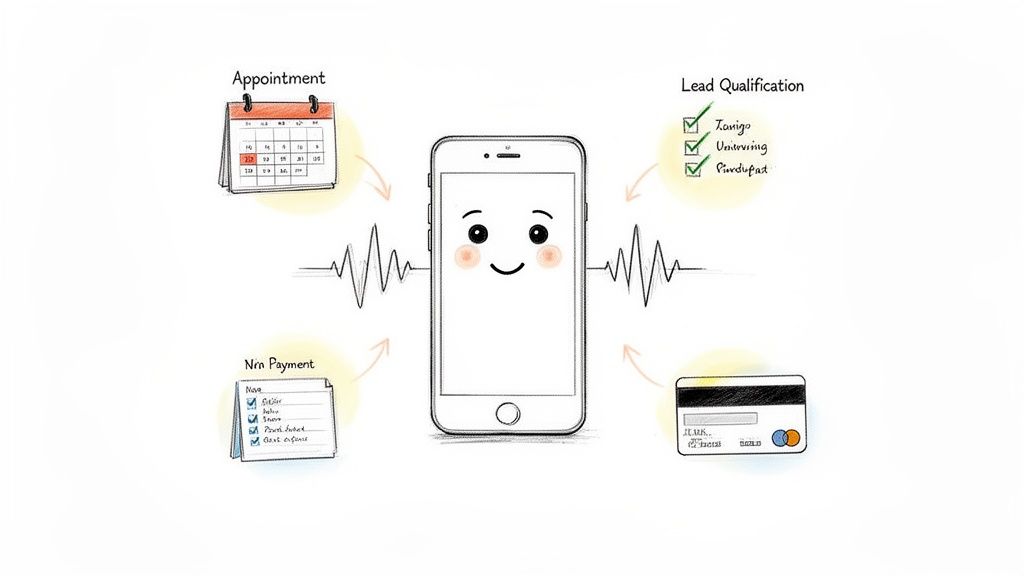
This isn't just a small step forward in phone answering for small business; it's a massive leap. Today’s AI can do a whole lot more than just take a message. It can book appointments, ask smart questions to qualify new leads, and even process payments securely over the phone, all with a surprisingly natural and friendly voice.
The real magic here is automating the routine. A huge chunk of inbound calls—often 60-80%—are for things like checking your hours, asking for directions, or rescheduling a visit. An AI handles these instantly, 24/7, without a single complaint.
The Power of Instant and Intelligent Responses
In business today, speed is the name of the game. People just don't wait around anymore. Caller attention spans have nose-dived from 2.5 minutes in 2004 to a brisk 47 seconds in 2023. If you make a potential customer wait, you’re rolling the dice—about 28% will hang up after just five minutes on hold.
AI assistants answer every call in under two seconds. No hold music, no waiting. That instant connection is absolutely critical for snagging leads who would otherwise just call the next business on the list.
The efficiency is also a huge win for your bottom line. Traditional call centers can run you over $2 per minute, which adds up fast. AI solutions, on the other hand, operate at a tiny fraction of that cost, potentially cutting your call-handling expenses by as much as 80%.
More Than Just Answering Calls
A top-tier AI assistant is much more than a glorified answering machine. It becomes a real operational partner, actively participating in your workflow and handling complex tasks that keep your business moving.
Here's a quick look at what this technology can actually do for you:
- Intelligent Lead Qualification: The AI can ask specific, custom questions to figure out if a caller is a good fit for your services before they ever take up a human's time.
- Seamless Calendar Integration: It syncs directly with your calendar to book, confirm, and reschedule appointments, completely eliminating the headache of double-bookings.
- Spam and Robocall Blocking: Good systems can identify and block all those junk calls, keeping your phone lines clear for actual customers.
- Smart Call Routing: If a caller has a complex problem or is a high-value lead, the AI knows exactly who to transfer the call to on your team based on what the caller says.
By taking these critical but time-sucking tasks off your plate, an AI phone assistant gives you back your team's most valuable asset: their time. You get to focus on strategy and growth instead of being chained to the phone.
A Better Experience for Customers and Staff
At the end of the day, any phone solution should make life better for everyone. For your customers, that means getting fast, frictionless answers. For your team, it means fewer interruptions and more time for meaningful work.
An AI assistant delivers on both. Customers love the 24/7 availability and instant help, and your staff will thank you for shielding them from the constant distraction of routine calls. To see how this tech could fit into your operations, check out our guide on finding the right AI receptionist for your small business.
This move toward smart automation is part of a bigger picture. To get a sense of these broader shifts, it’s worth reading about the dawn of smart internet and the AI revolution. This isn’t just some passing trend—it's quickly becoming the new standard for running an efficient, customer-focused small business.
Real-World Examples of Answering Services in Action
Theory is one thing, but seeing how a modern answering service delivers in the real world is what really counts. Let's get past the feature lists and look at some genuine success stories from businesses that have completely turned their operations around. These examples show how the right solution can do a lot more than just answer the phone—it saves a ton of time, locks in revenue, and keeps customers happy.
Think about a locksmith, fumbling for a pen and paper on a job site while a frantic caller is on the line. Now, picture their AI assistant instantly grabbing the year, make, and model of the car for a lockout, then zipping those details over to the nearest technician. That shift didn't just cut down on stress; it replaced a pricey call center with a system that's both quicker and more on the money.
The Driving School That Reclaimed Its Focus
SoHo Driving School had a problem every small business owner knows all too well. Their phone was ringing off the hook with the same routine questions—students needing to reschedule, parents asking about pricing, and new callers wanting to book their first lesson. Each call was an interruption, pulling the team away from the actual work of growing the business.
By bringing in an AI phone assistant, they automated the whole rescheduling dance and could instantly answer all those common FAQs. The impact was immediate.
- Human-handled calls plummeted by 70%, which freed up the team to finally focus on marketing and strategy.
- New leads are now automatically screened and sent to the right person, so high-value callers get the attention they deserve.
- Staff productivity went through the roof once the constant phone interruptions disappeared.
This one change allowed them to stop being reactive and start being proactive. It gave them the breathing room they desperately needed to think about growth.
The Law Firm That Unlocked Hidden Revenue
For a law firm, every single missed call is a potential client walking away. The team at "24/7 My Lawyer" knew they were leaving money on the table, especially after hours, but couldn't stomach the cost of a full-time, round-the-clock receptionist. They decided to try an AI assistant as their first line of defense.
The AI was set up to answer every call, ask a few critical qualifying questions to screen potential clients, and figure out what they needed. Only serious, relevant leads were then passed along to a lawyer for a proper consultation.
In just two months, this automated lead screening process brought in $20,000 in new revenue—all from cases that would have been lost to voicemail or a competitor who just happened to pick up the phone first.
This shows that a good answering service is more than a message-taker; it's a machine for generating and qualifying new business. Plenty of home service pros see similar wins, which is why a smart home services answering service can be such a game-changer for booking more jobs and running a tighter ship.
Quantifiable Impact Across Industries
These aren't just one-off wins. Look across different service industries, and the data paints a very clear picture. Service providers using modern phone solutions are saving an average of 10-15 hours per week on admin work alone. That reclaimed time translates directly into booking 20-60% more jobs, all while keeping callers happy with an impressive 94% satisfaction rate. For a deeper dive into these numbers, you can discover the full impact of optimized call handling.
From HVAC contractors to local clinics, small businesses are using this kind of technology to get more done with less. They're living proof that you don't need a massive budget or a huge team to give your customers world-class service and grab every opportunity that rings your line.
Choosing and Implementing the Right Solution
Taking back control of your business calls begins with a few simple questions. The perfect phone solution for one business might be complete overkill for another, so you’ve got to get clear on what you actually need before you pull the trigger.
Think of it as a quick self-audit. It doesn't have to be complicated. By walking through a few straightforward questions, you can paint a clear picture of your day-to-day demands and point yourself toward the right-fit solution. This initial clarity is the bedrock of a phone strategy that truly works for your business.
Assess Your Business Needs First
Start by getting a real handle on your daily call patterns. This isn’t about guesswork; it’s about understanding the actual flow of conversations that keep your business running. A clear-eyed assessment will stop you from overpaying for features you don't need or, worse, under-serving your customers when they need you most.
Here are the critical questions to nail down:
- What is your average daily call volume? Are you fielding 10 calls a day or 100? This is probably the single biggest factor in figuring out what you need.
- Do you require 24/7 coverage? For a lot of service businesses, the most valuable calls come in long after 5 PM. If those after-hours leads are gold, round-the-clock availability isn't a luxury—it's essential.
- What percentage of calls are routine inquiries? Be honest. How many calls are just people asking for your hours, directions, or to make a simple scheduling change? If that number is high, it’s a massive signal pointing toward an automated solution.
- What is your budget? Know your financial comfort zone. Options range from affordable AI assistants to premium (and pricey) live answering services. To get a better sense of the numbers, check out this detailed breakdown of the cost of an answering service.
This decision tree lays it out perfectly. It shows how an AI-powered system can take an incoming call and turn it directly into a booked job—the ultimate goal for any small business.
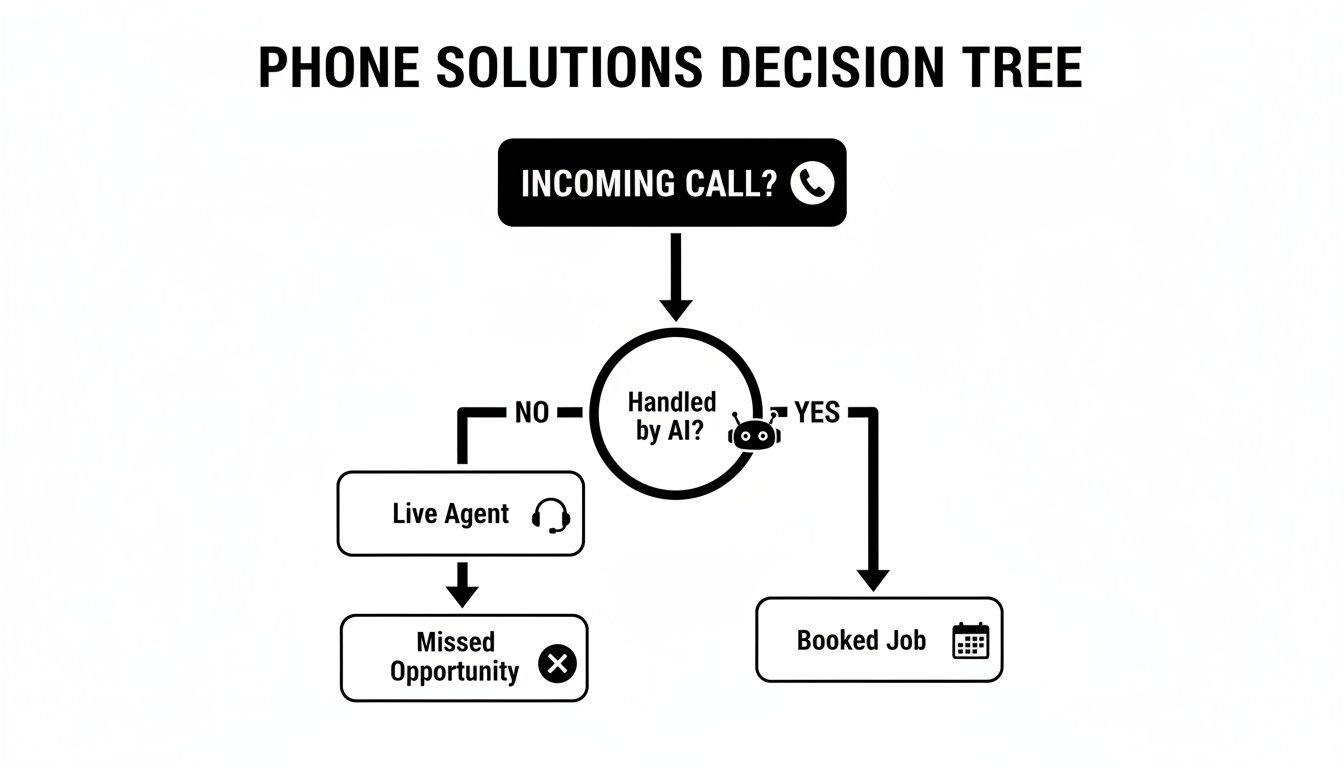
The visual makes one thing crystal clear: automating the routine stuff is the most direct path to converting a ringing phone into a confirmed appointment. That's the kind of efficiency you get when you let technology handle the first point of contact.
Implementing Your New Solution
Once you've picked your path, you'll find that putting a modern AI assistant to work is refreshingly simple. Gone are the days of needing special hardware or spending weeks on a complicated technical setup. Today, you can get a powerful system up and running in minutes, right from your web browser.
The whole process is designed to be intuitive and fast, knocking down any technical hurdles that might have held you back in the past.
Step 1: Create Your Call Flow
First, you'll map out how you want the AI to handle different kinds of calls. Think of it like giving instructions to a new receptionist. For example: if a caller wants to book a job, the AI should check your calendar and offer up available time slots.
Step 2: Forward Your Business Number
Next, you just tell your existing business number to forward calls to your new AI service whenever you're busy or don't pick up. This is a standard feature with every phone provider and ensures the system works with the number your customers already know and use.
Step 3: Go Live and Monitor
That's it—you're ready. Your AI assistant starts answering calls the moment you flip the switch. From there, you can log into your dashboard to listen to call recordings, read transcripts, and tweak your call flows anytime you want to fine-tune the customer experience.
The real beauty of a modern AI solution like Marlie.ai is its simplicity and adaptability. You can make adjustments on the fly without ever needing to call a support technician, giving you complete control over how your business communicates with customers.
Still Have Questions? Let's Clear Things Up.
Thinking about a new way to handle your business calls is a big step, and it's smart to have questions. You're probably wondering about everything from how this tech actually works to what it's really going to cost. Let's walk through the most common things business owners ask, so you can feel confident you're making the right move.
Will This Thing Sound Like a Robot and Annoy My Customers?
This is probably the biggest—and most valid—hang-up for anyone who's dealt with those awful, clunky automated menus from a decade ago. We've all been there, shouting "representative!" into the phone.
But the technology has come a ridiculously long way. Today's conversational AI uses voices that are incredibly natural and friendly. Honestly, most people can't even tell they're not speaking with a person. These systems understand how people actually talk, so your callers don't have to use weird, specific commands. They can just speak normally.
The proof is in the pudding: caller satisfaction rates are hitting as high as 94%. That number tells a clear story—when done right, customers have a genuinely great experience.
And here's the safety net: a real person is always just a button-press away. Any good system lets callers transfer to a human instantly if their problem is too complex or if they'd simply rather talk to someone.
Is This Going to Be a Huge Pain to Set Up?
Not at all. While old-school call centers often buried you in long contracts and complicated setups, modern AI assistants are built to be simple. The whole point is to get you up and running in minutes, not weeks, so you can start seeing the benefits without any technical headaches.
You can usually get everything configured online in just a few minutes. The best part? It works with your existing business phone number, which means there's no new hardware to buy or install. Everything is handled through a simple dashboard on a website, making it easy enough for anyone to manage.
What Can an AI Assistant Actually Do for Me?
Think of it less as a message-taker and more as a hyper-efficient front-desk coordinator. A good AI assistant can handle a huge chunk of your routine calls—often 60-80% of common questions—without ever needing to bother you or your team. This is about freeing you up to focus on the work that actually makes you money.
Here's a quick rundown of what it can take off your plate:
- Answering the Same Old Questions: It can instantly tell callers your hours, location, services, and pricing. No more repeating yourself ten times a day.
- Booking Appointments: The AI connects right to your calendar to schedule, reschedule, or cancel bookings automatically, so you never have to worry about double-booking again.
- Qualifying New Leads: You can set it up to ask specific questions to gather key info from new callers. You'll have all the details you need before you even return the call.
- Taking Payments: Many systems can securely process payments over the phone, which makes getting paid faster and easier.
- Routing Calls Intelligently: If a caller has a tricky issue, the AI figures out what they need and sends them to the right person or department. No more playing telephone tag.
It's like having the perfect employee who never takes a break, ensuring every single caller gets the help they need, right when they need it.
How Do I Know if I'm Getting a Return on My Investment?
This is the best part—calculating the ROI is surprisingly straightforward, and you'll likely see it in the very first month. The value comes from three places: the leads you capture, the time you get back, and the direct costs you save.
Here's a simple way to think about it:
- Value of Captured Leads: Take the number of calls you miss each month, and multiply that by your average conversion rate and the lifetime value of a new customer. That's pure revenue you were leaving on the table.
- Value of Reclaimed Time: Figure out how many hours you or your team spend on the phone with routine calls each week. Multiply those hours by your hourly rate. That number represents a massive gain in productivity.
- Direct Cost Savings: Just compare the small monthly fee for an AI assistant to what you'd pay a full-time receptionist or a traditional answering service that bills by the minute. The difference is usually staggering.
For most small businesses, the math is a no-brainer. When you add up the new jobs you book, the increased focus from your team, and the lower overhead, it becomes one of the smartest investments you can make.
Ready to see what an intelligent phone assistant could do for your business? Marlie Ai gives you a 24/7 solution that guarantees you never miss a call, capture every lead, and cut your call-handling costs by up to 80%. Get started with Marlie.ai today and take back your time.
