

Measuring customer experience isn't just about collecting feedback. It’s about turning feelings and interactions into hard data—numbers that tell you the real story about the health of your customer relationships. Think of it as translating conversations into a dashboard that can predict the future success of your business. This process is absolutely vital for spotting problems before they fester and finding opportunities to grow.
Why Measuring Customer Experience Is a Business Imperative

Trying to run a service business without measuring customer experience is like a pilot trying to fly through a storm without instruments. You might stay airborne for a bit, but you’re completely blind to turbulence, navigating on pure guesswork, and just one bad decision away from a nosedive. The old saying holds true: you can't manage what you don't measure. And in today's world, CX is the single most critical thing to manage.
Customers today have sky-high expectations, yet satisfaction is actually trending downward. This creates a quiet loyalty crisis for businesses operating in the dark. When you ignore CX data, you have no idea why customers are leaving, where your service is failing, or how much revenue is walking right out the door.
The Growing Gap Between Expectation and Reality
The data paints a pretty stark picture. Forrester's 2025 Global Customer Experience Index uncovered a troubling multi-year slide in CX quality across the board. North America hit an all-time low, with 25% of US brands seeing their scores drop for the second year in a row. This slow burn from positive to neutral sentiment signals a dangerous shift that directly hits customer retention and spending.
This gap is both a massive risk and a golden opportunity. Businesses that don't bother to monitor and act on CX feedback will watch customers quietly slip away to competitors. But those that consistently measure their performance gain an almost unfair competitive advantage.
"You’ve got to start with the customer experience and work back toward the technology—not the other way around." – Steve Jobs
This idea has never been more relevant. If you understand the customer journey first, you can make much smarter decisions about everything from agent training to the tech you invest in.
Connecting CX Measurement to Financial Health
Let’s be clear: measuring customer experience isn’t just about making people happy. It’s a core financial strategy. Every single interaction—good or bad—has a direct impact on your bottom line.
Here’s how consistent measurement protects your revenue:
- Reduces Customer Churn: By spotting friction points early, you can fix problems before they drive customers away for good.
- Increases Customer Lifetime Value (CLV): Great experiences keep people coming back and encourage them to spend more over time.
- Builds a Competitive Moat: In a crowded market, incredible service becomes your key differentiator. It makes your business the obvious choice.
Ultimately, every business has to get serious about understanding its customers through deliberate measurement. This guide is your roadmap to do it right, making sure you have the instruments needed to navigate any storm and steer your business toward lasting growth and true customer service excellence.
Understanding the Core Metrics of Customer Experience
Before you can start improving your customer experience, you need to learn to speak its language. That means getting comfortable with a few core metrics that act as your primary diagnostic tools.
Think of them less like complex formulas and more like simple questions that get to the heart of your customer relationships.
Each metric gives you a unique snapshot of a different part of the customer journey. When you combine them, you go from blurry guesswork to a high-definition picture of how your business actually performs from the customer's point of view. Let's break down the essentials.
The Big Three Relational Metrics
These three—NPS, CSAT, and CES—are the bedrock of any solid CX program. They directly measure what customers are thinking and feeling, giving you a powerful, unfiltered look into their experience with your company.
Key CX Metrics at a Glance
To quickly get your bearings, here's a simple breakdown of the "big three" relational metrics. Think of this as your cheat sheet for understanding what each one tells you and when you should pull it out of your toolbox.
| Metric | What It Measures | Key Question It Answers | Best Used For |
|---|---|---|---|
| Net Promoter Score (NPS) | Overall loyalty and brand advocacy | "Would you recommend us?" | Gauging long-term customer health and predicting future growth. |
| Customer Satisfaction (CSAT) | In-the-moment happiness with a specific interaction | "Were you happy with that specific interaction?" | Pinpointing friction points in individual processes (like a phone call). |
| Customer Effort Score (CES) | The ease of a customer's experience | "How easy was it for you to get your issue resolved?" | Identifying and removing obstacles that frustrate customers. |
Each of these metrics plays a distinct role, and the real magic happens when you start using them together to see the full story.
Net Promoter Score (NPS): Your Reputation Score
At its core, Net Promoter Score (NPS) is all about long-term loyalty. It cuts through the noise to answer one simple but profound question: "How likely are you to recommend our business to a friend or colleague?"
Customers give their answer on a 0-10 scale, and we group them into three buckets:
- Promoters (9-10): These are your die-hard fans. They're loyal, they'll keep coming back, and they'll sing your praises to others, fueling your growth.
- Passives (7-8): They're satisfied, but not thrilled. They got what they needed, but they could easily be tempted away by a competitor's offer.
- Detractors (0-6): These are your unhappy campers. They had a bad experience and are at risk of damaging your brand with negative word-of-mouth.
You calculate your NPS by simply subtracting the percentage of Detractors from the percentage of Promoters. It's a surprisingly powerful indicator of your company's growth potential.
Customer Satisfaction (CSAT): Your In-the-Moment Check-In
While NPS gives you the 30,000-foot view, Customer Satisfaction (CSAT) is all about the ground level. It zooms in on the immediate aftermath of a specific interaction, asking, "How satisfied were you with your recent [call, service appointment, etc.]?"
This is typically measured on a simple 1-5 scale.
CSAT is your go-to metric for finding specific points of friction. A low score right after a phone call, for instance, is a blaring alarm bell telling you to review that conversation and maybe offer some coaching. For a deeper look, our guide on customer satisfaction measurement methods has more strategies.
Customer Effort Score (CES): Your Friction Test
How much work do your customers have to put in to get help? That's exactly what the Customer Effort Score (CES) tells you. The question is usually framed as a statement they can agree or disagree with, like, "The company made it easy for me to handle my issue."
Research has shown time and again that making things easy for customers is a massive driver of loyalty. A high CES score is a great sign—it means your processes are smooth and intuitive. A low score, on the other hand, is a major red flag that customers are struggling, which is a leading indicator of churn. To really get this right, it's crucial to learn how to measure customer satisfaction the right way by pairing feedback with actual behavior.
Connecting CX to Your Bottom Line
The "big three" are fantastic for measuring sentiment, but two other metrics tie those feelings directly to your company's financial health. They translate emotions into dollars and cents.
Tracking these isn't just a feel-good exercise; it's about identifying pain points that directly impact growth. Companies that obsess over their customers see 41% faster revenue growth, 49% better profit gains, and 51% stronger retention than their peers.
Customer Churn Rate
This one is brutally simple: it's the percentage of customers who stop doing business with you over a specific period. It’s the ultimate sign that the customer experience has broken down somewhere along the line.
A rising churn rate is the business equivalent of a five-alarm fire. It's a signal to dive into your other CX metrics immediately to diagnose what's going wrong.
Customer Lifetime Value (CLV)
Finally, Customer Lifetime Value (CLV) is a prediction of the total revenue you can expect to earn from a single customer over the entire course of your relationship.
When you improve your CX, you boost satisfaction and loyalty. That, in turn, makes customers stick around longer and spend more, which directly increases their CLV. This metric is what helps you grasp the long-term financial payoff of keeping your customers happy.
How to Capture CX Data Beyond Surveys

Surveys are a classic tool for measuring customer experience, but if that's all you're using, you're only getting a dangerously small piece of the story. It's a bit like a biologist trying to understand an entire ecosystem just by asking the animals how they're feeling. You’d get some answers, sure, but you'd completely miss the real, unfiltered behaviors that actually define their world.
The hard truth is most of your customers will never fill out your survey. One study found that only 30% of customers ever provide direct feedback. That leaves a massive blind spot. At the same time, 92% of customers say that great customer service matters more to them than great value. This gap shows just how critical service quality is, and how little of it we're actually measuring with surveys alone.
This means the most honest, valuable feedback isn't waiting in a survey response. It’s hidden in plain sight, tucked away inside your everyday customer interactions. Your phone calls, your support chats, your online reviews—that's a goldmine of raw, unstructured data just waiting to be tapped.
Tapping Into Unstructured Feedback
Unstructured data is simply the raw, unorganized stuff customers share naturally. It’s the slight hesitation in their voice on a phone call, the exact words they use in an email, or the clear frustration bubbling up in a live chat. This is where the real story of your customer experience lives.
Of course, manually sifting through thousands of these conversations is just impossible. That’s where modern technology—especially AI-powered tools—changes the game. These systems can automatically process 100% of your customer conversations, turning all that qualitative chatter into quantitative, actionable insights.
By analyzing every single interaction, you stop just asking for opinions and start observing actual behavior. This gives you a far more accurate, comprehensive view of what's really going on in your business.
This approach lets you move past old-school surveys and explore more effective ways to collect customer feedback that drives growth.
Introducing Conversation and Sentiment Analysis
Two of the most powerful techniques for making sense of this data are conversation analysis and sentiment analysis. They work hand-in-hand to tell you not just what your customers are saying, but how they actually feel about it.
-
Conversation Analysis: This digs into the topics, keywords, and specific phrases that pop up over and over again in your customer interactions. It can automatically flag recurring problems, like customers getting confused about a new billing policy or repeated complaints about a particular service delay.
-
Sentiment Analysis: This goes a level deeper by detecting the emotional tone behind the words. It can classify interactions as positive, negative, or neutral and even pinpoint specific feelings like urgency, frustration, or delight.
Imagine you could automatically discover that 25% of your support calls this month mentioned the phrase "confusing instructions" and carried a distinctly negative sentiment. That’s a powerful, data-backed insight you would almost certainly never get from a survey alone.
Turning Conversations Into Actionable Data
So, how does this work in the real world? AI-powered systems listen to call recordings and read chat transcripts, identifying key patterns and moments. This is the core job of modern conversational analytics software, which acts like a tireless analyst for all your customer interactions.
Here’s a taste of what you can uncover:
- Identify Root Causes: Pinpoint the exact reasons for customer frustration or happiness by tracking recurring themes.
- Monitor Agent Performance: See which agents are masters at de-escalating tough situations and where others might need a bit more coaching.
- Track Product Feedback: Capture spontaneous, off-the-cuff feedback about your products or services mentioned during a conversation.
- Detect Churn Risks: Identify customers expressing high levels of frustration or mentioning competitors, giving you a chance to step in before it's too late.
By putting systems in place to capture and analyze this data, you create a constant, real-time stream of feedback. You stop measuring customer experience as a once-in-a-while event and start treating it as a continuous, data-driven process that fuels real, meaningful improvement.
Your Step-by-Step CX Measurement Implementation Plan
Knowing which metrics to track is one thing. Actually turning that knowledge into a system that works is a whole different ballgame. This is your blueprint for building a real-world customer experience measurement engine—a clear path from vague ideas to concrete, continuous improvement.
This framework isn't just theory. It's designed for service businesses ready to put this into practice. Follow these steps, and you’ll build a program that delivers results from day one, ensuring you're not just collecting data but actually using it to grow your business.
Step 1: Define Clear Business Goals
Before you measure a single thing, you have to know why. A CX program without a clear goal is like a ship without a rudder—drifting aimlessly and ending up nowhere useful. Your first move is to tie your efforts to a specific, tangible business outcome.
And I don't mean something fuzzy like "improve customer satisfaction." Get specific. Get measurable.
- Reduce customer churn by 10% within the next six months.
- Increase the Customer Lifetime Value (CLV) of our top client segment by 15% this year.
- Decrease repeat support calls for billing issues by 20% in the next quarter.
Goals like these give your program a clear purpose. They also make it a heck of a lot easier to prove its value to your team and leadership down the line.
Step 2: Select the Right Metrics to Track Progress
Once you have your goal, you need to pick the metrics that will act as your signposts, telling you if you’re heading in the right direction. Don't fall into the trap of tracking everything under the sun. Instead, choose the handful of key performance indicators (KPIs) that are most directly tied to your goal.
Connecting your metrics to your goals is non-negotiable. If your goal is to reduce churn, your primary metrics should be NPS and Churn Rate. If you want to improve service efficiency, focus on CSAT, CES, and Average Resolution Time.
This alignment makes sure every piece of data you collect has a purpose. You're not just filling up a dashboard with numbers; you're monitoring the vital signs that directly impact the health of your business.
Step 3: Choose Your Data Collection Tools
Now for the fun part: picking the tools you'll use to gather the data. A balanced approach usually works best, combining old-school methods with modern tech to get the full picture.
Your toolkit might look something like this:
- Email Surveys: Still simple and effective for capturing NPS, CSAT, and CES feedback right after a key interaction.
- Website Pop-ups: Great for grabbing in-the-moment feedback on your website’s usability or whether a customer found what they were looking for.
- AI-Powered Conversation Analysis: This is the game-changer. Tools like Marlie.ai automatically analyze 100% of your phone calls and chats, pulling out the unstructured sentiment and topic data that surveys completely miss. This is how you find the "why" behind your scores.
Step 4: Map Collection Points Across the Customer Journey
With your tools in hand, you have to decide when and where to ask for feedback. The best way to do this is to map out the key stages of your customer journey and pinpoint the most critical interaction points.
Think about the entire lifecycle, from start to finish:
- Initial Contact: How do people first find you and reach out?
- Scheduling/Booking: What’s the experience like when they book a job or an appointment?
- Service Delivery: How do they feel while the service is actually happening?
- Post-Service Follow-Up: What happens after the job is done? This is a perfect spot for a CSAT or NPS survey.
- Ongoing Support: When they call with a question, how easy is it to get help?
By placing your data collection tools at these key moments, you can build a detailed, step-by-step view of your customer's experience. This is also fundamental for establishing a solid system for quality control for call center interactions, ensuring every single touchpoint is measured.
Step 5: Analyze Data to Uncover Actionable Patterns
Collecting data is only half the battle. The real magic happens when you analyze it to find trends, patterns, and insights you can actually act on. You have to look beyond the raw scores and dig into the context.
For example, if your CSAT scores mysteriously dip every Tuesday afternoon, figure out what's going on. Is a new agent working that shift? Is call volume spiking? Combine your quantitative scores (the what) with the qualitative feedback from call transcripts (the why) to get the full story.
This is where you connect the dots between what customers are telling you and what’s happening on the ground, turning simple observations into real opportunities for improvement.
Step 6: Create a Feedback Loop for Continuous Improvement
This is the most critical step of all: closing the loop. A good CX measurement program isn't a one-and-done project. It’s a continuous cycle of listening, analyzing, acting, and then doing it all over again.
Set up a formal process for sharing what you find with the right people. If you discover customers are constantly confused by your invoices, share that data with your finance team. If call analysis shows agents are struggling with a specific objection, get that feedback to your training manager. Acting on the data shows your customers—and your team—that you’re actually listening. It’s how you build a culture of constant improvement.
CX Measurement Implementation Checklist
Getting started can feel like a lot, but breaking it down into a checklist makes it manageable. Here’s a simple table to guide you through setting up your CX measurement program, step by step.
| Step | Key Action | Tool/Resource Example | Common Mistake to Avoid |
|---|---|---|---|
| 1. Define Goals | Tie CX efforts to a specific business outcome (e.g., reduce churn by 10%). | Company OKRs or strategic plan. | Setting vague goals like "improve satisfaction." |
| 2. Select Metrics | Choose 2-3 primary KPIs directly linked to your goal. | KPI dashboards (Geckoboard). | Tracking too many "vanity metrics" that don't drive action. |
| 3. Choose Tools | Select a mix of survey tools and conversation intelligence. | Marlie.ai, SurveyMonkey. | Relying only on surveys and missing the "why" in conversations. |
| 4. Map Journey | Identify key touchpoints to collect feedback (e.g., post-service, support call). | Customer journey map (Miro). | Collecting feedback at the wrong time (too early or too late). |
| 5. Analyze Data | Schedule regular analysis sessions to find trends and root causes. | Call transcripts, sentiment analysis reports. | Looking only at scores without digging into qualitative feedback. |
| 6. Act & Iterate | Create a process to share insights with relevant teams and track actions. | Internal project management tool (Asana). | Collecting data but never acting on it (analysis paralysis). |
Use this checklist as your guide. It's not about being perfect from day one, but about taking consistent, deliberate steps toward understanding your customers better. Each step builds on the last, creating a powerful engine for growth.
How to Turn CX Data Into Tangible Business Growth
Collecting customer experience data is a bit like mining for gold. The raw numbers you pull out—your NPS, CSAT, and CES scores—are certainly valuable. But the real treasure, the stuff that changes your business, is buried deeper. The whole point isn't just to measure things; it's to turn those nuggets of insight into real, concrete changes that build loyalty and actually drive growth.
Data without action is just trivia. So let's get down to putting your CX measurements to work. We'll move from the "what" to the "so what," showing you how to build a system that turns customer feedback into your most powerful engine for growth.
Building Your Voice of the Customer Program
This is where a formal Voice of the Customer (VoC) program comes in. Think of it as the bridge between just having data and actually doing something meaningful with it. It’s the central hub where all your customer feedback—from surveys to call transcripts—gets collected, analyzed, and sent to the right teams. A VoC program makes sure insights don't just die in a dashboard but actively shape decisions across the company.
A strong VoC program doesn't just tell you about problems after the fact; it helps you see them coming. By systematically listening to what customers are saying everywhere, you can spot trends early and fix small issues before they snowball into widespread frustrations that hurt your reputation and your bottom line.
Here’s a simple way to visualize the flow, from setting your goals to analyzing what you find.
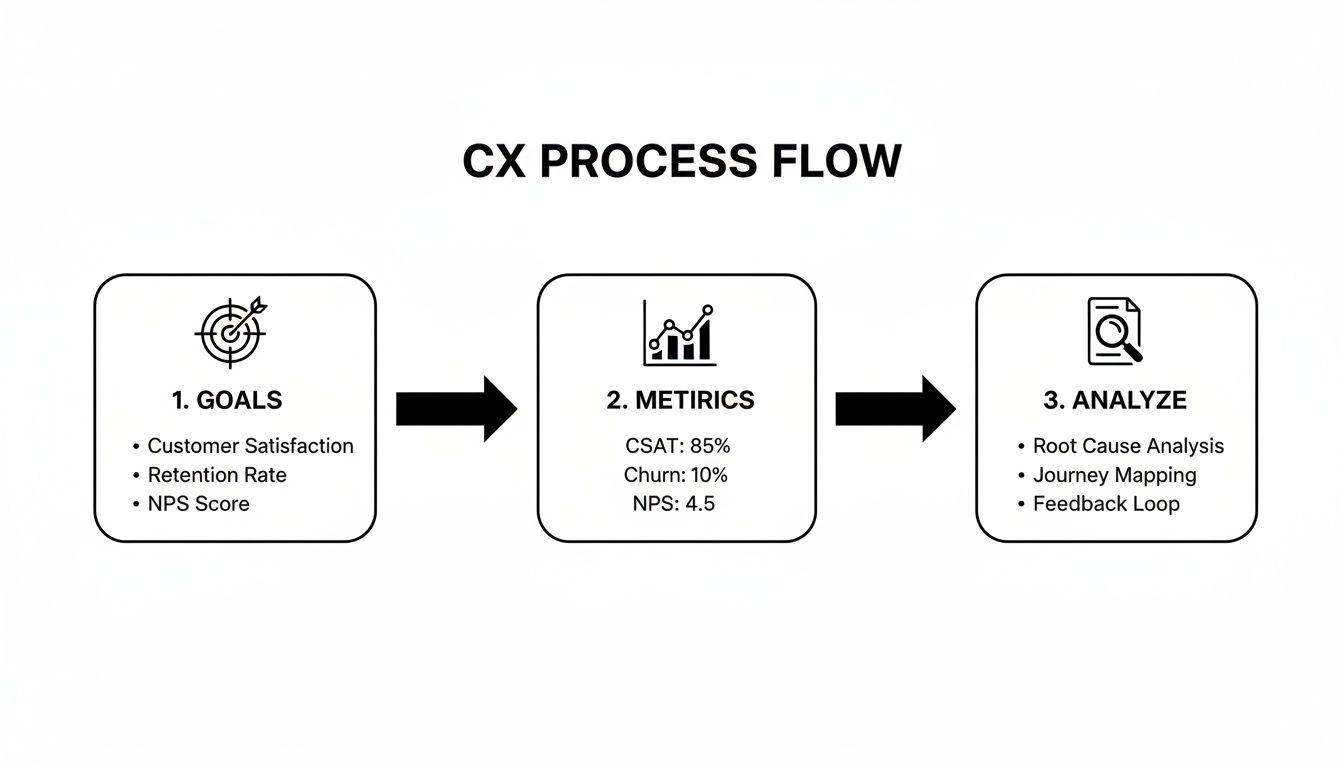
This process is a cycle. You set goals, pick the right metrics, and then continuously analyze the feedback to keep getting better.
From Call Transcripts to Operational Fixes
One of the richest, most unfiltered sources for your VoC program is the daily phone conversations you have with customers. Using a tool like Marlie.ai to analyze call transcripts can uncover patterns that surveys would never catch, often leading to simple fixes with a huge impact.
Here's a real-world example: a local HVAC company saw its CSAT scores start to dip. The surveys weren't telling them why. But after digging into their call recordings, they found a recurring theme. Dozens of customers were calling to ask the exact same basic question about a new maintenance plan—a detail that was buried on a back page of their website.
That single insight led to a dead-simple operational fix. They put a clear, concise banner about the plan right on their homepage. The result? Calls about that topic dropped by over 20% in the first month. Their agents were freed up to handle more complex problems, and overall customer satisfaction ticked back up.
This is the power of moving beyond scores. The real value in measuring customer experience lies in uncovering the specific, actionable "why" behind the numbers.
Using Sentiment to Inform Targeted Training
Sentiment analysis is another powerful tool you can pull from your call data, especially for improving your team's performance. By automatically identifying cues of frustration in conversations—like raised voices, repeated questions, or certain keywords—you can pinpoint exactly where your agents need more support.
For instance, an analysis might show that calls about "billing disputes" consistently have high levels of customer frustration. Digging in, you might discover that your agents are struggling to clearly explain a particular fee.
This lets you stop wasting time on generic training and start implementing highly targeted coaching. You can create new scripts, build better reference guides, or run role-playing exercises focused specifically on de-escalating those billing conversations. It directly boosts agent confidence and has a clear, measurable impact on CSAT for those specific call types. Understanding this is a core part of learning how to measure customer engagement effectively.
Presenting CX Insights to Leadership
To get buy-in and keep your CX program funded, you have to show its financial impact. When you're sharing your findings with leadership, you have to speak their language: the language of business growth and ROI.
Don't just walk in and say, "Our NPS score went up."
Instead, connect the dots for them. Say something like, "By fixing the top three issues we found in our call analysis, we cut customer churn by 5% last quarter. That translates to $50,000 in retained annual revenue."
Here's a simple framework for framing your insights:
- The Finding: Start with the core insight. "We found that 30% of our inbound calls are from customers confused about our return policy."
- The Action: Explain what you did about it. "So, we rewrote the policy on our website and created a one-page guide for our agents."
- The Result: Quantify the business impact. "This change cut return-related calls by 40% and saved an estimated 15 agent hours per week."
When you consistently link your measurement efforts to clear financial wins, you prove that investing in customer experience isn't just another cost—it's one of the smartest investments your business can make.
Common Mistakes to Avoid in CX Measurement
Even the sharpest, most customer-focused businesses can stumble into a few common traps when they start measuring CX. Knowing what not to do is just as important as knowing what to do. If you can sidestep these pitfalls, you'll end up with data you can actually trust and a clear path toward real improvement.
One of the biggest blunders? Causing survey fatigue. Blasting customers with feedback requests after every single interaction is a guaranteed way to get tuned out or, worse, tick them off. The hard truth is that most people will never fill out a survey. This leaves you making decisions based on a tiny, and often very loud, minority.
The smarter move is to balance this active feedback with passive data collection. Instead of always asking, start listening to the conversations you’re already having. Tools that can analyze your call recordings and chat histories capture the raw, unfiltered truth from 100% of your customer interactions. This gives you a complete, honest picture of what’s really going on.
Focusing On a Single Metric
Another classic mistake is getting fixated on one number—and it's usually NPS. While NPS is a great pulse check for overall loyalty, it doesn’t come close to telling the whole story. It's surprisingly easy to have a decent NPS score while specific, annoying friction points are quietly frustrating your customers and driving up your support costs.
A healthy CX program is like a balanced diet; you need a mix of different nutrients. You pair a big-picture loyalty score like NPS with more granular, in-the-moment metrics like CSAT and CES to get a complete view.
This approach lets you see both the forest and the individual trees. You can connect that broad customer sentiment directly to the specific, fixable problems that are causing it.
Drowning in Data Without Action
Finally, so many businesses fall victim to analysis paralysis. They collect mountains of data, build beautiful dashboards, and then… nothing happens. A screen full of charts is completely useless if it doesn't spark a change in how you operate, coach your agents, or improve your processes.
But the most critical error is ignoring the qualitative "why" hidden inside all those customer conversations. Your CSAT score might tell you a customer was unhappy, but the call recording tells you why—maybe they were completely baffled by a line item on their bill.
The goal is to create a tight feedback loop. Insights from all your data sources need to be regularly shared with the teams who can actually fix the root causes. That's how you ensure your measurement efforts lead to real, tangible change.
Got Questions About Measuring Customer Experience? Let’s Clear Things Up.
Diving into customer experience metrics always stirs up a few practical questions. It’s completely normal. Let’s walk through some of the most common things business owners ask when they’re just getting started.
How Often Should We Be Measuring This Stuff?
The right rhythm for measuring CX really depends on what you’re trying to figure out. The best approach usually involves a mix of two different cadences.
-
Transactional Feedback: Think of this as a quick pulse check right after a specific event. Someone just finished a support call or had a service appointment? That’s the perfect time to send a quick CSAT or CES survey. The feedback is fresh, in-the-moment, and directly tied to that interaction.
-
Relational Feedback: This is your big-picture view. It’s a periodic check-in to see how customers feel about your brand overall. Sending an NPS survey quarterly or even semi-annually is a great way to track long-term loyalty without bugging people too often.
What’s a “Good” NPS or CSAT Score, Anyway?
It’s tempting to hunt for a universal "good" score, but the truth is, benchmarks are all over the map depending on your industry. A fantastic NPS in hospitality might look mediocre in the software world.
The only benchmark that truly matters is your own last score. The goal isn’t to chase a competitor’s number; it’s about consistent internal improvement, month after month. Focus on your own trend line and celebrate the wins.
How Can a Small Business Do This on a Tight Budget?
You absolutely do not need a massive budget to get meaningful CX insights. For small businesses, it’s all about being resourceful and tapping into the goldmine of data you already have.
Start by just listening to your existing customer conversations—your phone calls, emails, and chat logs are packed with raw, unfiltered feedback. Tools like Marlie.ai can analyze these interactions automatically, pulling out customer sentiment and spotting recurring problems without any expensive survey platforms. You're simply tapping into what your customers are already telling you every single day.
Ready to stop guessing and start listening? Marlie Ai analyzes 100% of your customer calls to deliver the CX insights you need to grow. See how it works at https://www.marlie.ai.
