

So, what exactly is service level in a call center?
Put simply, call center service level is a measure of how quickly your team answers the phone. It's the percentage of calls that get picked up by an agent within a certain amount of time. Think of it as your contact center's core promise to customers: "When you call, this is how fast we'll be."
It’s the most direct way to see how accessible and responsive you really are.
A Simple Way to Think About Service Level

Imagine you’re at a busy deli during the lunch rush. You grab a ticket and wait for your number to be called. That deli's "service level" is the percentage of customers they serve before the wait gets frustrating—let's say, within five minutes. If they help 80 out of 100 customers in that timeframe, their service level is 80%.
The idea is exactly the same in a call center, we just measure it in seconds. This one metric speaks volumes about your operational efficiency and your real-world commitment to the customer experience. A high service level means customers aren't left hanging, which leads directly to better satisfaction and a stronger brand.
The Famous 80/20 Rule
You can't talk about service level without mentioning the classic industry benchmark: the 80/20 rule. These aren't just arbitrary numbers; each one plays a specific role in defining the target.
To make it crystal clear, let's break it down.
Breaking Down the 80/20 Service Level Standard
| Component | What It Represents | Why It's Important |
|---|---|---|
| 80% | The performance target. | This is your success rate. The goal is to successfully answer at least four out of every five incoming calls within the time limit. |
| 20 Seconds | The time threshold. | This is the maximum amount of time a customer should have to wait in the queue before an agent picks up. |
Putting it all together, you get a clear, powerful goal.
A service level of 80/20 means the call center aims to answer at least 80% of incoming calls within 20 seconds.
This target is so fundamental because it has a ripple effect on everything from staffing levels to customer loyalty. It’s the standard that shapes your day-to-day operations and, ultimately, how your customers feel about your company's reliability.
Now, this is closely related to a formal Service Level Agreement (SLA), but they aren't the same thing. An SLA is a much broader contract that usually covers multiple performance standards. If you want to dive deeper, you can learn more about what a service level agreement is in our detailed guide.
How to Nail Down Your Service Level Calculation
Calculating your service level isn't some dark art reserved for data scientists. Once you get the hang of it, the formula is surprisingly simple. Think of it as the tool that turns the fuzzy idea of a "service promise" into a hard number you can actually track, manage, and ultimately, improve.
At its core, the math just needs two pieces of information: how many calls your team answered quickly, and the total number of calls that came in during that time.
The Standard Service Level Formula
The most common formula you'll see across the industry is clean and to the point:
Service Level % = (Number of Calls Answered Within Threshold / Total Calls Offered) x 100
Now, what counts as "Total Calls Offered"? This usually includes all calls that were answered plus any calls that were abandoned, but only after your time threshold passed. Calls that someone abandoned in the first few seconds (say, 5-10 seconds) are often left out. The thinking is that those were likely wrong numbers or people who hung up by mistake.
Let's see this in action. A classic benchmark in the contact center world is the 80/20 rule, which means aiming to answer 80% of calls within 20 seconds. So, if your center gets 600 calls in a half-hour and your agents manage to answer 480 of them inside that 20-second window, you've hit your 80% service level. Boom. You can get a deeper dive into these kinds of benchmarks over on this detailed overview on Sprinklr.com.
Example 1: The Small Retail Business
Picture a small online boutique in the middle of a huge one-day flash sale. The phones are lighting up with customers asking about orders and checking if that one popular item is still in stock.
- Total Calls Offered: 200
- Calls Answered within 30 seconds: 150
- Service Level Target: 75/30 (Answer 75% of calls within 30 seconds)
Let's plug these into the formula:
(150 / 200) x 100 = 75%
Nice and simple. The team hit their goal right on the nose, making sure most shoppers got the help they needed during a super busy day.
Example 2: The Tech Support Center
Now for a different scene. A big tech company just pushed a major software update, and—no surprise—they're getting slammed with calls from users who need a hand. The pressure is on to be responsive and keep customer frustration from boiling over.
- Total Calls Offered: 1,200
- Calls Answered within 60 seconds: 900
- Service Level Target: 80/60 (Answer 80% of calls within 60 seconds)
Let's run the numbers for their performance:
(900 / 1,200) x 100 = 75%
They came up just short of their 80% target. This isn't a failure; it's a data point. It’s a clear signal that they were probably a bit understaffed for that flood of calls, which is a fantastic insight for planning the next big software release.
As you can see, the formula gives you immediate, actionable feedback. The right tools make tracking this even easier, which you can read more about in our call center software comparison guide.
Finding the Right Service Level Benchmark for Your Industry
The classic 80/20 rule is a great starting point, but it's not a universal law for every business. Sticking to it rigidly without thinking about your specific situation can be a costly mistake. The right service level for your call center hinges entirely on your industry, your customers' expectations, and the nature of their calls.
A one-size-fits-all approach just doesn't work because customer urgency varies dramatically. A patient calling a healthcare provider with a medical question needs a much faster response than someone asking about a t-shirt return policy. Setting the right benchmark means lining up your operational goals with what your customers actually need.
Why Industry Standards Differ
Different sectors face unique pressures that shape their service level targets. A high-stakes financial transaction demands immediate attention, while a routine home services inquiry might have more wiggle room. Getting the "why" behind these benchmarks is the key to setting goals for your team that are both realistic and effective.
This formula breaks down the core idea of how to calculate your service level.
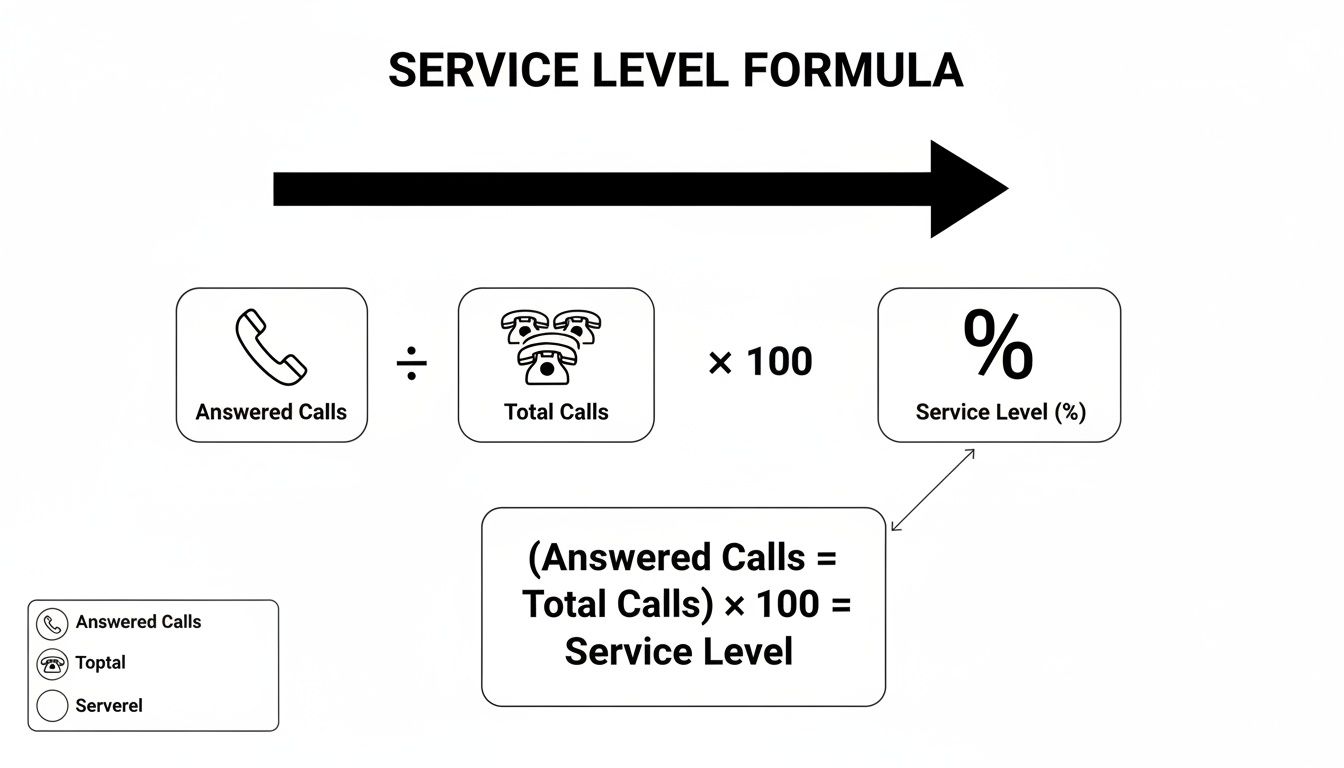
It really comes down to how many calls you answer within your target time, which directly drives your final percentage.
The 80/20 benchmark itself actually goes way back to telecom SLAs from the 1990s. More recently, an analysis of over 500 global centers showed that performance averages hover between 70-80%. Top performers, especially in finance, were hitting a swift 85/20. This data confirms that while 80/20 is a strong guide, what works in the real world is almost always industry-specific.
Comparing Service Level Targets Across Industries
Let's dive into how these standards actually play out. Every industry has to find that sweet spot between customer patience and operational reality, which leads to some pretty distinct service level goals.
| Industry | Common Target (Percentage/Seconds) | Driving Factor |
|---|---|---|
| Healthcare | 90/15 or higher | Urgency and criticality of calls for patient safety. |
| Finance & Banking | 85/20 | Security and trust are paramount when money is involved. |
| Retail & eCommerce | 75-80% within 30 seconds | Lower urgency allows for more flexibility than finance. |
| Home Services | Effectively 100/2 | Speed is critical to capture leads before they call a competitor. |
As you can see, what's considered "good" is all over the map. For businesses like HVAC or locksmiths, speed is everything. They often use a home services answering service to make sure no call is ever missed, essentially creating a 100% answer rate in under 2 seconds for that crucial first contact.
By understanding these industry nuances, you can move beyond a generic target and set a service level that truly reflects your business needs and keeps your customers happy.
The True Business Impact of Your Service Level
Your call center's service level is so much more than a number you track on a dashboard. Think of it as a vital sign for your entire business. It sends powerful ripples through everything you do, touching customer loyalty, brand perception, and—most importantly—your bottom line.
This single metric is the connective tissue between how efficiently you run your operation and how your customers feel about you.
When you consistently hit a high service level, you’re doing more than just picking up the phone quickly. You’re sending a clear message: "We're reliable. We've got your back." That responsiveness is the bedrock of customer satisfaction, turning one-off callers into genuine advocates for your brand and dramatically cutting down on churn.
On the flip side, a chronically low service level screams something else entirely. It tells your customers their time doesn't matter, leading straight to sky-high call abandonment rates, angry social media posts, and a tarnished brand. Every one of those dropped calls is a missed opportunity—a potential sale vanishing into thin air, a problem left to fester, or a customer relationship turning sour.
The Connection to Customer Loyalty and Costs
The link between how quickly you answer the phone and your business outcomes is incredibly direct. The numbers don't lie.
Take a look at a study of 1,000 call centers. It found that maintaining an 80/20 service level correlated with 18% higher CSAT scores and a 22% reduction in agent attrition. The takeaway is simple: quick answers build confidence, and in today's market, that's non-negotiable. You can dive deeper into these managerial insights on call center performance on Verint.com.
This isn't just about making people happy; it’s a smart financial move. When you handle calls efficiently, you stop wasting money on abandoned calls and frustrated agents. You can learn more about how to calculate cost savings from operational improvements in our guide.
The Human Element: Agent Burnout
Let's not forget the toll a poor service level takes on your most valuable asset: your people.
Picture a call center where the phones never stop ringing, where every call is a frantic race against the clock. That relentless pressure is a fast track to stress and burnout. Agents stuck in that kind of high-stakes environment feel overwhelmed and unsupported, and it's no wonder their turnover rates are higher.
High agent turnover is a massive, often hidden, cost. You're constantly spending money on recruiting, hiring, and training new people just to stay afloat. A stable, well-supported team isn't just more effective—it's far more economical.
Ultimately, investing in your service level is an investment in your entire business. It fortifies customer relationships, protects your reputation, plugs operational leaks, and builds a healthier, more sustainable workplace for the team that makes it all happen.
Proven Strategies to Improve Your Service Level
Trying to improve your service level isn't just about forcing agents to answer the phone faster. It’s about building a smarter, more resilient operation from the ground up. To really move the needle, you need a mix of solid operational discipline and the right modern tools. The end goal is a system where efficiency and a great customer experience aren't competing priorities, but two sides of the same coin.
This all starts with getting the fundamentals right. You absolutely cannot have a high-performing call center without accurate forecasting and scheduling—it's the bedrock of everything else. Using workforce management (WFM) tools helps you predict call volumes based on historical data, making sure you have the right number of people staffed at the right times. And of course, a key part of that is making sure your team is actually available, which means having effective strategies for reducing absenteeism to keep your schedules on track.
Master Your Call Routing
Once your staffing is dialed in, the next piece of the puzzle is getting calls to the right place as quickly as possible. This is where intelligent routing becomes a complete game-changer.
Skill-based routing is a powerful way to match callers with the agent who is best equipped to solve their specific problem. Instead of a call going to the next random agent in the queue, the system figures out what the caller needs—maybe it's technical support, a billing question, or a sales inquiry—and sends them straight to a specialist. This simple shift can dramatically slash handle times and give your first-call resolution a massive boost.
By connecting customers to the right expert on the first try, you eliminate frustrating internal transfers and solve problems faster. This not only improves your service level but also significantly enhances the customer experience.
Effective routing is a huge part of delivering consistent quality. To make sure your agents are always at their best, it's a good idea to pair these technical solutions with strong call center quality assurance practices.
Use AI as a Force Multiplier
Today, technology gives us more ways than ever to lift performance without just throwing more bodies at the problem. AI-powered platforms can act as a true force multiplier, handling all the routine, repetitive tasks and freeing up your human agents to focus on the high-value conversations that really matter.
An AI phone assistant, for example, can instantly answer every single call, manage common questions, and gather all the essential information before a human ever gets involved.
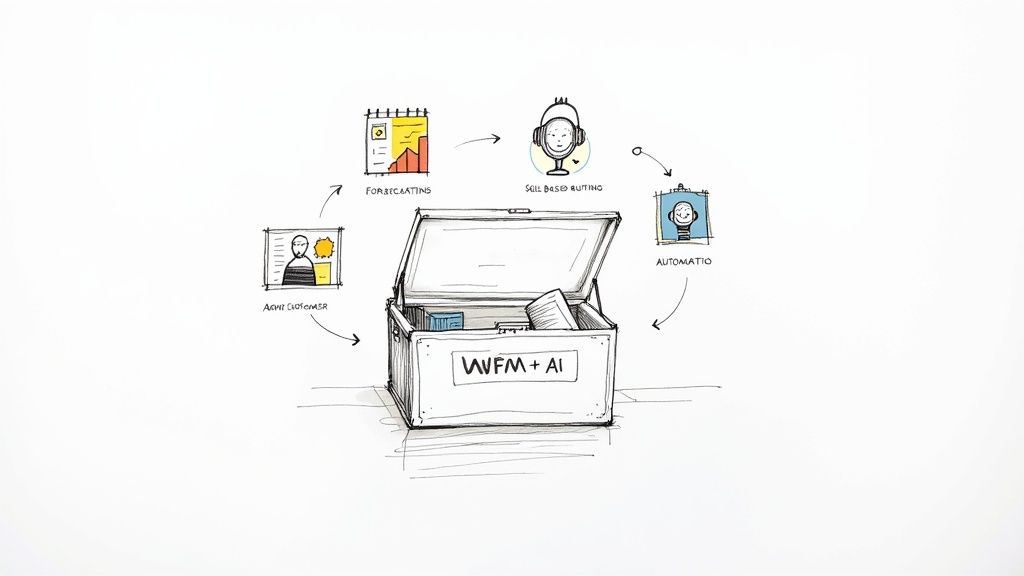
The best systems, like Marlie.ai, let you customize exactly how the AI responds, ensuring it aligns perfectly with your business processes—from booking appointments to routing calls to a specific department.
By automating 60–80% of those routine calls—things like status updates or simple FAQs—you free up your skilled agents for the conversations that truly require a human touch. This two-pronged approach of operational excellence and smart technology gives you a robust toolkit to consistently hit, and even exceed, your service level goals.
Got Questions About Service Level? Let's Clear Things Up.
Once you start digging into service level, a few questions always seem to surface. It’s one of those metrics where knowing the formula is just the start; the real magic happens when you understand the nuances and how they play out in your day-to-day operations.
Let's tackle some of the most common points of confusion I hear from managers all the time.
What's the Difference Between Service Level and Response Time?
It’s easy to mix these two up, but they measure fundamentally different things. Here’s a simple way to think about it: response time is a single data point, while service level is your overall grade.
Imagine a customer calls and your agent picks up in 18 seconds. That's the response time for that one, specific interaction. It’s a snapshot.
Service level, on the other hand, zooms out to see the big picture. It asks, "Out of all our calls, what percentage did we answer faster than our goal?" So, a service level of 80/20 means that 80% of your calls were answered in under 20 seconds. One tells you about a single experience; the other tells you how consistently you deliver that experience.
Should I Be Aiming for a 100% Service Level?
In a word: no. I know it sounds like the ultimate customer service achievement, but chasing a 100% service level is almost always a bad move strategically. It all comes down to the law of diminishing returns.
Think about what it would take to answer every single call within, say, 20 seconds. You’d have to overstaff your call center to a massive degree, with agents sitting around waiting for the phone to ring. Your operational costs would go through the roof, all for a tiny, incremental gain in customer experience.
A 100% service level target is the definition of inefficiency. The industry standard of 80/20 became the standard for a reason: it hits that sweet spot between providing an excellent customer experience and maintaining a cost-effective operation.
The goal isn't absolute perfection. It’s about finding a practical balance where customers are happy and your budget isn't bleeding. That last 5-10% costs way more than it’s worth.
How Do Abandoned Calls Factor into the Calculation?
This is a great question, and the answer depends entirely on when the caller decides to hang up. Getting this detail right is crucial for accurate reporting.
Most call center platforms have a built-in logic for this:
- Calls abandoned before the threshold: If your goal is to answer within 20 seconds and a customer hangs up at the 10-second mark, that call is usually ignored in the calculation. The rationale is that your team never had a fair shot at hitting the target.
- Calls abandoned after the threshold: If that same caller gets fed up and hangs up at 25 seconds, the system typically counts this as a missed opportunity. It dings your service level because the long wait is assumed to be the reason they gave up.
It's worth double-checking how your specific contact center software handles this. Knowing the rules of the game is the only way to understand your real score.
Does Service Level Only Apply to Phone Calls?
Not at all. While it started with phone calls, the core principle of measuring responsiveness within a set time frame is universal. You can and should apply it to every channel you support—you just need to adjust the goalposts.
The targets will naturally change based on customer expectations for that channel:
- Live Chat: A solid goal might be "90% of chats answered within 60 seconds."
- Email: Here, you have more breathing room. Something like "85% of emails replied to within 4 hours" is a reasonable target.
- SMS/Messaging: This channel demands speed, so you might aim for "80% of messages answered within 45 seconds."
The concept is exactly the same no matter the channel. You're making a promise to your customers about how quickly you'll be there for them, and then you're measuring how often you keep that promise. That's how you build a consistently great experience, everywhere.
Ready to answer every call in under two seconds and never miss another opportunity? With Marlie Ai, you can automate routine inquiries, book jobs 24/7, and free up your team to focus on revenue-generating calls. Discover how businesses are saving up to 80% on call-handling costs and see what our AI phone assistant can do for you.
