

A warm transfer is beautifully simple: it’s when a support agent talks to a second agent before handing off a customer. This quick conversation gives the next person all the necessary context, so the customer never has to repeat their issue from scratch. It’s a personal handoff that ensures the next agent is fully prepped and ready to help, creating a far smoother and more respectful experience.
Understanding the Power of a Seamless Handoff
We’ve all been there. You call a support line, patiently explain your problem in detail, and then get transferred to another department… where you’re forced to start all over again. It’s a universally frustrating experience that leaves you feeling unheard and like your time doesn't matter.
That broken process is what we call a "cold" or "blind" transfer—the call is just passed along with zero context. A warm transfer is the elegant solution to this all-too-common problem.
Think of it like being at a party. A cold transfer is like someone pointing you toward a stranger across the room and saying, "Go talk to them." A warm transfer, on the other hand, is like a personal introduction. Your friend walks you over, introduces you by name, and tells the other person a little bit about you. That second conversation starts with a real connection, not a moment of confusion.
Why This Handoff Matters
This seemingly small change in procedure has a massive impact on the entire customer journey. It’s a foundational piece of effective customer experience management, turning what could be a negative interaction into a genuinely positive one.
When you ensure a seamless transition, you're sending a clear message: "We value your time, and we're working together as a unified team to solve your problem." This not only gets issues resolved faster but also builds serious trust and loyalty along the way.
A warm transfer, also known as an attended transfer, is a call center technique where the first agent briefs the receiving agent about the customer's issue before connecting them. This ensures a seamless handoff without the customer repeating themselves. In contact centers, about 19% of all customer calls involve a transfer, and transfers without context can lead to a staggering 12% drop in customer satisfaction.
This principle of avoiding repetition extends beyond human agents. You can see the same logic in modern automated guest communication tools and smart chatbots. Whether it's a person or a bot, the goal is always the same: create an efficient, informed, and frustration-free experience for anyone who reaches out for help.
To give you a clearer picture, let's break down what makes a warm transfer so effective.
Warm Transfer At a Glance
The table below summarizes the core components of a warm transfer and shows why it’s a win-win for both the customer and the business.
| Key Component | What It Means for the Customer | Impact on Business |
|---|---|---|
| Agent-to-Agent Briefing | "They already know my story. I don't have to repeat myself." | Reduces handle time for the second agent and improves first-contact resolution. |
| Contextual Handoff | "The company is working together to help me, not just passing me around." | Creates a unified brand perception and boosts customer confidence. |
| Personal Introduction | "I feel like a valued person, not just another ticket number." | Increases customer satisfaction (CSAT) and Net Promoter Score (NPS). |
| Right Agent, First Time | "I'm being sent to the exact person who can solve my problem." | Lowers the number of repeat calls and reduces overall operational costs. |
Ultimately, each of these elements works together to transform a simple call transfer into a powerful moment of customer connection.
Comparing The Different Types of Call Transfers
Not all call transfers are created equal. Far from it.
How a call gets handed off can make the difference between a seamless, respectful experience and an abrupt, frustrating one. If you want to design a better customer journey—and who doesn't?—you have to understand the core differences between how calls get moved around.
There are really three ways to do it: warm, cold (sometimes called a blind transfer), and consultative. They all get a caller from point A to point B, but the journey and the destination are worlds apart.
Cold (Blind) Transfers: The Abrupt Handoff
A cold transfer is like tossing a football over your shoulder without looking to see if anyone's there to catch it. The agent sends the caller to another line and immediately hangs up. No introduction, no context, nothing.
This forces the customer to start from scratch, repeating their story all over again. You can probably get away with it for a simple directory request ("Can you connect me to sales?"), but for anything more complex, it's a fast track to customer frustration. It screams, "We don't talk to each other here," and makes customers feel like just another ticket number.
Warm Transfers: The Personal Introduction
A warm transfer, on the other hand, is a thoughtful, personal handoff. It’s the difference between being shoved into a room and being personally introduced. The first agent puts the customer on a brief hold, calls the next agent, and gives them a quick summary of the situation. "Hey, I've got Jane on the line, she's calling about a billing error on her last invoice, here are the details…"
Only after this briefing does the first agent connect the customer, often with a three-way introduction.
This approach creates a smooth, continuous conversation. It shows the customer you actually value their time and is the gold standard for handling complex issues, escalations, or any situation where context is king.
This simple illustration shows just how different the outcomes are.
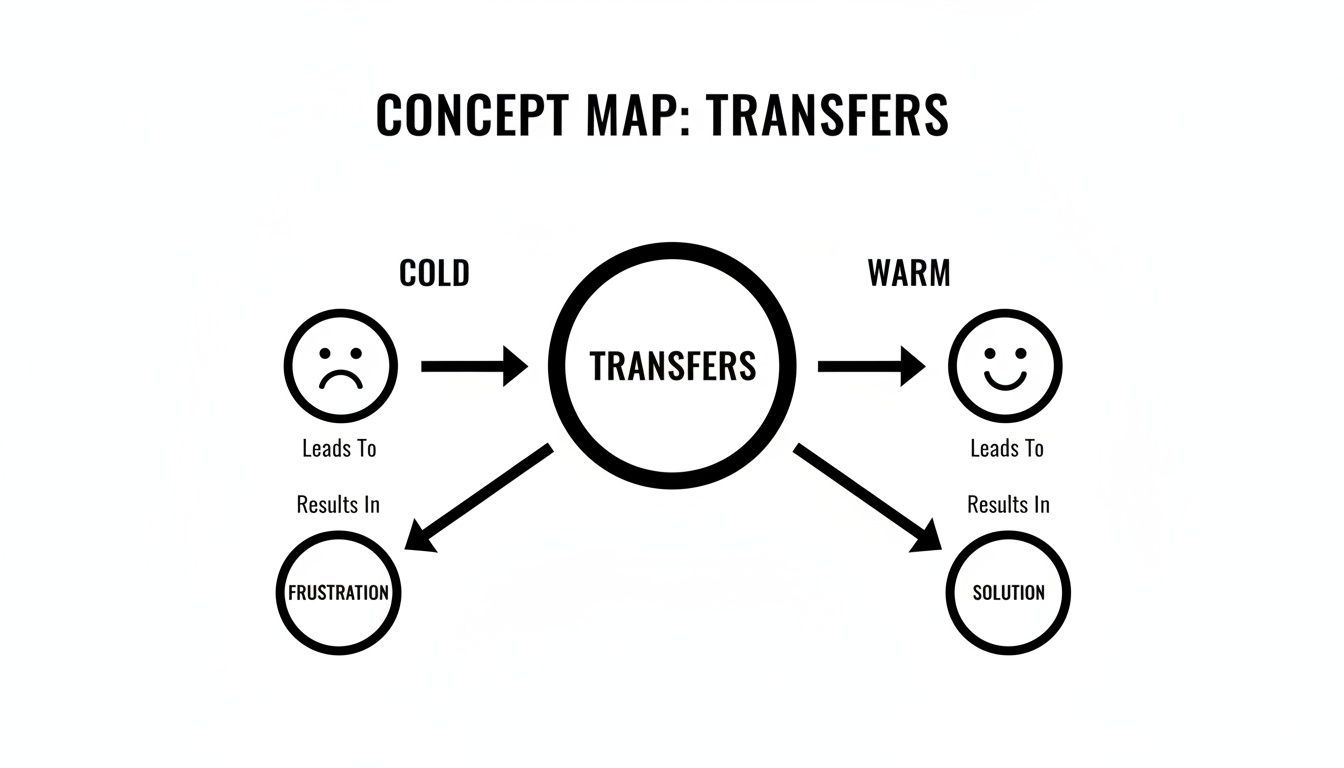
As you can see, the cold transfer is a recipe for a dead end. A warm transfer paves a direct path to a real solution.
Consultative Transfers: The Collaborative Approach
A consultative transfer takes the warm transfer one step further. Think of it as bringing in an expert for a quick huddle. The first agent will talk to a specialist to get advice while the customer is on the line or on a brief hold.
If the specialist is the right person to solve the issue directly, the call then smoothly becomes a warm transfer. This method is perfect for tricky troubleshooting or complex problems where two heads are better than one.
To really nail down the differences, here’s a quick side-by-side look at how these transfer types operate and what kind of experience they create.
Warm Transfer vs Cold Transfer vs Consultative Transfer
| Feature | Warm Transfer | Cold (Blind) Transfer | Consultative Transfer |
|---|---|---|---|
| Agent Handoff | The first agent speaks with the second agent before connecting the customer. | The call is transferred immediately without any prior talk. | The first agent consults a second agent, then may transfer the call. |
| Customer Experience | Seamless and personal. The customer feels valued and doesn't have to repeat themself. | Abrupt and impersonal. Often leads to high frustration. | Highly collaborative and efficient. The customer feels the team is working together for them. |
| Context Provided? | Yes. Full context and a summary of the issue are provided to the next agent. | No. The next agent receives the call with zero context. | Yes. The first agent gathers info from the specialist to either solve or transfer. |
| Best Use Case | Complex issues, escalations, high-value customers. | Simple directory requests or internal transfers. | Technical support, complex problem-solving, or when a subject matter expert is needed. |
| Primary Goal | Customer satisfaction and first-call resolution. | Speed and call volume management. | Expert resolution and knowledge sharing. |
Each method has its place, but it's clear that warm and consultative transfers are built around the customer, while cold transfers are built around speed—often at the customer's expense.
The damage from a bad transfer isn't just a hunch. Cold transfers can lead to a 12% drop in customer satisfaction for the 19% of calls that get transferred. On the flip side, call centers that track their metrics see 90%+ transfer success rates with warm methods, compared to just 70% for cold transfers.
For a deeper dive into how these two core methods stack up, check out our complete breakdown of warm transfer vs cold transfer.
How Warm Transfers Benefit Your Customers and Business
A warm transfer is so much more than a polite handoff. Think of it as a strategic move with a real, measurable return on investment. The benefits ripple out to both sides of the conversation, creating a genuinely better experience for your customer while boosting key metrics for your business.
For customers, the impact is all about feeling seen. When an agent takes a moment to brief the next person, the customer feels heard, valued, and respected. It’s a simple act of coordination that wipes out the single biggest frustration for callers: having to repeat their story from the beginning.
That positive feeling is powerful. It directly translates into stronger customer loyalty and a much better perception of your brand. It turns what could be a stressful support call into a reassuring, collaborative experience, proving your company is organized and actually cares about solving their problem without wasting their time.
Boosting Your Business Bottom Line
The operational advantages of mastering the warm transfer are just as compelling. By giving the next agent the full context upfront, you directly improve some of the most critical metrics in your contact center.
One of the biggest wins is in First Call Resolution (FCR). When the second agent already knows the story, they're equipped to solve the problem right away instead of spending time on rediscovery.
This kicks off a chain reaction of positive outcomes:
- Increased Efficiency: While a single warm transfer might take a few seconds longer for the agent briefing, the overall handle time for complex issues drops significantly because you’ve eliminated all that wasted, repetitive questioning.
- Reduced Customer Churn: It's simple: happy customers stick around. A smooth support experience is a massive differentiator that builds long-term trust and makes it far less likely that a customer will jump ship to a competitor.
- Empowered Employees: Agents feel more confident and effective when they have the information they need to succeed. This cuts down on their own frustration and is a huge boost for team morale.
Companies that embrace warm transfer protocols often see First Call Resolution (FCR) rates jump by up to 15-20%. This human touch doesn't just elevate customer satisfaction; it can also increase profits by up to 95% through stronger loyalty.
At the end of the day, FCR is a powerful indicator of your operational health. To learn more, check out our full guide on what is First Call Resolution and why it’s a metric worth obsession.
The Power of Better Communication
Strong client relationships are built on a foundation of effective communication, and warm transfers are a perfect example of this principle in action.
When you prioritize clear, contextual handoffs, you’re making a direct investment in customer satisfaction and the long-term health of your business. For more on improving these interactions, take a look at these client communication best practices. Putting a warm transfer strategy in place is a simple but profound way to show your customers you’re truly listening.
Putting Warm Transfers Into Practice
Knowing the theory is one thing, but pulling off a flawless warm transfer when you’re on a live call is a different ball game entirely. Getting it right, every single time, comes down to having a clear, repeatable playbook that every agent on your team knows by heart.
To the customer, a well-executed warm transfer should feel like a premium concierge service—effortless and personal. But behind the scenes, it’s a deliberate dance of practiced steps, all designed to guide them from one expert to another without a hint of friction. Nail this process, and you don’t just solve a problem; you build some serious trust.
A Step-by-Step Guide to the Perfect Handoff
Executing a warm transfer isn't rocket science, but the devil is in the details. Following a consistent procedure ensures no customer ever feels like they've been dropped or ignored during the handoff.
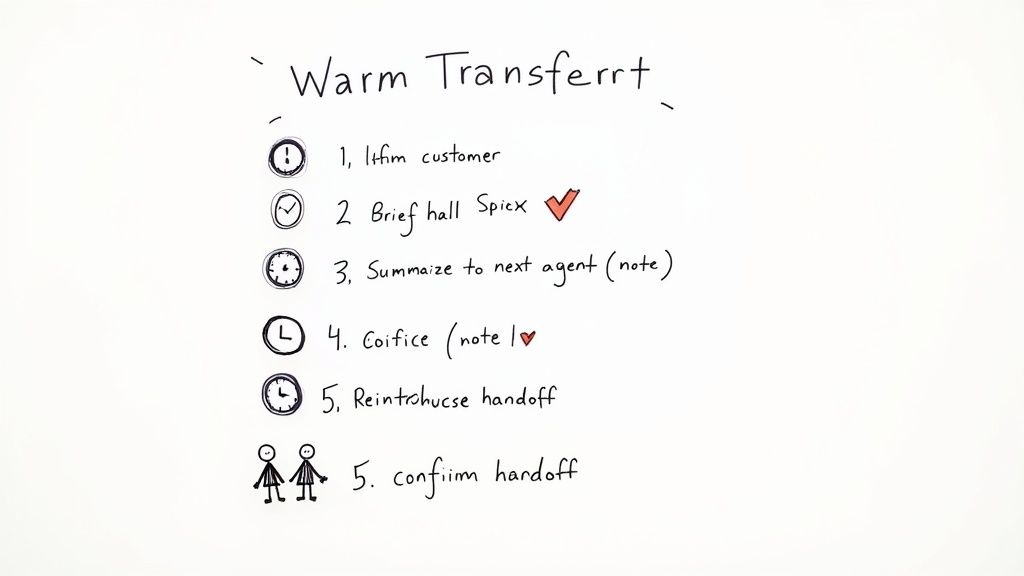
Here’s a simple, five-step process that just works:
-
Acknowledge and Inform. The moment you realize someone else is better equipped to help, tell the customer. Clearly explain why you're transferring them and who they'll be speaking with next. A little transparency goes a long way in setting expectations.
-
Place the Customer on a Brief Hold. Always ask for permission before putting them on hold. A simple script is your best friend here: "To get this sorted for you, I'm going to bring in Sarah from our technical team. Is it okay if I place you on a quick hold while I get her up to speed?"
-
Contact and Brief the Next Agent. This is the heart of what is a warm transfer. Get the receiving agent on the line and give them a quick, effective summary. You'll want to cover the customer's name, the reason for their call, and anything you've already tried. Keep it snappy—under 45 seconds is a good rule of thumb.
-
Make the Personal Introduction. Once you're ready, bring everyone together on a three-way call and make the introduction. "Sarah, I have John on the line who needs a hand with…" This one small act makes your team look incredibly coordinated and professional.
-
Confirm the Handoff is Complete. Before you hang up, just hang back for a second. Make sure the customer and the new agent are connected and have started their conversation. Once you hear that, you can gracefully exit the call.
A study by McKinsey found that 71% of consumers expect personalized interactions from companies. A warm transfer is one of the most direct ways to deliver on that—greeting a customer by name, with full knowledge of their issue, is personalization in its purest form.
Sticking to these steps turns a potentially frustrating moment into a genuinely positive experience. And if you're looking to really dial in your team's approach, our guide on how to transfer calls breaks down even more techniques and scripts. It's a structured method that doesn't just boost customer happiness but also makes your own operations a whole lot smoother.
When to Use a Warm Transfer in the Real World
Knowing what a warm transfer is is one thing. Knowing the perfect moment to use one is where the magic happens. Not every call needs this kind of personal touch, of course. The real skill is in spotting those high-stakes situations where a seamless handoff can turn a potential disaster into a moment of truly exceptional service.
Think of it as choosing the right tool for the job. You wouldn’t use a sledgehammer to hang a picture frame, right? In the same way, a quick, simple request might be fine for a cold transfer, but complex or sensitive issues demand the precision and care that only a warm transfer can provide.
High-Stakes Customer Scenarios
Some customer interactions just carry more weight. They have a massive impact on loyalty, and getting them wrong can cost you a customer for life. In these moments, a warm transfer isn't just a "nice-to-have"—it's an absolute necessity for protecting the relationship and making sure things end on a high note.
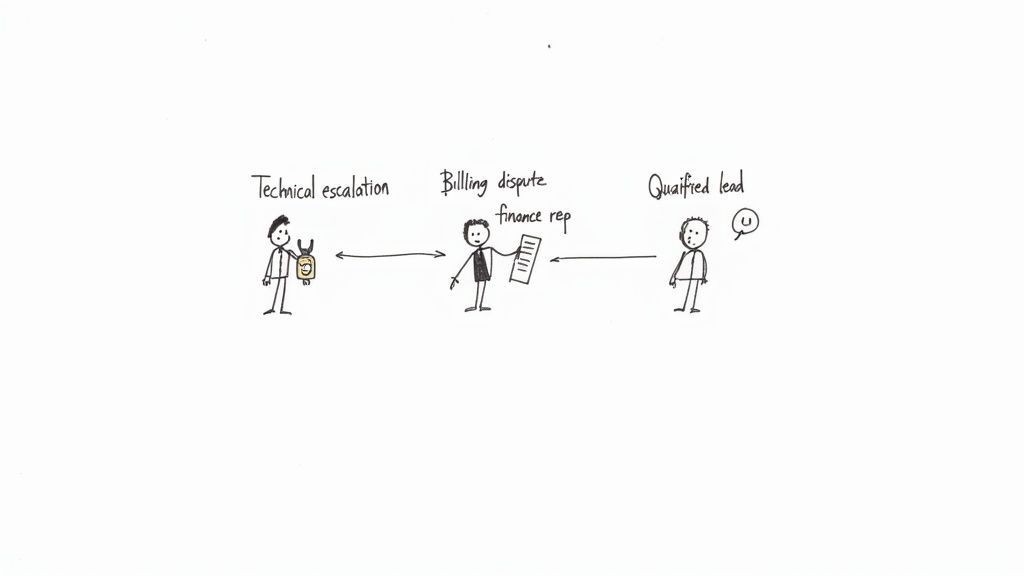
Here are a few classic examples where a warm transfer is the only right move:
-
Tricky Technical Support: A customer is wrestling with a nasty software bug. The Tier 1 agent has run through all the usual fixes, but nothing’s working. Instead of just dumping them into another queue, they start a warm transfer to a Tier 2 specialist. They quickly summarize the issue and what’s already been tried, so the specialist can jump straight into advanced troubleshooting without making the customer repeat their story.
-
Escalating a Billing Dispute: A long-time, loyal customer calls in, and they're not happy about a charge on their invoice. The first agent gets it and confirms their concern but needs a manager's sign-off for the refund. A warm transfer to the manager, complete with the context of the customer's history and the billing error, instantly lowers the temperature of the conversation.
-
Closing a High-Value Sales Lead: Someone calls in with detailed, high-level questions about your top-tier enterprise service. A junior sales rep does a great job qualifying them, then sets up a warm transfer to a senior account executive. The handoff—"Hey, I've got a fantastic potential client on the line who needs your specific expertise"—frames the entire conversation for success.
The Impact on Critical Metrics
It’s in these high-stakes moments that warm transfers really prove their worth, because they directly move the needle on key business metrics.
When agents provide that continuity for customers calling back about the same issue, you see repeat contact rates plummet. In sensitive discussions, that compassionate handoff makes people feel heard and respected, which sends customer satisfaction scores through the roof.
And the numbers don't lie. One key stat shows that warm transfers resolve issues in under 10 minutes on average, while cold transfers often drag on for 15+ minutes. That's a huge time-saver and a big win for first-call resolution. For more insights, check out this great piece on enhancing the customer journey from Voiso.com.
Measuring the Success of Your Transfer Strategy
So, you've put in the work to implement a warm transfer strategy. It feels like a huge win, and it probably is. But how do you actually prove it's working?
The answer is in the data. To show the real impact, you need to be tracking the right Key Performance Indicators (KPIs)—the numbers that tell the full story of what's happening with your customer experience and your team's efficiency. This isn't about cherry-picking one metric that looks good. It's about seeing how different numbers influence each other to justify the effort, find spots to improve, and calculate the real return you're getting from creating better customer handoffs.
Key Metrics for Warm Transfer Success
While there are dozens of metrics you could track, a few are especially powerful for seeing if your warm transfer protocol is truly effective.
You'll want to keep a close eye on these three core KPIs:
-
First Call Resolution (FCR): This is the big one. Are you solving the customer's issue on the very first try, even after the transfer? A rising FCR rate is the clearest sign that your warm transfer process is giving agents the context they need to nail it.
-
Customer Satisfaction (CSAT): Happy customers don't lie. CSAT surveys, especially when sent right after a call, will tell you if the smoother handoff is cutting down on frustration and making people feel better about your service. To get more granular, you can explore different customer satisfaction measurement methods and find what works for your team.
-
Average Handle Time (AHT): Now, this metric can be a little tricky. A warm transfer might add a minute or two to the first agent's AHT because they have to provide a briefing. But—and this is the important part—it should dramatically decrease the handle time for the second agent and slash the need for repeat calls. You're looking for a drop in the total time to resolution.
The real win is when you see your FCR and CSAT scores climbing together. Even if the AHT for transferred calls ticks up slightly, that surge in resolution and satisfaction proves the strategy is a massive success. It shows you're investing a little time upfront to save a ton of time—and customer goodwill—down the line.
Ultimately, you can boil this down to a Transfer Success Rate. This is simply the percentage of transfers that end with a confirmed resolution, no callback needed. It’s a powerful metric that directly connects your warm transfer process to a positive business outcome.
Got Questions About Warm Transfers?
Even the best-laid plans run into real-world questions. When you start weaving a new strategy like warm transfers into your daily workflow, a few things are bound to pop up. Here are some straight answers to the most common queries we hear.
Does a Warm Transfer Always Add to the Call Time?
Not when you look at the big picture. It’s true that a single warm transfer might tack on an extra 30 to 60 seconds for the first agent to brief the next one. But that small upfront investment almost always shrinks the total time it takes to solve the customer's problem.
Think about it: by getting the right agent the right information from the jump, you eliminate those long, frustrating repeat explanations and kill the need for follow-up calls. That little bit of time spent upfront is a massive driver for boosting First Call Resolution and saves way more time across the entire customer journey.
Is There Ever a Good Time for a Cold Transfer?
Absolutely. While a warm transfer is the gold standard for anything complex or emotionally charged, a cold (or blind) transfer is perfectly fine for simple, direct requests where zero context is needed.
For example, if a caller knows exactly who they need—"Can you put me through to Sales?"—a direct transfer is faster and more efficient for everyone. The trick is to use cold transfers strategically for simple routing, not for actual problem-solving.
Remember: The goal is always to get the customer to the right resolution, efficiently. Use a warm transfer when context is king and a cold transfer for straightforward, A-to-B requests.
What Tools Do I Need to Do This Well?
Most modern VoIP and cloud contact center platforms come with "attended transfer" functionality baked right in—that’s just the technical term for a warm transfer.
But to really make it sing, you need that system hooked up to your Customer Relationship Management (CRM) software. That connection gives agents an instant look at the customer's history, making the handoff briefing incredibly fast and thorough. For teams looking to level up, advanced features like "agent whisper" can even let managers coach new reps through the process in real time, right on the call.
Ready to make sure every caller gets the VIP treatment they deserve? Marlie Ai delivers intelligent call routing and smart transfer capabilities so your customers always find the right person without ever having to repeat themselves. See how our AI phone assistant can free up your team and make your customers happier by visiting https://www.marlie.ai.
