
At its core, screening a call means figuring out who is calling and why before you ever pick up the phone.
Think back to the classic answering machine, where you could listen in as someone left a message. That was the original, old-school version of call screening. It gave you a split-second to decide: jump in and take the call, or let it go to tape?
From Answering Machines to AI Call Screening
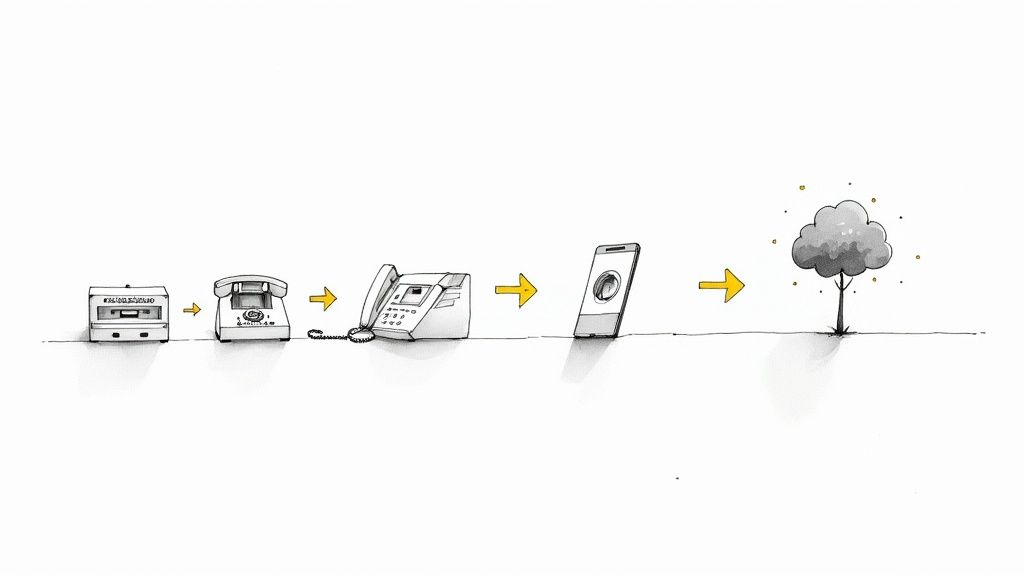
That simple goal—knowing who's on the other end of the line—hasn't changed. But the technology that gets us there? It’s a completely different world. This journey from passively listening in to proactively filtering calls marks a huge shift in how businesses handle their phones.
The Manual Era
In the beginning, call screening was a hands-on job. You had a couple of basic tools, and that was about it.
- Caller ID: This was a step up, giving you a name and number. But it gave you zero context. Was it a new customer ready to book a job, or just another sales pitch? It was a guessing game.
- Answering Machines: Listening to a voicemail as it was being recorded offered a bit more insight, but it was slow and reactive. You had to wait for the caller to start talking, hoping they’d get to the point quickly.
This manual process was better than flying blind, but it was clunky. It still let countless interruptions slip through the cracks, demanding your attention for calls that were rarely urgent or important.
The Rise of Automation
The next logical step was bringing in more structured systems. We all know the classic Interactive Voice Response (IVR) menus: "press 1 for sales, press 2 for support." They offered a basic way to route callers, but let's be honest—they often created a frustrating maze for real customers while doing little to stop sophisticated spam calls.
This frustration, however, laid the groundwork for smarter solutions. It opened the door for a modern automated call system that could actually understand what a caller was saying in plain English.
Today, call screening has moved into a new phase, powered by artificial intelligence. Modern tools can automatically pinpoint a caller's intent, instantly telling the difference between spam, a sales pitch, and a genuine customer inquiry—all without a human lifting a finger. This evolution isn't just about blocking bad calls; it's about making sure the good ones get through immediately.
An industry analysis found that AI-based call screening can lead to 27% higher customer satisfaction scores and a 37% improvement in first-call resolution rates. That’s the real-world value of intelligent filtering in action.
The Real Cost of Unwanted Business Calls

Every single unwanted call is more than a minor annoyance. It’s a direct hit to your team's focus and productivity. An unscreened business line is basically like leaving your office door wide open on a busy street. Sure, you might get a few real customers wandering in, but you’ll also be flooded with solicitors, noise, and endless distractions that pull your team away from the work that actually matters.
This constant stream of interruptions has a real, tangible cost. It's not about the few seconds it takes to hang up on a robocall. It's the cumulative loss of focus, the disruption to deep work, and the mental energy burned just switching from one task to another and back again. Every time the phone rings with a junk call, your team has to completely restart their thought process, killing their momentum on critical projects.
Quantifying the Productivity Drain
The scale of this problem is just staggering. In the United States, consumers were hit with nearly 5 billion robocalls in a single recent month. For a business, that firehose of junk translates into a massive operational drag. According to Hiya's 'State of the Call' report, a whopping 28% of all unknown calls were spam or fraud. The time your team spends filtering that junk adds up, fast. You can dig into a deeper breakdown of the operational impact of these interruptions in this report.
All that lost time hits your bottom line directly. Even a small team can lose hundreds of hours a year simply dealing with unwanted calls—time that could have been spent helping customers or closing deals. In that chaos, it's tragically easy for legitimate customer calls to get lost in the noise, leading to missed opportunities and a frustrating service experience.
When every call is a potential interruption, your team starts treating the phone as an enemy instead of an asset. This defensive posture means important calls are met with hesitation, while spam calls are accidentally given valuable time.
This is the hidden tax of an unfiltered phone line. It’s a recurring expense paid in lost hours, tanking efficiency, and missed revenue. To get a clearer picture, let's look at the specific ways these calls eat away at your business.
The True Business Impact
The fallout from unfiltered calls ripples through every part of your operation. Beyond the obvious time sink, the constant barrage of spam creates a high-stress environment that leads to employee burnout and cratering job satisfaction.
Here’s where the damage really accumulates:
- Lost Focus: It can take over 20 minutes to fully get back on track after a single interruption. A few spam calls an hour can completely destroy any chance for deep, productive work.
- Missed Opportunities: When your lines are jammed with junk, real customers with real needs are more likely to hit a busy signal or just give up. And they'll take their business with them.
- Degraded Customer Service: A team that's constantly on edge from fending off sales pitches is less likely to provide the patient, friendly service your customers deserve.
Putting a solid call screening strategy in place isn't just a defensive move. It's a proactive investment in protecting your team’s most valuable asset: their time and attention. You can even calculate the cost savings for your specific business to see just how much you stand to gain.
How Different Call Screening Methods Work
Understanding what it means to screen a call is one thing; seeing how it’s actually done is another. The methods range from a completely hands-on, human approach to sophisticated systems that run themselves. Each one acts as a different kind of gatekeeper for your business, with its own quirks and strengths.
Think of your business phone line as the front door to your office. How you decide to manage that door determines who gets in, how fast they’re helped, and how much time your team loses to interruptions. Let's look at the different "doormen" you can hire for the job.
The Human Touch: Manual Screening
The old-school method is manual screening, which is just a fancy way of saying a person handles it. This is your classic live receptionist who picks up every single call, quickly figures out what the caller needs, and then decides whether to transfer them, take a message, or politely end the conversation.
- How it works: A dedicated person—either an in-house receptionist or an answering service—answers every incoming call. They use their judgment and a set of company guidelines to filter and direct callers where they need to go.
- Key Advantage: You can't beat the personal, high-touch experience. A skilled human can build instant rapport and navigate complex, nuanced conversations that would stump an automated system.
- Primary Drawback: It’s easily the most expensive and least scalable option. This approach is also prone to human error, and since one person can only handle one call at a time, you're guaranteed to miss calls when things get busy.
Structured Automation: IVR Systems
A step up from purely manual screening brings us to the Interactive Voice Response, or IVR system. You know this one well: it’s the familiar "press 1 for sales, press 2 for support" menu that forces callers into predefined boxes. While it does automate routing, it screens calls by sorting them, not by actually understanding their intent.
We have a complete guide that dives deeper into what an IVR system is and how it works.
This approach is like a digital maze. It's helpful for callers who know exactly which department they need, but it often becomes a frustrating dead-end for anyone with a unique or urgent problem, forcing them to just guess which option is "close enough."
An IVR system doesn't truly "screen" in an intelligent sense; it just sorts. It can't tell a high-value lead from a persistent robocaller—it simply sends them both down different paths in the maze. This lack of nuance is its biggest flaw.
Intelligent Screening: AI Assistants
The modern approach uses artificial intelligence to screen calls based on the actual content of the conversation. An AI phone assistant answers instantly and uses natural language processing to understand why someone is calling, in their own words.
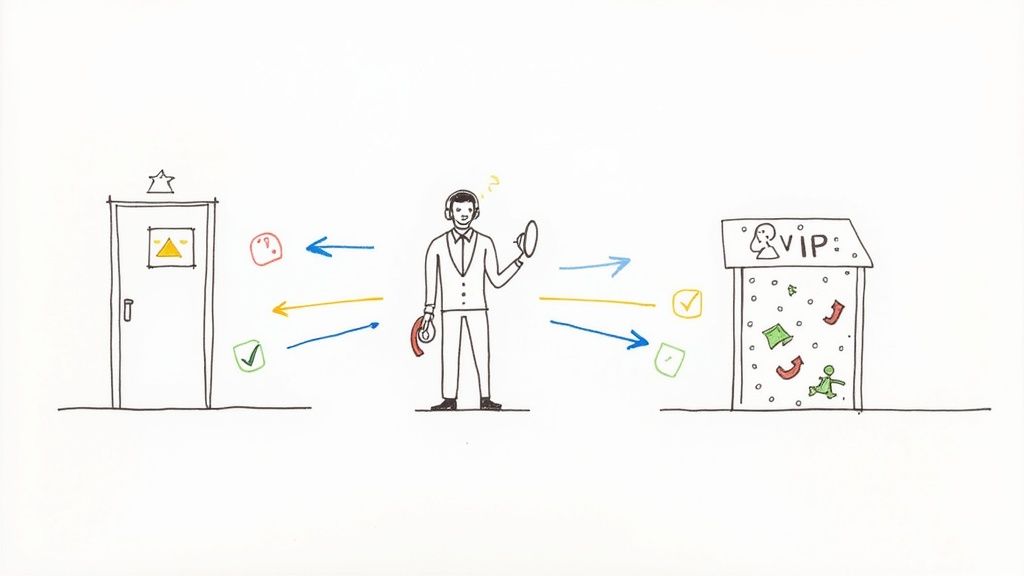
This method is like having a super-powered doorman who instantly recognizes VIPs, knows every employee's schedule, and can spot a solicitor from a mile away.
- AI identifies intent: The system listens to what the caller says and determines if they're a new customer, an existing client with a question, a spammer, or a salesperson trying to pitch you.
- It takes action: Based on that intent, the AI can automatically book an appointment, answer a common question, block the spam call, or route the conversation to the right human expert without missing a beat.
This approach gives you the efficiency of automation combined with the conversational nuance that was once only possible with a live human, offering a solution that's both scalable and surprisingly cost-effective.
To really see how these three methods stack up, let's put them side-by-side. Each has a place, but they solve very different problems for a business.
Comparing Call Screening Methods
| Method | How It Works | Best For | Key Advantage | Key Disadvantage |
|---|---|---|---|---|
| Manual | A live person (receptionist) answers, assesses, and routes every call based on conversation and judgment. | Businesses needing a highly personal, white-glove service for every single caller, regardless of cost. | Unmatched personal touch and ability to handle complex, nuanced inquiries. | Extremely expensive, not scalable, limited to one call at a time, and prone to human error. |
| IVR | An automated phone menu ("Press 1 for…") that forces callers to self-sort into predefined categories. | Large organizations with distinct departments where callers generally know exactly who they need to talk to. | Low-cost call routing that can handle high call volumes without human intervention. | Impersonal, often frustrating for callers, and completely unable to understand intent or context. |
| AI Assistant | An AI-powered system answers calls, understands the caller's intent through conversation, and takes action. | Service-based businesses that need to capture leads, book appointments, and block spam efficiently. | Blends human-like conversational ability with automation's scalability and efficiency. | Requires initial setup and works best when integrated with business scheduling/CRM software. |
Ultimately, the right "doorman" for your business depends on what you value most: the personal touch of a human, the rigid structure of a menu, or the intelligent efficiency of AI.
Screening vs Blocking vs IVR Explained
It’s easy to lump call screening, call blocking, and IVR systems into the same bucket, but they actually handle incoming calls in fundamentally different ways. To really get what it means to screen a call, you have to see how it stacks up against the others.
Think of each one as a different kind of gatekeeper for your business, each with its own philosophy.
Call Blocking: The Brick Wall
Call blocking is a brick wall. It’s a purely defensive move designed to stop known troublemakers—spam callers, robocallers—from ever getting through.
It works by checking an incoming number against a blacklist. If it finds a match, the call gets dropped. Simple. It’s great for shutting down repeat offenders but does absolutely nothing for calls from new or unknown numbers, whether they're good or bad. For a deeper dive, check out our guide on how to block spam phone calls.
IVR: The Digital Maze
An IVR (Interactive Voice Response) system, on the other hand, is like a complex digital maze. It forces every single caller—your best customer and a pesky telemarketer alike—to navigate a rigid menu of button presses. "Press 1 for sales, press 2 for support…"
It sorts calls into predefined buckets, but it has zero intelligence to understand what a caller actually wants. This often leads to a frustrating dead-end for anyone whose problem doesn’t fit neatly into a category.
Call Screening: The Smart Doorman
This brings us to intelligent call screening, which is best imagined as a smart doorman. Instead of putting up a wall or creating a maze, a modern screening system actually engages with every visitor to figure out their purpose.
A smart doorman doesn't just block everyone or force them through a confusing hallway. It greets everyone, instantly recognizes VIPs, politely turns away solicitors, and efficiently directs legitimate visitors to the exact person they need to see. This is the essence of modern call screening.
This approach is proactive, not just reactive. It prioritizes the caller's experience by having a brief, natural conversation to determine who is calling and why. It then uses that context to take the right action—block a spammer, schedule an appointment for a new lead, or transfer an urgent issue straight to a human.
This quick decision tree shows how automated and manual screening approaches differ in practice.
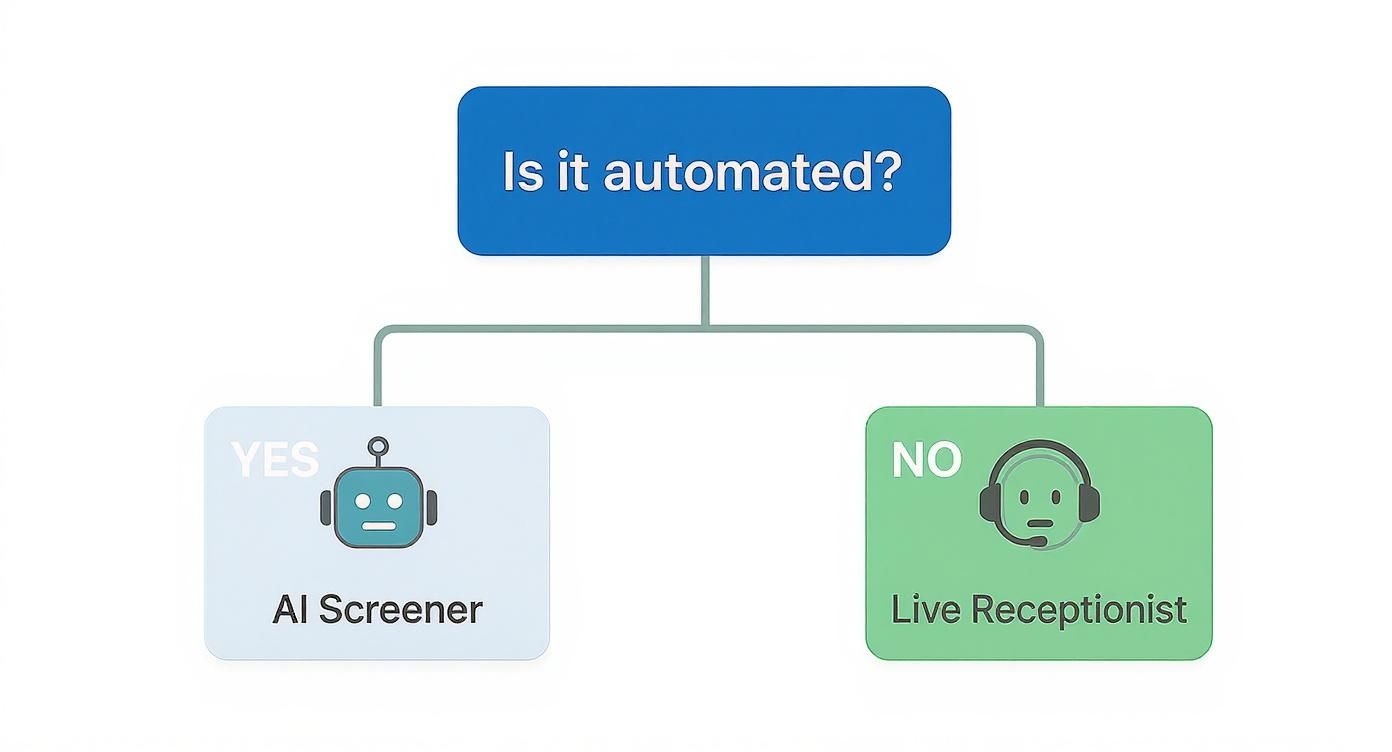
The key takeaway? Automation, especially with AI, lets you filter intelligently at scale, while manual options provide that classic personal touch.
Choosing the Right Gatekeeper
Understanding these differences is the key to picking a solution that helps, rather than hinders, your business.
- Blocking is a simple filter.
- IVR is a rigid sorter.
- Screening is an intelligent qualifier.
For service businesses where every legitimate call is a potential job, just blocking known numbers or frustrating real customers with menus isn't going to cut it. An intelligent screening system makes sure you capture valuable opportunities while protecting your team’s time, making it the most effective "doorman" for a growing business.
The Real Payoff of Automated Call Screening
Putting an automated call screening system in place is about much more than just stopping annoying robocalls. It's a strategic move that hits your bottom line, hard. Forget vague promises about "better efficiency." The benefits here are specific, measurable, and can completely change how your service business operates.
The goal is to turn your phone line from a constant source of interruption into a powerful asset for growth. The most immediate return you'll see is the recapture of lost time. Every single moment your team spends fending off a sales pitch or answering the same simple question is time they aren't spending on work that actually makes you money. An AI-powered system acts as a frontline defender, handling all that noise so your skilled people can focus on high-value work.
Drive Measurable Performance Gains
This is where the rubber meets the road. Automated screening delivers a clear return on investment by optimizing the numbers that matter. It’s not just about feeling less busy; it’s about seeing concrete, data-backed improvements across your entire operation.
You'll see these gains pop up in a few critical areas:
- Shorter Call Handling Times: Imagine an AI gathering the caller's name, their issue, and contact details before a human ever picks up. When a call finally gets transferred, your team has all the context they need to solve the problem fast, without asking a bunch of repetitive questions.
- Increased First-Call Resolution: With intelligent routing, customer calls get to the right person or department the first time, every time. This simple change eliminates those frustrating transfers and dramatically boosts the chances that a customer's problem gets solved in a single interaction.
- Reduced Employee Burnout: By filtering out the 90% of unwanted calls that pester many businesses, you're shielding your team from the constant stress and distraction of spam. A focused, less-frustrated team is a team that provides better service—and is far more likely to stick around.
Think of it this way: an automated screener isn't just a filter; it's a professional assistant for every single person on your team. It preps them for every important call, making sure they're ready to win from the moment they say "hello."
Convert More Leads Into Booked Jobs
For any service business, a ringing phone is a potential opportunity. The problem is, without a good screening process, high-quality leads can easily get lost in the sea of spam calls and misdials. This is where a modern AI assistant creates a powerful competitive edge, making sure you never miss a chance to win new business.
An intelligent screener like Marlie.ai does more than just answer the phone—it actively qualifies and converts callers. When a new customer calls, for example, the AI can instantly figure out what they need, ask the right qualifying questions, and even tap into your calendar to book an appointment right then and there.
This means a potential customer can go from their first call to a confirmed job on your schedule in minutes, 24/7, without any human ever touching it. By automating the very top of your sales funnel, you capture leads when their interest is highest, turning your phone line into an automated, revenue-generating machine.
How to Implement a Call Screening System
Alright, so you’re ready to finally take control of your phone lines. The good news is, putting a call screening system in place isn’t some monumental task. It really just starts with getting a clear picture of your specific needs. The whole point is to build a filter that works for your business, letting the important calls glide through while keeping the time-wasters out.
First thing’s first: do a quick audit. For just one week, keep a simple log of the calls coming in. What are your biggest headaches? Are you drowning in a sea of spam calls? Are genuine customers getting bounced around to the wrong person? Or, like so many service businesses, are you just flat-out missing calls because your team is out on a job?
Knowing exactly what you're up against is half the battle.
Defining Your Call Screening Rules
Once you've identified the enemy, you can build your battle plan. This is all about setting crystal-clear rules for how different calls get handled. Think of it like giving a really smart doorman a very specific set of instructions.
Start by figuring out what a “priority” call looks like. Is it a brand-new customer asking for a quote? An existing client with an emergency? Pinpointing these high-value interactions is the most important step.
From there, you can create some simple routing rules:
- New Leads: These need to be captured instantly. An AI system can qualify them and get them booked on the spot, while a manual setup should send them straight to your best salesperson.
- Existing Customers: Get them to the right person fast—whether that's support or their account manager. No runaround.
- Known Spam Numbers: Block them. They shouldn't even make your phone ring once.
- Solicitors & Sales Pitches: These can be funneled to a general voicemail box or politely handled (and disconnected) by an AI.
For companies in the service industry, weaving these rules into a specialized CRM for telecommunications can unlock even deeper insights and make your whole operation run smoother.
Rolling Out Your New System
With your rules mapped out, it's time to pick your tool—whether that’s a live answering service, a basic IVR, or a smart AI assistant. A great way to ease into it is with a small pilot program. Test the new system on just one phone line or during your slower hours to iron out any wrinkles. Using an automated calling system can make this testing phase a lot simpler.
But the final piece of the puzzle isn't technology—it's your team. Make sure everyone understands how the new system works, what their role is, and most importantly, how it’s going to make their jobs easier, not harder. A great implementation is as much about people as it is about software.
Ready to stop missing calls and start booking more jobs? Marlie.ai is a 24/7 AI phone assistant that answers every call, qualifies leads, and books appointments automatically, so you can focus on running your business. Discover how Marlie.ai can transform your phone lines today.
