

Ever heard of a virtual office telephone service? It's essentially a cloud-based phone system that gives your business a professional, centralized phone presence without being chained to a physical office. It works using Voice over IP (VoIP) technology, which lets you take and make calls from pretty much any device with an internet connection—your laptop, your smartphone, you name it. The end result is a polished, credible image for your customers, no matter where you're working from.
How a Virtual Phone Service Modernizes Your Business

Picture a traditional office landline. It’s a physical wire connected to a single, clunky desk phone. If you're not sitting at that specific desk when it rings, you miss the call. Simple as that.
A virtual office telephone service cuts that cord entirely. Instead of your business calls traveling through a physical wire, they zip across the internet.
This one simple shift changes everything. It means your "office phone" is no longer a piece of hardware but a flexible piece of software living on the devices you already own. You can answer a client call on your laptop from a coffee shop or transfer an urgent call to a team member’s mobile phone with a single tap.
The Core Components of a Virtual System
This kind of technology gives solopreneurs, remote teams, and growing businesses the same powerful communication tools that big corporations use, but without the staggering cost or complexity. The core idea is to separate your business number from a physical location, giving you complete freedom.
A virtual office telephone service essentially provides a professional address and communication infrastructure without the need for a physical office lease. It’s a lean, flexible solution for modern businesses.
For example, this system is a key piece in setting up a virtual front desk, allowing one person or a small team to manage all incoming communications efficiently from literally anywhere. You can even create a presence in a new city by getting a local number for that area code, even if you’re operating thousands of miles away.
Why This Matters Now More Than Ever
The massive shift to remote and hybrid work has made these services indispensable. The global VoIP market, which powers every single virtual office telephone service, was valued at US$178.89 billion in 2025 and is projected to hit US$413.36 billion by 2032.
This incredible growth isn't surprising. It’s driven by the reality that over half the workforce now operates in a hybrid model, and they need tools that can replicate a physical office's functionality without the four walls.
As businesses roll out effective strategies to get your phone ringing, a virtual system becomes critical for handling that increased call volume professionally. It’s no longer just about answering calls; it’s about creating a seamless, credible experience for every single customer who reaches out.
How Virtual Phone Systems Actually Work
A virtual phone system might sound technical, but it’s actually pretty simple. Think of it less like a single piece of tech and more like a communication toolkit. The whole point is to intercept your business calls before they hit your personal phone, giving you a few different ways to manage them.
Each option offers a totally different experience for your callers. Nailing this choice is the key to getting a service that doesn't just answer the phone but actively helps you run a smarter business. Let's pull back the curtain on how each model works.
The Personal Touch of a Live Receptionist
This is the classic, high-touch option. When someone dials your virtual business number, the call gets routed to a professional, human receptionist who works remotely. This isn't someone you hire directly; they're part of a trained team from the service provider.
The receptionist answers with your custom greeting, something like, "Thank you for calling Smith Consulting, how can I help you?" From there, they become your gatekeeper, screening calls exactly how you've instructed. They can tell the difference between a hot lead and a cold sales pitch, making sure only the important stuff gets through to you.
Once they've greeted the caller, they can:
- Transfer the call: They'll announce who's calling before connecting them, so you can decide whether to take it or send it to voicemail.
- Take a detailed message: If you're busy, they’ll get all the necessary info and shoot it over to you in an email or text.
- Handle basic inquiries: They can answer common questions about your business hours, location, or services.
This approach is perfect for businesses like law firms or financial advisors where that first impression of credibility and professionalism is everything. You get all the flexibility of a virtual setup with the irreplaceable warmth of a real human connection.
The Efficiency of an IVR or Auto-Attendant
You've definitely run into this one before. An Interactive Voice Response (IVR), or auto-attendant, is the automated menu that greets callers with, "Press 1 for Sales, Press 2 for Support, Press 3 for Billing."
This system is your digital switchboard operator, working 24/7 to get calls to the right person or department without anyone lifting a finger. Instead of one person screening every single call, the caller routes themselves. It's incredibly efficient for businesses that juggle a high volume of calls for different reasons.
An IVR ensures every call is sorted and sent to the correct destination instantly. This prevents your main line from becoming a bottleneck and frees up your team from the repetitive task of transferring calls all day.
Think of an e-commerce store. An IVR can automatically send questions about order status to one queue while piping new sales leads directly to the sales team. This intelligent direction of traffic is a core part of modern call routing, a process that keeps your operations smooth and lets your staff focus on what they do best.
The Intelligence of AI-Powered Systems
This is the newest and most advanced option, using Artificial Intelligence to manage calls. An AI phone assistant is miles ahead of a simple "press 1" menu. It uses natural language processing to actually understand what a caller is saying and can have a real, two-way conversation.
When a customer calls, the AI can:
- Answer routine questions: It can handle 60-80% of common inquiries like "Are you open on Saturdays?" or "What's the status of my appointment?" all on its own.
- Perform tasks: A properly set-up AI can book appointments, process payments, or gather lead information right there on the call.
- Triage and transfer: If a caller has a problem the AI can't solve, it intelligently transfers them to the right human agent and even gives that agent a transcript of the conversation so far.
For a service business like an HVAC company or a locksmith, an AI assistant can get a customer's name, location, and issue, then immediately fire that information off to a technician in the field. This model delivers incredible efficiency and savings, handling the bulk of your calls for a fraction of the cost of live agents and making sure you never miss an opportunity.
Choosing A Service Based On Cost and ROI
When you’re looking at a virtual office telephone service, it's easy to get fixated on the monthly subscription price. But the smartest move isn't just about comparing sticker prices—it's about digging into the true return on investment (ROI) each model really offers.
Your goal isn't just to find the cheapest option. It’s to find the one that delivers the most value for your business. That means weighing the direct costs against the powerful, indirect gains like saved labor, happier clients who stick around, and a brand that sounds more professional than ever.
Breaking Down The True Cost
Let's unpack the financial trade-offs between the three main service models. Each one is built for a different purpose, and knowing that difference is the key to getting the most bang for your buck.
A live receptionist service will have the highest monthly fee, no doubt. But its value comes from creating a premium, personal experience. For a law firm or a high-end consultancy, that human touch can be the very thing that lands a high-value client, making the investment pay for itself over and over again.
On the other end, an IVR or auto-attendant is all about cost savings, especially for businesses drowning in calls. By automatically routing calls, it frees your team from playing switchboard operator, letting them focus on work that actually brings in revenue. For a deeper dive into the numbers, check out our guide on virtual receptionist cost.
Calculating Your Potential Return
The ROI from a virtual phone service isn't just about soft benefits; it shows up in hard numbers, too. One of the biggest drivers is pure cost savings. International calls that used to cost dollars a minute now cost pennies, with VoIP solutions expected to grab 56.7% of the market by 2025.
In fact, businesses that move their contact centers to the cloud can cut call handling costs by an average of 15%.
To get a clear picture of your potential ROI, think about these things:
- Reduced Labor Costs: How many hours do your people spend just answering and routing basic calls? An automated or AI system can make that cost practically disappear.
- Increased Lead Capture: Think about all the calls you miss after hours or when every line is busy. A 24/7 service means every single lead gets captured, which is a direct boost to your bottom line.
- Improved Client Retention: A smooth, professional answering service makes for happy customers. Happy customers are loyal customers, and that loyalty is priceless.
This flowchart shows how these different call-handling paths line up with different business goals—from building personal relationships to managing huge call volumes with pure efficiency.
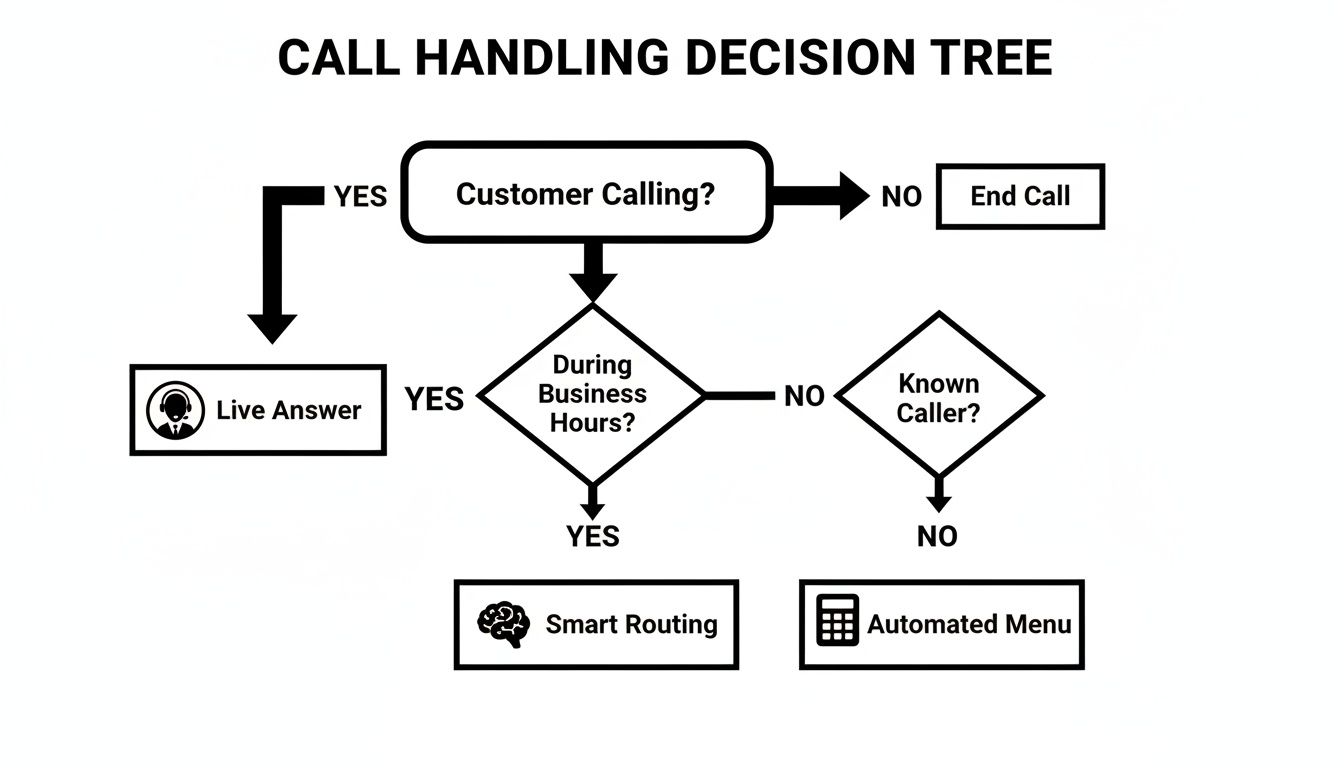
The big takeaway here is that the right service depends entirely on what you're trying to achieve. Are you building relationships, managing traffic, or boosting efficiency?
A Comparative Look At Service Models
Picking the right virtual office telephone service really comes down to what each option brings to the table. What works for a lean startup is rarely the right fit for an established enterprise. It's always a good idea to compare the best internet telephone service options to see how their features stack up.
The most effective choice is the one that aligns your budget with your biggest business goal. Are you trying to project a premium image, handle massive call volumes efficiently, or automate routine tasks to free up your team? The answer to that question points directly to your ideal service model.
To make this crystal clear, let's lay out the key differences side-by-side in a table.
Virtual Phone Service Model Comparison
This table breaks down how the three main service models stack up against critical business factors like cost, customer experience, and scalability.
| Feature | Live Receptionist Service | IVR/Auto-Attendant | AI-Powered System |
|---|---|---|---|
| Direct Cost | High | Low | Moderate |
| Customer Experience | Highly Personalized | Impersonal but Efficient | Conversational & Instant |
| Best For | Building client trust and a premium brand image. | High-volume call routing and departmental sorting. | 24/7 lead capture and automating routine inquiries. |
| Key ROI Driver | Increased client acquisition and retention rates. | Massive savings on labor and operational costs. | Drastically reduced cost-per-call and zero missed opportunities. |
Each model has its place. A live receptionist excels at building trust, an IVR is a workhorse for high-volume routing, and an AI system offers a powerful blend of 24/7 availability and intelligent automation. The best choice is the one that solves your most pressing communication challenge.
Essential Features Every Business Needs
Picking a virtual office telephone service is a lot like buying a new car. The main goal is obvious—getting from point A to point B—but it’s the features that really define the experience. A bare-bones model works, sure, but the right additions can turn a simple utility into something that genuinely pushes your business forward.
Think of this as your must-have checklist. These aren't just shiny objects; they are practical tools built to save you time, make every customer interaction better, and ultimately help you grow. Let's dig into the non-negotiables.
Foundational Call Management Tools
Before we get into the clever stuff, any solid virtual phone system has to nail the basics. These are the engine of your communications, making sure every call is handled cleanly and professionally, no matter where you are.
-
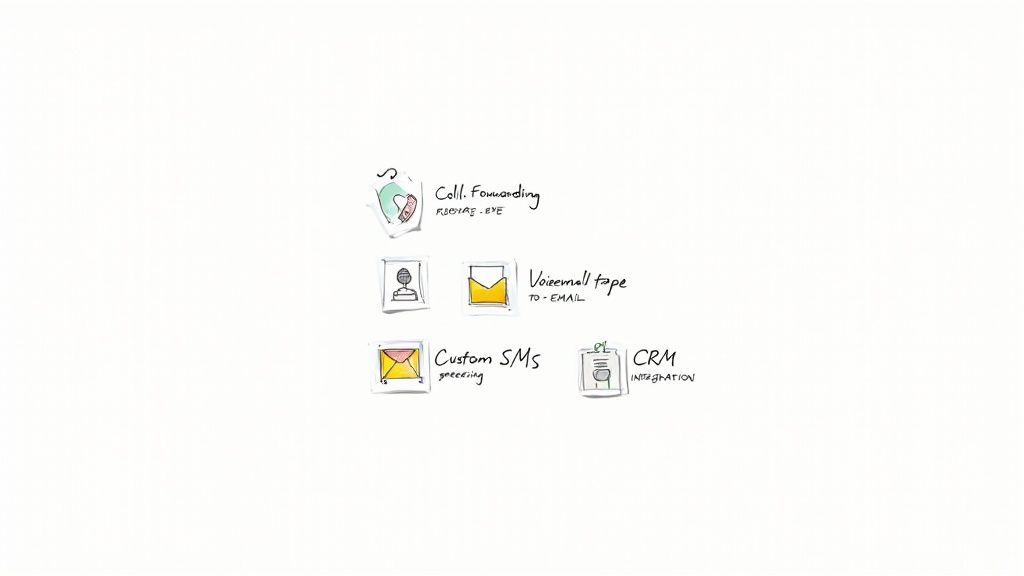
Call Forwarding: This is more than just bouncing a call from one number to another. It’s what turns your personal cell into a secure business line. You can send calls to your mobile, a teammate, or even a landline without ever giving out your private number.
-
Custom Greetings and Hold Music: First impressions are everything. A polished, custom greeting immediately signals that you're a serious business. Good hold music lets callers know they haven't been forgotten if they need to wait a minute.
-
Mobile and Desktop Apps: Real flexibility means you can run your business line from anywhere, on any device. A good app lets you make calls, check voicemails, and send texts from your business number, keeping your work and personal lives completely separate.
Game-Changing Productivity Features
With the fundamentals locked in, the next layer is all about efficiency. These are the tools that automate the tedious little tasks, handing you back precious time. They turn your phone system from a passive tool into an active partner.
A perfect example is voicemail-to-email transcription. Instead of dialing in and listening to messages, the system automatically turns the audio into text and shoots it straight to your inbox. You can scan a message in seconds during a meeting or on a loud train, making it easier to respond quickly.
Another one is business texting (SMS). More and more, customers prefer sending a quick text for simple questions or appointment reminders. Building this into your main business number gives them another easy way to connect, and it keeps all your communications in one place.
The right set of features transforms your phone service from a passive utility into the central nervous system of your customer communication strategy. It’s about creating a connected, efficient, and professional experience at every single touchpoint.
Advanced Integrations and Intelligence
This is where a modern virtual phone service really starts to pull away from the pack. The magic happens when it connects with the other software you use every day. The most critical integration of all is with your CRM.
When your phone system and Customer Relationship Management (CRM) software are linked, an incoming call can instantly pull up that caller’s entire history—past conversations, orders, and support tickets. This gives you immediate context, turning a cold call into a warm, informed conversation.
Demand for this kind of intelligence is exploding. Small and mid-sized businesses, in particular, are expected to drive over 15% of the market's growth by 2025, mostly by adopting smart features like AI-powered call routing and deep CRM connections. You can get a closer look at these trends in this market analysis from Data Insights Market.
These features, from basic call handling to intelligent CRM links, are what give a virtual phone system its power. You can see a full list of advanced AI phone features that take this a step further, automating everything from scheduling to lead qualification.
How Different Industries Use Virtual Phones
Theory is one thing, but you really see the power of a virtual office telephone service when it's put to work in the real world. This isn't some one-size-fits-all gadget; it's more like a versatile toolkit that smart professionals adapt to solve their specific communication headaches.
Let’s walk through a few scenarios to see how different businesses use these systems to look bigger, work smarter, and ultimately grow. Each one connects a real business problem to a practical, effective solution.
The Boutique Law Firm Projecting Prestige
Picture a small, ambitious law firm. For them, every single interaction has to scream authority and trust. A missed call isn't just a lost lead—it’s a dent in the professional armor they’ve so carefully built.
They opt for a live receptionist service, which basically acts as their virtual front desk. When a potential client, a judge's clerk, or opposing counsel calls, they're greeted by a calm, professional human being who actually understands the nuances of the legal world.
This receptionist can:
- Screen calls intelligently: They know the difference between an urgent client matter and a sales pitch, making sure the attorneys’ time is never wasted.
- Gather essential intake information: When a new client calls, the receptionist collects the key details right away, so the legal team is prepped and ready before they even pick up the phone.
- Schedule consultations directly: By plugging into the firm's calendar, they can book initial consultations on the spot, capturing high-value leads before they can call someone else.
For this firm, the slightly higher cost of a live service pays for itself many times over. It gives them the presence of a much larger, more established practice and guarantees every caller gets a white-glove experience from the very first ring.
The E-commerce Brand Automating Support
Now, think about a growing e-commerce brand shipping hundreds of orders a day. Their small support team was drowning in the same question over and over: "Where is my order?" Answering that one question all day kept them from handling more complex problems like returns or product issues that actually required their expertise.
They put an IVR/auto-attendant in place, and it completely changed their workflow. When a customer calls now, the first thing they hear is a menu, with "Press 1 to check your order status" as the top option.
By routing routine inquiries through an automated system, the e-commerce brand freed up an estimated 10-15 hours of staff time per week. This let their support team focus on the high-value interactions that build loyalty and bring customers back.
Customers get instant answers 24/7 without waiting for an agent, and the support team can finally dedicate their skills to solving problems that actually need a human touch.
The National Consulting Firm Building a Local Presence
Finally, let’s look at a national consulting firm trying to expand its reach. They want to land clients in big cities like New York, Chicago, and Los Angeles, but they can't afford to open physical offices in all those places.
Their whole strategy is built around using local virtual numbers. The firm gets a unique phone number for each target city, complete with the right area code. When a potential client in LA sees an ad with a familiar (213) number, they're just far more likely to pick up the phone. These different approaches show how a virtual office telephone service can be adapted for a wide variety of business communication needs across industries.
All calls to these local numbers get sent straight to their central sales team, but to the caller, it feels like they’re dialing a neighborhood business. It’s a simple move, but it builds instant trust and allows the firm to establish a solid local presence in multiple markets at once, all run from a single hub.
Your Step-by-Step Implementation Checklist

Making the switch to a virtual office telephone service feels like a big move, but with a solid plan, it’s surprisingly straightforward. Think of this checklist as your roadmap. It’s designed to walk you through everything, from the early "what do we need?" phase all the way to a successful launch, so you can choose the right system and get it humming with confidence.
Step 1: Define Your Core Needs
Before you even glance at a provider’s website, you need to get crystal clear on your own communication habits. This is the foundation. Skipping this step is how you end up overpaying for bells and whistles you never use or, worse, picking a plan that can't handle your volume.
Start by asking yourself a few simple questions:
- What’s your average call volume? Get a rough idea of how many calls you handle each day or week. This will help you find a plan that actually fits.
- What are your must-have features? Do you absolutely need business texting, call recording, or a way to link up with your CRM? Make a list of your non-negotiables.
- What’s a realistic budget? Figure out a monthly number that works for your business. Remember to factor in the ROI from all the time you'll save and leads you'll capture.
Step 2: Vet Potential Service Providers
With your needs mapped out, it's time to start comparing your options. You need to look past the slick marketing and focus on what really matters for your day-to-day operations: reliability. A cheap service that’s always down is no bargain.
When you’re sizing up providers, zero in on these three areas:
- System Uptime and Reliability: Look for a provider that guarantees 99.9% uptime or better. Your business phone simply cannot afford to go down.
- Customer Support: When something goes wrong—and eventually, it will—how easy is it to get help? Check for 24/7 support through phone, chat, or email.
- User Reviews and Case Studies: See what actual customers are saying on independent review sites. There’s no substitute for real-world feedback.
Step 3: Secure and Configure Your System
Once you’ve picked your provider, the real fun begins. This is where you bring your virtual phone service to life and mold it to fit your brand’s personality.
First, you’ll secure your business number. You can pick a new local number to build a community presence, a toll-free number for that national feel, or even a catchy vanity number. If you already have a number you love, the provider will walk you through the simple porting process to bring it with you.
Next, you'll configure your call flow. This is where you decide exactly what happens when someone dials your number. You’ll record a professional greeting and set up the routing rules—whether you want calls to go to a live receptionist, an automated menu, or an AI assistant.
This configuration stage is your opportunity to design the perfect caller experience. A well-planned call flow ensures every caller is greeted professionally and routed efficiently, reflecting the quality of your business from the first second.
Step 4: Onboard Your Team and Go Live
The last piece of the puzzle is getting your team ready and flipping the switch. A powerful system is only useful if everyone knows how to drive it.
Make sure every team member downloads the mobile and desktop apps. They need to be comfortable making, receiving, and transferring calls within the new system. It’s always a good idea to run a few test calls to iron out any kinks before you’re live.
Finally, it's go-time. Announce your new number everywhere—update your website, social media, and email signatures. With this careful planning, you'll have a seamless launch, ready to catch every single call with unmatched professionalism.
Still Have Questions About Virtual Phone Services?
Stepping into something new always brings up a few last-minute questions. It's completely normal. Let’s tackle the most common ones we hear from business owners, so you can make a decision feeling clear and confident.
Think of this as the final checklist before you move forward.
Can I Keep My Current Business Phone Number?
Yes, you absolutely can. This is probably the biggest sigh of relief for most people. Your business number is part of your brand—your clients know it, it's on your marketing materials, and you don't have to change a thing.
The process is called porting, and it's a standard, behind-the-scenes task for any good provider. You just give your new service the green light to transfer the number from your old carrier. They take care of all the technical heavy lifting, making sure the switch is seamless with no dropped calls or downtime.
How Reliable Is The Call Quality?
Modern virtual phone systems sound fantastic—so good, in fact, that you and your callers won't be able to tell the difference from an old-school landline. The technology runs on Voice over Internet Protocol (VoIP), which means the only thing that really matters is your internet connection.
If you have a stable broadband connection, your calls will be perfectly clear. On the rare occasion you hear a bit of jitter or a call drops, it’s almost always a symptom of a spotty Wi-Fi signal, not an issue with the phone service itself.
It's a lot like streaming a movie in HD. If your internet can handle Netflix without constantly buffering, it has more than enough power to handle a business call flawlessly. The tech is built to be lightweight and reliable.
Are Virtual Phone Services Secure?
Security is baked right into these systems. Business conversations are sensitive, and reputable providers make protecting them a top priority. They use industry-standard encryption protocols, like Transport Layer Security (TLS) and Secure Real-Time Transport Protocol (SRTP), to shield your calls.
These protocols essentially scramble the call data while it's in transit over the internet, turning it into gibberish for anyone trying to eavesdrop. It’s a simple, effective way to ensure your business discussions stay private.
How Is This Different From Google Voice?
This question comes up a lot. While Google Voice is a handy tool for personal calls or maybe a brand-new solo venture, it's not in the same league as a dedicated business phone service. Once you start growing, the differences become pretty stark.
A professional service is built from the ground up for business needs and gives you a much deeper toolbox:
- Smarter Call Routing: You get access to sophisticated tools like live receptionists, detailed multi-level auto-attendants, and AI assistants that do far more than just forward a call.
- Real Support: When you need help, you can actually talk to a dedicated support team that knows the system inside and out and can solve problems fast.
- Built to Scale: Adding new lines, team members, or even new office locations is simple. Plus, they integrate with the other tools you rely on, like your CRM, which is a huge efficiency win.
Simply put, a professional service gives you the robust infrastructure, expert support, and advanced features a growing business needs to sound polished and operate efficiently.
Ready to ensure you never miss another opportunity? Marlie Ai provides a 24/7 AI phone assistant that answers every call, books appointments, and captures leads, all while reducing your call-handling costs by up to 80%. See how Marlie can transform your business communications.
