

Picture this: you're right in the middle of a career-defining showing, guiding your clients through their potential dream home, and your phone just won't stop buzzing. New leads, current clients, another agent—they all need you right now. A real estate answering service is your secret weapon here. It’s like having a dedicated receptionist on call 24/7, making sure every single one of those calls gets a professional, human response.
You never miss a beat, and more importantly, you never miss a commission.
Never Miss a Call, Never Lose a Commission

Let's be honest, the life of a real estate pro is a constant balancing act. You're juggling showings, trying to nail down marketing, drowning in paperwork, and somehow, you're also supposed to be capturing every new lead that comes your way. It’s chaotic. In that chaos, your phone is your lifeline, but it can also be your biggest liability.
Every single call that comes in is a potential deal. It might be a qualified buyer ready to put in an offer or a seller finally ready to list their property. When you can't pick up, that opportunity doesn't politely wait for you. It usually just vanishes.
The True Cost of a Missed Call
The money you lose from unanswered calls is way more than you probably think. A staggering 67% of callers will hang up the second they hit your voicemail. Worse, up to 85% of them will simply never bother to call you back.
In a competitive market, this isn't just a missed connection; it's a direct hit to your bottom line. Some agents are losing as much as $100,000 a year from just a handful of deals that slipped through the cracks. This is the exact problem a real estate answering service was designed to solve.
And no, we're not just talking about a simple message-taking service. This is a strategic tool built for growth.
Think of it as your always-on front desk—a professional team ensuring every lead is captured, every question is handled with care, and every urgent issue gets escalated to you immediately, day or night.
This simple fix turns one of the industry's biggest headaches into a massive competitive advantage. It frees you up to focus on what you do best: closing deals and building relationships, all while knowing your phone lines are being managed perfectly.
Whether it's a late-night inquiry from a motivated buyer or a call that comes in during a critical negotiation, you're covered. To get a better handle on managing these off-hour opportunities, you might want to check out our guide on after-hours answering services.
How an Answering Service Transforms Your Real Estate Business
Let's get one thing straight: a modern real estate answering service isn't just a digital secretary or a glorified message-taker. Think of it more like a digital front desk that never sleeps, an extension of your business that turns your call flow from a potential liability into a streamlined, lead-generating machine.
The most obvious change is 24/7 call handling. No more missed calls from late-night drivers who just saw your "For Sale" sign. No more leads falling through the cracks on a Sunday afternoon. That alone is a game-changer, but the real power is how these services plug directly into your sales and property management funnels.
Beyond Just Answering the Phone
Imagine a system that does more than just forward a message. A well-designed answering service can be programmed to actively engage with callers, acting as an intelligent first point of contact for your entire operation. It can take on a ton of the little tasks that eat up your day.
We're talking about things like:
- Pre-qualifying buyer leads by asking the exact knockout questions you've defined.
- Scheduling property viewings and dropping them right into your personal or team calendar.
- Intelligently routing urgent maintenance calls to the right on-call technician, not your personal cell at 2 AM.
This level of automation means every single call becomes a productive interaction. Callers get the help they need right away, and you get organized, actionable information delivered to you on a silver platter.
Two Primary Models: Human vs. AI
When you start looking into this, you'll find two main flavors: traditional human-operated services and modern AI-powered assistants.
Human agents are fantastic at navigating those tricky, nuanced conversations where empathy and complex problem-solving are key. They're perfect for high-touch interactions when you really need to make a personal connection.
On the other hand, AI voice assistants bring incredible efficiency and scale. They can handle hundreds of routine calls at once without ever getting tired or making a mistake. These systems are ideal for managing the high volume of predictable questions, like "Is the property on Elm Street still available?" or "What are the viewing times?" Understanding the capabilities of a telephone answering service for business can help you figure out which model—or maybe a hybrid of both—is the right fit for your agency.
By automating routine interactions and intelligently filtering calls, an answering service doesn't just manage your phone line—it actively organizes your workflow, captures revenue, and protects your most valuable asset: your time.
There's a reason the market for these solutions is blowing up. The global real estate virtual assistant service market was valued at around USD 0.4 billion in 2023 and is on track to hit USD 0.75 billion by 2032.
Why the surge? It's fueled by massive cost savings—up to 60-80% compared to hiring full-time staff—and the urgent need to stop leaking revenue from missed calls. After all, a staggering 67% of callers will just hang up if they hit voicemail. You can dive deeper into the growth of the virtual assistant market on businessresearchinsights.com. This trend makes one thing clear: successful real estate pros are rethinking how they manage communication to scale their operations effectively.
Choosing Your Frontline: AI vs. Human Agents
Deciding who—or what—answers your phone is a huge deal. You're choosing between the warm, understanding touch of a human agent and the lightning-fast efficiency of an AI voice assistant. This isn't just about fielding calls; it’s about crafting the very first impression a potential client has of your business.
Both have their place, and both offer some serious advantages. A traditional human-staffed answering service is fantastic at handling tricky, emotional conversations where nuance is key. On the other hand, an AI-powered service delivers speed, scalability, and cost savings that are tough to beat. The right call for you really boils down to your call volume, what you're trying to achieve, and your budget.
The Case For Human Agents
Human operators truly shine when a conversation demands real empathy or creative problem-solving. Imagine a panicked tenant calling about a burst pipe or a first-time homebuyer with a list of anxious, off-the-wall questions. In these moments, a human’s ability to pick up on tone and emotion is priceless.
They can calm a tense situation and build a genuine connection in a way that technology is still figuring out. For brokerages that built their brand on high-touch, personal service, sticking with human agents often feels like the only way to stay true to that promise.
The Power Of AI Assistants
But let’s be honest: the vast majority of calls aren't high-stakes emotional dramas. The reality is that 60-80% of calls coming into a real estate business are for routine, predictable stuff. People want to know if a listing is still available, when the next showing is, or basic details about a property.
This is where AI assistants change the game. An AI can juggle hundreds of these simple inquiries at the same time without ever missing a beat or sounding tired. Think about an AI scheduling ten different property viewings simultaneously—a task that would instantly create a bottleneck for a human operator. A real estate answering service built on AI doesn't just help; it acts as a force multiplier for your entire team.
This flowchart gives you a clear picture of how an AI can intelligently route calls based on what the caller needs.
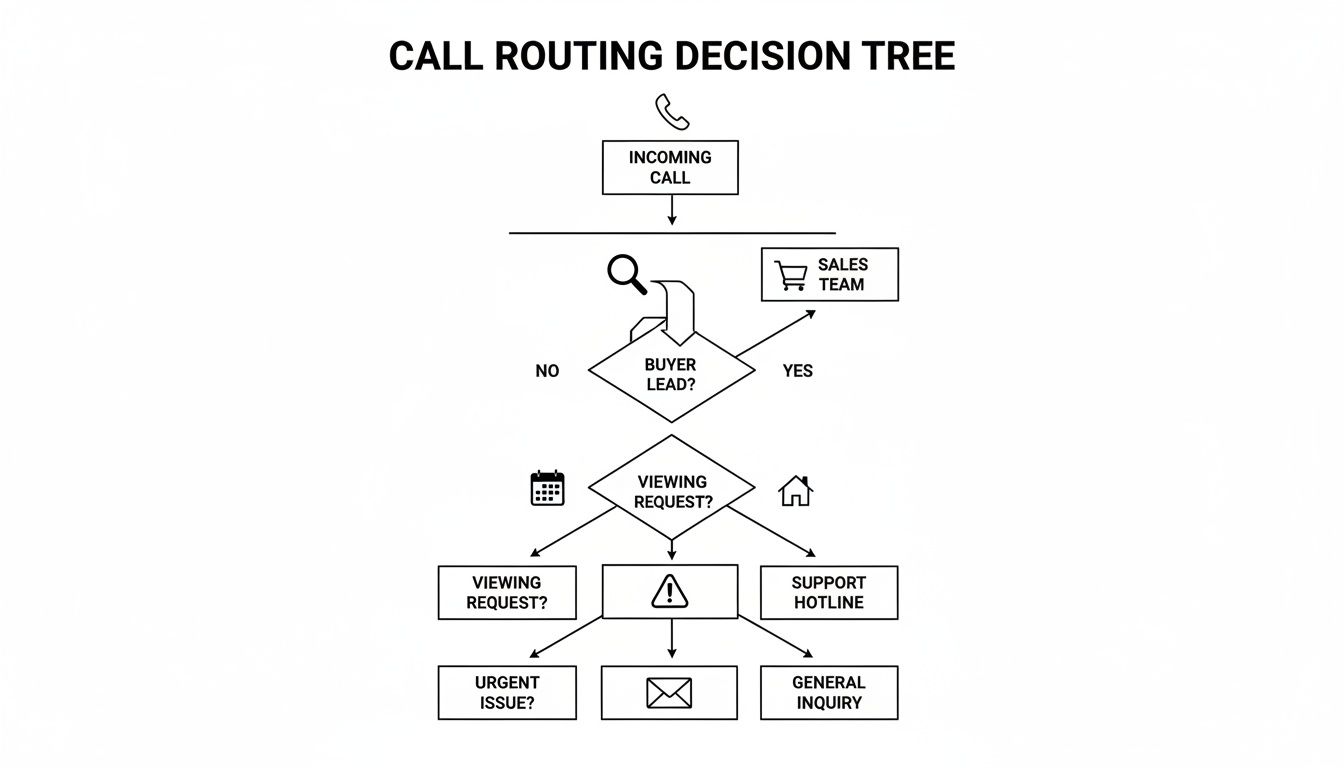
As you can see, calls get sorted the moment they come in. Hot buyer leads, viewing requests, and urgent maintenance issues are all sent down the right path for the fastest, most effective response.
Comparison Human Call Center vs AI Answering Service
To really wrap your head around the differences, it helps to put the two models side-by-side and see how they stack up on the metrics that actually matter to your business.
| Feature | Human Answering Service | AI Answering Service |
|---|---|---|
| Cost | Higher (per-minute or monthly fees) | Significantly Lower (fraction of human cost) |
| Availability | Typically 24/7, but may have shift changes | True 24/7/365, no breaks or holidays |
| Scalability | Limited by number of available agents | Virtually limitless; handles surges instantly |
| Consistency | Varies by agent and training | Perfectly consistent every single time |
| Emotional IQ | High; excels at empathy and nuance | Developing; best for transactional calls |
| Integration | Can be manual or require complex setup | Seamlessly connects with CRMs and calendars |
Ultimately, the choice comes down to a trade-off. You're balancing the high emotional intelligence and flexibility of a human against the incredible efficiency, consistency, and cost savings of an AI.
The Financial and Operational Impact of AI
The efficiency gains from AI aren't just a nice idea; they hit your bottom line directly. AI-driven answering services are making a huge splash in real estate, automating as much as 37% of the typical tasks in the industry. How? By handling that huge volume of routine calls for a tiny fraction of the cost. Some platforms are saving businesses up to 80% compared to what they'd pay a traditional call center.
For many modern real estate teams, the smartest move is a hybrid approach. Let an AI screen and handle all the routine calls, but program it to transfer the complex or truly urgent ones to a live person.
This setup gives you the best of both worlds. You get the cost-slashing efficiency of automation for the bulk of your calls and that essential human touch right when it matters most. If that sounds like the right path, a quality https://www.marlie.ai/solutions/24-7-answering-service can be the perfect foundation to build on.
When you start digging into what an AI can really do—like sorting leads and handling client communication—it’s worth exploring the full role of an AI Real Estate Assistant for Smarter Property Management. The end goal is simple: create a system that captures every single opportunity without burning you or your team out.
Must-Have Features for Real Estate Professionals
When you start shopping for a real estate answering service, it's easy to get lost in a sea of options. The thing is, not all services are created equal. The right features can be the difference between just taking messages and actively growing your business.
Think of this as your buyer's checklist—the absolute non-negotiables that will actually make an impact on your bottom line.
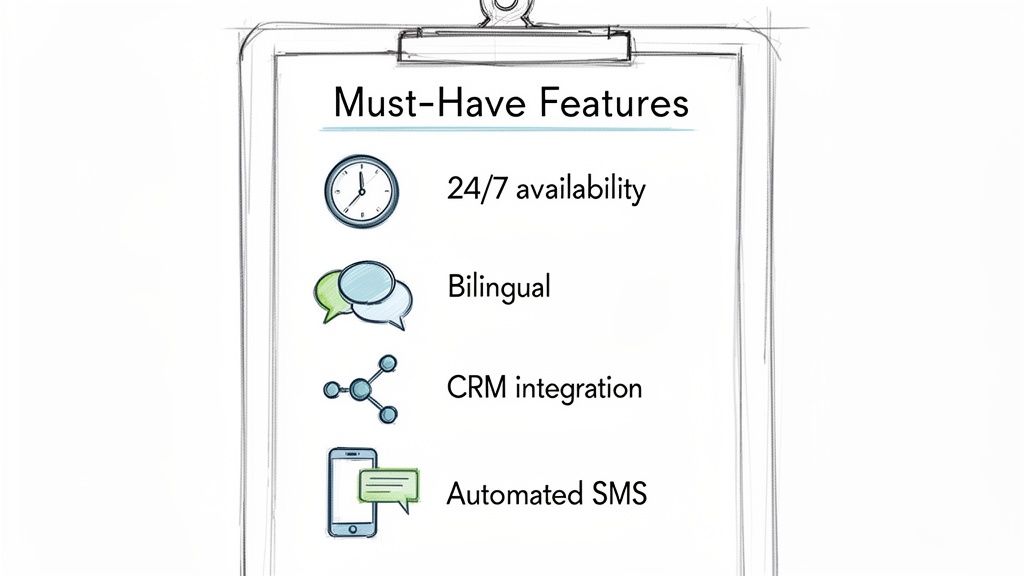
The first and most fundamental feature is 24/7/365 availability. Let's be real, real estate happens far outside a 9-to-5 schedule. A motivated buyer might drive by a listing at 10 PM on a Friday night, or a tenant could have an emergency leak on a holiday weekend. Your answering service has to be a true around-the-clock operation to catch every single one of those opportunities.
Core Communication and Lead Management
Beyond just being available, the service needs to handle the specific communication demands of your market. This is where a basic answering service transforms into a powerful business tool.
These features are the backbone of any system worth your money:
- Bilingual Support: In today's diverse markets, having fluent English and Spanish-speaking agents isn't a perk; it's a necessity. It shows you can serve your entire community professionally and builds trust right from the first call.
- Customizable Lead Qualification: Your service should be your frontline filter. You need the ability to build custom scripts that ask the exact questions you would, qualifying leads before they ever hit your phone. This alone ensures you only spend your time on serious prospects.
- Automated SMS Follow-ups: An immediate text message after a call can dramatically boost engagement. This feature can confirm an appointment, send a link to a listing, or just thank the caller for reaching out, keeping you top-of-mind.
A great answering service doesn't just answer calls; it advances the conversation. It intelligently qualifies leads, schedules appointments, and provides instant follow-up, acting as an extension of your sales and client care team.
This level of intelligent intake is a total game-changer. To see what this looks like in practice, check out how a dedicated lead screening and intake service can overhaul your entire lead management process. It’s all about making sure only high-quality opportunities land on your desk.
Seamless Tech and System Integrations
In modern real estate, your tech stack has to talk. An answering service that operates in its own little silo just creates more work, defeating the whole purpose. That’s why deep integration capabilities are absolutely non-negotiable.
The most critical connection is to your Customer Relationship Management (CRM) software and your calendar. When a new lead calls at midnight, the service should be able to capture their info and automatically create a new contact in your CRM. If they want to book a showing, it should go straight into your calendar—no manual entry required from you.
On top of that, look for these key technical features:
- Intelligent Spam Filtering: Your time is way too valuable to be wasted on robocalls. A service with built-in AI spam filtering keeps your lines clear for actual clients.
- Detailed Call Reporting: Having access to analytics is vital. You should be able to see call volume, peak times, and call outcomes to make smarter business decisions.
Your answering service should fit neatly alongside the other tools you rely on. For example, many agents and brokers use top property management applications to manage their portfolios. The right answering service will integrate with these systems, creating a unified hub that makes your whole business run smoother.
Getting Your Answering Service Up and Running in 5 Steps

Rolling out a new system can feel like a massive undertaking, but a good real estate answering service is surprisingly simple to get going. It’s less like a huge construction project and more like assembling a high-end piece of furniture—all the parts are designed to click into place.
With the right plan, you can be up and running in minutes, not days. This five-step roadmap will walk you through everything, from figuring out your goals to launching your new setup with zero friction.
Step 1: Define Your Primary Call Goals
Before you touch a single setting, you have to decide what, exactly, you want this service to do. Is the main goal to snatch up every single buyer lead that calls after 5 PM? Or is it to screen out routine tenant maintenance calls so you can focus on closing deals?
Knowing your core objective is everything because it steers every other choice you make down the line. A great way to start is by pinpointing your biggest communication headaches.
Most agents and brokers are trying to solve one of these problems:
- Maximize Lead Capture: Make sure no new buyer or seller inquiry ever hits voicemail.
- Improve Tenant Experience: Offer 24/7 support for urgent maintenance requests and other issues.
- Boost Personal Productivity: Stop the constant interruptions from non-urgent calls when you're with clients or at a showing.
Once your main goal is locked in, the rest of the steps practically fall into place. For instance, if lead capture is your #1 priority, your scripts will be laser-focused on qualification questions.
Step 2: Craft Your Custom Call Scripts
Think of your call script as the playbook for your answering service. This is what transforms a generic call handler into a seamless extension of your brand, ensuring every call is handled just like you would handle it yourself.
You'll definitely want different scripts for different situations. How you talk to a potential buyer is worlds away from the information you need from a tenant with a leaky faucet.
A Quick Look at Buyer Inquiry Script Logic:
- Greeting: The agent answers with your brokerage's name.
- Information Gathering: They get the caller's name, number, and which property they’re calling about.
- Qualification: They ask the big questions, like, "Are you currently working with an agent?" and "Have you been pre-approved for a mortgage?"
- Action: Depending on the answers, they either book a showing directly on an agent's calendar or fire off the qualified lead's info via text and email.
Your script is more than just a list of questions; it's a workflow. It dictates how information is gathered, how calls are triaged, and what happens next. It turns a simple phone call into a productive business action.
Step 3: Configure Call Forwarding
This is the technical bit that connects your business line to the answering service, and it's far easier than it sounds. Call forwarding is a basic feature on almost every phone plan out there.
You usually get a few choices for how calls get routed:
- Full-Time Forwarding: Every single call goes straight to the service.
- Busy/No-Answer Forwarding: Calls only get sent over if your line is busy or you don't pick up after a few rings.
- After-Hours Forwarding: You set a schedule, and calls are forwarded only when you're "closed."
Setting this up is often as simple as dialing a special code (like *72) from your business phone. Your new service will give you the exact, step-by-step instructions for your specific carrier.
Step 4: Connect Your Essential Tools
Here’s where you unlock the real magic. To get the most out of your service, you need to plug it into the tools you already use every day. This is the step that automates your life and kills manual data entry. The two most important integrations are your CRM and your calendar.
When it's all connected, a new lead captured at 2 AM can be automatically logged in your CRM, and a showing request can be booked directly into your Google Calendar or Outlook. This seamless flow of information means nothing ever slips through the cracks.
Step 5: Orient Your Team
The last step is a simple one: make sure everyone on your team knows what's going on. This isn't some exhaustive training session; it's usually just a quick huddle.
Explain how they'll receive new leads, how appointments will pop up on their calendars, and what to do when they get a notification for an urgent call. By making the new process clear, you get instant buy-in from your team. They'll quickly see the service not as another tool to learn, but as a powerful assistant that makes their job easier.
Calculating Your Return on Investment
For any business-minded agent or broker, a new expense has to pull its weight. It needs to show a clear financial return. A real estate answering service isn't just another line item on your budget; it’s a tool designed to make you money and give you back your time. To really see its value, you have to look at both what you put in and what you get out.
The cost side is pretty simple. You’ll have a monthly fee and maybe some usage charges based on call volume or minutes. For most agents or small teams, this is a surprisingly small number, often less than $200 a month.
But the return side of the equation is where things get interesting.
Quantifying the Financial Gains
The real return on investment (ROI) isn't just one number. It's a mix of captured revenue, reclaimed time, and straight-up cost savings. Each of these pieces adds directly to your bottom line, turning a small monthly expense into a huge financial win.
Here are the three main ways an answering service pays for itself, and then some:
- The Value of a Captured Lead: Every call you miss is a potential commission walking out the door. If your service snags just one serious buyer lead that you otherwise would have missed, the commission from that single sale could pay for the service for years.
- The Dollar Value of Reclaimed Time: Let's be honest, your highest and best use isn't answering calls about lockbox codes. Your time is for negotiating deals, showing properties, and meeting clients. By handing off the constant interruptions, you get back hours every week to focus on the work that actually puts money in your pocket.
- Savings vs. a Full-Time Receptionist: Hiring someone to sit at the front desk comes with a hefty price tag—easily over $3,500 per month once you add up salary, benefits, and overhead. An answering service gives you 24/7 coverage for a tiny fraction of that cost.
A Realistic ROI Example
Let's run the numbers with a conservative scenario. Say your average commission check is $8,000, and the answering service costs you $199 per month.
The ROI Calculation: If the service helps you land just one extra deal over the course of an entire year, you bring in $8,000 in new revenue. Subtract the annual cost of the service—$2,388 ($199 x 12)—and you're left with a net profit of $5,612.
That simple math reveals a powerful truth. The service doesn't need to work miracles to deliver a massive return. Closing a single additional transaction—a completely realistic goal—instantly flips the service from an expense into a highly profitable part of your business.
And that's before you even factor in the value of your reclaimed time or the money you saved by not hiring a receptionist. When you look at it that way, the financial argument is rock solid.
Answering Your Answering Service Questions
Even when the benefits seem clear, bringing any new system into your business comes with practical questions. I get it. Agents and brokers always want to know the specifics of how a real estate answering service will actually talk to their clients and handle the unique details of their listings. Let's tackle some of the most common concerns I hear so you can make a confident, informed decision.
One of the first questions that usually comes up is about customization. How can some outside service possibly know the ins and outs of your specific properties? It’s actually simpler than you might think.
How Does It Know My Listings?
Modern services, especially the AI-powered ones, are designed to be "trained" on your specific data. You can upload custom scripts, pricing details, key property features, and even specific showing times for every single listing in your portfolio.
When a caller asks about the house on "Oak Street," the service instantly pulls up that exact dataset. It can then rattle off accurate details, pre-qualify the prospect, and even get a viewing on the calendar, all without ever having to ping you with routine questions.
Think of the system as a digital extension of your own knowledge base. It’s not just answering a phone; it's providing precise, relevant information based on the exact playbook you create for it.
Will Clients Know It's An AI?
This is a totally valid concern, but today's high-quality AI voice assistants use incredibly lifelike voices and advanced conversational tech. For the 60-80% of calls that are just routine inquiries, many callers won't even realize they aren't speaking to a human.
But the most important part is that you always have full control over the client experience. You can customize the greeting to be completely upfront (e.g., "You've reached the automated assistant for…"). Even better, you can program a seamless "press 0 to speak to an agent" option for anyone who wants or needs that human touch.
Is This Affordable For Solo Agents?
Absolutely. In fact, this is one of the biggest wins for a modern real estate answering service. Instead of taking on the massive overhead of a full-time receptionist—which can easily top $3,000 per month—a solo agent can get all the benefits for a tiny fraction of that cost.
Many services run on a pay-as-you-go or usage-based model. This means you only pay for the call time you actually use, making it an incredibly scalable and cost-effective solution. It lets individual agents offer the same 24/7 professional response as a huge brokerage, leveling the playing field completely. For a deeper dive into other common questions, feel free to explore our comprehensive FAQs page.
Ready to capture every lead and reclaim your time? Marlie Ai provides a 24/7 AI phone assistant that answers every call in seconds, pre-qualifies leads, and integrates with your tools—all for up to 80% less than a traditional service. Discover how Marlie can transform your business.
