
In a world of constant digital communication, a phone call remains a direct, personal touchpoint with your customers. The first words a caller hears, your office phone message greetings, set the tone for the entire interaction and immediately shape their perception of your brand. A professional, clear, and helpful greeting builds instant trust, while a confusing or generic one can lead to frustration and lost opportunities. It's not just about what you say, but how you say it. To truly make a strong first impression, it's essential to understand how to enunciate better and speak with clarity, ensuring every word of your greeting is perfectly understood.
This comprehensive guide is designed to eliminate the guesswork. We will break down eight distinct types of greetings, from standard professional scripts to menu-based IVR prompts and after-hours messages. For each category, you’ll find ready-to-use examples, a strategic analysis of why they work, and actionable tips for customization. Our goal is to equip you with the tools to craft the perfect first impression every time. We'll explore how to balance professionalism with brand personality, manage caller expectations effectively, and ensure every call starts on the right foot, turning routine interactions into valuable customer connections.
1. Professional Standard Greeting
The Professional Standard Greeting is the bedrock of business telecommunications. This classic approach immediately identifies the company and the speaker, then proactively offers assistance. It's designed to be efficient, clear, and universally understood, setting a tone of competence and respect from the very first interaction. Its structure is simple yet powerful: Identification + Offer of Help.
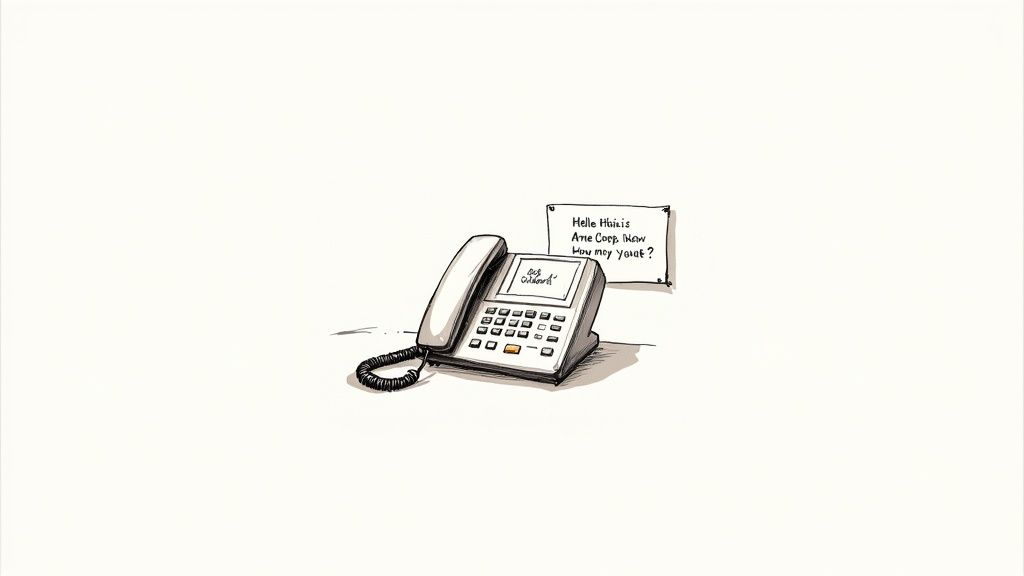
This method eliminates caller uncertainty and gets straight to the point, which is why it's a cornerstone of effective office phone message greetings. For businesses in professional services like clinics, legal offices, or corporate headquarters, this greeting reinforces brand credibility and assures callers they've reached the right place.
Strategic Breakdown
- Example 1 (Direct Line): "Thank you for calling ABC Corporation, Marketing Department. This is Sarah speaking. How may I help you?"
- Example 2 (Main Line): "Welcome to XYZ Solutions. Your call is important to us. Please hold for the next available representative."
The core strategy here is clarity and efficiency. By stating the company name, and often the department, the greeting confirms the caller has dialed correctly. Introducing the speaker by name adds a personal touch that builds immediate rapport. Ending with an open-ended question like "How may I help you?" transfers control to the caller, empowering them to state their purpose.
Key Takeaway: This greeting prioritizes professionalism and speed. It builds trust by providing essential information upfront, reducing confusion and setting a positive, helpful tone for the entire call.
When and Why to Use This Approach
This greeting is the ideal choice for businesses where professionalism, trust, and a straightforward approach are paramount. It's particularly effective for:
- Corporate Environments: Reinforces a polished, professional brand image.
- Healthcare and Legal: Conveys authority, confidentiality, and competence.
- Financial Institutions: Builds immediate trust and security with clients.
Essentially, if your primary goal is to sound credible and handle calls efficiently, this classic format is your best option. You can discover more variations by reviewing these professional phone greeting examples.
2. Personalized Individual Extension Greeting
The Personalized Individual Extension Greeting moves beyond a generic company message to create a direct, personal connection with the caller. This approach is a customized voicemail recorded by an individual employee for their specific office extension or direct line. It adds a human touch, conveys personality within professional bounds, and efficiently manages caller expectations when the person they are trying to reach is unavailable. The formula is straightforward: Personal Identification + Status Update + Call to Action.
This greeting is a critical component of modern office phone message greetings, especially in environments where direct client or colleague relationships are key. By providing a personal message, employees can manage their own communications, offer alternative contacts, and reinforce a sense of individual accountability and professionalism.
Strategic Breakdown
- Example 1 (Standard Unavailability): "Hi, you've reached Tom Johnson, Senior Account Manager at Anderson & Co. I'm either on another call or away from my desk. Please leave your name, number, and the best time to reach you, and I'll return your call within 24 hours."
- Example 2 (Extended Absence): "Hello, this is Jessica Chen. I'm currently out of the office until January 15th. For urgent matters, please contact my colleague Michael at extension 4521."
The strategy here is managing expectations with a personal touch. Stating your name and role confirms the caller has the right person. Crucially, providing a reason for your unavailability (even a general one) and a clear timeframe for a return call sets a professional expectation. Offering a backup contact for urgent needs demonstrates proactivity and ensures important business is not delayed.
Key Takeaway: This greeting empowers individual team members to control their communications. It builds rapport by using their own voice and provides clear, actionable instructions, preventing caller frustration and missed connections.
When and Why to Use This Approach
This personalized greeting is essential for any business where employees have direct lines and manage their own client or project relationships. It is particularly effective for:
- Sales and Account Management: Reinforces the personal relationship between the client and their dedicated representative.
- Creative and Tech Industries: Allows for a touch of personality that aligns with a more modern, less rigid corporate culture.
- Any Role with High Call Volume: Helps individuals manage their workflow by setting clear expectations for callbacks.
This method is ideal when you want to combine professionalism with a personal connection. For businesses scaling this approach, it's useful to understand how to manage multiple business phone lines effectively to ensure consistency.
3. Menu-Based Interactive Voice Response (IVR) Greeting
The Menu-Based Interactive Voice Response (IVR) Greeting is a sophisticated automated system that empowers callers to self-direct their calls to the appropriate department. It functions as a digital receptionist, presenting callers with a menu of options that they can select using their phone's keypad. This structure is designed for efficiency and scalability, allowing organizations to manage high call volumes and route inquiries with precision. Its formula is: Company Identification + Menu Options + Operator Escape Hatch.
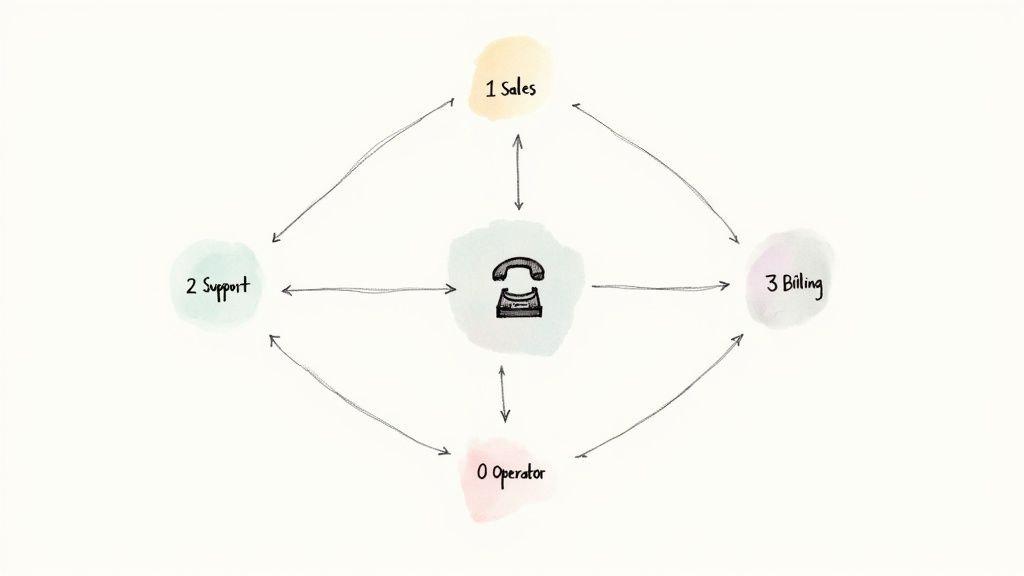
This method streamlines the caller journey by getting them to the right person or information faster, without requiring a live operator for every call. For businesses like healthcare systems, financial institutions, and large corporations, this type of greeting is essential for operational efficiency and providing a structured customer service experience.
Strategic Breakdown
- Example 1 (Departmental): "Thank you for calling Global Tech Industries. Press 1 for Sales, 2 for Support, 3 for Billing, or 4 for Human Resources. Press 0 at any time to speak with an operator."
- Example 2 (Multilingual): "Welcome to HealthCare Plus. For English, press 1. Para español, presione 2. Pour le français, appuyez sur 3."
The strategy here is caller segmentation and automation. By presenting a clear, concise menu, the system immediately sorts callers based on their needs. This reduces hold times and frees up human agents to handle more complex issues. Providing a multilingual option upfront also enhances accessibility and customer experience for a diverse audience.
Key Takeaway: This greeting automates call routing to improve efficiency and reduce operational costs. It puts callers in control of their journey, ensuring they connect with the correct resource on the first try.
When and Why to Use This Approach
This greeting is indispensable for businesses with distinct departments that handle high volumes of inbound calls. It is most effective for:
- Large Corporations: Manages complex organizational structures and directs thousands of daily calls.
- Healthcare Systems: Routes patients to scheduling, billing, or nurse lines efficiently.
- Financial and Telecom Companies: Provides self-service options for common inquiries like account balances or technical support.
Ultimately, if your goal is to manage a large influx of calls systematically and provide callers with immediate, self-service routing options, an IVR is the superior choice. You can learn more about how this system functions by exploring this guide that answers the question, what is an IVR?.
4. Warm Transfer Protocol Greeting
The Warm Transfer Protocol Greeting is a crucial tool for creating a seamless and positive customer experience during call handoffs. Unlike a "cold" transfer where the caller is sent to another line without introduction, this approach involves the initial agent briefing the next representative about the caller's needs. This system bridges the gap between receptionists and department staff, ensuring the caller doesn't have to repeat themselves. Its structure is: Acknowledge + Inform + Transition.
This method transforms a potentially frustrating transfer into a reassuring and efficient process. For businesses focused on high-touch customer service, such as hospitality, healthcare, or specialized technical support, this greeting demonstrates a commitment to resolving issues thoughtfully and collaboratively. It shows the internal team is communicating effectively for the caller's benefit.
Strategic Breakdown
- Example 1 (To the Caller): "Thank you for your patience, Mr. Smith. I'm transferring you to Jennifer in our Technical Support team now. I've briefed her on the software issue, and she's ready to assist you."
- Example 2 (To the Caller): "I'm connecting you to our Billing Department. They have access to your account information and will be right with you to discuss the invoice."
The core strategy here is continuity and context. By explicitly stating that the next person is already informed, you eliminate the caller's biggest frustration: repeating their story. Using the caller's name and clearly identifying the destination department and contact person (if possible) provides clarity and a personal touch. This thoughtful transition makes the caller feel valued and well-cared for.
Key Takeaway: This greeting prioritizes the customer experience over mere call routing. It builds confidence by demonstrating internal coordination and a genuine effort to resolve the caller's issue efficiently and with personal attention.
When and Why to Use This Approach
This greeting is ideal for any business where callers have complex or multi-step issues that require routing to specialized departments. It is particularly effective for:
- Customer Support & Call Centers: Drastically reduces caller frustration and improves first-call resolution rates.
- Healthcare Clinics: Ensures patient information is handled smoothly and confidentially between reception, nursing, and billing.
- High-End Hospitality & Luxury Brands: Reinforces a premium, white-glove service standard where every interaction feels personalized.
If your goal is to deliver exceptional customer service and make internal transfers invisible to the caller, this protocol is a necessity. You can dive deeper into the mechanics of this by understanding what is a warm transfer and how to implement it.
5. After-Hours and Holiday Greeting
An After-Hours and Holiday Greeting is an essential tool for managing caller expectations when your team is unavailable. This specialized message clearly communicates that the office is closed while providing crucial next steps, such as business hours and emergency contact information. It prevents caller frustration and ensures no urgent opportunity is lost, effectively acting as a digital gatekeeper. Its structure is: Closure Acknowledgment + Essential Information + Alternative Contact.
This type of greeting transforms a dead-end call into a helpful, informative interaction. For businesses that operate on a set schedule like clinics, law firms, or service providers, this message maintains a professional image 24/7 and directs critical issues to the proper channels, preserving both customer trust and potential revenue.
Strategic Breakdown
- Example 1 (Standard After-Hours): "Thank you for calling ABC Services. Our office is currently closed. Our business hours are Monday through Friday, 9 AM to 5 PM Eastern Time. For emergencies, please call our 24-hour support line at 1-800-XXX-XXXX. We look forward to speaking with you."
- Example 2 (Holiday Specific): "Happy Holidays! You've reached XYZ Company. We are closed from December 24th to the 25th and will reopen on December 26th. For urgent matters, please contact extension 9999. We wish you a wonderful holiday season!"
The strategy here is proactive information delivery. By immediately stating the office is closed, the greeting manages expectations. Providing exact business hours and a specific reopening date offers clarity and removes guesswork for the caller. Most importantly, offering an emergency or alternative contact method provides a vital lifeline for urgent needs.
Key Takeaway: This greeting is about maintaining control and providing value even when you're not there. It shows respect for the caller's time by giving them all the information they need to either call back later or resolve a critical issue immediately.
When and Why to Use This Approach
This greeting is non-negotiable for any business that does not operate 24/7 but may receive urgent calls outside of working hours. It is particularly effective for:
- Service-Based Businesses (HVAC, Plumbing): Captures emergency job leads that would otherwise be lost.
- Medical and Dental Clinics: Provides clear instructions for patients with urgent health concerns.
- Professional Services (Legal, Financial): Reinforces reliability and offers a protocol for critical client matters.
Using this approach ensures you never appear "closed for business." Instead, you demonstrate preparedness and a commitment to client needs around the clock. Exploring an after-hour answering service can further enhance this strategy by providing a live or AI-powered response.
6. Branded and Company Culture Greeting
The Branded and Company Culture Greeting infuses your company’s unique personality and values directly into the initial phone interaction. This approach moves beyond simple identification to create a memorable first impression that reflects what your brand stands for. It's a powerful tool for differentiation, transforming a standard greeting into a brand-building opportunity. The core formula is: Identification + Brand Statement + Offer of Help.
This method immediately communicates your company’s ethos, whether it's innovation, creativity, sustainability, or exceptional service. For businesses in competitive markets like tech startups, creative agencies, or mission-driven organizations, this greeting helps forge a stronger emotional connection with callers from the very start. It aligns your phone communication with your broader marketing and brand identity.
Strategic Breakdown
- Example 1 (Mission-Driven): "Welcome to GreenTech Solutions, where sustainability meets innovation. How can we help you power a better future today?"
- Example 2 (Creative Agency): "Hi there! You've reached Spark Creative. We're busy bringing ideas to life, but we'd love to help with your project. How can we assist you?"
The strategy here is brand reinforcement. By including a tagline or a value statement, you’re not just answering the phone; you’re reinforcing your brand’s promise. This approach makes the call feel less transactional and more like an authentic interaction with a brand that has a clear personality. The offer of help is then framed within the context of that brand identity, making it more impactful.
Key Takeaway: This greeting uses your company’s unique voice to create a distinctive and memorable experience. It builds brand affinity by consistently communicating your core values across all customer touchpoints, including your office phone message greetings.
When and Why to Use This Approach
This greeting is ideal for companies that have a strong, well-defined brand culture and want to stand out from the competition. It is particularly effective for:
- Tech Startups and Innovative Companies: Highlights a forward-thinking, dynamic culture.
- Creative and Marketing Agencies: Showcases personality and creativity, which is central to their service.
- Mission-Driven Organizations: Reinforces commitment to a specific cause or value, attracting like-minded clients.
If your goal is to build a strong brand identity and create a loyal customer base that connects with your company’s personality, this personalized approach is an excellent choice.
7. Multilingual and Accessibility-Focused Greeting
The Multilingual and Accessibility-Focused Greeting is an inclusive approach designed to serve a diverse audience from the moment they call. This method immediately offers language options and provides clear paths for callers with accessibility needs. It demonstrates a commitment to inclusivity, broadens customer reach, and ensures every caller feels valued and understood. Its structure is built on Inclusivity + Clear Navigation.
This approach is crucial for businesses operating in multicultural areas or serving a global clientele. By removing language and accessibility barriers at the first point of contact, it builds significant goodwill and ensures a positive experience for all callers, making it one of the most considerate office phone message greetings available.
Strategic Breakdown
- Example 1 (Language Options): "Thank you for calling Global Solutions. For English, press 1. Para español, presione 2. Pour le français, appuyez sur 3."
- Example 2 (Accessibility Focus): "Welcome to the Community Health Clinic. This call may be recorded. Press 1 for English. If you require language assistance or have hearing difficulties, please press 0 to speak directly with an operator for support."
The core strategy is to eliminate barriers immediately. Presenting language options upfront prevents non-English speakers from struggling through a menu they cannot understand. The accessibility prompt provides a direct lifeline for those who may need TTY/relay services or specialized assistance, bypassing complex automated systems.
Key Takeaway: This greeting prioritizes inclusivity and user experience. It shows respect for a diverse customer base and ensures that everyone, regardless of language or ability, can access your services with dignity and ease.
When and Why to Use This Approach
This greeting is essential for any organization dedicated to serving the public or a diverse customer base. It is particularly effective for:
- Healthcare Organizations: Ensures all patients can access critical health information and care.
- Government Agencies: Fulfills public service mandates to be accessible to all constituents.
- Large Corporations: Reflects a global brand image and caters to an international customer base.
- Financial and Utility Companies: Provides essential services to every member of the community.
If your goal is to build a truly inclusive brand and ensure equitable access to your services, this greeting is not just an option; it's a necessity. It is a powerful statement that your business is open and ready to serve everyone.
8. Queue Status and Expected Wait Time Greeting
The Queue Status and Expected Wait Time Greeting transforms the frustrating experience of being on hold into an informed, managed wait. Instead of leaving callers in limbo, this dynamic system provides real-time data about their position in the queue and an estimated wait time. This transparency is a powerful tool for managing caller expectations, reducing frustration, and significantly lowering call abandonment rates. Its structure is based on Transparency + Empowerment.
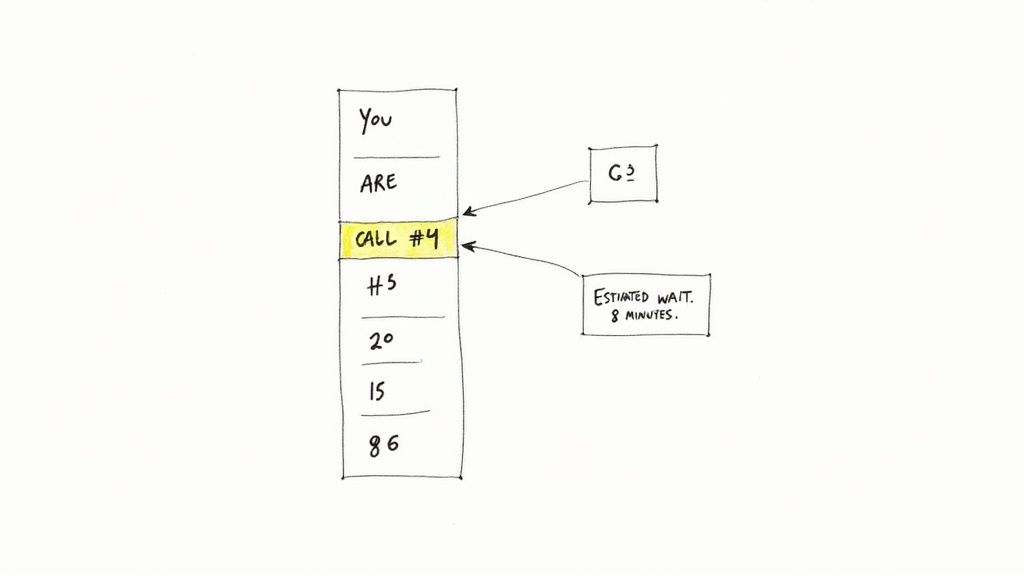
This approach is one of the most effective office phone message greetings for high-volume environments like call centers, support desks, and service industries. By giving callers concrete information, you empower them to decide whether to wait, call back later, or choose an alternative like a callback request.
Strategic Breakdown
- Example 1 (Basic Queue): "Thank you for calling Customer Support. You are currently number 4 in the queue. Your estimated wait time is approximately 8 minutes."
- Example 2 (With Options): "Welcome to our service center. We're experiencing higher than normal call volume. Your estimated wait is 12 minutes. You may press 1 to request a callback from the next available agent."
The core strategy is to reduce caller anxiety through information. An unknown wait time feels infinite, but a defined wait time becomes a manageable event. Providing queue position ("number 4") gives a sense of progress. Offering a callback option gives the caller control over their time, turning a potentially negative experience into a positive, customer-centric one.
Key Takeaway: Honesty about wait times builds trust. This greeting shows respect for the caller's time, which can preserve customer goodwill even during peak hours and prevent hang-ups.
When and Why to Use This Approach
This greeting is essential for any business that regularly experiences call queues and wants to improve customer satisfaction and operational efficiency. It is particularly effective for:
- Customer Support and Tech Helpdesks: Manages high call volumes and sets clear expectations for resolution time.
- Airlines and Travel Companies: Handles urgent, time-sensitive inquiries during peak travel seasons or disruptions.
- Banking and Financial Services: Provides a secure and orderly process for clients waiting for assistance.
If your goal is to minimize caller frustration and abandonment during busy periods, implementing a queue status system is a critical strategic move.
Office Phone Message Greetings: 8-Point Comparison
| Greeting Type | 🔄 Implementation Complexity | ⚡ Resource Requirements | 📊 Expected Outcomes | 💡 Ideal Use Cases | ⭐ Key Advantages |
|---|---|---|---|---|---|
| Professional Standard Greeting | Low — simple script, occasional updates | Low — basic recording tools | Clear credibility and consistent caller expectations | Corporate offices, professional services, front desks | Establishes immediate professionalism and clarity |
| Personalized Individual Extension Greeting | Medium — individual recording & maintenance | Medium — employee time, decent microphone | Strong personal connection, higher callback relevance | Sales, client-facing roles, managers | Humanizes contact and improves message relevance |
| Menu-Based Interactive Voice Response (IVR) Greeting | High — menu design, testing, updates | High — IVR platform, professional recordings | Efficient routing, reduced misdirects, 24/7 handling | Large orgs, call centers, multi-dept businesses | Scales call handling and automates routing |
| Warm Transfer Protocol Greeting | Medium — staff training and coordination | Low–Medium — staff time and briefings | Smoother transfers, better context for receivers | Customer service, multi-department orgs, sales ops | Reduces caller frustration and improves handoffs |
| After-Hours and Holiday Greeting | Low — scheduled updates and recording | Low — recording + scheduling system | Manages expectations, directs urgent contacts | Healthcare, professional services, seasonal businesses | Prevents missed opportunities and clarifies availability |
| Branded and Company Culture Greeting | Medium — creative development and approvals | Medium — voice talent/production for tone | Memorable caller experience, brand reinforcement | Startups, creative agencies, consumer brands | Differentiates brand and builds emotional connection |
| Multilingual & Accessibility-Focused Greeting | High — translations, accessibility design | High — translators, accessibility tech, maintenance | Inclusive reach, legal compliance, improved satisfaction | Healthcare, govt., large/multicultural markets | Expands reach and meets accessibility/legal requirements |
| Queue Status & Expected Wait Time Greeting | High — real-time integration and accuracy | High — analytics, advanced PBX/CC platforms | Reduced abandonment, informed callers, higher satisfaction | High-volume call centers, customer support ops | Transparently manages wait expectations and reduces churn |
Automating Excellence: The Future of Your Phone Greetings
Throughout this guide, we've explored the strategic depth behind crafting effective office phone message greetings. We've moved beyond simple scripts to analyze the critical role these greetings play in shaping customer perception, streamlining operations, and reinforcing your brand identity from the very first second of contact. You now have a comprehensive toolkit of examples, from the professional standard to the accessibility-focused greeting, each designed to address specific business needs and caller expectations.
The core lesson is this: your phone greeting is not a passive placeholder. It is an active tool. It sets the tone for every interaction, manages caller flow, provides essential information, and ultimately determines whether a potential customer feels valued or ignored. A well-designed system of greetings, covering everything from warm transfers to after-hours support, creates a consistent and reliable communication framework that builds trust and loyalty.
Key Takeaways for Immediate Implementation
To transform your phone system from a simple utility into a strategic asset, focus on these core principles:
- Clarity and Brevity: Every greeting, whether for an IVR menu or a personal voicemail, must be direct and easy to understand. Eliminate jargon and get straight to the point to respect your caller's time.
- Brand Consistency: Your audio branding is just as important as your visual branding. Ensure the tone, language, and voice used in your greetings align perfectly with your company's culture and values.
- Caller-Centric Design: Always anticipate your caller's primary needs. Is it to reach a specific department, check business hours, or get an update on their queue position? Build your greetings to solve their problems efficiently.
The Next Frontier: Intelligent Automation
Implementing these manually recorded scripts is a powerful first step. However, the true future of professional call handling lies in intelligent automation. Modern systems can dynamically adapt greetings based on time of day, caller ID, or even real-time business conditions without requiring you to re-record messages. For truly cutting-edge automation in your phone greetings, consider systems that leverage advanced text-to-speech voice generation to create natural, clear, and easily updatable audio prompts on the fly.
By embracing this technology, businesses from small HVAC companies to multi-location medical clinics can ensure that every single call is answered with the perfect, professionally toned greeting, 24/7. This level of consistency and responsiveness elevates the customer experience, captures every opportunity, and frees your human team to focus on the complex, high-value interactions that drive growth. Mastering your office phone message greetings is no longer just about what you say; it's about building an intelligent, automated system that says it perfectly every single time.
Ready to automate your first impression and ensure no call goes unanswered? See how Marlie Ai can deliver flawless, AI-powered office phone message greetings and handle your calls 24/7, so you can focus on running your business. Discover Marlie Ai today and transform your customer communications.
