
When people talk about Interactive Voice Response (IVR) in a call center, they’re really talking about an automated system that acts as your first point of contact. Think of it as a digital receptionist that guides callers through a menu using their voice or keypad, helping them get what they need without having to wait for a human.
What IVR Really Means for Your Call Center
Imagine your business is a busy library. Without any system in place, every single person has to line up to ask the front-desk librarian for help, which quickly creates a bottleneck. An IVR is like putting an interactive digital directory right at the entrance, letting most people find exactly what they need all on their own.
At its core, Interactive Voice Response is the technology that automates those initial phone interactions. It lets callers use simple voice commands or their phone's keypad to navigate menus, get quick answers, or find their way to the right department. It's the shift from a purely manual, all-hands-on-deck approach to a more efficient, self-service model.
The Two Core Jobs of an IVR
When you boil it down, a good IVR system is designed to do two critical things for your call center:
- Enable Self-Service: It empowers customers to solve simple, repetitive issues entirely on their own. Things like checking an account balance, tracking an order, or confirming an appointment can be handled in seconds, no agent required.
- Route Calls Intelligently: For more complex issues, it acts as a sorter, directing callers to the agent or department best equipped to help them. (We dive deeper into this in our guide on what is call routing, which is all about getting callers to the right expert, fast.)
By automating these first few steps of the conversation, IVR becomes your first line of defense. It filters and manages call volume before it ever hits your team, freeing up your agents to focus their brainpower on the more complex, high-value conversations that really matter.
This kind of automation has become a pillar of modern customer service. The global conversational AI market, which includes IVR technology, is projected to hit $17.05 billion by 2025 and is on track to reach $49.8 billion by 2031. You can read more about the future of IVR software on teneo.ai.
A Look Inside How an IVR System Works
Ever wondered what’s actually happening behind the scenes when you're asked to “press 2 for customer support”? Think of an IVR system as a digital switchboard operator, but one that’s meticulously following a pre-written script. We call this script a call flow.
This call flow is the heart of the entire IVR experience. It’s a decision-making map that guides a caller’s journey from the moment they dial in to the moment they hang up.
When a customer calls, the IVR immediately kicks into gear. It greets them and presents a menu of pre-recorded options, like "Press 1 for Sales, Press 2 for Support." The system then simply waits for the caller to make a choice.
This is where a clever bit of technology called Dual-Tone Multi-Frequency (DTMF) signaling comes into play. Every time you press a number on your keypad, it generates a unique tone. The IVR is trained to listen for these specific tones and match them to the next step in the call flow.
Tracing a Typical Call Flow
Let's walk through a common scenario. Imagine a customer wants to check their order status.
- Caller Dials: The journey starts when the customer calls your main business number.
- IVR Greets: The system plays a welcome message and lays out the options. The customer hears, "For order status, press 3."
- Customer Responds: They press '3' on their phone.
- IVR Acts: The system instantly recognizes the DTMF tone for '3'. Following its script, it connects to the company's database or CRM to find the order information linked to that customer's phone number.
- Information Delivered: The IVR then turns that data into a spoken message, saying something like, "Your order is scheduled for delivery on Tuesday." The whole request is handled without ever needing a human agent.
The chart below shows this basic journey from caller to resolution.
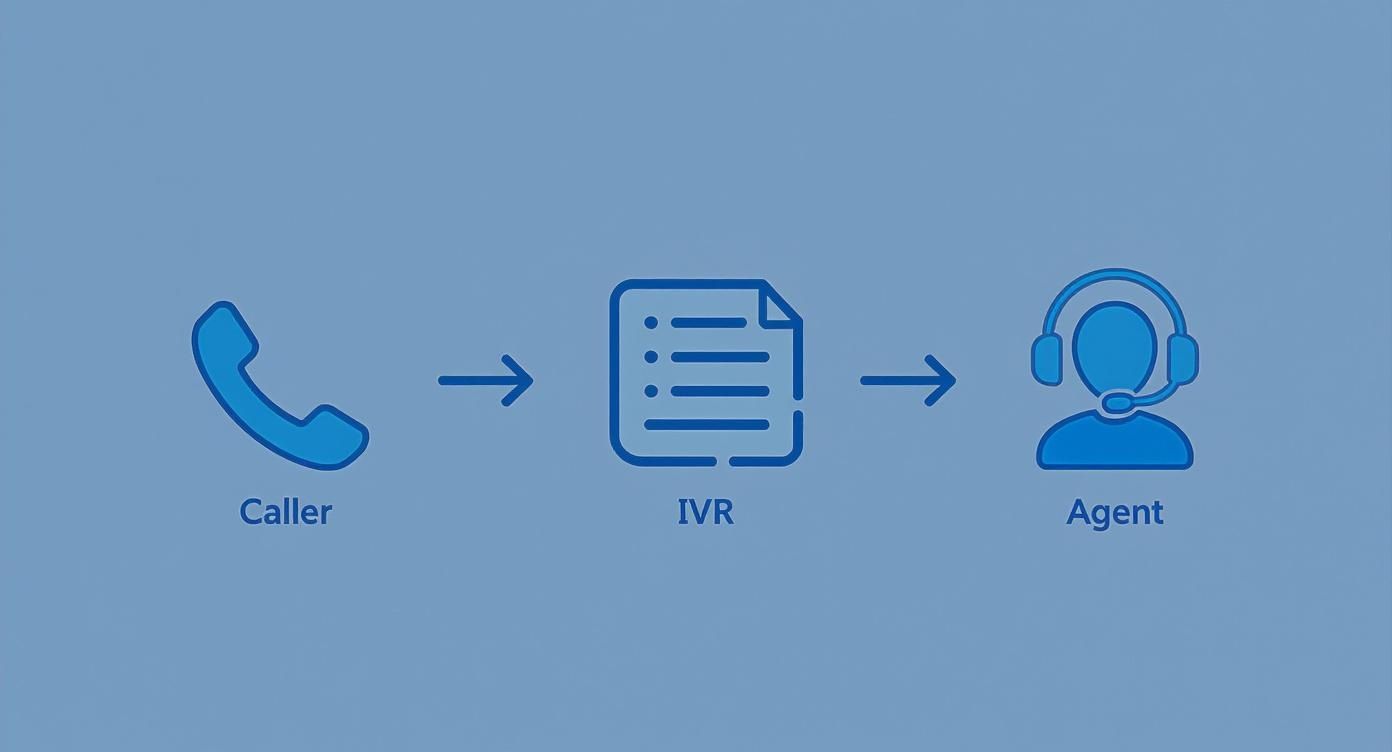
As you can see, the IVR acts as an automated filter, sorting and solving calls before they ever reach a person. This basic process is the foundation of any automated calling system, where the name of the game is resolving issues as quickly and efficiently as possible.
So, Why Should Your Business Care About IVR?
Adding an IVR system isn't just another tech upgrade—it's a serious strategic move. It's the kind of decision that ripples across your entire operation, and for businesses trying to work smarter, not harder, understanding what an IVR can do for a call center is a massive advantage.
Think of it this way: an IVR is like hiring a virtual, 24/7 workforce. It's always on, tirelessly answering calls, dishing out basic info, and handling routine requests long after your team has clocked out. This constant availability means your customers always have a lifeline, which is a huge win for their overall experience.
Boost Productivity, Slash Costs
One of the first things you'll notice is how it eats up all the repetitive stuff. An IVR can churn through a high volume of common questions—"What's my order status?" or "What are your hours?"—that would otherwise keep your best agents tied to their phones.
This automation translates directly into cost savings. You’re filtering out the simple, low-value calls and freeing up your team to tackle the complex problems where their skills actually matter. Not only does this crank up their productivity, but it also makes their jobs more interesting and satisfying.
A well-designed IVR does more than just cut costs; it polishes your professional image. It gives callers the impression of a larger, more organized company, building trust right from the first interaction.
Make Your Customer Service Sharper and More Efficient
IVR systems are also clutch for hitting those tough service benchmarks. In 2025, the standard in many markets is to answer over 80% of calls within 20 seconds. Good luck hitting that with humans alone. IVR automation helps you get there by handling a chunk of inquiries instantly.
When you consider that the average customer service call can cost anywhere from $2.70 to $5.60, automating even a slice of that traffic keeps your expenses on a tight leash. You can find more of these insights in Sprinklr’s breakdown of key call center statistics.
Ultimately, a smart IVR is all about intelligent routing. It makes sure every caller gets screened and sent to the right expert on the first try. This cuts down on annoying transfers, reduces customer frustration, and ensures that when a caller finally does need a human, they’re talking to the exact person who can solve their problem.
IVR in the Wild: Practical Examples from Different Industries
Theory is one thing, but seeing how Interactive Voice Response (IVR) works in the real world is where it all clicks. Let's look at how different businesses put this technology to work every day, solving specific challenges and making life easier for both their teams and their customers.
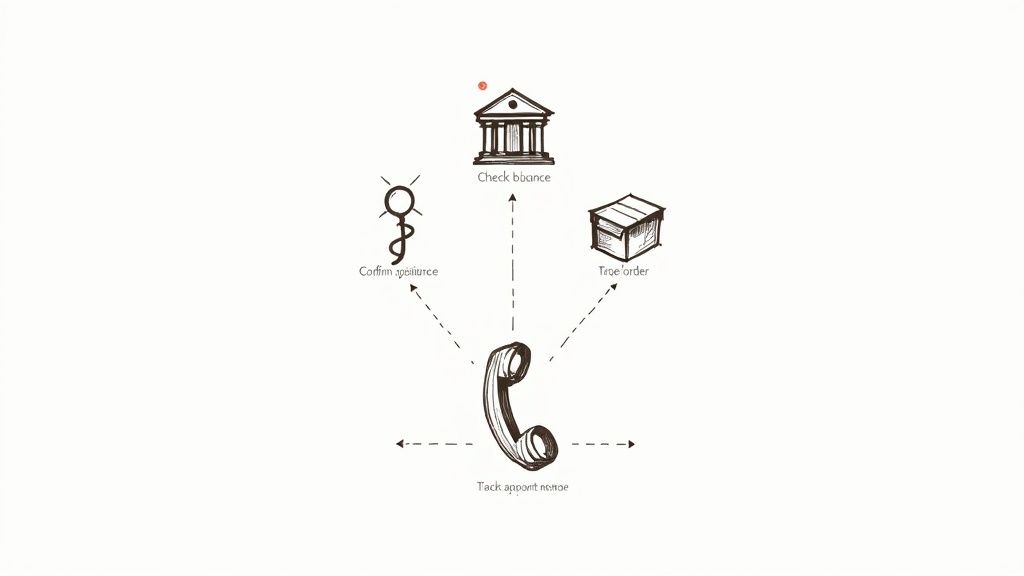
The smartest companies tailor their IVR menus to handle their most frequent, repetitive questions. This isn't just about automation for automation's sake; it's a strategic move to free up human agents for the calls where they're needed most.
Finance and Banking
For banks and financial institutions, security and speed are everything. An IVR is the perfect gatekeeper, letting customers handle sensitive tasks on their own time without waiting for an agent.
- Check Account Balances: Get a quick, secure update on checking or savings account totals.
- Report a Lost or Stolen Card: A critical, time-sensitive task. The IVR can immediately lock a card to prevent fraud.
- Make a Payment: Authorize a payment for a credit card or loan balance right from the phone keypad.
Healthcare Clinics
Medical offices are constantly buried in administrative calls. A good IVR acts as a virtual receptionist, triaging calls so the front desk staff can focus on the patients right in front of them.
By automating routine inquiries, healthcare providers can ensure patients get the information they need quickly, 24/7, while reducing the administrative burden on front-desk staff.
Simple, self-service options like confirming an appointment time, requesting a prescription refill, or just checking clinic hours can make a huge difference. This kind of efficiency is a game-changer in any appointment-based business, like a busy home services answering service where scheduling is constant.
E-commerce and Retail
"Where's my order?" It's the number one question for any online retailer. Instead of tying up agents with shipping updates, an IVR can provide instant answers, which goes a long way in creating a better post-purchase experience.
- Order Tracking: Callers just need to punch in their order number to get a real-time status update.
- Initiate a Return: The IVR can kick off the return process and automatically send instructions via text or email.
How to Measure Your IVR Success
Putting an IVR in place is one thing, but how do you know if it’s actually working? If it's helping or just frustrating your customers? You've got to move beyond guesswork and look at the hard data. That's the only way to see the real story.
Tracking the right Key Performance Indicators (KPIs) will show you exactly where your IVR is a hero and where it’s falling flat. This isn't just about tweaking a system; it’s about making smart, data-driven improvements that pay off.
Core Metrics to Track
To get a clear picture of what's going on, you need to zero in on a few essential metrics. Each one tells a different part of your customer's journey.

-
Containment Rate: Think of this as the percentage of callers who get what they need entirely within the IVR, without ever having to talk to a person. A high containment rate is a great sign that your self-service options are hitting the mark.
-
Abandonment Rate: This one’s simple: how many callers just hang up while stuck in the IVR menu? If this number is high, it’s a massive red flag. It usually points to a confusing menu, painfully long waits, or a dead end with no relevant options.
-
First Call Resolution (FCR): While this is often seen as an agent metric, a good IVR plays a huge role here. FCR tracks how many problems get solved on the very first try. A well-designed IVR is your secret weapon, making sure callers land with the right expert from the get-go. You can get the full rundown on what is First Call Resolution in our detailed guide.
Ultimately, these numbers help you answer one critical question: is your automated system solving problems or just creating new ones? A truly successful IVR doesn't just deflect calls—it delivers real, efficient solutions.
Today’s IVR platforms are built to scale, with some handling over 10 million calls per month. Looking ahead, things get even more interesting. By 2025, sentiment analysis tools are expected to process nearly 95% of all customer interactions, giving businesses an incredibly deep look into the actual user experience.
Knowing When to Upgrade to Conversational AI
A traditional IVR is a solid workhorse, but what happens when your customers’ needs get more complex than its rigid "press 1, press 2" menu can handle? Knowing when it's time to evolve is what separates businesses that thrive from those that just get by. Stick with the old model for too long, and it quickly becomes a source of pure frustration for your callers.
The warning signs are usually hiding in plain sight. Are your callers constantly mashing the '0' button, desperately trying to escape the menu and talk to a person? That's a massive red flag that your IVR just isn't cutting it. Another big one is a low self-service rate—it means the system isn't actually solving problems on its own.
Moving Beyond Basic Menus
This is exactly where Conversational AI and advanced AI Phone Assistants completely change the game. Instead of being stuck with a limited, pre-programmed script, these systems are built on Natural Language Understanding (NLU). This allows them to actually grasp what customers are saying in their own words, with no specific keywords needed.
An upgrade to AI isn't just about swapping out technology. It's a strategic move to create a more human-like, intelligent, and genuinely helpful experience for your customers. It’s about meeting them where they are and speaking their language.
For instance, a caller can just say, "I need to reschedule my Friday appointment," and the AI gets it. It understands the intent, checks the calendar, and offers up new times—no navigating a clunky menu required. For a deeper look at making this kind of switch, you can learn more about how to replace your IVR with AI and what it really means for your business.
This jump allows you to automate far more nuanced and complex conversations, which is at the heart of what the "ivr meaning call center" has evolved into. Businesses thinking about this leap can also pull ideas from other innovative applications, like these AI chatbot advertising strategies, which show the broader power of conversational AI. Ultimately, making this move builds real loyalty and sets your operations up for future growth.
A Few Lingering Questions About IVR
Let’s tackle some of the common questions that pop up when business owners start thinking about what an IVR really means for their call center.
So, What's the Real Difference Between an IVR and an Auto-Attendant?
It's a subtle but important distinction. While both can greet and direct callers, an auto-attendant is basically a simple traffic cop for your phone lines. Think: “Press 1 for Sales, Press 2 for Support.”
An IVR, on the other hand, is much smarter. It can actually do things. It connects to your other business systems, like a database or CRM, to provide real information or complete tasks. That's how a caller can check an account balance or pay a bill without ever speaking to a person. It's the engine for true customer self-service.
Is an IVR System Something a Small Business Can Actually Afford?
Absolutely. The old days of needing a massive, expensive server rack in a closet are long gone. Modern IVR systems are cloud-based, which makes them incredibly affordable and easy to scale up or down.
In fact, many of the best VoIP phone systems for small businesses already include IVR features in their standard packages. This means you can get your hands on some powerful automation without a huge upfront investment.
How Do I Make an IVR Menu That People Don't Hate?
The secret to a good IVR menu is to keep it simple, logical, and brief. Your goal is to get callers where they need to go, fast.
- Put your most common options right at the top. Don't make people listen to five things they don't need.
- Try to limit the choices in any single menu to four or less. Anymore than that and it becomes cognitive overload.
- Always, always give them an "out"—a clear and easy way to connect with a live agent.
The whole point is to solve problems quickly, not trap callers in a frustrating phone maze. Use clear language, keep it short, and make sure the audio quality is crystal clear. That's the foundation of a good experience.
Ready to move beyond rigid menus entirely? See how Marlie Ai uses conversational AI to actually understand what your callers are saying and solve their issues on the spot—no button-mashing required. Discover a smarter way to handle calls.
