
Let's talk about automated calling systems. The easiest way to think about them is as a tireless virtual assistant, one that's laser-focused on handling all your phone outreach. We're talking about technology that automates high-volume calls, both inbound and outbound. This goes way beyond basic robocalls, managing everything from simple appointment reminders to complex lead qualification and customer surveys.
What Is an Automated Calling System?
At its core, an automated calling system is software that manages and places phone calls without a human being needing to manually dial anything. Instead of your team grinding through a list of numbers one by one, the system takes over the entire process. This is how businesses instantly and efficiently scale up their communication.
Picture this: your sales team just got 500 fresh leads. Doing that follow-up manually would eat up days of repetitive, mind-numbing work. With an automated calling system, that whole list gets dialed in a tiny fraction of the time, and the system only connects the calls that are actually answered to your available agents. It’s this jump from manual to automated that really defines the value here.
Core Components and Functionality
Fundamentally, this technology is built to make communication workflows smoother. The main goal is to save a massive amount of time, cut down on operational costs, and free up your staff to handle more complex, high-value conversations. This all happens through a mix of key functions:
- Automated Dialing: These systems can blaze through a pre-loaded contact list, using different dialing modes like predictive or power dialing to maximize efficiency.
- Message Delivery: They can play pre-recorded audio messages, perfect for announcements, reminders, or marketing campaigns.
- Call Routing: Inbound calls get intelligently sent to the right department or agent based on what the caller wants or rules you’ve already set.
- Interactive Voice Response (IVR): Callers can interact with the system using their voice or keypad to get info or get things done, like checking on an order status without ever needing to speak to a person.
The Business Case for Automation
Bringing in these systems isn't just a tech upgrade; it's a strategic move toward smarter communication. The market growth really tells the story. The global Contact Center as a Service (CCaaS) market, which includes technologies like Automatic Call Distribution (ACD), was valued at USD 4.7 billion in 2022. Even more telling, projections show ACD revenue alone is expected to leap from USD 1.02 billion to about USD 5.10 billion by 2032. That's a huge indicator of the demand for automated solutions.
An automated calling system doesn't just replace manual dialing; it introduces a new layer of efficiency, consistency, and scalability to your entire communication strategy. It's the difference between sending individual letters and launching a full-scale email campaign.
For a lot of businesses, this kind of technology works hand-in-glove with how they already manage inbound calls. You can check out our guide on automated telephone answering services to see how these systems create a seamless customer experience from start to finish. This synergy ensures no call goes unanswered and every interaction is handled as efficiently as possible.
How Automated Calling Technology Works
To really get what makes an automated calling system so powerful, it helps to peek under the hood. Think of it as a super-efficient mission control for all your business calls, juggling everything from contact lists and call execution to tracking performance with surgical precision. At the very center of this whole operation is the dialing engine—a powerful piece of software that acts like a tireless dispatcher, lining up and placing calls way faster than any human ever could.
This engine is the heart of the system. For outbound campaigns, it pulls from a list of contacts you've loaded and just starts dialing. For inbound calls, it works with other parts of the system to figure out who's calling and get them to the right place, whether that's a recorded message or a live person. It’s this seamless coordination that makes talking to thousands of people possible.
Understanding the Different Dialing Modes
Not all calling campaigns have the same goal, which is why automated calling systems come with a few different dialing modes. Each one works a bit differently and is built for specific needs. Picking the right one is a huge part of getting the results you want.
Here are the three main modes you'll run into:
- Predictive Dialer: This is the high-speed, no-nonsense option. A predictive dialer uses smart algorithms to call multiple numbers at once, predicting exactly when an agent will be free to take the next call. It only connects calls when a real person answers, filtering out all the busy signals, voicemails, and dead numbers.
- Progressive Dialer: This mode gives you a bit more control. A progressive dialer (sometimes called a power dialer) calls one number at a time for each agent who's available. It waits until an agent finishes their current conversation before dialing the next number, guaranteeing someone is always ready to talk when the call connects.
- Preview Dialer: This one is all about preparation. The system actually shows an agent information about the next person on the list before it places the call. The agent gets to review the contact’s details and then clicks a button to start the dial, giving them valuable context for the conversation.
This image really drives home the massive efficiency gains you get when you switch from manual dialing to an automated system.
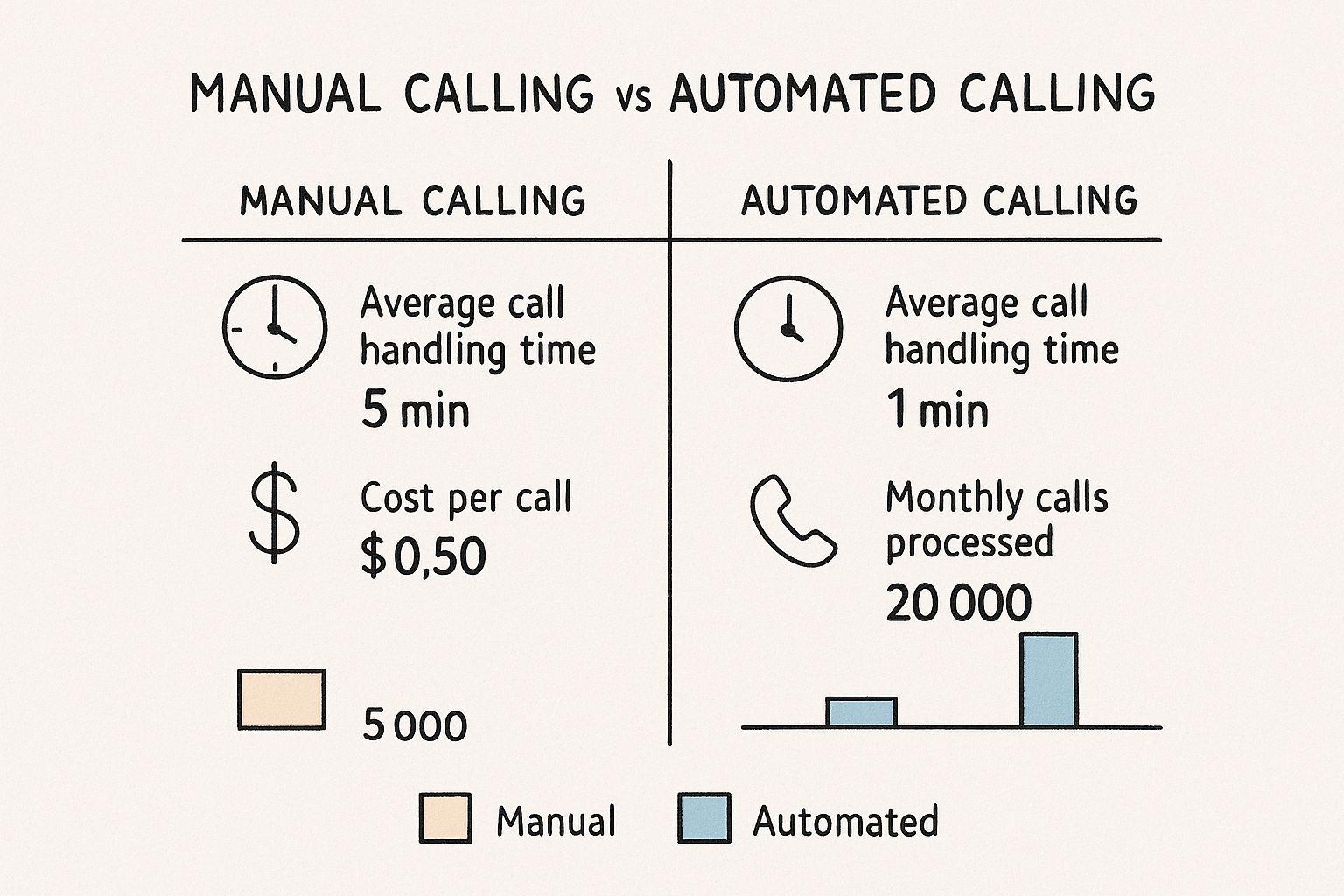
The numbers don't lie. Automation slashes call handling times and costs while managing to process four times as many calls. It's a game-changer.
The Brains Behind the Conversation
But modern systems do a lot more than just dial numbers. They have sophisticated tech built in to manage the conversation itself. One of the most important pieces is Interactive Voice Response (IVR). An IVR is basically an automated virtual receptionist that guides callers through a menu using voice prompts or their keypad.
This lets customers handle simple things on their own—like checking an account balance or tracking a package—without ever needing to talk to a human. If you're curious, we have a great guide that explains what IVR is and how it works in more detail.
An automated calling system isn’t just about making calls; it’s about intelligently managing interactions to resolve issues, gather information, and route inquiries to the most appropriate resource efficiently.
A huge part of how this all works is AI's ability to understand and reply to what people are saying, a concept that's covered well in this article on using AI to answer questions. This is what allows the best systems to understand natural language, making the whole experience feel more human and less like you're talking to a robot. It means that when a call goes out, the system can deliver a message, connect the person to a live agent, or even have an interactive, AI-driven chat to get the job done.
The Impact of AI on Call Automation

If traditional automated calling systems were about doing things faster, adding Artificial Intelligence (AI) is all about doing things smarter. It’s the difference between a simple tool and an intelligent partner. This is a massive shift—we're moving away from systems that just follow commands to ones that understand intent, context, and even human emotion.
The whole game changes when you go from rigid, pre-programmed scripts to dynamic, responsive conversations. We've all been trapped in that frustrating loop of "press one for sales, press two for support." AI-powered systems let us break free by understanding natural language, making interactions feel less robotic and genuinely more helpful.
From Rigid Menus to Natural Conversations
The most obvious upgrade AI brings is to Interactive Voice Response (IVR) systems. We all know the pain of old-school IVRs with their clunky menus and dead ends. AI injects them with Natural Language Understanding (NLU), a technology that allows the system to figure out what you're saying in your own words.
So, instead of navigating a maze of options, a caller can just say, "I need to reschedule my appointment for next Tuesday afternoon." The AI gets it. It can process the request, check the calendar, and offer specific time slots. That's a world away from the old way of doing things.
This conversational ability is the foundation of a modern automated calling system. It smooths out the experience for the caller and solves issues faster, often without ever needing to bring in a human.
Understanding More Than Just Words
But great AI goes even deeper. Beyond just understanding what's said, advanced systems can perform sentiment analysis. This means the software can get a read on a caller's emotional state—frustration, happiness, urgency—by analyzing their tone of voice, word choice, and even the pace of their speech.
Why is that such a big deal?
- Proactive Problem-Solving: If the AI detects a caller is getting upset, it can automatically flag the call and escalate it to a human agent who’s best suited for tricky situations.
- Personalized Responses: The system can tweak its own tone and language to better match the caller's mood, which helps build a more empathetic connection.
- Valuable Business Insights: By tracking sentiment over thousands of calls, a business can spot common friction points in the customer journey and make smart, data-backed improvements.
AI doesn't just hear what customers say; it understands how they say it. This emotional intelligence is key to creating automated interactions that feel surprisingly human.
This isn't just a niche trend; it's a booming market. The global call center AI market was valued at around USD 2.1 billion in 2024 and is on track to grow at a blistering annual rate of 18.9% through 2034.
Predictive Power and Intelligent Workflows
AI’s impact isn’t limited to inbound calls, either. For outbound calling, AI-driven systems use predictive analytics to fine-tune their outreach. Instead of just dialing numbers down a list, the system analyzes historical data to figure out the perfect time to call a specific person to maximize the chance of a good conversation.
This intelligent timing means sales teams spend less time talking to voicemails and more time engaging with people who are actually interested.
Even better, a smart system can automate entire workflows after a call ends. For instance, once a conversation is finished, an AI assistant like Marlie Ai can automatically:
- Shoot over a follow-up text with important details.
- Book a meeting directly on a sales rep's calendar.
- Update the customer's profile in the CRM with notes from the call.
That kind of seamless handoff is a game-changer for any business trying to scale up. To really get a feel for how all this comes together, it’s worth looking into the features of top-tier AI call center software. This blend of conversational smarts, emotional awareness, and predictive action is what defines the new wave of call automation.
Core Benefits for Your Business Operations
Bringing an automated calling system into your business isn't just a tech upgrade. Think of it as a strategic move that sends ripples across the entire organization, hitting your bottom line by completely changing how you handle productivity, costs, and customer relationships.
Don't just see it as another piece of software; it's a force multiplier for your team. It goes straight to the heart of operational bottlenecks, turning those repetitive, soul-crushing tasks into sleek, automated workflows. This shift lets you point your most valuable resource—your team's time—toward activities that actually move the needle.
Boost Agent Productivity and Focus
The first thing you'll notice is a huge leap in agent productivity. Manual dialing is a notorious time-killer, a black hole of busy signals, wrong numbers, and voicemails. An automated system vaporizes all that dead time, letting your agents spend their day having actual, meaningful conversations.
By taking over the dialing, the system makes sure agents are only connected when a real, live person picks up the phone. This one change can dramatically multiply the number of productive conversations an agent has every single hour.
By automating routine call tasks, businesses can free up their teams to focus on more complex, high-value interactions. This shift doesn't just improve efficiency; it boosts morale by making work more engaging and rewarding.
This isn't just about quantity, either. It's about quality. When your team isn't burned out from the sheer monotony of dialing, they bring more energy and focus to every call. That leads to better outcomes and, frankly, a much happier team.
Reduce Operational Costs Significantly
Implementing an automated calling system also brings some serious cost savings to the table. By automating tasks that would otherwise need a human touch, some businesses have cut their related staffing expenses by as much as 60%. It's not about replacing people, but optimizing what they do for maximum impact.
Think about the overhead of a manual call center: hourly wages, benefits, and all the infrastructure needed to support a big team. Automation lets you handle a much larger call volume with a smaller, more specialized crew. Plus, smarter call pacing and shorter handling times mean you get more done, which drives down your cost for every single interaction.
You can then pour those savings back into other parts of the business, like product development or marketing. To get a bigger picture of the financial upside, you can dig into the many business process automation benefits that go way beyond just call handling.
Enhance Customer Engagement and Consistency
Consistency is everything when you're building trust with customers. An automated system makes sure every bit of outreach is on time and professional, every single time. Whether it's an appointment reminder, a payment notification, or a special offer, the system executes it perfectly.
This steady, reliable outreach keeps your brand top-of-mind and shows customers you’ve got your act together. The benefits here are tangible:
- Timely Follow-Ups: Automatically contact new leads within minutes of them showing interest, which can have a massive impact on conversion rates.
- Reduced No-Shows: Automated appointment reminders can slash no-show rates, saving a ton of lost revenue for service-based businesses.
- Consistent Brand Voice: Every pre-recorded message aligns perfectly with your brand's specific tone and personality.
This kind of proactive communication builds a much stronger relationship with your audience, leading to better loyalty and higher customer lifetime value. It turns communication from a chore into a genuine engagement strategy.
Practical Use Cases Across Industries

An automated calling system isn't just a piece of tech; it's a problem-solver. Seeing how it works in the real world—across totally different industries—is when its value really clicks. This is where abstract concepts turn into tangible results.
From busy clinics to online storefronts, automation opens up a path to working smarter and connecting better with customers. Each of these examples shows how you can turn routine, mundane communication into a real strategic advantage.
Healthcare Patient Management
Missed appointments are a killer for healthcare clinics. They create scheduling chaos and represent a massive amount of lost revenue—a study found that no-shows cost the U.S. healthcare system millions of dollars every single year. An automated calling system tackles this head-on by sending out timely appointment reminders.
It’s a simple, automated nudge that can drastically slash patient no-show rates. These systems can also handle routine follow-ups, like prescription refill notifications or sending pre-appointment instructions, which frees up your administrative staff to focus on the people standing right in front of them.
By automating these reminders, healthcare providers can stop bleeding revenue, lighten the administrative load, and make sure patients are getting the care they need, when they need it.
Finance and Collections
In the world of finance, communication has to be both timely and secure. Automated systems are incredibly valuable here, especially for sending out payment reminders. It's a simple way to improve collection rates and keep cash flow healthy, ensuring every single customer gets a professional notification without anyone having to manually track it.
But it goes beyond collections. These systems are also a crucial layer of security. Automated fraud alerts can be fired off the instant suspicious activity is flagged on an account. That immediate response gives customers a chance to act fast, protecting both them and the financial institution.
Retail and Ecommerce Customer Service
For any retail or e-commerce business, keeping customers in the loop is everything. An automated system can proactively send updates on order status, shipping confirmations, and delivery estimates, taking the guesswork out of the post-purchase experience. That kind of transparency goes a long way in building customer loyalty.
On top of that, retailers use these systems to run targeted marketing campaigns. Imagine launching an automated call campaign to a specific group of customers announcing a flash sale. It’s a powerful, scalable way to drive immediate traffic and sales by engaging thousands of people with personalized offers.
Home and Field Services
If you run a business out in the field—think HVAC contractors, locksmiths, or plumbers—you know the struggle. You can't answer the phone when you're under a sink or up a ladder. This is where an automated assistant like Marlie Ai comes in. It can answer every single call, collect crucial job details like the customer's location and the service they need, and then pass that info along to the nearest technician.
This ensures you never miss a lead just because you couldn't get to the phone. You can get a much deeper look into this specific application in our guide on the benefits of a home services answering service.
To get a broader feel for how versatile this technology is, you can also explore some of illumichat's use cases, which showcase a variety of applications across different sectors.
How to Choose the Right Automated Calling System
Picking the right automated calling system is a big deal. It's a choice that will either boost your efficiency and make customers happier, or create a ton of headaches. With so many options out there, it’s easy to get buried in feature lists and tech jargon. To choose well, you need a simple framework to figure out what your business actually needs.
Think of it like hiring a key person for your team. You wouldn't bring someone on without checking their skills, making sure they’re a good culture fit, and feeling confident they can handle growth. The same logic applies here. Your calling system has to fit your current workflow, play nice with your other tools, and be able to scale as your business grows.
Assess Scalability and Performance
Your business doesn't stand still, so your communication platform shouldn't either. The first question you have to ask is about scalability. Can the system handle a massive spike in calls during a big sale or your busy season? A platform that hums along with 100 calls a day might completely fall apart under the weight of 10,000.
Look for a solution that gives you flexible capacity, letting you scale up or down without getting hit with penalties. This way, you only pay for what you use but have the firepower ready when you need to expand your outreach. Performance is everything; the system has to maintain clear call quality and reliability, even when you're pushing it to its limits.
Evaluate Integration Capabilities
An automated calling system can't be a lone wolf. Its real magic is unlocked when it connects seamlessly with the tools you already use every day, especially your Customer Relationship Management (CRM) software. This isn't just a "nice-to-have"—it's a must-have for getting a complete picture of your customer interactions.
When a system is properly integrated with your CRM, it can:
- Automatically log call activity right into the customer's record, so no one has to do manual data entry.
- Pull contact lists directly from your CRM to run highly targeted campaigns.
- Pop up relevant customer info for your agents the second a call connects, giving them instant context.
Without that smooth connection, your team is stuck wasting time jumping between different apps, and you're losing out on the very data that could make your strategy smarter.
Prioritize Reporting and Analytics
You can’t improve what you don’t measure. Any system worth its salt must give you detailed, easy-to-read analytics that show you exactly how your calls are performing. Basic stuff like call duration is a starting point, but you need to go much deeper than that.
The right platform turns raw call data into actionable business intelligence. It reveals trends in customer behavior, shows you how effective your campaigns are, and helps you track agent performance.
Look for reporting features that track key performance indicators (KPIs) like connection rates, call outcomes, and how much time agents spend talking. The really good systems are now including speech analytics to gauge customer sentiment and pick up on common keywords. This is a fast-growing market for a reason; speech analytics is on track to be a USD 6 billion industry by 2029, which tells you just how vital these data-driven insights have become. You can learn more about the growth of call center analytics on GivaInc.com.
Ensure Robust Compliance Features
Navigating the legal minefield of automated calling is non-negotiable if you want to avoid massive fines. Regulations like the Telephone Consumer Protection Act (TCPA) in the U.S. have very strict rules about who you can call and when. Your provider absolutely must have tools built-in to keep you compliant.
Essential compliance features include:
- DNC List Scrubbing: Automatically checking your call lists against national and internal Do-Not-Call registries before dialing.
- Time Zone Management: Preventing calls from going out before 8 a.m. or after 9 p.m. in the recipient's local time zone.
- Consent Management: Tools that help you track and document exactly how and when you got permission to contact someone.
Choosing a platform with these safeguards isn't just a good idea—it's a fundamental step in protecting your business from serious legal trouble.
Got Questions? Let's Talk Specifics
Jumping into any new technology brings up good questions. When it comes to automated calling, most people want to know about the rules, the quality, and of course, the cost. Let's break those down.
Are These Things Even Legal?
Yes, they are, but you have to play by the rules. The big one in the United States is the Telephone Consumer Protection Act (TCPA). The most important thing to know is that you need prior express written consent before you send most automated or pre-recorded calls to someone's cell phone.
This is why you can't just pick any system off the shelf. A good one will have compliance baked right in. It should help you scrub your lists against Do-Not-Call registries and be smart enough to respect time zones so you're not calling someone at 5 a.m. Always get familiar with the laws where you operate—the penalties for getting it wrong can be painfully steep.
But Can an Automated System Actually Sound Human?
Absolutely. The days of the choppy, robotic voice are pretty much over. Modern systems use advanced Text-to-Speech (TTS) engines, many of them powered by AI, to create voices that are surprisingly natural and smooth.
What really makes a difference, though, is personalization. By connecting to your CRM, the system can pull in customer data on the fly. It can greet someone by name or reference a recent order, which immediately makes the call feel less like a broadcast and more like a real conversation. The magic is in combining a well-thought-out script with today's high-quality voice tech.
So, How Much Is This Going to Cost Me?
The price tag on an automated calling system is all over the map. It really depends on the provider, what features you need, and how many calls you're making. Most platforms you'll find today run on a subscription model, much like any other Software as a Service (SaaS) tool.
You’ll generally run into a few pricing models:
- Per-Minute Rates: You pay for every single minute the system is on a call.
- Per-Call Fees: A simple flat fee for each call made or taken.
- Monthly Subscriptions: A fixed monthly price that gives you a certain bucket of minutes or calls.
When you're looking at different options, try not to get stuck on the sticker price. The real story is the return on your investment (ROI). Think about the productivity gains, the money saved on labor, and all the new business you can land by never missing another call.
When you look at it that way, it stops being a "cost" and starts looking like what it is: an engine for growth.
Ready to see how an AI phone assistant can transform your business operations? Marlie Ai answers every call instantly, books jobs, and frees you to focus on what matters most. Discover what Marlie can do for you.
