

To really boost your first call resolution, the goal is simple: solve the customer's problem the first time they contact you. No follow-ups needed. This means giving your team the tools, knowledge, and authority to get things done right away. For any service business, getting this right means happier customers and lower costs.
Understanding First Call Resolution and Its Impact
Let’s cut through the jargon. First Call Resolution, or FCR, is all about fixing a customer's issue on that very first call.
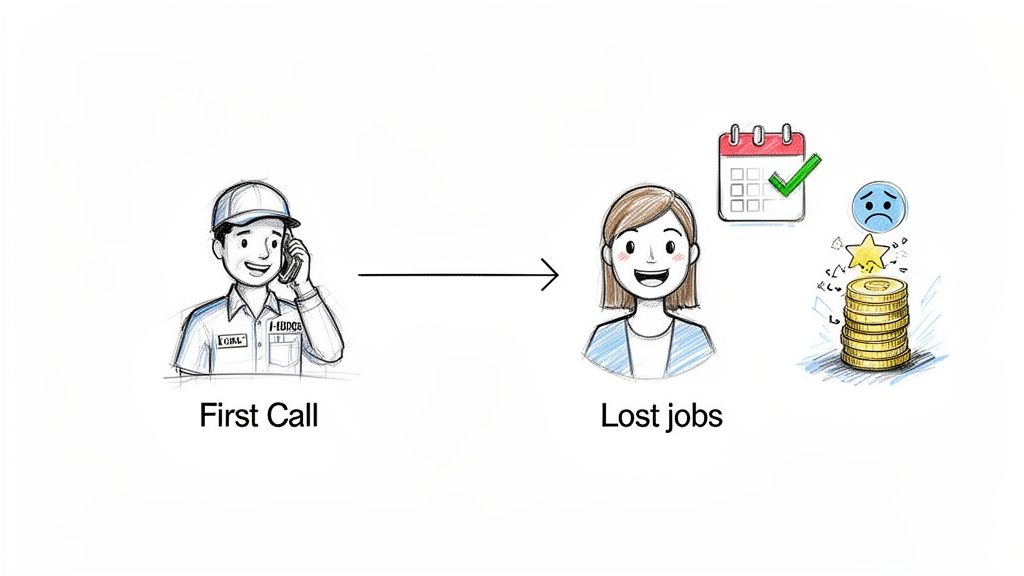
Think about it from the perspective of a local HVAC contractor. A high FCR means you're booking jobs and satisfying customers in one go. It’s the difference between a quick, positive interaction and a frustrating chain of callbacks that kills trust and eats up your profits.
When you don't resolve an issue on the first try, the ripple effects are huge. First, you get a frustrated customer. That frustration almost always leads to repeat calls, tying up your phone lines and pulling your team away from actually booking new jobs. Every single callback costs you money—you're paying an employee to handle the same problem twice.
The Real-World Costs of Low FCR
The financial drain isn't just about wasted staff time. A poor FCR rate is a warning sign of deeper issues that can tank your reputation and your bottom line.
When customers have to call back, it usually points to one of these problems:
- Your team doesn't have the right information at their fingertips.
- Your processes are too rigid, stopping your staff from making decisions.
- The wrong person answered the phone, forcing an unnecessary transfer.
Imagine a homeowner calling your plumbing company about a leaky faucet. If the person who answers can't give a price estimate or schedule a visit right then and there, what happens? The customer hangs up and calls your competitor. That's a lost job and lost revenue, all because that first call fell flat.
Nailing FCR dramatically cuts down on customer frustration and the chances of them leaving a bad review. But when things do go wrong, having solid strategies for responding to negative feedback is non-negotiable for protecting your brand.
To really see how FCR affects a business, let's break down the different performance levels.
FCR Performance Levels and Their Business Impact
This table shows how different FCR percentages translate into real-world business outcomes, from poor to world-class performance.
| FCR Rate Tier | Customer Experience | Operational Efficiency | Example Scenario for a Service Business |
|---|---|---|---|
| Poor (Below 60%) | Customers are frequently frustrated, leading to complaints and negative online reviews. | High callback volume, wasted staff time, and increased operational costs. | A landscaping company where callers can't get a quote and have to wait for a call back, often losing the job to a competitor. |
| Industry Average (60-70%) | Service is inconsistent. Some calls are resolved quickly, others require multiple follow-ups. | Moderate efficiency, but still significant room for improvement. Costs are higher than necessary. | An electrical contractor resolves simple scheduling calls but has to transfer all pricing questions, creating delays. |
| Good (70-80%) | Most customers have their issues resolved on the first call, leading to good satisfaction ratings. | Operations are smooth. Staff are empowered, and costs are well-managed. | A cleaning service where the front desk can handle scheduling, pricing, and special requests without needing a manager. |
| World-Class (Above 80%) | Customers are consistently impressed, becoming loyal advocates for the brand. | Highly efficient operations with minimal wasted effort. This becomes a key competitive advantage. | An HVAC company whose phone assistant books appointments and answers questions instantly, 24/7, resolving most inquiries on the spot. |
As you can see, even small improvements in your FCR can have a massive impact on both customer happiness and your bottom line.
Why FCR Is the Cornerstone of Customer Experience
On the flip side, getting FCR right pays off big time. When you solve a problem quickly, you're not just fixing an issue—you're building confidence. Customers feel heard and valued, which is the bedrock of loyalty. This blend of speed and effectiveness is a huge part of delivering true customer service excellence.
The industry benchmarks tell a clear story. Only 5% of call centers hit that world-class benchmark of an 80% FCR rate or higher. The industry average is stuck just under 70%. That means nearly a third of all customers have to call back, which only magnifies their frustration and your costs.
For a small or mid-sized business, bumping up your FCR by just a few percentage points can make a huge difference:
- Lower Operational Costs: Fewer callbacks free up your team for more valuable work.
- Stronger Customer Loyalty: A smooth, one-and-done resolution makes customers stick around and refer you to others.
- Happier Employees: Giving your team the power to solve problems makes their jobs more satisfying and less stressful.
You don't need a perfect score overnight. The real win is in making steady, meaningful improvements that create a better experience for your customers and a more efficient business for you. And making that kind of progress is absolutely within your reach.
How to Figure Out Your Real FCR Baseline
Before you can fix your First Call Resolution, you have to know where you're starting from. It’s that old saying: you can't improve what you don't measure. Establishing a clear FCR baseline is ground zero.
The good news is, you don't need some fancy, expensive software to get a surprisingly accurate picture of how you're doing right now.
The Standard FCR Formula
The whole process starts with a simple, universally recognized formula. It's how you turn raw call data into a metric you can actually work with.
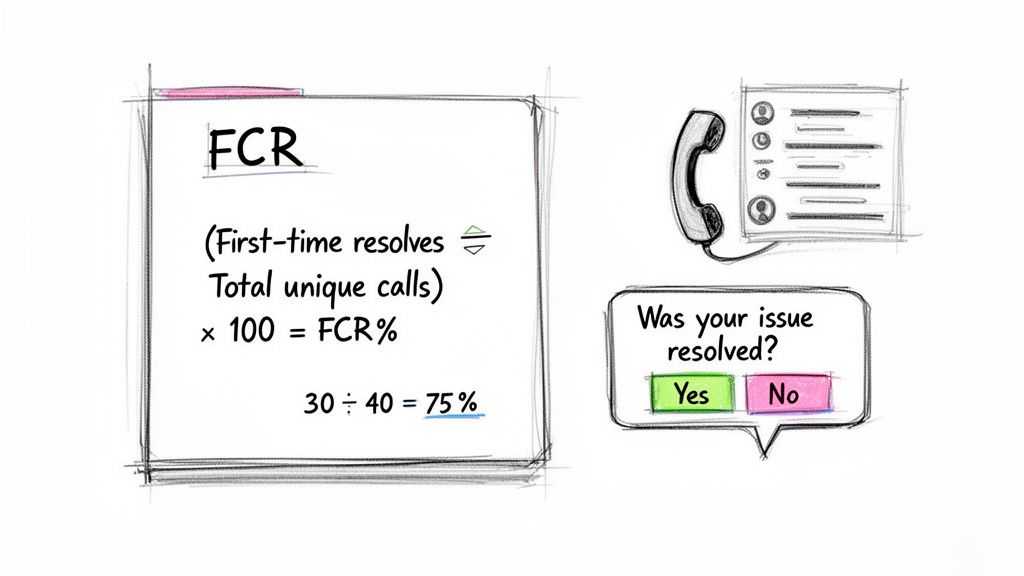
The industry-standard calculation for FCR is:
(Total Calls Resolved on the First Try ÷ Total Number of Unique First Calls) x 100 = FCR Rate (%)
Let's make that real. Say you run a local towing company. Last week, you handled 400 unique calls from customers needing a tow, a jump, or a tire change. After looking through your notes, you see that 280 of those situations were handled completely—the customer didn't need to call back for anything.
Plugging that into the formula:
- (280 resolved calls ÷ 400 total calls) = 0.70
- 0.70 x 100 = 70% FCR
This 70% baseline is your starting line. Industry benchmarks would call that a pretty solid average, but it also screams that there's a lot of room for improvement. Just knowing this number is the first small victory in the journey to a better FCR.
How to Actually Gather the Data
The math is the easy part. The real work is in gathering clean, accurate data. For a small or mid-sized business, you can use some pretty practical, low-cost methods to figure out which calls were truly one-and-done.
Here are a few ways to pull this information together:
- Check Your Call Logs: Dive into your phone system's records. If you see the same number popping up again within 24-48 hours, that’s a big red flag that the first call didn't stick.
- Use Simple Agent Tagging: This is super straightforward. Just have your team add a simple tag or note in your CRM (or even a shared spreadsheet) after a call. Something as simple as "Resolved" or "Needs Follow-up" works wonders.
- Send a Post-Call Survey: An automated text or email that goes out after a call asking, "Was your issue resolved today? Reply YES or NO" is gold. It gives you direct, unfiltered feedback straight from the customer.
Always remember, the customer's point of view is the only one that truly matters. A problem is only solved when the customer thinks it's solved. That's why those post-call surveys are often the most honest tool you have.
While FCR is a vital sign for your service health, it's just one part of the picture. Getting a handle on broader customer satisfaction measurement methods will give you a much more complete view of your service quality.
Don't Settle for One Big Number—Segment Your Data
A single, company-wide FCR rate is a decent starting point, but the truly actionable insights are buried deeper. Not all calls are the same, and lumping them all together hides your biggest problems and your brightest spots.
Think about a local HVAC company. They could track FCR for a few different types of calls:
- New Appointment Bookings: Are we getting jobs on the schedule in one call, or are people calling back confused?
- Service Status Updates: Can a customer get a quick ETA on their tech without a hassle?
- Billing Questions: Are we clearing up invoice questions right away, or are they turning into multi-call headaches?
- Basic Troubleshooting: Can we solve simple thermostat issues over the phone, or does every call lead to a dispatch?
When you break it down like this, you might find that your FCR for new bookings is a stellar 90%, but your rate for billing questions is a painful 40%. Now you know exactly where to focus. You don’t have a general FCR problem; you have a billing communication problem.
This is how you make smart changes that actually move the needle.
Give Your Team the Tools and Training to Succeed
A high First Call Resolution rate doesn't just happen because you tell your team to work harder. It's a direct result of giving them the right tools, knowledge, and confidence to solve problems the first time. When you invest in your team, you're really investing in your FCR.
Think about a locksmith's dispatch operator juggling a dozen urgent calls. They simply can't afford callbacks—every minute spent on a repeat call is a minute they're not helping someone else who is locked out or stranded. Getting it right the first time cuts down on those expensive second calls and builds incredible customer loyalty.
The global average for FCR hovers around 74%, with a pretty wide industry standard of 65-75%. But the top dogs in any industry consistently hit much higher numbers. Their secret? They equip their teams for fast, accurate fixes.
When an agent says, "I'm not sure, I'll have to call you back," it's almost never a personal failure. It's a resource gap. The fix starts with creating a simple, easy-to-access source of truth for your entire team.
Build a Simple, Powerful Knowledge Base
You don’t need fancy software to get started. A "knowledge base" can be as straightforward as a shared Google Doc or a folder with clearly named files. The goal is to create one central place where your team can find consistent, correct answers to customer questions.
Kick it off by documenting the answers to your top 15-20 most frequently asked questions. What are the things you hear every single day?
- "What are your hours?"
- "How much is your initial diagnostic fee?"
- "Do you service the Miller Creek area?"
- "What's your cancellation policy?"
This becomes a living document, your team's first line of defense. It turns frantic searching into quick, confident answers. And make sure everyone can contribute. When an agent gets stumped by a new question, the answer should go straight into the knowledge base so the next person has it ready.
Develop Scripts That Guide, Not Dictate
Let’s be honest, the word "script" can make you think of robotic, impersonal phone calls. But that’s not what we’re talking about here. Good scripts are more like guides or cheat sheets. They ensure all the critical info is gathered and every key point is communicated, every single time.
Take a local pharmacy, for example. A solid script for a refill request isn't just "Hello, how can I help?" It prompts the agent to cover all the bases:
- Verify the patient: "To get started, could I please get your full name and date of birth?"
- Confirm the prescription: "Perfect, are you calling to refill the Lisinopril for John Doe?"
- Set clear expectations: "Great. That will be ready for pickup after 3 PM tomorrow. We’ll text you as soon as it's filled. Sound good?"
This structure ensures nothing gets missed. No more callbacks because a refill wasn't ready or was for the wrong medication. The script provides the skeleton; the agent brings the personality.
Key Takeaway: A well-designed script is a safety net. It gives agents the confidence that they're covering all the bases, freeing them up to focus on the customer's tone and unique needs.
Master Active Listening and De-Escalation
Sometimes, the biggest obstacle to FCR has nothing to do with information—it's about emotion. A frustrated customer isn't in the right frame of mind to hear your solution, no matter how perfect it is. This is where soft skills training becomes your secret weapon.
Active listening is about more than just hearing words; it's about understanding the problem behind the problem. Train your team on a few key techniques:
- Repeat the issue back: "So, if I'm hearing you correctly, you were quoted one price, but the final invoice was higher. Is that right?" This simple act validates their concern and makes sure you're both on the same page.
- Listen for emotional cues: Is the customer worried, rushed, or just plain angry? Acknowledging their feelings with a phrase like, "I can see how that would be incredibly frustrating," can de-escalate a tense situation in seconds.
De-escalation training provides a playbook for handling those tough calls. The goal isn't to "win" an argument, but to guide the conversation back toward a solution. When your team has these skills, they can prevent calls from spiraling, making a one-call resolution possible even when things get heated. In fact, strong agent training is a pillar of any effective call center quality control strategy.
Use Technology to Streamline Resolutions
While empowering your team is essential, technology is the real force multiplier for your First Call Resolution rate. The right tools can automate the grunt work, serve up instant answers, and free up your agents to handle the complex calls that truly demand a human touch.
A smart tech stack doesn't just make you faster; it makes your entire operation more resilient and responsive. From simple spam blockers that clear your lines to sophisticated AI assistants, technology is your best ally in solving customer problems the first time they call.
Let AI Handle the Routine Work
For most service businesses, a shocking amount of inbound calls—often 60-80%—are for the same handful of routine tasks. Just think about it. How many calls a day are for simple appointment scheduling, status checks, or basic questions about your services? Each one ties up a human who could be handling a tricky customer issue or a new sales lead.
This is where an AI phone assistant like Marlie.ai changes the entire dynamic. An AI can instantly answer every call, 24/7, and handle these common requests without any human intervention at all.
Just look at a couple of real-world examples:
- A busy driving school can deploy an AI to reschedule lessons and answer questions about class times. This simple step could cut their human-handled call volume by 70%, freeing up staff to focus on enrolling new students.
- A local locksmith can have an AI act as the first point of contact, capturing critical details like the vehicle's year, make, and model, plus the customer's exact location, before a tech is even dispatched. This ensures the locksmith arrives with the right tools and information, preventing callbacks from the field.
By automating the high-volume, low-complexity calls, you create the bandwidth for your team to focus on resolving the issues that actually matter. This is one of the most direct ways you can start using AI for customer service to boost your FCR.
Other Simple Tech Wins for Better FCR
Beyond a full-fledged AI assistant, several other pieces of tech can make an immediate impact on your ability to resolve calls on the first try.
Automated Appointment Reminders
How many calls are just customers confirming an appointment? Sending automated text or email reminders a day before the service call can almost completely eliminate this type of call. It's proactive communication that keeps customers in the loop and your phone lines clear.
Effective Spam Blockers
Junk calls aren't just an annoyance; they're an operational drag that wastes your team's time and energy. A quality spam blocker integrated into your phone system ensures your people are talking to actual customers, not robocallers. More available agents means a higher chance of resolving real issues on the first attempt.
In the world of customer service, nailing First Call Resolution is the secret sauce. Global benchmarks are pushing for an 80% success rate, yet the average still hovers between 70-74%, leaving up to 30% of customers needing to call back. Investing in technology helps bridge this critical gap, especially as self-service channels increase call complexity.
Gathering Feedback to Drive Improvement
Technology also plays a huge role in closing the feedback loop. You can't fix what you don't know is broken, right? Simple, automated tools can help you gather the insights you need to pinpoint the root causes of repeat calls.
Investing in real-time feedback resolution software can give you the power to take immediate action and solve problems faster, which directly improves FCR.
Think about something as simple as a post-call SMS survey asking, "Was your issue fully resolved today? (Yes/No)". This gives you direct, actionable data.
When a customer replies "No," you have an immediate opportunity to follow up, understand what went wrong, and fix the underlying process issue. This doesn't just help that one customer; it prevents the same problem from causing more repeat calls down the road. Technology turns customer feedback from a passive metric into an active tool for continuous improvement. This is how you systematically chip away at the reasons people call back, pushing your FCR rate higher and higher.
Developing Smart Call Routing and Escalation Paths
Nothing poisons a customer interaction and kills First Call Resolution faster than the dreaded transfer.
Being bounced between different people is the ultimate sign that a business is disorganized. It practically guarantees a frustrated customer and, you guessed it, a repeat call.
The fix is to build clear, intelligent pathways for every call that comes in. This isn't about creating those infuriatingly complex phone trees; it's about making sure each call lands in the right hands the first time, with all the info needed for a quick resolution.
Empowering the First Point of Contact
The most direct way to boost FCR is to empower the very first person—or system—that answers the phone. The whole game is to resolve as many issues as possible at this initial touchpoint, preventing unnecessary transfers from ever happening in the first place.
This means giving your frontline team, whether it's a receptionist or an AI assistant, the knowledge and authority to handle common requests. If they can solve the problem right then and there, the customer wins, and your FCR rate climbs. An AI phone assistant is a powerhouse here, since it can be programmed to handle a massive volume of routine inquiries—from scheduling to status updates—completely on its own.
This visual shows a simple but powerful decision tree for exactly this kind of triage.
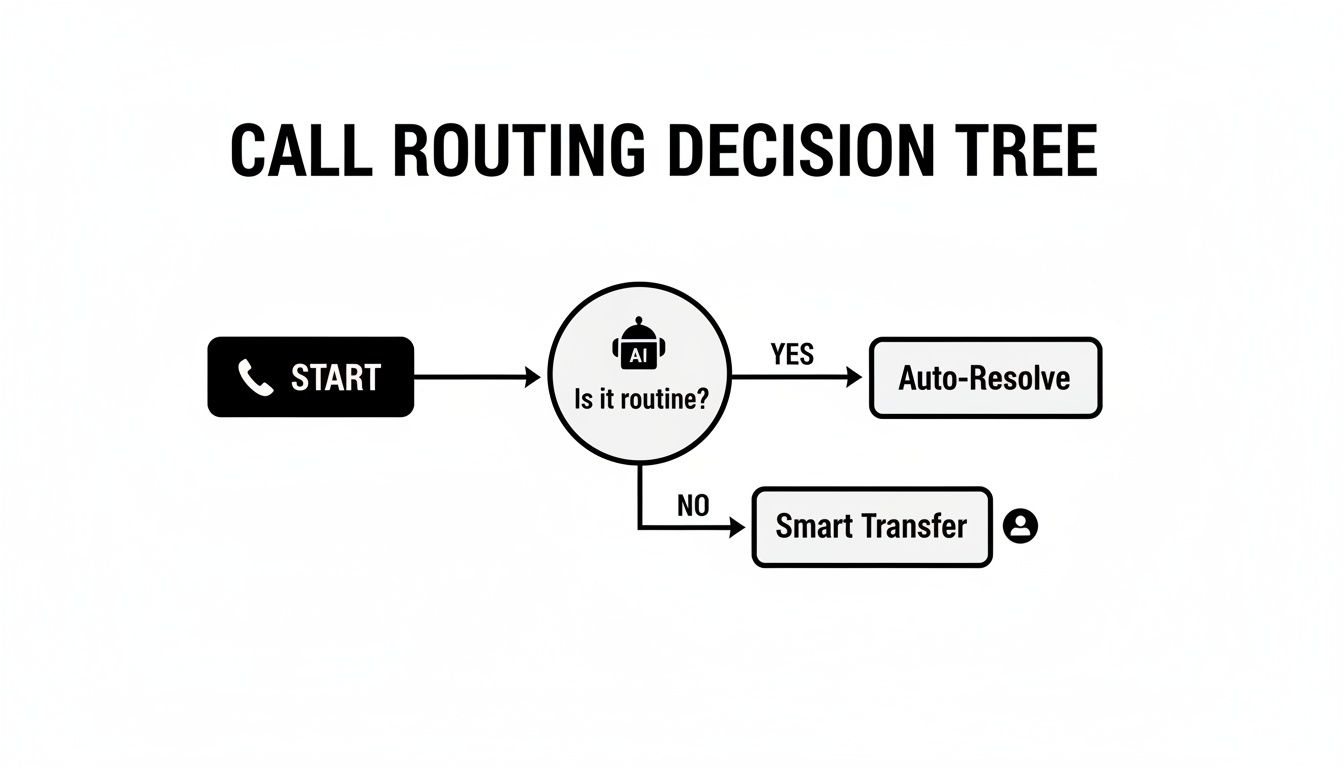
The key insight here is how a smart system can effectively sort calls, automatically resolving the bulk of routine issues while making sure the truly complex problems get a warm handoff.
The Power of the Smart Transfer
Of course, not every call can be resolved by that first point of contact. This is where the "smart transfer" becomes a game-changer for FCR.
A smart transfer isn't just mindlessly passing the call along. It's about gathering critical information before the handoff so the next person is fully briefed and ready to solve the problem immediately.
Think about an auto repair shop. A customer calls about a check engine light. Instead of a blind transfer to a busy mechanic, an AI assistant first asks for the vehicle's year, make, and model.
Scenario: The Smart Transfer in Action
AI Assistant: "I can connect you with a technician. To make sure they have all the details, could you please tell me the year, make, and model of your vehicle?"
Customer: "It's a 2019 Ford F-150."
AI Assistant: "Thank you. Connecting you now. I've noted it's a 2019 F-150."
When the mechanic picks up, they aren’t starting from zero. They already have the core details, letting them dive right into diagnosis. This simple step stops the customer from having to repeat themselves and arms the expert with the context needed for a one-call solution.
Creating Clear Escalation Rules
A well-defined escalation path is the backbone of any solid call handling process. Your team needs to know exactly when to handle an issue themselves and when to pass it to someone with more specialized knowledge. For a deeper look at the mechanics, our guide on what is call routing explores different strategies in detail.
Your escalation rules don't need to be some complicated novel. Start with a simple framework:
- Tier 1 (Frontline/AI): Handles all routine inquiries, like scheduling, pricing, service areas, and business hours.
- Tier 2 (Specialist/Manager): Takes on complex technical questions, billing disputes, or customer complaints that need a manager's authority.
The rule of thumb should be: if you can solve it, solve it. Only escalate when you've hit a wall or lack the authority to provide a final resolution. This keeps calls moving efficiently and ensures only the truly tough issues require a second touch, protecting your FCR from unnecessary hits.
Common Questions About Improving First Call Resolution
Whenever we start digging into call metrics, a lot of questions pop up. As a business owner, you don't need academic theories; you need straightforward answers you can actually use. So, let's tackle the most common questions we hear about improving first call resolution, with practical advice you can apply right away.
What Is a Realistic FCR Goal for a Small Business?
It’s easy to see that world-class benchmark of 80% and feel a little discouraged. That's not a practical starting point for a busy service business just getting its arms around this.
A much more realistic—and highly effective—goal is to aim for somewhere between 70-79%. Honestly, the most important thing isn't hitting some perfect number. It's about achieving consistent, steady improvement.
First, figure out where you are right now. Once you have your baseline, set an achievable goal, like a 5-10% increase over the next quarter. For many small businesses, one of the fastest ways to see a jump is by automating the answers to your most frequent, simple questions—things like business hours, service areas, or basic pricing. This move alone can handle a huge chunk of your call volume instantly.
Chasing a perfect score is a recipe for frustration. Focus on progress, not perfection. A small, sustained increase in FCR delivers real value to your customers and your bottom line.
How Can I Boost FCR Without a Big Budget?
Improving your First Call Resolution doesn't have to break the bank. In fact, some of the most effective strategies are low-cost or even free. They rely on smart process changes, not expensive new tech.
Here are a few high-impact ideas that won't strain your budget:
- Create a Simple Knowledge Base: You don't need fancy software for this. Start a shared Google Doc or a simple text file that lists the top 10-15 questions you get every single day, along with the correct, standardized answers. This empowers anyone answering the phone to give consistent, accurate information on the spot.
- Empower Your Team: Give your front-line staff the authority to solve minor issues without needing a manager's approval. Can they offer a small discount for a service delay or waive a nominal fee to resolve a complaint? A little autonomy goes a long way in preventing callbacks and making customers happy.
- Implement an Affordable AI Assistant: This is a huge lever you can pull. An AI phone assistant can handle all your routine calls—scheduling, status updates, FAQs—for a fraction of the cost of a traditional answering service or hiring more staff. It can instantly resolve a massive percentage of your calls and dramatically increase your FCR overnight.
These steps are all about efficiency and empowerment. They deliver big results with minimal spending.
Will an AI Assistant Hurt My Customer Relationships?
This is a completely valid concern, but here’s what we see in the real world: when done right, an AI assistant actually strengthens customer relationships.
Think about the biggest source of customer frustration—waiting on hold or having a call go completely unanswered. An AI solves that problem by making sure every single call is answered instantly, 24/7.
Customers calling with routine requests, like confirming an appointment or asking about your hours, often prefer a fast, automated answer over waiting to speak to a person. It saves them time and gets them what they need without any friction.
And for more complex issues, a modern AI doesn't create a barrier. It acts as the perfect filter. It includes a seamless "smart transfer" option, allowing a caller to simply press a button or say a keyword to be connected to a human. This gives your customers the best of both worlds: immediate help for simple needs and easy access to an expert for everything else.
Ready to see how an AI phone assistant can instantly improve your FCR and capture more business? Marlie Ai answers every call in under two seconds, books jobs, and frees up your team to focus on what matters most. See how it works for your business at https://www.marlie.ai.
