
An IVR, or Interactive Voice Response system, is really just a smart, digital receptionist for your call center. Its whole job is to greet callers, figure out what they need using their voice or keypad, and then automatically send them to the right place. It's the technology that turns a potential flood of inbound calls into a calm, organized flow.
What Is an IVR Call Center?
Think of an IVR system as the traffic controller for your phone lines. When a customer calls, instead of getting dumped into a long queue waiting for a human, the IVR greets them with a simple menu. This first touchpoint is crucial; it sorts callers based on what they're trying to do, which prevents operational logjams and gets everyone where they need to go, fast.
This sorting process is the heart of the matter when we define IVR call center technology. It’s a bit like a highway interchange, directing callers down different paths. For instance, a caller might be guided to a self-service option to check an account balance, pay a bill, or just hear your business hours. This automated route handles the simple, repetitive stuff without ever needing a human agent.
If the issue is more complex, though, the IVR funnels the call to a specific department or an agent who has the right skills to actually help. This intelligent distribution is a massive part of effective call routing strategies, which are all about connecting a customer to the best possible resource on the very first try.
An effective IVR is designed to resolve common customer issues instantly while ensuring complex problems reach a skilled human agent without delay. The goal is efficiency for the business and a frictionless experience for the caller.
The technology can get surprisingly sophisticated, especially in specialized fields. To really get a feel for what’s possible, it’s helpful to see how it’s integrated within healthcare call center software, where it handles sensitive tasks like scheduling appointments and refilling prescriptions. This shows how an IVR isn't just a simple menu, but a powerful tool for customer interaction and operational efficiency.
How an IVR System Works Step by Step
To really get what IVR is all about in a call center, it’s best to just walk through what happens when a customer calls. It might look complicated from the outside, but it’s actually a pretty logical flow, all designed to get things done quickly. The whole thing kicks off the second a customer dials your number.
Instead of hearing a phone ring, the caller is immediately greeted by the Interactive Voice Response (IVR). This is the first, crucial touchpoint. The IVR plays a pre-recorded message that gives the caller a menu of options. You know the drill: "Press one for sales, press two for support, or say 'check my order status.'"
Input and Recognition
Next up, the system waits for the caller to respond. This usually happens in one of two ways:
- DTMF Tones: That's the technical name for the touch-tone sounds your phone makes when you press a number. Each key corresponds to a specific path that’s already mapped out in the IVR.
- Speech Recognition: Smarter systems use speech recognition to understand what you're saying. A caller can just state their reason for calling, and the system figures out the right command by analyzing their words.
This is a massive leap from the early days of IVR. Research looking at the technology from 1991 to 2023 shows just how far it's come—from clunky touch-tone menus to sophisticated voice recognition that has become a cornerstone of customer management. You can read the full study on IVR's evolution.
Processing and Routing
Once the IVR gets the caller's input and understands it, it looks at its "call flow" map. Think of this as a decision tree that tells the system exactly what to do next based on what the caller chose.
This diagram gives you a simple look at how an IVR routes a call, from the moment it comes in to its final destination.
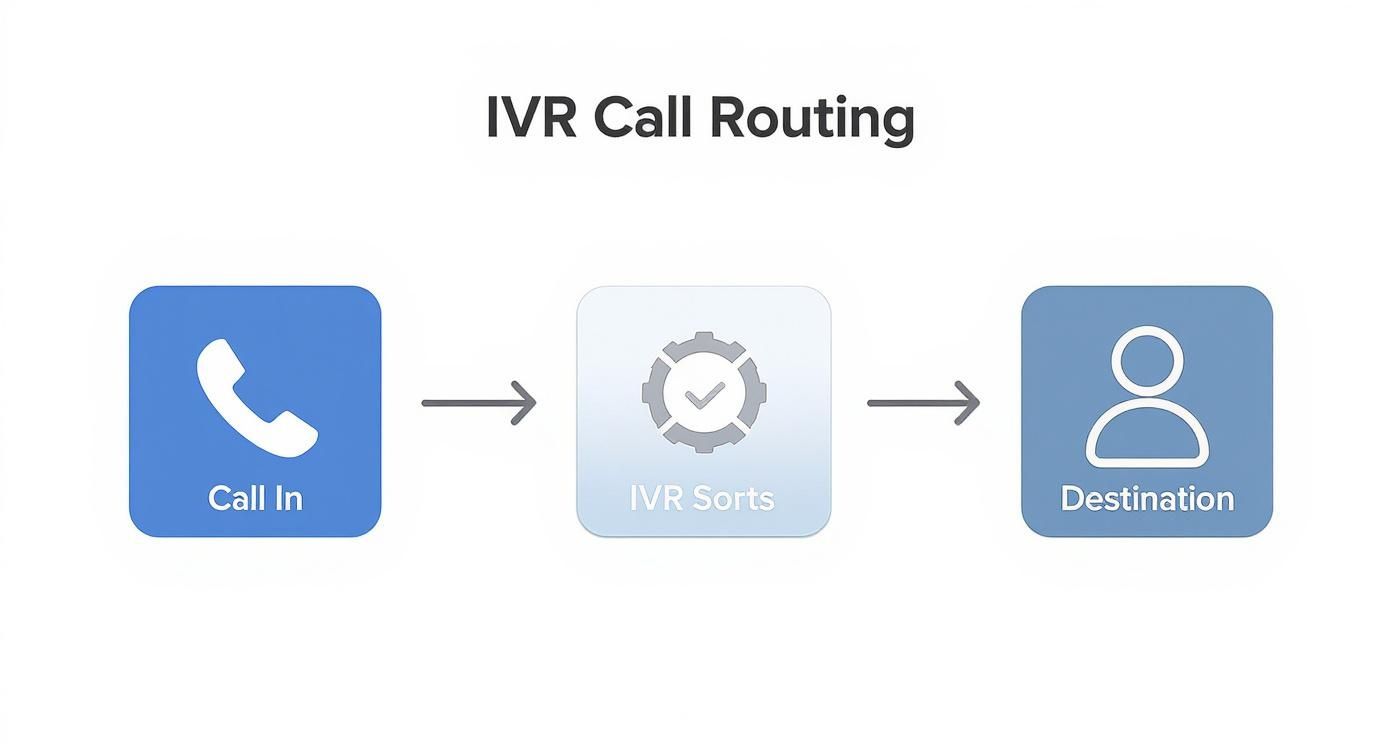
As you can see, the IVR is basically a smart filter. It sorts incoming calls so they land in the right place without wasting anyone's time.
Depending on the choice, the IVR might connect to a database to pull up an account balance, or it could transfer the call straight to the best-equipped agent. This whole handoff is managed seamlessly by an automated calling system.
The Real-World Benefits of Using IVR
Beyond the technical nuts and bolts, the real reason businesses lean on Interactive Voice Response is for the hard, measurable advantages it brings. An IVR isn't just a fancy call-routing tool; it's a strategic asset that delivers tangible returns across the board, starting with some serious cost savings.
Think about it. By automating all those routine, repetitive questions—like "what's my order status?" or "what are your hours?"—IVR frees up your human agents. Suddenly, they can focus their brainpower on the tricky, high-value conversations that actually require a human touch, improving how you use your team and cutting down operational costs.
Boosting Efficiency and Customer Access
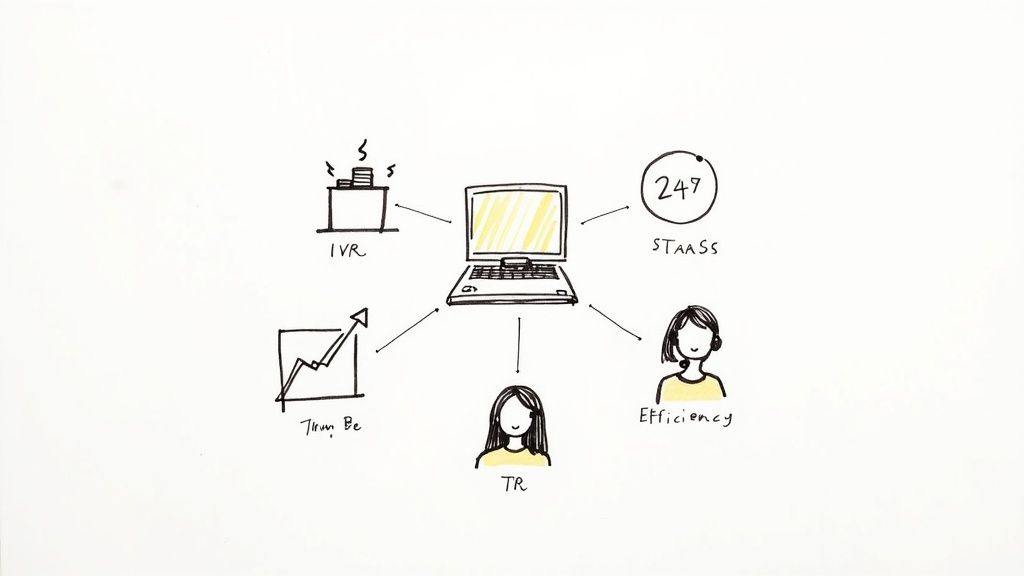
An IVR system is the ultimate workhorse. It runs 24/7 without needing coffee breaks or racking up overtime pay. This constant availability means customers can get simple answers or handle basic tasks whenever it suits them, not just during your business hours. That’s a huge win for both accessibility and efficiency.
A well-designed IVR delivers instant gratification for customers with straightforward needs. It cuts down on frustrating hold music and shows you respect their time, setting a positive tone right from the start of the interaction.
Of course, the whole point is to make the customer's journey better. To know if you're actually succeeding, you have to get good at how you measure customer satisfaction effectively.
To really grasp the impact, let's look at a simple before-and-after snapshot of a typical call center's operations.
Call Center Operations Before and After IVR Implementation
| Metric | Without IVR | With IVR |
|---|---|---|
| Agent Availability | Limited to business hours; prone to staffing shortages. | 24/7 basic service; consistent availability. |
| Average Wait Time | High, especially during peak hours; all calls queue for a live agent. | Significantly reduced; simple queries are self-serviced instantly. |
| First Contact Resolution | Lower, as agents handle both simple and complex calls. | Higher, as agents focus their expertise on complex issues. |
| Cost Per Call | High, as every interaction requires a paid human agent. | Lower, with automation handling a large percentage of inbound call volume. |
| Data Collection | Manual and often inconsistent, relying on agent input. | Automated and structured, capturing valuable data on every call. |
The difference is pretty stark. Implementing an IVR doesn't just add a feature; it fundamentally changes the operational dynamics of your customer service for the better.
Enhancing Performance with Modern Technology
Today's IVR systems are a far cry from the clunky, robotic menus of the past. With AI baked in, we're seeing a 14% increase in issues resolved per hour and a 9% reduction in the time it takes to handle a call.
Modern systems use natural language processing, which allows callers to just say what they need instead of mashing buttons. This one change alone has been shown to slash call abandonment rates by 50-70%.
That’s why so many businesses see their IVR as more than just tech—it’s a core piece of their customer service strategy. It fills the same role as a top-tier automated telephone answering service, making sure every single call is answered professionally and handled efficiently, day or night. That kind of consistency builds trust and loyalty, turning a simple phone call into a genuinely positive brand experience.
Where Good IVRs Go Bad
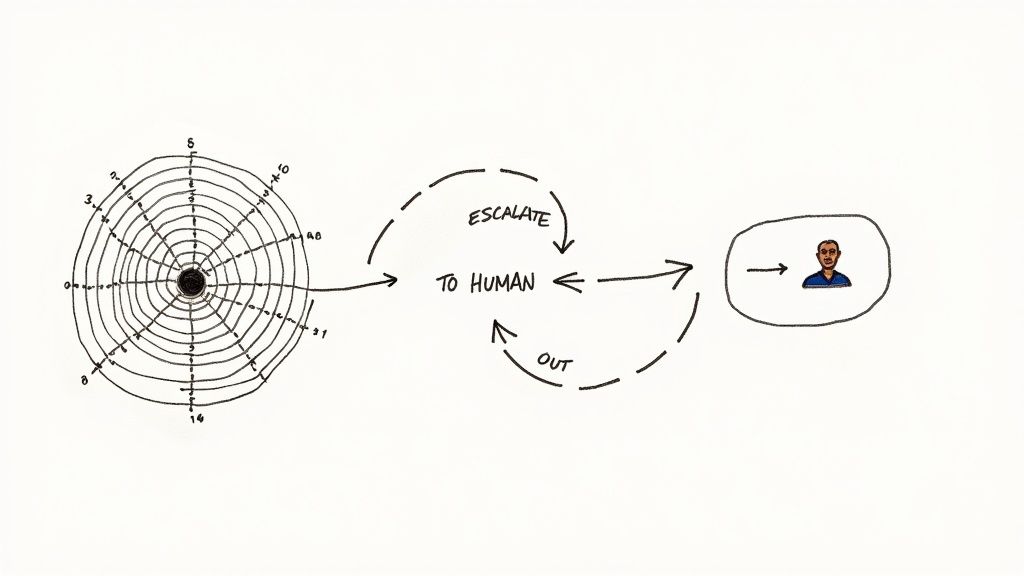
We’ve all been there. Trapped in a robotic menu that feels like a maze you can't solve, repeating "agent" into a void that doesn't understand, or stuck in a loop with no escape to a real person.
While the benefits of a good IVR are clear, a poorly designed one can become a fast track to customer rage. The very tool meant to help can backfire, tarnishing your brand's reputation with every frustrating dead end. This is where theory meets reality when you define what an IVR call center should actually do for your customers.
Many people dread calling a company for this exact reason. Those bad experiences stick.
User-Centric Design Isn't Optional
The root of the problem is almost always the same: the system was built around the company’s internal logic, not the customer’s journey. A successful IVR has to offer a clear, intuitive path to an answer. If callers can't get what they need quickly, the system has failed. Plain and simple.
Here are the most common traps to watch out for:
- Endless Menu Mazes: Throwing too many options at a caller just creates confusion. Keep your menus short, simple, and logical. Think 3-4 options max per level.
- The Hidden "Escape Hatch": Always, always provide a clear and easy way to reach a live agent. Hiding the "press 0" option is a guaranteed way to spike frustration and call abandonment.
- Poor Voice Recognition: If your system can't understand different accents or common phrases, it stops being a helpful tool and becomes an infuriating barrier.
- Cold, Robotic Interactions: A monotone, impersonal voice makes customers feel like just another number. Use warm, natural-sounding voice prompts to create a better experience.
An IVR’s real job isn't just to deflect calls—it's to provide immediate value. When your IVR can actually solve a customer's problem on the first try, it massively boosts one of the most critical call center metrics. You can learn more about why that matters by exploring guides on what is first call resolution and its impact.
From IVR to Conversational AI: The Next Generation
The old-school IVR certainly laid the groundwork for automation, but its next evolution is already here, and it’s powered by Conversational AI. We’re moving far beyond the rigid, often frustrating "press one for sales, press two for support" menus that have defined automated phone systems for decades.
Instead, the systems are becoming smarter, more intuitive, and almost surprisingly human.
This leap forward is all about Intelligent Virtual Agents (IVAs). Don’t think of an IVA as just another phone menu. Think of it as a digital team member that can actually understand and respond to natural, everyday language. It uses technologies like Natural Language Processing (NLP) to grasp the real intent behind what a caller is saying, not just hunt for keywords.
How Conversational AI Changes the Game
A classic IVR is stuck on a strict, pre-programmed path. An IVA, on the other hand, can navigate complex, multi-part conversations with ease.
For instance, a customer can just say, "I need to check the status of my recent order and update my shipping address." The AI gets it—processing both requests in a single, fluid interaction, without forcing the caller to start over.
And here’s the kicker: these systems learn from every single call. They get progressively better at solving problems. This shift is huge. While the first IVRs were brought in back in the 1980s for basic call routing, today’s AI-powered systems are completely transforming customer service. Right now, there are over 16,000 AI agents that have taken the place of more than 100,000 human agents, boosting customer satisfaction by 60-80%.
The goal isn't to just throw out the old IVR, but to give it a massive upgrade. By learning how to replace IVR with AI, businesses can finally deliver a self-service experience that customers don't just tolerate—they actually appreciate.
The point of Conversational AI in a call center is simple: make self-service feel less like navigating a machine and more like having a helpful conversation. It closes the gap between automated efficiency and genuine human understanding.
This evolution is now a core part of how we define an IVR call center. It's no longer a static menu, but an intelligent, dynamic first point of contact that can solve real problems right away.
Got Questions About IVR?
Even after you get the basics down, it’s natural to have questions about where IVR fits into the bigger picture of a call center. Let’s tackle some of the most common ones that pop up.
What’s the Real Difference Between an IVR and an ACD?
Think of it like a restaurant. The IVR is the host at the front door, and the ACD is the manager figuring out the seating chart.
An Interactive Voice Response (IVR) is that first point of contact. It greets the caller and figures out what they need. "Are you calling about a new order or an existing one?" Its entire job is to understand the caller's intent.
An Automatic Call Distributor (ACD) is the routing logic that kicks in next. It takes the information from the IVR and decides where to send the call. Based on the caller's needs, the ACD sends them to the best-equipped agent or department. They're a team, but the IVR handles the "what" and the ACD handles the "where."
How Do You Know if an IVR Is Actually Working?
You have to look at the right numbers. A good IVR doesn't just block calls from agents; it actually solves problems for your customers. Here’s what to track:
- Containment Rate: What percentage of calls are completely handled by the IVR, with no human handoff needed? A high rate is great, as long as customers are happy.
- Abandonment Rate: How many people just hang up while they're in the IVR menu? If this number is high, it’s a huge red flag that your system is confusing or frustrating.
- First Call Resolution (FCR): For the calls the IVR does handle, did it actually solve the customer's problem on that one automated touch?
- Customer Satisfaction (CSAT): The ultimate test. Post-call surveys give you direct, unfiltered feedback on what people really thought of the experience.
A successful IVR isn't just a deflection tool—it's a resolution tool. The goal is to find that sweet spot between a high containment rate and genuinely positive customer feedback. That’s when you know it's both useful and easy to use.
Is an IVR System Overkill for a Small Business?
Not at all. Years ago, IVR felt like something only giant corporations could afford, but modern cloud-based systems have made it accessible and affordable for literally any size business.
For a small team, an IVR punches well above its weight. It immediately gives you a professional polish that puts you on par with bigger competitors. It makes sure every single call gets answered 24/7, gives instant answers to common questions (like your hours or address), and gets callers to the right person without needing a dedicated receptionist.
This frees up a small team to stop sorting calls and start focusing on the work that actually grows the business.
Ready to see how an AI-powered voice assistant can transform your call handling? Marlie Ai provides a 24/7, natural-sounding assistant that handles routine calls, books appointments, and frees your team to focus on what matters most. Discover the future of call management today.
