

Let's be honest, what exactly is a telephone answering service business? At its core, it’s a team of professionals you hire to handle your incoming calls. Think of it as your company's digital front door, always open and ready to greet visitors. This is more important than you might think—a staggering 80% of customers will walk away for good after just one bad phone experience.
Unpacking the Core Value of an Answering Service

Here’s a real-world scenario. Imagine a small plumbing company. The owner is crawling under a sink, hands covered in grime, and his phone rings. It's a new customer with a burst pipe. He can’t answer, so it goes to voicemail. That potential customer isn't waiting around—they’re already dialing the next plumber on the list.
That's a lost job and lost revenue. A telephone answering service is designed to stop that from ever happening.
Fundamentally, this kind of business is an external partner that manages your communications. But it's so much more than just taking messages. The good ones have evolved into sophisticated hubs that handle a whole range of tasks, all aimed at helping you grow.
Beyond Just Answering Calls
Today's top-tier answering services act as a seamless extension of your own team. They provide a genuine human touch that an automated menu or a cold voicemail greeting just can't match. And that matters. Over 50% of customers still prefer to speak with a real person, and that preference has a direct line to how they feel about your brand.
This human element is where the real value lies.
Their responsibilities often go much deeper than you'd expect:
- Appointment Scheduling: They can book consultations for a law firm or schedule patient visits for a busy medical clinic, right in your calendar.
- Lead Capture and Qualification: When a new sales inquiry comes in, they gather the crucial details and get that warm lead over to your team instantly.
- Emergency Dispatch: For an HVAC company or a towing service, they can relay urgent calls to the on-call technician, no matter the time of day.
- Basic Customer Support: They can field all those frequently asked questions, freeing up your internal staff to focus on more complex work.
And this isn't just a 9-to-5 gig. Many offer 24/7/365 coverage, making sure your business is always on, even on weekends and holidays. If you're curious to learn more about the mechanics, we break it all down in our guide on what an answering service is.
The Strategic Business Advantage
For any business, bringing on an answering service isn't just about convenience. It’s a strategic play. It lets a small operation project the image of a much larger, more established organization, which builds instant credibility with customers.
By making sure every single call is handled with professionalism, businesses can dramatically improve their customer experience. They capture more leads and operate with greater efficiency—all without the staggering overhead of hiring more in-house receptionists. This operational leverage is what makes the service truly indispensable.
How the Call Answering Game Is Changing
The world of telephone answering services is in the middle of a massive shake-up. It's moving far beyond its old-school roots of human operators just taking down messages. The whole industry is being rewired by new technology and, frankly, by new expectations from all of us as customers. We now demand instant, helpful support on whatever channel we choose, and that’s pushing businesses to get a lot smarter about how they answer the phone.
This isn’t just some passing trend; it’s a complete redefinition of what a call answering service is supposed to do. We're moving from a purely reactive, message-taking function to something more like a proactive, fully integrated communications partner. A few key forces are driving this evolution and setting a new bar for what success looks like.
The Rise of Hybrid Models
The biggest change is the shift away from operations run entirely by people. The most effective services today are a blend of human empathy and the raw efficiency of artificial intelligence. This hybrid model really does give you the best of both worlds.
Think of it like a hospital's triage desk. The AI is your frontline, handling the high volume of routine stuff—checking appointment times, answering basic questions, or gathering initial details. This is like a nurse taking vitals. It frees up your skilled human agents to step in for the complex, emotional, or high-stakes conversations that absolutely need a human touch.
This approach creates a much smarter, more scalable telephone answering service business model. Simple tasks get handled instantly and cheaply, while the calls that really matter get the thoughtful attention they deserve. If you're looking to modernize your own communications, checking out an AI phone answering system is a great way to see how this works in the real world.
What's Driving the Shift?
A few powerful forces are pushing this change forward, forcing providers to adapt or get left behind. These drivers aren't unique to this industry; they reflect bigger shifts in how we all live and work.
- Demand for 24/7 Availability: Let's be honest, in an always-on world, a "closed for the day" sign is a huge liability. Customers expect help when they need it, not just between 9-to-5. AI makes this possible without the crippling cost of staffing a human team around the clock.
- Multichannel Communication: The phone is just one piece of the puzzle now. Customers reach out via text, web chat, and social media. A modern answering service has to pull all of these into one place to provide a seamless experience.
- Data Security and Compliance: With privacy being a bigger concern than ever, handling sensitive information is a serious responsibility. For industries like healthcare or finance, meeting regulations like HIPAA isn't optional—it demands rock-solid security and expertly trained people.
This shift toward integrated, tech-driven solutions is reshaping the entire market. It's no longer about just answering calls; it's about managing the whole customer conversation, from start to finish, both efficiently and securely.
The sheer economics of the industry backs this up. As you can see from research on the US telephone answering service market on AnythingResearch.com, the market's growth is being fueled by AI, automation, and a relentless focus on the customer experience.
The numbers tell a clear story: the market is in transition. Services powered by technology are grabbing a bigger piece of the pie, proving that this new model isn't just a concept—it's profitable. Businesses that get on board are simply better equipped to meet modern demands. The future belongs to those who can masterfully blend technology with a human touch.
Comparing Human Agents and AI Receptionists
Deciding between a human touch and AI efficiency is one ofthe biggest forks in the road when you’re building a telephone answering service business. This isn't just about choosing a person or a machine; it's a strategic call that will define your clients' customer experience, your own operational costs, and how fast you can grow.
A human agent brings something special to the table: empathy, intuition, and the knack for navigating tricky emotional conversations. They're fantastic at building a genuine connection and can think on their feet when a call goes off-script. This makes them perfect for high-stakes moments, like calming down a distressed client or closing a sale that requires a delicate touch.
On the flip side, an AI receptionist offers something else entirely—unbeatable consistency, speed, and 24/7 availability, all at a fraction of the cost. It can juggle hundreds of routine calls at once without ever getting tired or making a simple mistake, making it a powerhouse for tasks like booking appointments or knocking out frequently asked questions.
Human Agent vs AI Receptionist: A Feature Comparison
To really see the differences side-by-side, it helps to break down their core attributes. This table pits a traditional human-operated service against a modern AI-powered solution, showing where each one shines.
| Feature | Human Answering Service | AI Answering Service |
|---|---|---|
| Availability | Typically limited to business hours or requires expensive shift work. | 24/7/365 coverage without extra cost. |
| Cost | High overhead: salaries, benefits, training, and infrastructure. | Low, predictable subscription fees; no HR overhead. |
| Scalability | Slow and expensive; requires hiring and training more agents. | Instant and seamless; can handle unlimited simultaneous calls. |
| Consistency | Variable; performance can depend on agent's mood or experience. | Perfectly consistent; delivers the same scripted experience every time. |
| Emotional IQ | High; excels at empathy, nuance, and complex problem-solving. | Evolving; can detect sentiment but lacks genuine human connection. |
| Speed | Limited to one call at a time per agent. | Handles thousands of calls simultaneously with zero wait time. |
| Error Rate | Prone to human error, especially with repetitive tasks. | Near-zero error rate for scripted, data-driven tasks. |
| Integration | Often requires manual data entry into other systems. | Deeply integrates with CRMs and other software for full automation. |
As you can see, the choice isn't about which one is "better" in a vacuum. It’s about what’s better for a specific job. For businesses that need to nail routine tasks with flawless consistency, AI is a clear winner. But for those moments that demand a true human connection, an agent is irreplaceable.
Cost and Scalability
This is where the two models really diverge. Bringing on a team of human agents is a serious investment. You've got salaries, benefits, training, and the physical space to support them. And when call volume spikes? Scaling up means hiring more people, which is both slow and expensive.
AI receptionists play by a completely different set of economic rules. They’re software, which means all that human-related overhead just disappears. An AI can handle a sudden flood of calls without breaking a sweat or seeing a dip in performance. It offers almost infinite scalability on demand, which is why an AI receptionist for small business can be such a game-changer for growth.
Consistency and Quality of Service
Let's be honest, people are variable. The quality of a call can hinge on an agent's mood, their energy level, or how much experience they have. A great agent can create an amazing experience, but one bad day can lead to a customer interaction that sours a client's brand reputation.
AI, on the other hand, delivers the exact same performance every single time. It sticks to the script perfectly, never has an off day, and maintains a professional tone around the clock.
Key Takeaway: For businesses where brand consistency and predictable interactions are top priorities, AI offers a level of reliability that's tough for human teams to match. It guarantees every caller gets the same high-quality, on-brand experience, day or night.
This flowchart helps visualize how to think about directing calls based on their complexity.
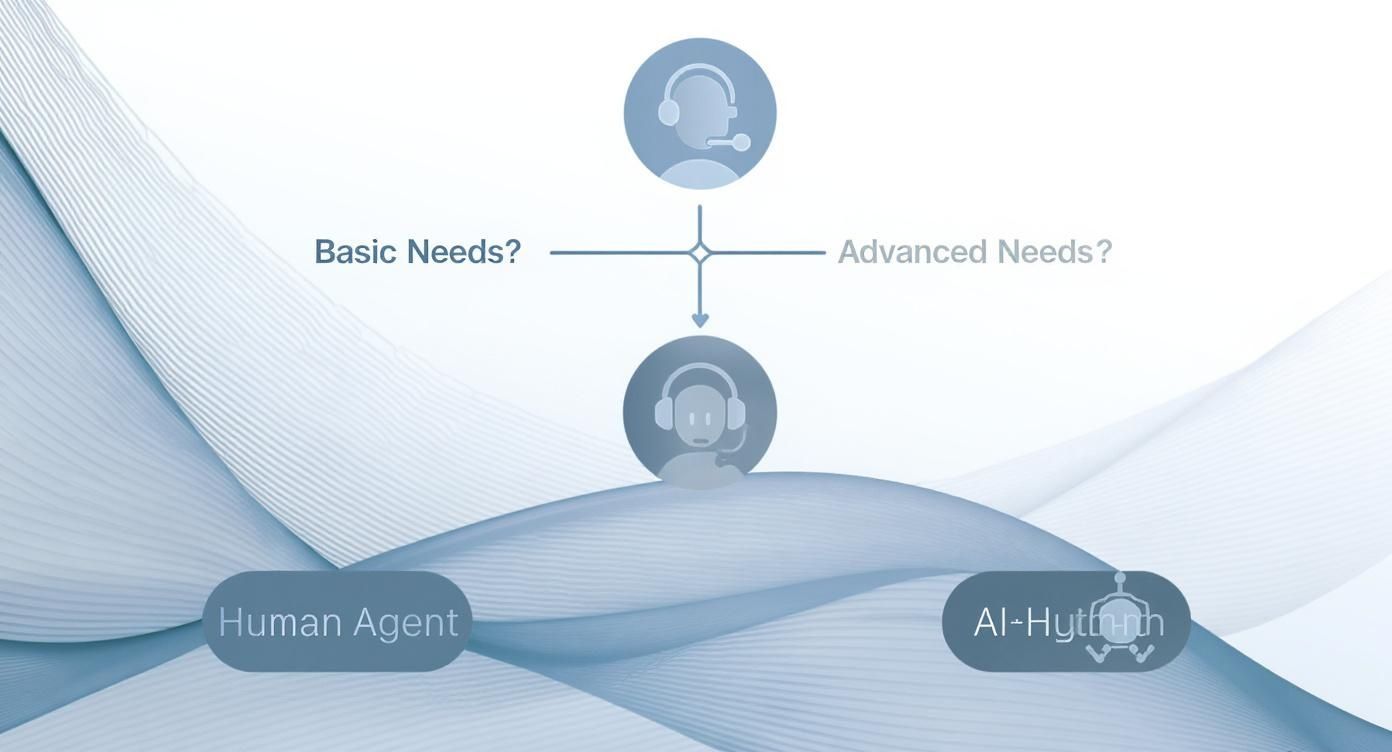
As the decision tree shows, human agents are great for straightforward needs, but a blended AI approach often makes more sense for advanced, scalable operations.
Handling Complexity and Nuance
This is where human agents have traditionally held the crown. They can read between the lines, pick up on a caller's tone, understand sarcasm, and show genuine empathy to someone who's frustrated. For complex problem-solving or sensitive situations, that human ability to think critically and connect emotionally is priceless.
But AI is closing the gap, and fast. Today’s conversational AI can understand context, manage conversations that go back and forth, and even detect a caller's sentiment to figure out when it's time to pass the baton to a human. To get a better sense of how this is reshaping industries, check out this guide on Artificial Intelligence in Hospitality.
In the end, the smartest solution often isn't an either/or decision. A hybrid model gives you the best of both worlds. Let AI handle the high volume of routine calls, and then have it seamlessly transfer the complex or emotional ones to a skilled human agent. This approach gives you maximum efficiency and cost savings while making sure every single caller gets the right level of support—the foundation of a powerful and flexible telephone answering service business.
How to Pin Down the ROI of an Answering Service
It’s easy to look at an answering service as just another line item on the expense sheet. That's a mistake. The smarter way to see it is as a revenue-generating engine humming in the background. To really grasp its value, you have to look past the monthly invoice and calculate its actual return on investment (ROI). This means putting real numbers to both the direct savings and the new opportunities it creates.
The math isn't some dark art. At its core, you're just weighing what you pay for the service against the financial perks it delivers. These benefits really break down into two buckets: cost savings you get from being more efficient, and more revenue from leads you'd otherwise miss and customers you manage to keep.
Once you break down the numbers, you can build a rock-solid case for why bringing on a professional telephone answering service business is one of the shrewdest moves a company can make. For a deeper dive into the formulas and methods, check out our complete guide on how to calculate return on investment.
Quantifying Cost Savings
The first and most obvious win comes from the money you don't have to spend anymore. Hiring a full-time, in-house receptionist brings a ton of overhead that goes way beyond a simple salary.
Let's do some quick back-of-the-napkin math. That average receptionist salary is just the starting line. You also have to tack on:
- Benefits and Taxes: This usually adds another 20-30% right on top of their base pay.
- Training and Onboarding: All the time and resources it takes to get a new hire up to speed.
- Equipment and Office Space: Think desks, computers, phones, and the square footage they take up.
- Paid Time Off: You’re still on the hook for coverage when they’re on vacation, out sick, or on holiday.
When you add it all up, the true cost of one in-house receptionist can easily be double what you see on their paycheck. An answering service swaps all those shifting expenses for one predictable monthly fee, delivering immediate and significant savings.
Measuring Revenue Gains
Cost savings are great and easy to spot, but the revenue side of the ROI equation is where an answering service really proves its worth. Every single call that lands in voicemail is a potential customer—and potential revenue—gone forever. An answering service is your 24/7 safety net, making sure those opportunities are captured.
The core idea is simple: a missed call is a missed sale. By making sure every lead is caught and every customer feels heard, an answering service directly fuels your growth and stops money from slipping through the cracks.
Economic analyses show a clear pattern of cost efficiencies when businesses adopt professional call-handling. A common finding is that businesses recover around $5.50 for every $1 spent on answering services, mostly by cutting down on missed calls. You can dig into more of the data-driven insights about telephone answering service costs and ROI on callin.io.
This chart paints a clear picture of the cost differences between various ways of handling calls.
As the data shows, solutions like virtual receptionists offer a much more compelling financial case compared to the high overhead of traditional in-house staff. This makes professional-grade call handling a real possibility for businesses of any size.
Factoring in Customer Retention
The final piece of the ROI puzzle is customer loyalty. A great first impression and responsive support are absolutely vital for keeping customers happy, and happy customers tend to stick around. In fact, studies show that professional call handling can boost customer retention by up to 37%.
That number is huge. Getting a new customer can cost five times more than just keeping an existing one. By eliminating frustrating phone experiences—like endless hold times or calls that ring into oblivion—an answering service strengthens your customer relationships, reduces churn, and builds a loyal base that delivers predictable, recurring revenue. It's an investment in both this month's sales and your company's long-term health.
Key Industries That Need Answering Services Most
For some industries, a professional call handling service isn't just a nice-to-have—it's the backbone of the entire operation. When you run a telephone answering service business, you quickly learn that these are your most loyal clients. Why? Because for them, every single call carries immense weight. It could be a medical emergency, a once-in-a-lifetime legal case, or a frantic homeowner with a burst pipe.

To really succeed here, you have to understand the unique pressures of these verticals. Their needs go way beyond simple message-taking. They're looking for specialized protocols, absolute discretion, and someone who's ready to jump into action, day or night. Let’s break down the industries where a top-notch answering service truly makes a difference.
Healthcare Providers
The medical field is probably the most demanding client you’ll ever have. A missed call isn't just a lost lead; it could be a patient in real distress or a critical update from another doctor's office. The stakes couldn't be higher, and there is absolutely no room for error.
Here's what a healthcare practice is trying to solve:
- HIPAA Compliance: This is non-negotiable. Every communication has to follow strict patient privacy laws, which means using secure messaging platforms and having agents who grasp the gravity of handling protected health information (PHI).
- After-Hours Triage: People don't just get sick between 9 and 5. A great answering service acts as the 24/7 frontline, sorting routine calls (like prescription refills) from genuine emergencies that require paging the on-call physician immediately.
- Appointment Management: The sheer volume of calls for scheduling, confirming, or canceling appointments can overwhelm a front desk. A dedicated service frees up in-house staff to focus entirely on the patients standing right in front of them.
Without a professional service, a busy practice is gambling with patient satisfaction and, even more seriously, potential medical liabilities.
Legal and Professional Services
For law firms, financial advisors, and consultants, every ringing phone could be the next big case or a high-value client. First impressions are everything. Projecting an image of constant availability and sharp professionalism is a massive competitive advantage.
A potential client looking for a lawyer is often stressed and in a hurry. If their first call goes to a generic voicemail, they are almost guaranteed to hang up and call the next firm on their list. Answering services make sure that opportunity is captured, right then and there.
Law firms, in particular, need a service that can:
- Handle New Client Intake: Agents can follow a custom script to gather the essential details of a case, so the lawyer has all the necessary information before the first consultation.
- Screen Calls with Confidentiality: Attorney-client privilege is sacred. A trained agent knows how to handle sensitive information with the utmost discretion.
- Project a Larger Presence: For a solo practitioner or a small firm, a professional answering service creates the impression of a bigger, more established operation. This builds instant trust and credibility.
Home and Emergency Services
Think about your local plumber, HVAC tech, locksmith, or towing company. Their entire business is built on reacting to emergencies the moment they happen. A flooded basement or a car lockout simply can't wait until morning.
For these businesses, a telephone answering service business isn't just helpful; it's the central nervous system of their whole operation. They need a partner who can:
- Dispatch Technicians 24/7: When an emergency call comes in at 3 AM, the service has to instantly understand the problem and dispatch the right on-call tech based on a clear protocol.
- Capture Every Single Lead: During a sudden heatwave, an HVAC company might get slammed with dozens of calls at once. A service can handle that surge, scheduling the non-urgent jobs and making sure no potential customer is lost to a busy signal.
- Qualify Service Requests: Agents can get the critical info upfront—the customer's location, the specific issue—so the technician shows up knowing exactly what they’re walking into.
Choosing the Right Answering Service Technology
The engine behind any answering service isn't just the people—it's the tech that gives them superpowers. Picking the right software is one of those foundational decisions that will shape everything else you do. It dictates how efficient you can be, how quickly you can grow, and the level of service you can promise your clients.
This isn't about finding a one-size-fits-all box. It’s about building a tech stack that actually fits your operational goals. Your core platform should be the central nervous system of your entire operation, connecting every agent, call, and client seamlessly. A bad choice leads to dropped calls, frustrated agents, and unhappy clients. The right one? It creates a smooth experience for everyone involved.
Core Features That Drive Success
As you start looking at different platforms, you'll find some features are simply non-negotiable. These are the tools that separate a basic message-taking operation from a true communication hub for your clients. Think of this as your essential checklist.
You absolutely need a platform that delivers:
- Seamless CRM Integration: Your system has to talk to popular CRMs like Salesforce, HubSpot, or any industry-specific software your clients use. This link pushes and pulls data automatically, which kills data entry errors and gives your agents the context they need to sound like they've been working with that caller for years.
- Customizable Call Scripting: Every client is different, period. Your software must let you build dynamic, branching call scripts that walk agents through any possible scenario. This is how you ensure they collect the right information and follow a client's specific instructions, every single time.
- Robust Security and Compliance: For a lot of industries—especially healthcare and legal—data security is everything. You have to look for platforms that are HIPAA compliant, with iron-clad encryption and access controls to protect your clients' sensitive information.
The right technology stack transforms your service from a simple call handler into an integrated business partner. It's the difference between just taking a message and actively helping your clients grow their business through better communication management.
Advanced Capabilities for a Competitive Edge
Once you have the basics covered, a few advanced features can give you a serious leg up on the competition. These tools don't just make your internal workflow better; they let you offer more value to your clients.
A great example is Interactive Voice Response (IVR), which can intelligently get callers where they need to go. If you want to dive deeper, you can learn more about the fundamentals of IVR systems and see how they can untangle complicated call flows. Even better, modern AI-powered IVRs, like the one Marlie.ai uses, let callers speak naturally instead of forcing them through a maze of confusing phone menus.
It's also worth exploring options like hosted VirtualPBX solutions as you build out your tech. They can offer huge advantages in both cost and flexibility.
Analytics and Reporting
At the end of the day, you can't prove your value without data. The technology you choose must have a powerful analytics dashboard that tracks the key performance indicators (KPIs) that matter.
This includes metrics like:
- Average Answer Speed: How quickly are your agents actually picking up the phone?
- Call Duration: What's the average call length for each client?
- Call Volume Trends: Are there specific times of day or week when things get crazy?
- First Call Resolution: How often are issues being completely resolved on the first try?
These reports aren't just for you. They are powerful tools you can share directly with clients to show them the tangible return on their investment, justifying what you do and making your partnership that much stronger.
A Few Common Questions
If you’re kicking the tires on a telephone answering service—either starting one or hiring one—you probably have some questions. Let's get into the most common ones that come up.
What Is the Difference Between a Call Center and an Answering Service?
Think of it like the difference between a massive warehouse and a curated boutique. A call center is built for sheer volume. They’re the heavy machinery for huge corporations, focused on getting through calls as fast as possible, whether it's for sales or massive support operations. The agents might be juggling dozens of completely unrelated companies.
An answering service, though, is much more personal. It’s meant to feel like a seamless part of your team. The whole point is to offer a tailored, high-touch experience that perfectly represents your brand. Quality over quantity, always. It’s less about call processing and more about creating great interactions.
Can I Customize How Calls Are Handled?
You absolutely can, and you should settle for nothing less. Real customization is the heart and soul of a good answering service. You need to be able to set the exact scripts, greetings, and rules for just about any scenario you can think of—from greeting a brand new lead to dispatching an emergency technician after hours.
For example, you could dictate that your agents:
- Always answer with, "Thank you for calling Smith & Jones Law, how can I help you?"
- Collect a specific list of qualifying details from a new prospect before transferring the call.
- Route any call mentioning an "invoice" or "billing" straight to your accounts department.
This is the kind of detail that makes the service feel like it's your own receptionist sitting in the front office, not some anonymous third party.
The goal is to make callers feel like they’re talking to someone on your actual team. With the right scripts and protocols, they’ll never guess they’ve reached an outside partner, which keeps your brand’s consistency and trust intact.
How Much Does an Answering Service Typically Cost?
Pricing is all over the map, but it usually boils down to a few common models. Many services charge by the call or by the minute, which can be a good fit if your call volume swings wildly from month to month. Others prefer flat-rate monthly plans that give you a set bucket of minutes or calls.
But don’t just look at the sticker price. It's really important to ask about the extras. Find out what they charge for things like after-hours support, scheduling appointments, or what happens when you go over your monthly limit. You’re looking for a clear, transparent structure that matches your needs without hitting you with surprise fees.
Ready to see how an AI-powered assistant can transform your call handling? Discover how Marlie Ai provides 24/7 coverage, books appointments, and captures leads for a fraction of the cost. Learn more at https://www.marlie.ai.
