
Screening a phone call just means figuring out who’s calling and what they want before you decide to answer. The simplest way to think about it is like a smart gatekeeper for your business phone line, one that’s trained to filter out all the noise so you only deal with conversations that actually matter.
What Does Screening Phone Calls Actually Mean?
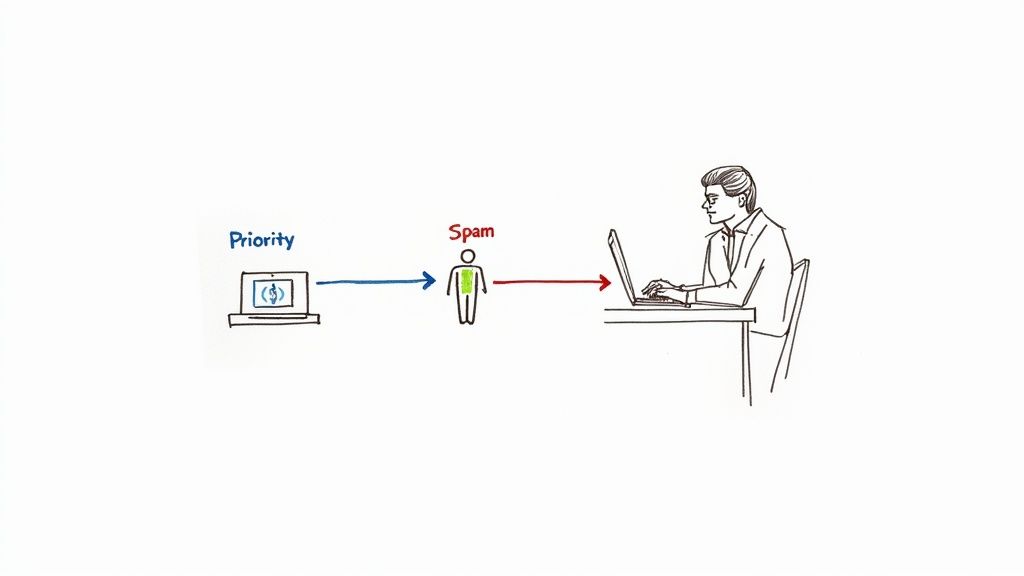
At its heart, screening phone calls is a system for taking back control over your inbound calls. It’s not just about dodging telemarketers—it’s a genuine business strategy meant to guard your most precious resource: time. Every single minute your team is stuck on an irrelevant call is a minute they could have spent helping a great client or closing a new deal.
This "gatekeeper" can look a couple of different ways. You've got the classic manual approach, with a human receptionist personally answering, qualifying, and routing every call that comes in. Then you have the more modern, automated solutions that use technology to do all that heavy lifting for you.
Whichever path you take, the mission is the same. It’s about putting a buffer between your team and the relentless stream of incoming calls, allowing you to instantly tell the difference between a golden opportunity and a pointless interruption.
Why Screening Matters More Than Ever
Let's be honest, the need for a good call screening process has become critical. The sheer volume of junk calls is out of control. Just in April 2024, people in the U.S. were bombarded with nearly 5 billion robocalls. This constant flood forces business owners and their staff to waste valuable time just sorting through the garbage.
One study actually found that the average person burns over 30 minutes a week on this alone. For a small team, that time adds up fast, turning into hundreds of lost work hours every year.
This is exactly where having a structured screening process pays off. It lets you systematically sort every single call into a handful of useful categories:
- Urgent Client Needs: Your existing customers who need help right away.
- High-Potential Leads: New prospects who are ready to talk business.
- Operational Calls: Important calls from vendors, partners, or suppliers.
- Spam and Sales Pitches: All the unsolicited junk that just kills productivity.
By getting this sorting done upfront, you make sure your team’s energy is focused only on conversations that actually move the needle.
From Defense to Offense
At the end of the day, effective screening is so much more than a defensive move against spam. It’s an offensive strategy for capturing value. Of course, before you set up any system, it’s vital to nail down your team's definition by understanding what constitutes a qualified lead to get the most out of your efforts.
When you can reliably spot and fast-track your most valuable callers, your phone line stops being a source of frustration and turns into a powerful engine for growth. You can dive deeper into how new tech makes this happen in our guide to the modern automated call system.
The goal isn't just to block bad calls; it's to create an express lane for the good ones. Screening ensures your best opportunities never get stuck in traffic.
The True Business Cost of Unanswered Phones
Every time an unknown number rings, it's easy to just roll your eyes. Another annoyance. But for a business, each one of those rings is a hidden tax on your resources. Choosing not to have a solid strategy for screening phone calls isn't just inefficient—it's a direct drain on your bottom line that cuts much deeper than just wasted time.
Think about it. When your best people have to stop what they're doing to field a robocall or an aggressive sales pitch, you're paying for that distraction. That constant stop-and-start kills any chance for deep, focused work and pulls them away from the tasks that actually bring in money. It's like having your top technician pause a complex repair to answer a call about their car's extended warranty. That's billable time, gone forever.
The Financial Impact of Missed Opportunities
Beyond the productivity drain, there's a much bigger cost: the actual customer or high-value lead who gets lost in the noise. When your phone lines are clogged with junk, real opportunities fall through the cracks. A potential new client might call, hit a busy signal or get sent to voicemail, and simply hang up and call your competitor.
This isn't just some hypothetical scenario. It happens all the time. Businesses lose countless leads this way, effectively turning away revenue because they have no system to flag the important calls. Over the long haul, this chips away at your reputation, making you seem unresponsive right when customers need you the most. It's worth figuring out what this is costing you, and you can explore how to calculate your potential cost savings with a better phone system.
When every call is treated with the same level of urgency, nothing is truly urgent. Screening is the tool that separates the revenue-generating calls from the resource-draining ones.
Employee Burnout and Sinking Morale
The constant barrage of pointless calls also takes a serious toll on your team. Forcing your employees to act as human spam filters is demoralizing and a surefire recipe for burnout. Their jobs are meant to be strategic, creative, or customer-focused—not fending off an endless stream of interruptions.
That frustration really builds up, leading to lower job satisfaction and, eventually, higher turnover. When your team feels like their skills are being wasted on mind-numbing administrative work, their engagement tanks, and that negativity inevitably trickles down to the quality of their work and the customer experience they provide.
The Growing Threat of Scams and Fraud
Finally, the threats coming through the phone line have gotten much more dangerous. Unscreened calls are basically an open invitation for sophisticated scams like vishing (voice phishing), where criminals pose as banks, the IRS, or even one of your own vendors to steal sensitive information or money. These aren't the obvious, poorly-scripted scams of the past; they can be incredibly convincing.
The financial stakes here are massive. In fact, the problem is growing so fast that robocall fraud is projected to cause global consumer losses of more than $80 billion in 2025. For a business, a single successful scam can be devastating, leading to direct financial loss, data breaches, and a badly damaged reputation. Inaction isn't just a missed opportunity anymore; it's a security risk you simply can't afford to ignore.
Choosing Your Gatekeeper: Manual vs. AI Screening
When you decide to start screening phone calls, you’re essentially hiring a gatekeeper for your business. The big question is, who gets the job?
Your choice boils down to two very different candidates: a traditional human receptionist or a modern AI assistant. Each brings a unique set of skills to the table, and the right one depends entirely on your business's needs, budget, and goals.
The manual approach is classic for a reason. A human receptionist offers a warm, personal touch that can make callers feel heard and valued. They’re great at navigating complex emotional cues and building genuine rapport—something technology is still learning to mimic. For businesses where those high-touch personal relationships are the cornerstone of the brand, that human element is priceless.
But that personal touch comes with some serious operational costs. Beyond salary and benefits, a human gatekeeper is, well, human. They can only handle one call at a time, they get overwhelmed during peak hours, and they’re only on the clock during business hours. This inevitably creates bottlenecks where important calls get missed, leading to lost opportunities and frustrated customers.
The Rise of the Automated Gatekeeper
This is where automated solutions, especially AI assistants, completely change the game. An AI gatekeeper operates on a different set of rules entirely.
It works 24/7/365, ensuring you never miss a call, whether it’s at 2 PM on a Tuesday or 2 AM on a Sunday. This constant availability is a massive advantage for any service business where a client’s needs don't stick to a 9-to-5 schedule. You can dig deeper into the impact of around-the-clock availability in our guide to setting up a 24/7 answering service.
AI also brings flawless consistency to the screening process. It asks the same qualifying questions every single time, captures information with perfect accuracy, and never has an off day. This eliminates the risk of human error, making sure every lead is vetted properly and every critical detail is recorded correctly.
This decision tree shows the immediate choice every business faces when an unknown number rings.
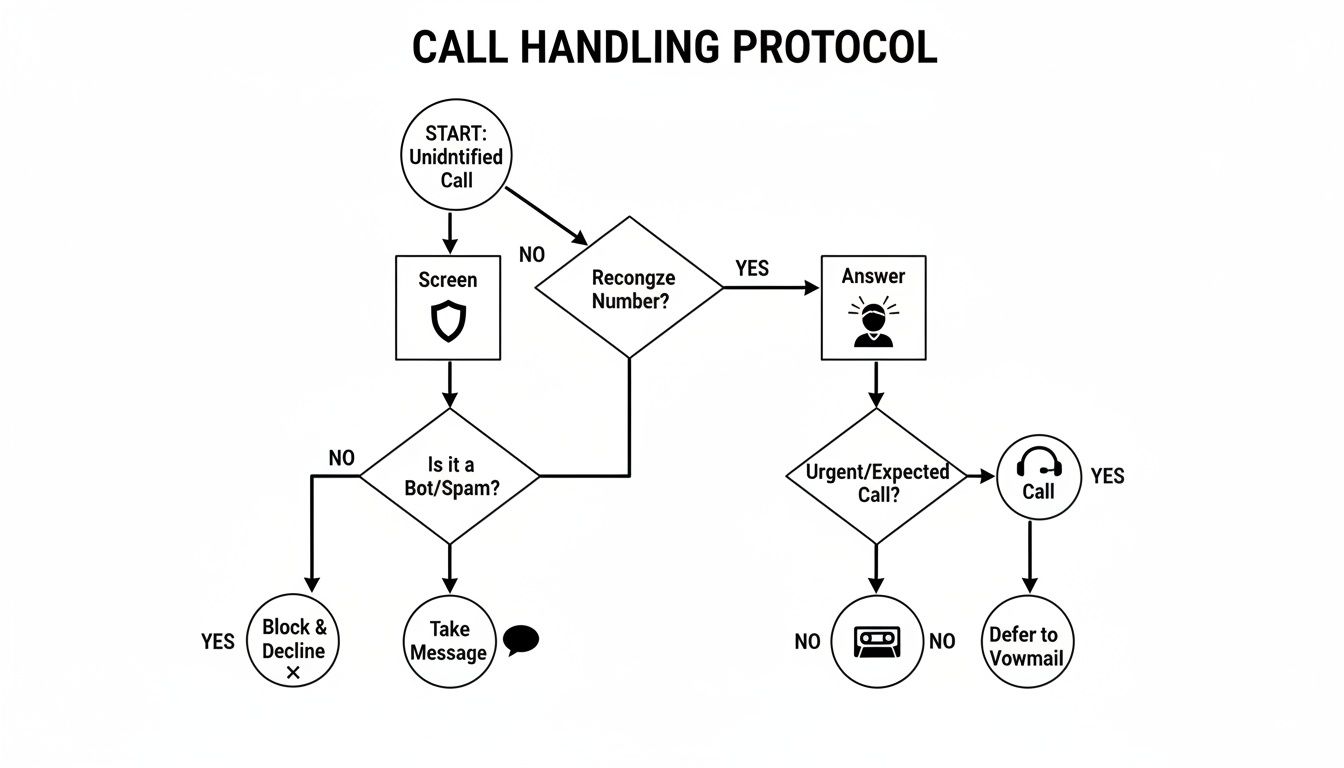
Ultimately, what this shows is that screening is a strategic choice to bring order to your inbound calls. Just answering everything that comes in is a recipe for chaos and inefficiency.
A Head-to-Head Comparison
To make the best call for your business, it helps to see both options laid out side-by-side. Each approach has clear pros and cons across a few key areas.
Manual vs. AI Call Screening: A Side-by-Side Comparison
| Feature | Manual Screening (Human Receptionist) | Automated Screening (AI Assistant) |
|---|---|---|
| Availability | Limited to business hours; takes breaks and vacations. | 24/7/365 coverage with no downtime. |
| Cost | High overhead (salary, benefits, training). | Low operational cost, often a fraction of a human salary. |
| Scalability | Cannot scale; one person handles one call at a time. | Instantly scales to handle hundreds of simultaneous calls. |
| Consistency | Performance can vary based on mood, training, and workload. | Flawlessly consistent with every interaction. |
| Customer Experience | Provides a personal, empathetic touch. | Offers instant, efficient service and zero hold time. |
| Data Collection | Relies on manual notes, which can be inconsistent or lost. | Automatically captures and logs all call data for analysis. |
While the human touch is still vital for certain high-value interactions, the data tells a clear story. For the vast majority of initial business calls—which are often just routine questions or lead qualification—AI offers a far more efficient, scalable, and cost-effective solution.
By deploying an AI gatekeeper, you’re not just blocking spam. You’re building a smarter, more resilient front door for your business's communications—a system that works tirelessly to make sure every valuable opportunity is captured and every customer feels heard, instantly.
How AI Is Redefining Business Phone Calls
Artificial intelligence is doing a lot more than just blocking spam calls these days. It’s fundamentally changing how businesses handle their phones. Forget just building a taller wall to keep bad calls out. AI is creating a smarter, more efficient front door—one that can greet every visitor, figure out what they need, and get them to the right place.
This is a huge shift. Screening phone calls is no longer a defensive move. It’s an offensive strategy. It’s not about avoiding calls anymore; it's about engaging every single one and creating value from the moment the phone rings.
The tech behind this magic comes down to two powerful ideas: Natural Language Processing (NLP) and machine learning. Think of NLP as the AI's "ears and brain," letting it understand the subtleties of human speech—what someone is actually asking for, their tone, and how urgent it is. Machine learning is its memory, helping it learn from every conversation and get smarter over time.
More Than Just a Filter
An AI phone assistant isn't just a robotic bouncer. It's a surprisingly capable digital team member. It goes way beyond a simple "yes/no" screening to handle a whole range of tasks that used to eat up your team's day.
This intelligent first point of contact can turn your phone system from a passive call-catcher into an active, automated asset.
Here’s a quick look at what a modern AI assistant can do:
- Intelligent Greeting and Triage: It greets every caller professionally, right away. Then it asks smart, qualifying questions to understand why they're calling.
- Automated Scheduling: The AI can look at your calendar and book appointments or schedule service calls on the spot, with zero human input.
- Instant FAQ Answers: For the 60–80% of calls that are simple, repetitive questions (like "What are your hours?" or "Where are you located?"), the AI gives immediate, accurate answers.
- Strategic Call Routing: Only the most important calls—like a new customer ready to buy—are passed along to your human team.
This all means your team only gets involved in conversations that truly need their expertise. If you want to dive deeper into how this changes the game, it’s worth understanding the broader role of AI in Sales and Marketing.
The Power of an AI Phone Answering System
The truth is, AI has completely changed the game for phone communications, giving systems the ability to understand and sort calls with incredible accuracy. This is why tools like Marlie.ai are so powerful. The whole point is to turn raw call data into something you can actually use to make better business decisions.
This dashboard gives you a clear, at-a-glance summary of every single interaction, making sure no opportunity ever slips through the cracks. The real value, though, comes from spotting patterns in what your callers are asking for, which can directly inform how you run your business.
An AI assistant doesn't replace your team; it empowers them. By handling the repetitive, low-value interactions, it frees up your best people to focus on the high-value work that drives growth.
For any business looking to take the next step, a dedicated AI phone answering system is the way to go. These platforms, which you can learn more about here: https://www.marlie.ai/blog/ai-phone-answering-system, are built from the ground up to manage inbound calls with precision.
Ultimately, this intelligent approach turns your phone line into a data-gathering powerhouse. Every call becomes a chance to learn more about your customers, refine your services, and operate more efficiently. It’s all about capturing the maximum value from every single ring.
Your Blueprint for an Effective Call Screening System
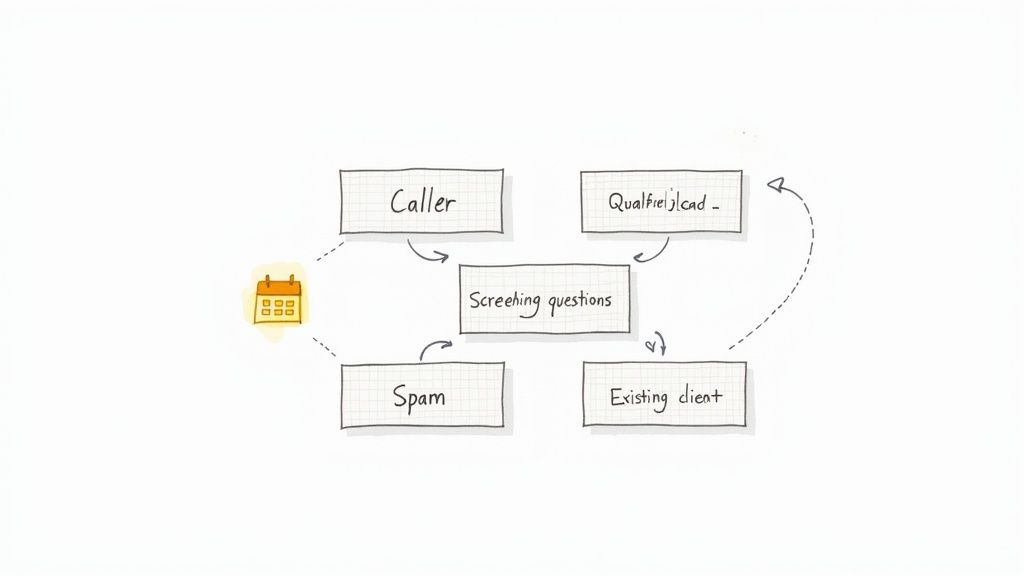
Putting an effective call screening system in place isn't like flipping a switch. It's more like designing a custom workflow that fits your business like a glove. This blueprint ensures you’re not just blocking interruptions but actively improving how you talk to clients and bring in new business.
Think about it like building a house—you wouldn't just start laying bricks without a detailed plan. The same logic applies here. A well-thought-out strategy is the foundation for a more efficient, less chaotic, and ultimately more profitable business.
Step 1: Define Your Primary Goals
Before you even think about the tech, you need to know what a "win" looks like for you. What's the single biggest headache you're trying to solve with call screening? Your answer here will guide every other decision.
So, what are you really trying to accomplish? Are you aiming to:
- Reduce Spam and Robocalls? This is a big one for most businesses. The goal is to reclaim lost productivity and cut down on team frustration.
- Improve Lead Qualification? Maybe your objective is to make sure your sales team only talks to genuine, high-intent prospects.
- Enhance Customer Service? You might want to get existing clients to the right person or answer common questions instantly.
- Automate Routine Tasks? This is about offloading jobs like booking appointments or giving out basic info to free up your staff for more important work.
Your main goal dictates how simple or complex your system needs to be. A business drowning in spam needs a different setup than one focused on pre-qualifying high-value leads.
Step 2: Map Your Caller Journeys
Next up, figure out who is calling you and why. Not all calls are created equal, and mapping out the typical "journeys" for different callers helps you build rules for each one.
Think about the main groups of people who ring your phone:
- New Leads: These are potential customers checking you out. Their journey needs to be smooth and guide them toward becoming a client.
- Existing Clients: They want quick help with support, billing, or scheduling. Their journey should be all about speed and getting their issue resolved.
- Vendors and Partners: These are operational calls. They need to get to the right department—like accounting or management—without getting stuck.
- Unsolicited Callers: This is your bucket for telemarketers, robocalls, and wrong numbers. They need to be filtered out cleanly and efficiently.
When you visualize these paths, you can start designing a system that gives VIP treatment to the people who matter and puts up a wall against the time-wasters.
Step 3: Craft Smart Screening Questions
With your goals and caller journeys laid out, it's time to script the actual interaction. What key information do you need to collect to send a caller to the right place? These questions are the engine of your screening system.
For a new lead, you might ask things like:
- "Are you calling about a new project, or do you already work with us?"
- "To get you to the right person, could you tell me a bit about the service you're looking for?"
For an existing client, the questions would be different:
- "Do you have an account number handy, or the name your service is under?"
- "Are you calling for technical support, a billing question, or to schedule a follow-up?"
The right questions act as an intelligent sorting hat, gathering just enough information to make a smart decision without annoying the caller.
Step 4: Choose Your Technology and Configure Rules
Now for the fun part: picking the tool that will bring your plan to life. This could be anything from a human receptionist working off a script to a sophisticated AI phone assistant. For businesses that need 24/7 coverage and the ability to scale, an AI solution is often the most sensible choice. For a deeper dive on this, you can explore our guide on lead screening and intake services.
Once you have your tech, you’ll set up the routing rules based on the answers to your screening questions. This is where your blueprint becomes a reality. You'll create automated workflows that direct callers exactly where they need to go—a specific team member, a voicemail, a scheduling link, or, for spam, a polite but firm goodbye.
How to Measure Your Call Screening Success
A good call screening strategy should deliver results you can see on a dashboard, not just feel in your daily workflow. It’s one thing to feel less stressed, but it's another to prove the system is adding real value. That means tracking the right numbers.
Think of it like upgrading a piece of equipment in your workshop. You wouldn't just assume it's better; you'd measure its output, how much faster it is, and what it saves you on materials. We're applying the same logic here. By focusing on a few key performance indicators (KPIs), you can turn those abstract benefits into cold, hard proof of success.
Key Metrics for Call Screening
To get the full picture, you need to look past just the number of calls answered. The real story is in the quality and outcome of those calls. Most AI phone assistants track these for you, so it's just a matter of paying attention to them.
-
Spam Block Rate: This one's straightforward. It’s the percentage of all incoming calls your system flags and blocks as spam or robocalls. A high number here is a direct measure of reclaimed time and focus.
-
Lead Qualification Rate: This metric tracks the percentage of legitimate calls that your system successfully qualifies as a new business opportunity. It shows you how well you’re capturing revenue that might have otherwise slipped through the cracks.
-
First-Call Resolution: How many callers get their issue solved without ever needing to talk to a human? For businesses using an AI to answer common questions or book appointments, a high first-call resolution rate means your team is saving a serious amount of time.
Success isn’t just about blocking bad calls. It's about how efficiently you handle the good ones, turning every ring into a measurable business outcome.
Turning Data into Business Intelligence
Tracking these numbers is just the starting point. The real magic happens when you analyze the data your screening system is collecting and use it to make smarter decisions. Your call logs and transcripts are a goldmine.
For instance, if you review the questions your AI assistant answers most often, you might find a big gap on your website's FAQ page or a common point of confusion for new customers. Fix that, and you'll cut down your call volume even more while making customers happier.
You can also spot trends in what people are asking for. Let's say you're an HVAC contractor, and you see a sudden spike in calls about heat pump repairs. That's pure business intelligence. You can use it to tweak your marketing, order parts, or get your technicians ready for the demand. Your phone system just went from being a simple tool to a source of insight that helps you constantly fine-tune your entire operation.
Common Questions About Screening Phone Calls
Even with the best plan, putting a new system in place always brings up a few questions. Let's tackle the most common ones we hear from businesses so you can move forward feeling confident.
Will Call Screening Annoy My Customers?
This is a fair question, but our experience shows the exact opposite is usually true. A well-designed screening process, especially with a natural-sounding AI, is far less frustrating than being dumped into voicemail or getting stuck on hold forever.
Think about it. Modern systems answer instantly and give callers immediate help with simple requests. When customers get what they need faster—without waiting for a human to finish up another call—their experience is actually significantly improved. The key is making things more efficient, not putting up a wall.
The goal of screening isn't to create a barrier. It's to create an express lane for legitimate callers, ensuring they get the attention they deserve without delay.
How Much Does a Call Screening Service Cost?
The cost can swing wildly depending on whether you go with a human or an automated solution. Hiring a full-time receptionist or using a traditional answering service can easily run you hundreds or even thousands of dollars every single month. It all depends on your call volume and the hours you need covered.
On the other hand, an AI-powered service like Marlie.ai works for a fraction of that cost. Because it handles the bulk of routine calls automatically, businesses can save up to 80% compared to what they’d spend on a traditional call center. This makes top-tier call screening a realistic option even for small businesses.
What if an Urgent Call Needs to Reach Me?
This is probably the most critical piece of any good screening system. Both human and AI gatekeepers are set up with specific rules to spot and escalate urgent calls the second they come in. For instance, an AI assistant can be programmed to recognize certain keywords or caller IDs that signal a high-priority situation.
These systems are designed to make sure you never miss the important stuff. You can set them up to:
- Instantly transfer the call to your personal line or a specific department.
- Send an immediate text alert with the caller's details and why they're calling.
- Allow callers to bypass the AI by pressing a key (like '0') to connect directly with a person.
This kind of smart routing means urgent matters get through faster, while all the non-urgent stuff is handled efficiently without blowing up your phone. It turns your call screening system into a tool that helps your responsiveness, rather than getting in the way.
Ready to stop wasting time on unwanted calls and start capturing every opportunity? Marlie.ai provides a 24/7 AI phone assistant that screens calls, books appointments, and ensures your business runs smoothly. See how it works.
