

Lawyer lead generation is simply the process of finding potential clients and getting them interested enough to contact you about their case. Sounds straightforward, right? But the secret is focusing on where they’re actually looking. And today, that’s almost exclusively online.
In fact, 96% of people searching for a lawyer start on a search engine like Google. This single statistic has completely changed how law firms need to think about growth.
Building Your Law Firm's Lead Generation Foundation
A steady flow of high-quality leads doesn't just happen by accident. It’s the direct result of a carefully designed system built on a few core pillars. For any modern law firm, that foundation is digital.
Gone are the days when a Yellow Pages ad or a single billboard could sustain a practice. Today, your firm’s survival and growth hinge on how well you connect with clients the exact moment they realize they need legal help—which is usually when they're typing a frantic query into Google.
The path is usually pretty predictable: a potential client searches for help, lands on your website, and then decides if you're the right firm to call.
This is what that modern client journey looks like, from their first search to becoming a new case on your desk.
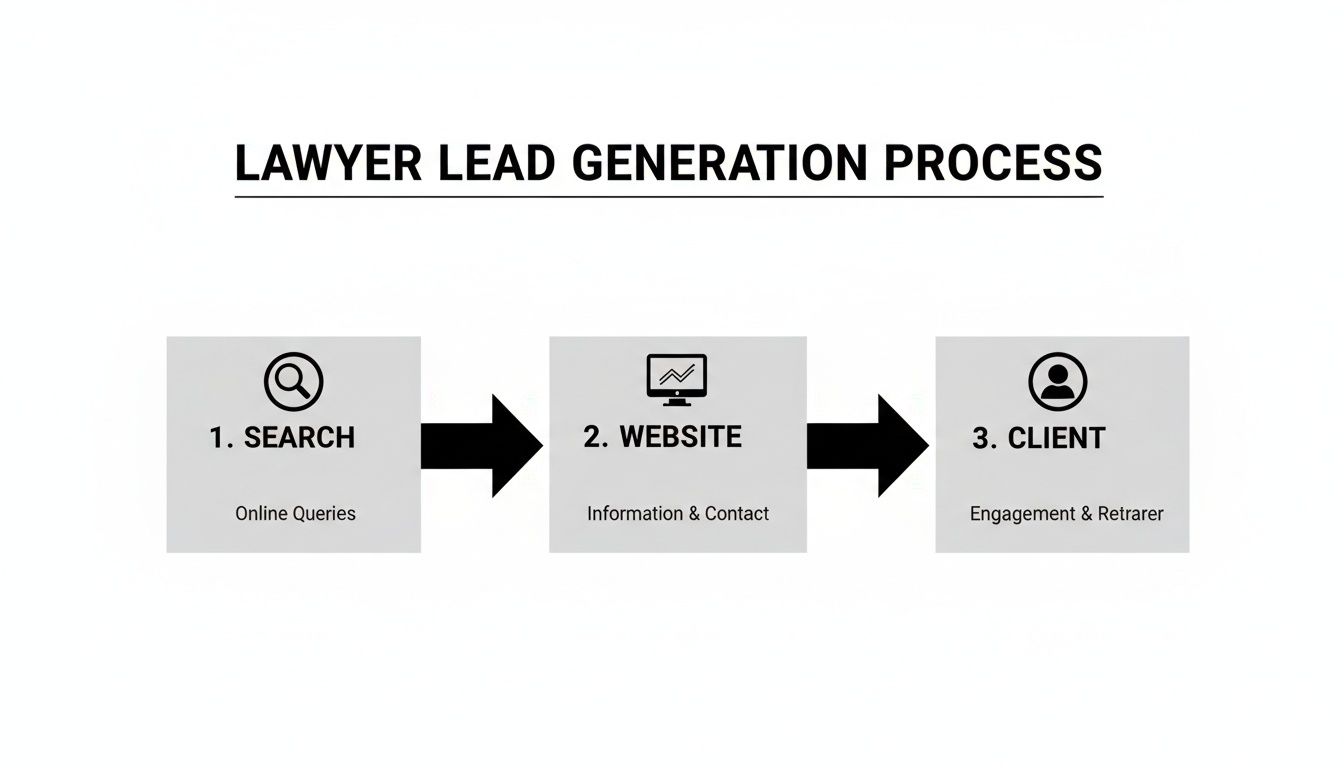
As you can see, your website is the crucial bridge between someone's problem and their decision to hire your firm. Everything flows through it.
Understanding the Modern Client Journey
It all starts with a question typed into a search bar. It could be “car accident lawyer near me” or “how to start an LLC,” but either way, Google is the new frontier for legal client acquisition. This is where your lead generation efforts have to be concentrated.
The three pillars that hold this entire foundation up are:
- Search Engine Optimization (SEO): This is your long game. It's the art and science of getting your website to show up in Google's organic (free) search results. Good SEO builds your firm's authority and generates a sustainable, free flow of traffic over time.
- Pay-Per-Click (PPC) Advertising: This is your short game. You pay for ads that appear at the very top of the search results. PPC delivers immediate visibility and leads, making it perfect for capturing high-intent prospects right now while your SEO builds momentum.
- Your Website: This is your digital office. It's the central hub where all your marketing efforts point. It has to look professional, be dead simple to navigate, and be built to convert visitors into leads with clear calls-to-action and easy-to-use contact forms.
These three elements aren't separate tasks; they're parts of a single engine. PPC gets you immediate results and provides keyword data that makes your SEO smarter. SEO builds a long-term asset that eventually reduces how much you need to spend on ads. And your website is where the magic happens, turning clicks from both channels into actual phone calls and form submissions.
A winning lead generation strategy doesn't treat SEO, PPC, and your website as a checklist. It weaves them into a cohesive system where each part strengthens the others, maximizing your reach and your return on every dollar spent.
The Economics of Acquiring Legal Clients
To budget effectively, you have to understand the numbers. The legal field is intensely competitive, and the data shows it.
Firms are putting their money where the clients are, dedicating roughly 65% of their marketing budgets to online strategies because, as we saw, 96% of clients start their search there.
The investment pays off. SEO is reported to deliver an average 526% ROI over three years. But getting there isn't cheap. The average cost-per-lead (CPL) for a law firm can range from $456 to $653.
This high cost is precisely why a bulletproof intake process is non-negotiable. Missing even a single call isn't just a missed opportunity; it's a significant financial loss, flushing hundreds of dollars in marketing spend down the drain. You need a system that ensures every single lead is captured and qualified, instantly. If you're struggling with this, our guide on choosing a call answering service for your business is a good place to start.
Comparing Top Lawyer Lead Generation Channels
Not all channels are created equal. Some are fast but expensive; others are slow but build long-term value. Knowing the difference helps you build a balanced strategy.
| Channel | Average Visitor-to-Client Conversion Rate | Typical Time to See Results | Best For |
|---|---|---|---|
| Local SEO | ~3.0% (Organic) | 6-12 Months | Building a long-term, sustainable asset that generates free leads and establishes local authority. |
| PPC Ads | ~4.3% (Paid) | Immediate | Quickly capturing high-intent leads for specific, profitable case types. |
| Referrals | 20%+ | Varies | Generating high-trust, high-quality leads from your existing network of clients and peers. |
| Review Sites | ~5% (from profile views) | 1-3 Months | Leveraging social proof and third-party validation to build trust with prospects. |
Ultimately, the most successful firms don't just pick one channel. They create a blended strategy, using PPC for immediate wins while patiently investing in SEO and referrals for stable, long-term growth. This approach diversifies your lead sources and builds a more resilient practice.
Dominating Local Search for Consistent Client Calls
For most law firms, the best clients aren't across the country; they're right in your backyard. Winning at local search isn't just another marketing tactic—it's your most direct line to a steady stream of high-quality client calls.
When someone in your community desperately needs a lawyer, you want your firm to be the very first name they see.
It all boils down to a simple fact: most searches for local legal help happen on a smartphone. Potential clients are often in a moment of crisis, like right after a car accident or during a heated family dispute. They need help now. Being visible in those critical moments is the entire game.

Master Your Google Business Profile
Your Google Business Profile (GBP) is, without a doubt, the single most powerful tool you have for local lead generation. This free listing is what gets you into the coveted "Map Pack"—that box of three local businesses popping up at the top of searches like "divorce lawyer near me."
Just claiming your profile isn't nearly enough. You have to treat it like a mini-website to truly stand out.
- Fill Out Everything: Go through every single field and complete it. Services, hours, photos, a detailed business description—all of it. Weave in your keywords naturally by describing what you do and who you help.
- Get Specific with Categories: Don't just choose the generic "Lawyer." If you're a personal injury attorney, select "Personal Injury Attorney" as your primary category. Add relevant secondary ones, too.
- Upload High-Quality Photos: Get professional headshots, team photos, and pictures of your office, both inside and out. This stuff builds immediate trust and makes your profile far more engaging.
- Use Google Posts: Make it a habit to share updates, new blog posts, or firm news using the "Posts" feature. It’s a clear signal to Google that your profile is active and relevant.
A small detail that’s surprisingly critical is your primary phone number. It needs to be the same everywhere online, and ideally, a local number to strengthen your community ties. We've got a whole guide on choosing the right business phone number that dives deeper into this.
Build a Powerful Local Citation Portfolio
Beyond Google, your firm’s name, address, and phone number (your NAP) must appear consistently across the web. Every time a reputable online directory lists your NAP, it's called a citation. Google uses these as proof that your firm is a legitimate, established local business.
Inconsistency is your worst enemy here. A single typo in your street name or a different phone number listed somewhere can confuse search engines and tank your rankings. The goal is a clean, uniform digital footprint.
Think of local citations like votes of confidence. Every time a reputable directory like Avvo, FindLaw, or Yelp lists your firm's information correctly, it tells Google that your business is real, located where you say it is, and trustworthy.
Start by making sure your info is perfect on the major legal and local directories. You can use a tool to audit your existing citations and clean up any errors. It’s tedious work, but the payoff in local search visibility is massive.
Generate a Consistent Stream of Positive Reviews
Reviews are the lifeblood of local SEO. They influence not only your search rankings but, more importantly, the potential clients reading them. A steady flow of recent, positive reviews is one of the strongest signals you can send.
Here’s a simple system to make it happen:
- Ask at the Right Time: The perfect moment to ask for a review is right after a positive case outcome or when a client expresses their gratitude. Strike while the iron is hot.
- Make It Easy: Don't make them hunt for it. Send a direct link to your Google Business Profile review section via email or text. The fewer clicks, the better.
- Respond to Every Single Review: Thank clients for positive feedback and always address negative reviews professionally. How you handle criticism shows prospective clients that you’re attentive and genuinely care.
When you optimize your GBP, build consistent citations, and cultivate reviews, you create a powerful local presence that drives calls from the clients who matter most—the ones right down the street.
Using Content to Build Authority and Trust
Dominating local search is great for catching clients who need a lawyer right now. But an elite lead generation strategy does more than that. It builds a brand that pulls clients in proactively, long before they're in the middle of a crisis.
This is where content and social media come in. They are your best tools for putting a stake in the ground and showing you're an authority in your field.
Potential clients aren't just searching for any lawyer; they're looking for an expert they can trust. When you create genuinely valuable content—the kind that actually answers their questions and makes complex legal topics understandable—you're proving you're that expert. It completely flips the script. Instead of you chasing leads, the best leads start seeking you out.
This isn't about a hard sell. It's about educating, informing, and building a relationship with your audience over time. When a legal problem eventually pops up, your firm will be the first one they think of.
Choosing the Right Platforms for Your Practice
Not all social media platforms are created equal, especially for lawyers. A common mistake is spreading yourself too thin, trying to be everywhere at once. Don't. Focus your energy where your ideal clients—and just as importantly, your best referral sources—actually spend their time.
- For B2B firms, LinkedIn is non-negotiable. If you serve other businesses (think corporate law, employment, or intellectual property), LinkedIn is your primary battleground. It's the perfect place to connect with executives, in-house counsel, and other professionals who can send work your way.
- For B2C practices, Facebook is incredibly powerful. If your work involves family law, estate planning, or personal injury, Facebook lets you connect with people in your community on a much more personal level. It's fantastic for sharing client-focused content and building a local following.
The data backs this up. Social platforms are now a mainstream source for legal leads. Recent surveys show that 71% of lawyers have landed new clients from social media. But which platform you choose is what really counts.
For business-focused firms, industry research shows that LinkedIn generates roughly 80% of B2B social prospects. It’s the clear winner. While the overall social media visitor-to-lead conversion rate is around 1.7%—lower than search—the high ROI from a well-targeted LinkedIn campaign makes it an essential part of your strategy.
Practical Content Strategies That Actually Build Trust
Your content needs to be a resource, not a sales pitch. Your goal is to answer the questions your potential clients are already typing into Google. Think about the common concerns you hear during initial consultations and turn those conversations into helpful, easy-to-digest content.
Here are a few formats that work consistently well for law firms:
- "How-To" Blog Posts: Write articles that walk readers through a specific legal question or process. A family lawyer might write "How to Prepare for Your First Divorce Consultation." An estate planning attorney could create a guide on "The First 5 Steps to Creating a Will." Simple, direct, and incredibly useful.
- Video Explainers: Make short, 1-3 minute videos breaking down a tricky legal concept. Video is super engaging and, more importantly, it puts a human face on your firm. That personal connection is something text alone just can't replicate.
- Case Study Summaries: Take a successful case, anonymize the details, and tell the story. Explain the client's challenge, the strategy you used, and the positive outcome you delivered. This is powerful social proof in action.
Building a content engine is like planting a tree. It takes time and consistent effort, but eventually, it grows into a valuable asset that provides shade—or in this case, a steady stream of inbound leads—for years to come.
To build real authority and trust, you also need to master Online Reputation Management for Lawyers. Your content helps shape your reputation, but you also have to pay attention to what others are saying about your firm online.
Ultimately, effective content creation is all about clear and consistent messaging, which is the foundation of any strong relationship. For a deeper look at this, check out our guide on client communication best practices. By consistently providing value, you're not just generating leads; you're building a reputation that attracts high-quality clients and valuable referral partners for the long haul.
Turning Website Clicks Into Signed Clients
Getting a potential client to click on your website is a huge win, but it’s only half the battle. All the effort you put into SEO, content, and ads goes right down the drain if your intake process is broken. This is the exact spot where so many law firms unknowingly leak their most valuable leads—and with them, their revenue.
The whole point is to close the gap between a person’s initial interest and a signed retainer. To do that, you need a system that’s seamless, professional, and incredibly fast. It has to make a prospective client feel heard and valued from the very first interaction. Every second of delay, every bit of friction, just increases the odds they’ll hang up and call the next lawyer on their Google search list.
Designing a Website That Converts
Think of your website as your digital front door. Its number one job is to turn casual visitors into real, actionable leads. A high-converting law firm website isn't just about looking good; it's about being ruthlessly effective at one thing: getting people to contact you.
This starts with clear, compelling calls-to-action (CTAs). Vague prompts like "learn more" just don't work. Your CTAs need to be direct and show an immediate benefit to the visitor.
- "Schedule Your Free Consultation Now"
- "Talk to an Attorney Today"
- "Get a Confidential Case Review"
Sprinkle these CTAs strategically across your site—in the header, at the end of blog posts, and on every single practice area page. You're guiding the user toward the exact action you want them to take.
Next up, your contact forms. Keep them simple. Nobody wants to fill out a 15-field questionnaire just to ask a quick question. Stick to the absolute essentials: Name, Email, Phone, and a small message box. The easier you make it to get in touch, the more people will actually do it.
Finally, you have to build trust, and you have to do it instantly. Your site should be loaded with trust signals that scream credibility and validate your track record.
A potential client is often in a vulnerable, stressful situation. They need immediate reassurance that they’ve landed in the right place. Testimonials, case results, and attorney awards aren't just marketing fluff; they are critical pieces of evidence that build the confidence someone needs to pick up the phone.
Building an Unbeatable Intake System
The moment a lead comes in, the clock starts ticking. In the legal world, a slow response is often seen as a lack of interest, and that’s a fatal mistake in a competitive market. To really squeeze the most out of your lead generation, you need a rock-solid process, which is where a good intake specialist law firm playbook becomes essential for turning those initial inquiries into signed clients.
The foundation of a great intake system is an effective script. No, this isn't about making your team sound like robots. It's about ensuring every single caller gets a consistent, professional, and empathetic experience. A well-designed script makes sure all the critical information gets gathered efficiently without missing a beat.
From there, a Customer Relationship Management (CRM) tool is non-negotiable. Seriously. A CRM tracks every interaction you have with a potential client—every call, every email, every form submission. This organized approach stops leads from falling through the cracks and lets you build methodical, automated follow-ups. For example, if a lead doesn't book a consultation on the first call, an automated email can go out 24 hours later, keeping your firm top-of-mind.
This is especially critical when it comes to phone calls. A structured process ensures you capture every single opportunity. If your firm is struggling with high call volume or after-hours inquiries, looking into a specialized law firm phone answering service can be a total game-changer, making sure no call ever goes unanswered.
When you combine a sharp, conversion-focused website with a systematic intake process, you create a well-oiled machine that turns clicks into clients and maximizes the return on every single marketing dollar you spend.
All the marketing in the world is useless if you can't answer the phone when a potential client calls.
What happens when someone needs you at 8 p.m. on a Tuesday? Or when your entire team is tied up on other lines? In most law firms, that high-value lead goes straight to voicemail—and then immediately calls the next attorney on their list.
This is a critical leak in any law firm's lead funnel. Every single missed call is more than a lost opportunity; it's wasted marketing spend. The fix isn't just about having someone pick up the phone. It's about having an intelligent system that can instantly engage, qualify, and move that person forward, no matter the time of day.
This is where an AI phone assistant like Marlie.ai becomes a game-changer, ensuring every inbound call is captured and handled professionally, 24/7/365.
Moving Beyond the Answering Machine
Let’s be honest: traditional solutions like voicemail or a basic answering service are passive. They just take a message and promise a callback. In the legal world, that delay is often fatal to the lead. A potential client in distress wants help now, not tomorrow morning.
An AI assistant does much more than just record a message. It actively engages with the caller to perform crucial intake tasks on the spot.
- Immediate Qualification: The AI can ask custom questions to figure out if the caller is a good fit. For a personal injury practice, it could ask, "Were you injured in the accident?" or "Has it been less than two years since the incident?"
- Intelligent Routing: Based on those answers, the AI can transfer a high-priority lead directly to an on-call attorney's cell while scheduling consultations for others.
- Automated Scheduling: The assistant integrates directly with your firm's calendar to book qualified callers for an initial consultation right then and there, sending confirmation texts to both the client and the attorney.
The real power here is turning a simple phone call into a productive, forward-moving interaction. An AI assistant doesn’t just stop the bleeding from missed calls; it actively advances the client relationship before a human even gets involved.
The Practical Impact on Your Firm
Putting this technology to work isn't just about plugging a hole. It’s about fundamentally improving your firm’s efficiency and profitability.
When an AI handles the initial screening and scheduling, your paralegals and intake specialists are freed from repetitive, low-value phone calls. They can stop fielding basic questions about office hours or directions and instead dedicate their expertise to high-touch client communication, case prep, and other billable work. This shift doesn't just boost staff morale—it directly impacts your bottom line.
Here’s a look at the Marlie.ai dashboard, which gives you a real-time overview of every call the AI handles.

This kind of immediate, transparent data lets you see exactly how many leads are being captured and qualified, even after hours.
Traditional Intake vs. AI-Powered Intake
The difference between a standard receptionist and an AI phone assistant is stark. One is a cost center designed to simply answer calls; the other is a revenue-generating tool built for lead conversion. For a deeper look, you can learn more about how an AI phone answering service outperforms the old ways.
Let’s break down the key differences in a typical law firm intake scenario.
Traditional Intake vs AI-Powered Intake
The table below shows a direct comparison of how an AI phone assistant like Marlie.ai transforms key aspects of the client intake process for law firms.
| Intake Aspect | Traditional Method (Receptionist/Answering Service) | AI Phone Assistant (Marlie.ai) |
|---|---|---|
| Availability | Limited to business hours or relies on costly after-hours staff. | 24/7/365 at no extra cost for nights or weekends. |
| Lead Qualification | Takes a basic message; qualification happens during a callback. | Asks custom screening questions to qualify leads in real time. |
| Scheduling | Relays a request for an appointment. | Books consultations directly into your firm’s calendar. |
| Cost Structure | High per-minute rates or expensive monthly retainers. | Significantly lower cost, often around $0.25 per minute. |
| Data & Analytics | Basic call logs, often with little actionable insight. | Provides detailed call transcripts, recordings, and conversion data. |
By bringing an AI assistant into your workflow, you create a system that works tirelessly to grow your practice. It ensures that no matter when a potential client decides to reach out, your firm is ready with an immediate, professional, and effective response. That's how you dramatically increase your capture rate and turn more clicks into clients.
Answering Your Top Lead Generation Questions
If you're trying to grow your law firm, you've probably got questions swirling around about how to actually make it happen. From budgets and timelines to the right strategies, it’s easy to get stuck in the weeds.
Here, I’ll tackle some of the most common questions we hear from law firms, with straight answers to help you move forward.

How Long Does It Take for SEO to Generate Leads?
Let’s get this out of the way: SEO is a marathon, not a sprint. If you're starting fresh or just getting serious about your firm's website, expect to see a meaningful impact on your traffic and lead flow within 6 to 12 months of consistent work.
Of course, this timeline depends on a few things. How competitive is your practice area? Are you in a major metro or a smaller town? What shape is your website in right now? You might see some quick wins early on, but the real prize is building a long-term asset that brings in high-quality leads for years.
What Is a Good Cost Per Lead for a Lawyer?
This is the million-dollar question, and the answer varies wildly. A personal injury lead in a big city could easily run you over $500, while a family law lead in a suburb might be closer to $100.
Instead of chasing some universal "good" number, shift your focus to your firm’s return on investment (ROI). A high-cost lead is a bargain if it turns into a massive case. The trick is to track your cost per lead (CPL) against your client acquisition cost (CAC) and the lifetime value (LTV) of a client. That’s how you find out what’s actually profitable for your firm.
The most important metric isn't how much a lead costs, but how much revenue that lead ultimately generates. A cheap lead that never converts is far more expensive than a costly one that turns into a high-value case.
Should My Law Firm Use PPC or Focus Only on SEO?
Why choose? The best approach almost always involves both. Think of SEO and PPC as a one-two punch; they serve different but complementary purposes.
- PPC gives you immediate visibility. It’s perfect for driving leads and cash flow right now while your long-term SEO efforts are still building momentum.
- SEO builds a sustainable asset. Those organic rankings you earn will generate "free" traffic over the long haul, driving down your average client acquisition cost.
Use PPC to get instant results and figure out which keywords convert into paying clients. Then, take what you learn and pour it into your SEO strategy. It's a powerful combination.
How Can I Get More Referrals from Other Attorneys?
Building a solid referral network is about genuine relationships, not just collecting business cards at a mixer. You have to be proactive.
Start by finding lawyers in practice areas that complement yours. If you're a family law attorney, you should be friends with estate planning and criminal defense lawyers—they’re constantly running into issues they can't handle.
- Be a Giver First: The golden rule of referrals is to send business before you expect to receive it. Actively look for good cases to send to your network.
- Stay Top-of-Mind: Don't let those connections go cold. Keep in touch on LinkedIn, share helpful articles, and show up at local bar events and CLE seminars.
- Demonstrate Your Expertise: Make it clear you're the go-to person in your niche. When other lawyers are confident you're an expert, they'll have no problem sending clients your way.
At the end of the day, relationships built on mutual trust and benefit are what create a steady stream of high-quality, attorney-to-attorney referrals.
Stop letting missed calls turn into missed opportunities. Marlie Ai ensures your firm captures every single lead, 24/7, with an intelligent AI phone assistant that qualifies callers and schedules consultations automatically. See how much your firm can grow at https://www.marlie.ai.
