
The first few seconds of any phone call can make or break the entire interaction. How you answer sets the tone for everything that follows. I’ve found that the best approach is always a prompt, professional greeting that clearly states your company's name and your own. This simple formula instantly tells the caller they've hit the right number and are speaking with someone who's ready to help.
Nailing the First Impression
Those initial five seconds of an inbound call? They determine its entire trajectory. This is your one shot to establish a professional, helpful tone and build immediate rapport. A solid greeting reassures callers and kicks things off on a positive, confident note.
Even a slight delay or a fumbled, mumbled hello can create a negative vibe before the real conversation even gets off the ground.
The infographic below shows you the three core things you should do to get ready for every single call. It’s all about making sure you’re set up to create that positive first impression, every time.
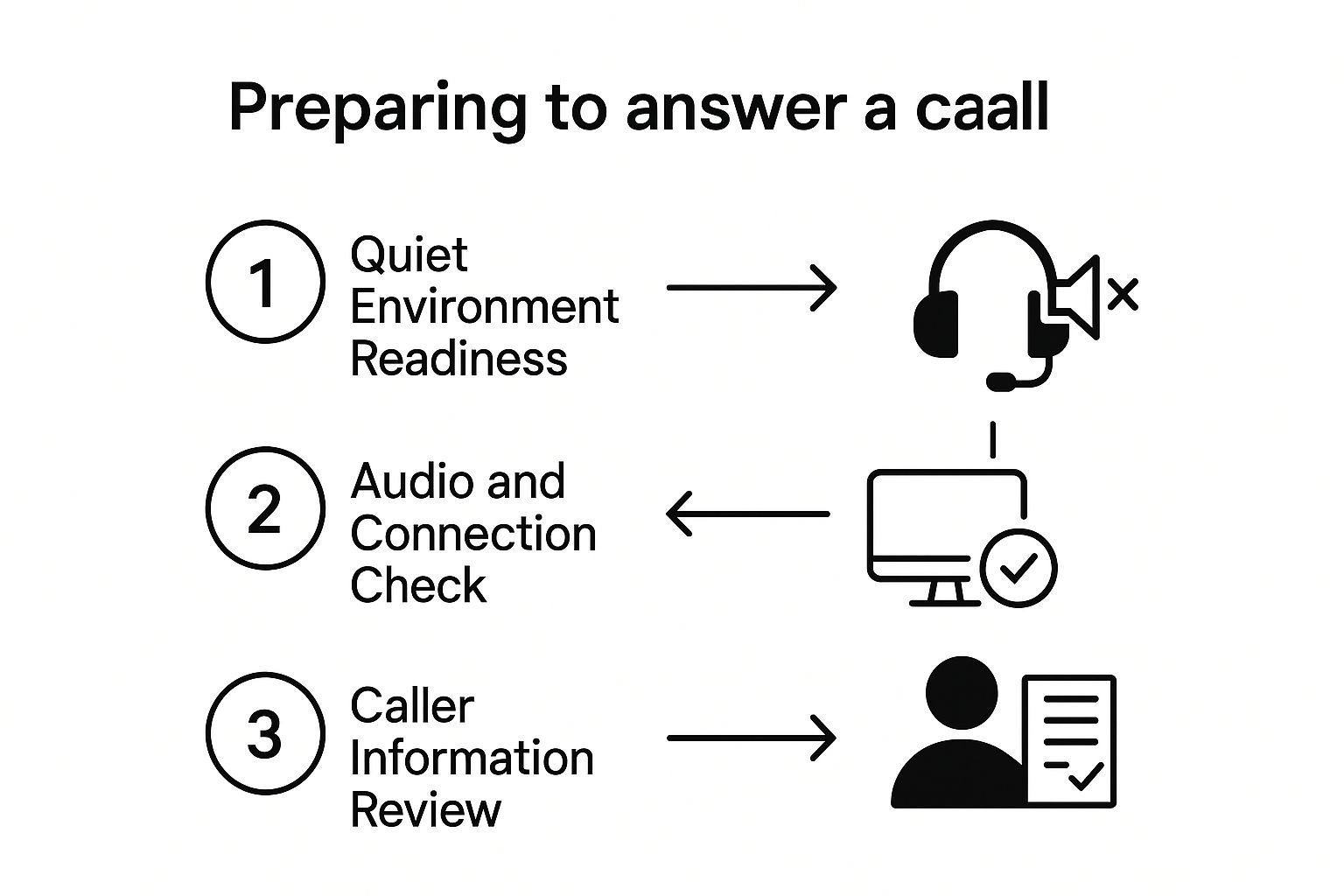
As you can see, a successful call starts before you even say a word. It's about having your space ready, your tech checked, and your key information right at your fingertips.
What Goes Into a Professional Greeting?
First off, speed is non-negotiable. I've seen it time and again—customers hate waiting. Top-performing call centers actually aim to answer 80% of calls within 20 seconds. That benchmark alone tells you how much people value a quick response. A delayed answer feels disorganized, but a prompt one screams efficiency.
From there, the structure is simple but absolutely vital:
- State Your Company: Always start by identifying your business. "Thanks for calling Precision Plumbing" is clear and gets right to the point.
- Introduce Yourself: Next, let them know who they're talking to. "This is Alex." It's personal and direct.
- Offer to Help: End with a simple, open-ended question. "How can I help you today?" This immediately passes the conversational baton to the caller.
This three-part greeting—Company, Name, Offer—is the bedrock of a professional phone presence. We get into even more detail in our full guide on how to answer the phone professionally.
To make it even clearer, here’s a quick breakdown of what makes the perfect call opening.
The Perfect Call Greeting Breakdown
This table summarizes the essential components for a professional and effective call opening.
| Component | Example | Why It Matters |
|---|---|---|
| Warm Opening | "Thank you for calling…" | Sets a positive, welcoming tone from the start. |
| Company Name | "…Precision Plumbing." | Immediately confirms the caller reached the right place. |
| Your Name | "This is Alex speaking." | Adds a personal touch and establishes accountability. |
| Offer of Help | "How can I help you?" | Proactively invites the caller to state their reason for calling. |
Following this simple structure removes the guesswork and ensures a smooth start to every conversation.
The goal here is consistency. Every single person who calls your business should get the same high-quality, professional greeting, no matter who answers or what time of day it is. This is how you build brand trust and set a standard of excellence.
This is exactly where an AI assistant like Marlie can be a game-changer. It guarantees a perfect, polished, and professional greeting for every call, 24/7. You completely eliminate the risk of human inconsistency—whether it's a bad day or a busy moment—ensuring every first impression is your best one.
Guiding the Conversation with Active Listening

Okay, the greeting is done. Now for the real work: skillfully guiding the conversation. This isn't about control; it’s about understanding what's really going on through active listening.
I’ve found that most callers state a symptom, not the actual problem. Your ability to listen past the surface-level comment and ask the right questions is what separates a quick, temporary fix from a real, lasting solution.
Take this common example: a caller says, "My basement is wet." A passive listener hears that and just books a standard water removal service. An active listener, though, hears an opportunity to dig deeper. This is where you shift from just taking an order to solving a problem.
Uncovering the Real Need with Open-Ended Questions
The absolute key to getting to the heart of the matter is asking questions that can't be answered with a simple "yes" or "no." We call these open-ended questions, and they get the caller to open up and give you the context you need.
Here’s how that plays out:
- Closed Question: "Is there a leak?" (Answer: "Yes.")
- Open-Ended Question: "Can you tell me more about what you're seeing down there?" (Answer: "Well, there's a puddle right by the old furnace, and I first saw it after that huge storm last night.")
See the difference? That second answer is gold. It gives you a potential cause (the storm) and a specific location (the furnace), helping you dispatch the right team with the right equipment.
Active listening isn’t just about hearing words; it's about understanding the meaning and emotion behind them. A powerful technique is to paraphrase their concern: "So, if I'm hearing you right, the water is pooling around the furnace, and it only showed up after last night's rain?" This confirms you get it and, more importantly, shows the caller you're genuinely paying attention. That simple act builds incredible trust.
Adapting to Different Caller Personalities
Every caller is different, and a one-size-fits-all approach just doesn't work. A rushed business owner needs you to be quick, sharp, and to the point. A frustrated homeowner, however, needs you to show some empathy and reassurance before you even think about jumping into solutions.
Learning to read these personalities and adjust your tone and questions on the fly is a crucial skill. For someone who’s angry, I always start with empathy: "I can absolutely understand why that would be so frustrating." For a caller who loves to talk, I use polite interruptions to steer things back on track: "That's a great point, and to make sure we solve this for you, could you tell me…?"
This kind of intense focus can be draining, which is where a little help from technology comes in handy. An AI tool like Marlie.ai can handle real-time transcription, so you’re not scrambling to take notes. This frees you up to concentrate completely on the caller’s tone and what they truly need.
Collecting Information Without Being Intrusive

Every inbound call is a goldmine of data, but how you dig for it makes all the difference. The real skill is making your questions feel like part of the solution, not a frustrating interrogation. Let's be honest, nobody enjoys getting hit with a list of demands before they've even finished explaining why they called.
The trick is to weave your questions into the conversation organically. First, listen. Really listen to what they need. Once you’ve confirmed you understand their problem, then you can start gathering the details. This simple shift in timing shows them that their problem is your priority.
How to Ask for Information the Right Way
Your phrasing can be the make-or-break moment. You can come across as a gatekeeper demanding a toll, or a partner clearing the path. A tiny tweak in how you ask can completely change the tone from transactional to helpful.
Think about the difference between these two approaches:
- The Abrupt Way: "I need your name and phone number."
- The Helpful Way: "So I can pull up your file and make sure we have everything documented for you, could I get your first name and the best number to reach you?"
The second one works because it explains the why. You're not just taking their info; you're using it to help them. It’s a subtle but powerful way to build trust and get what you need without a hint of friction.
The goal is to make information gathering feel like a service, not a hurdle. When you explain that getting a name and number helps you track their issue or ensure a smooth callback, you’re showing respect for their time and problem. It transforms a transactional question into a relational action.
The AI Advantage: Never Miss a Detail
This is where a solid system becomes non-negotiable for any business owner serious about knowing how to answer a call well. Juggling a conversation while manually typing notes is a recipe for errors and, worse, it pulls your focus away from the actual person on the line.
An AI assistant like Marlie.ai is built for this. It can ask for and capture key information—names, callback numbers, service needs—with perfect consistency, every single time. Better yet, it logs all that data directly into your CRM automatically. This means every lead gets captured accurately, without you lifting a finger, preventing lost opportunities and keeping your records flawless.
How AI Is Changing the Game for Business Calls
The way businesses handle phone calls is going through a massive overhaul. We're moving far beyond the simple world of answering machines and basic voicemail. Today, artificial intelligence is turning phone communication from a purely manual chore into a powerful, automated asset for businesses of every size.
And this isn't just about catching missed calls anymore. It's about using intelligent systems to actively get better results. Instead of a generic "we'll call you back," AI can now qualify leads, book appointments, and even solve common customer problems right on the spot. This drastically improves how many issues get solved on the first try and, more importantly, frees up your team's precious time.
The New Baseline for Being Efficient
This shift isn't just hype; it's driven by clear, tangible results. In fact, companies that have started using generative AI service agents are seeing a 14% increase in issues resolved per hour. On top of that, they've cut down their average call handling time by 9%. That means more customers helped in less time, which flows directly to your bottom line. You can dive deeper into these call center performance metrics to get the full picture of AI's impact.
A few years ago, this kind of efficiency was something only huge corporations with massive budgets could even dream of. That's just not true anymore. The technology has become surprisingly accessible and affordable.
AI isn't some far-off luxury; it's becoming a competitive must-have. For a small service business, where every single call represents a potential job, this tech ensures you never miss an opportunity. It helps you deliver a level of service that can go toe-to-toe with your much larger competitors.
So, How Does an AI Assistant Actually Work?
Think of an AI phone assistant like Marlie as your ultimate front-desk operator, one who's on the clock 24/7. It guarantees every single person who calls gets a professional, consistent greeting—something that's tough to pull off with a human team, especially after hours or on weekends.
Picture this: a potential customer calls late one night with a leaky pipe. Instead of hitting your voicemail and moving on to the next plumber on their list, they have a conversation with an AI that:
- Understands what they need by talking like a real person.
- Gathers the key details—name, number, address, and the specifics of the problem.
- Schedules the job right into your calendar based on your availability.
- Sends an automated confirmation text to the customer so they know they're taken care of.
This isn't just about figuring out how to answer a call. It's about crafting a seamless, reassuring customer experience from the very first ring. This kind of tech makes sure every lead is captured and every urgent call gets the immediate attention it needs to become a paying job.
Ending Calls with Clarity and Confidence

How you end a call is just as important as how you start it. Seriously. This is your last chance to drive home your professionalism and make sure every detail is locked in. A strong, clear closing prevents those annoying misunderstandings and leaves the caller feeling confident and taken care of.
The absolute best way to do this? A quick summary. Before you say goodbye, just run through the main points and any actions you both agreed on. It’s a simple step that confirms you’re on the same page.
For example, you could say, "Great, so I have you down for a service visit this Friday at 2 PM, and I'm sending a confirmation text right now. Does that sound right?" That little confirmation loop is surprisingly powerful.
Professional Closing Statements
Your closing line should always show you appreciate their time and clearly state what’s next. It's a fundamental piece of good phone communication. For a deeper dive, check out our guide on telephone etiquette samples.
Here are a few closers I use all the time:
- After fixing an issue: "I'm glad we could get that sorted out for you. Thanks so much for calling, and have a great rest of your day!"
- After booking something: "We're all set. We look forward to seeing you on Tuesday. Thanks for choosing us!"
- When you need to escalate: "Okay, I've sent this ticket over to our senior team. Someone will call you back within the hour. Thank you for your patience."
A clear, confident closing does more than just end a conversation—it solidifies the customer relationship. It’s the final handshake that says, "We've got this handled." That last impression is often what a customer remembers most.
This is another spot where an AI assistant like Marlie really shines. Imagine Marlie automatically sending a follow-up text or email that summarizes the call and confirms the appointment details. This automated final touch creates a seamless, impressive end to every interaction, reinforcing your brand’s reliability without you lifting a finger.
Have Questions About Answering Business Calls?
Over the years, I've seen countless business owners run into the same handful of problems with their phone communication. It's a universal challenge. Getting straight, practical answers is the fastest way to polish your approach and make every customer call a good one. Let's tackle some of the most common questions I hear.
What’s the Single Most Important Part of Answering a Business Call?
It’s all about the greeting. No question.
Answering within three rings and immediately stating your company's name and your own sets a professional, confident tone right from the start. It instantly reassures the caller they've got the right number and that you're ready and able to help them.
How Do I Actually Handle an Angry Caller?
The absolute key is to stay calm and de-escalate. Don't match their energy; guide it.
First, just listen. Let them get their entire issue out without cutting them off. Then, use phrases that show you're on their side, like, "I can definitely understand your frustration with that."
Repeating their problem back to them not only proves you were paying attention but can seriously improve the outcome. We've got a whole guide on this with more first-call resolution tips that actually work if you want to dive deeper. Finally, you have to take ownership of the solution and clearly explain the exact next steps you're going to take for them.
An angry caller just wants to feel heard. When you actively listen and validate their feelings before jumping to a solution, you can turn a confrontation into a collaboration.
When Should I Start Using an AI Answering Service?
It's probably time to look into an AI service when you notice a few tell-tale signs. Are you starting to miss calls because you're busy? Is the sheer volume of calls keeping you from your actual work? Or do you just need to guarantee professional, 24/7 coverage without hiring a huge team?
It's also a no-brainer when you find yourself wanting to automate the routine stuff—things like qualifying new leads or getting appointments on the calendar. That's the perfect hand-off for AI.
Ready to make sure every call gets answered like a pro and every opportunity is captured? See how Marlie Ai can take over your phone answering, book jobs for you, and give you back hours every single week. Find out more at https://www.marlie.ai.
