

Contact center AI is basically intelligent software built to automate and seriously level-up your customer service. Think of it less like a tool and more like a strategic partner. It uses smart tech like Natural Language Processing and Machine Learning to figure out what customers actually need, give your human agents a helping hand, and create smooth, satisfying experiences, day or night.
The New Reality of Customer Service
The old rules of customer service are out the window. Today's customers expect answers now, support at 2 a.m., and a personalized touch every time. These are tough demands for a traditional contact center to keep up with. Long hold times and inconsistent service just don't fly anymore.
This massive shift means intelligent automation isn't some futuristic nice-to-have; it's a must-have for staying in the game.
Contact center AI is the answer to these ever-growing expectations. We're talking way beyond the clunky, first-generation chatbots. This is about making AI a core part of how you serve your customers.
Evolving From Manual To Intelligent Support
Imagine the difference between an old-school switchboard operator manually plugging in cables and a smart digital assistant like Siri or Alexa. That's the leap we're talking about.
The old way forced agents to juggle every single call, hunt for information, and manually route people, which naturally led to frustrating bottlenecks and burned-out agents.
The new way uses AI to:
- Instantly resolve common issues: AI can handle all the routine stuff like "What are your hours?" or "Where is my order?" without ever needing a person involved.
- Empower human agents: When a tricky problem comes up, AI acts like a co-pilot, feeding the agent real-time information and guidance so they can find the right answer faster.
- Understand customer sentiment: By analyzing a customer's tone of voice or word choice, AI can tell if they're getting frustrated. This allows your team to respond with more empathy and head off problems before they escalate.
Making this transition from manual to intelligent support is what will separate the businesses that thrive from those that just survive. You can really see the fundamental shift when you look at a deep comparison of AI voice agents versus traditional call centers.
AI is no longer optional for contact centers—it’s a necessity. These systems don’t just automate processes; they enhance customer interactions, improve efficiency, and allow agents to focus on what they do best.
By embracing this new reality, you can start delivering the kind of immediate, high-quality service that customers now demand. If you're looking to really nail your approach, diving into modern customer service best practices is a fantastic place to start.
How Contact Center AI Actually Works

To really get what makes contact center AI tick, let's start with a simple comparison. Think of a classic call center as a manual library. A customer calls, the agent has to mentally walk the aisles, find the right book of information, and then flip through the pages to get an answer. It works, but it’s slow and completely reliant on what that one agent happens to know.
Now, picture an AI-powered contact center as a super-smart digital library. It doesn't just store information; it actually understands it. When a customer calls, the AI instantly pulls the answer, anticipates the next question, and creates a dramatically better experience.
This intelligence isn't magic. It’s a combination of a few core technologies working in concert behind the scenes.
The Engine That Understands Language
At the absolute heart of contact center AI is Natural Language Processing (NLP). This is the technology that lets a machine understand, interpret, and make sense of human language, whether it’s spoken out loud or typed in a chat.
Think of NLP as the system's universal translator. When a customer says, "My appointment is for tomorrow, but I need to reschedule," NLP gets to work. It breaks that sentence down, figures out the core intent (rescheduling), and pulls out the key pieces of information (appointment, tomorrow).
Without NLP, a computer just sees a string of characters or hears a bunch of sounds. With it, the AI grasps the actual meaning and context, which allows it to take the next logical step. That might mean routing the call to the right person or, even better, just offering up new appointment times on the spot. It's a foundational piece of any modern AI phone answering system.
The Brain That Learns and Improves
The next crucial piece is Machine Learning (ML). If NLP is the engine for understanding language, ML is the brain that learns from every single interaction. This is what makes the AI smarter over time—it doesn't stay static.
For instance, an ML model can analyze thousands of past call recordings. It starts to connect the dots, learning which agent responses lead to happy customers and which ones fall flat. It can also spot trends, like realizing that calls about a specific issue are 90% more likely to come from a certain neighborhood after a big storm.
Machine Learning turns historical data into predictive power. It allows the system to move from simply reacting to customer queries to proactively anticipating their needs and guiding agents toward the best possible outcomes.
This constant learning cycle means the AI isn't just following a rigid script. It adapts. It refines its suggestions and gets more accurate with every call, chat, and email it handles.
The Voice That Creates Responses
Finally, Generative AI is the creative part of the trio. It's the technology that actually crafts helpful, human-sounding responses. While NLP understands what the customer is saying, generative AI figures out how to reply in a natural, conversational way.
So when an AI assistant needs to confirm a new booking, it doesn't just spit out raw data like "BOOKING: PLUMBING, TUES, 3PM." Instead, it might say, "Great, I've got you down for a plumbing service at 3 PM on Tuesday. Does that sound right?"
This ability to generate fluent, natural language is what bridges the gap between a robotic system and a genuinely helpful interaction. When these three technologies come together, they create a powerful ecosystem that can understand, learn, and communicate with remarkable effectiveness.
Key Features That Reshape Your Operations
It’s one thing to talk about the theory behind contact center AI, but it's another thing entirely to see how these tools actually work on the ground. These aren't just buzzwords; they're specific features designed to tackle the most common operational headaches and completely change how you talk to your customers.
To make it simple, you can think of contact center AI as having three core pillars: conversational bots, voice analytics, and intelligent routing.
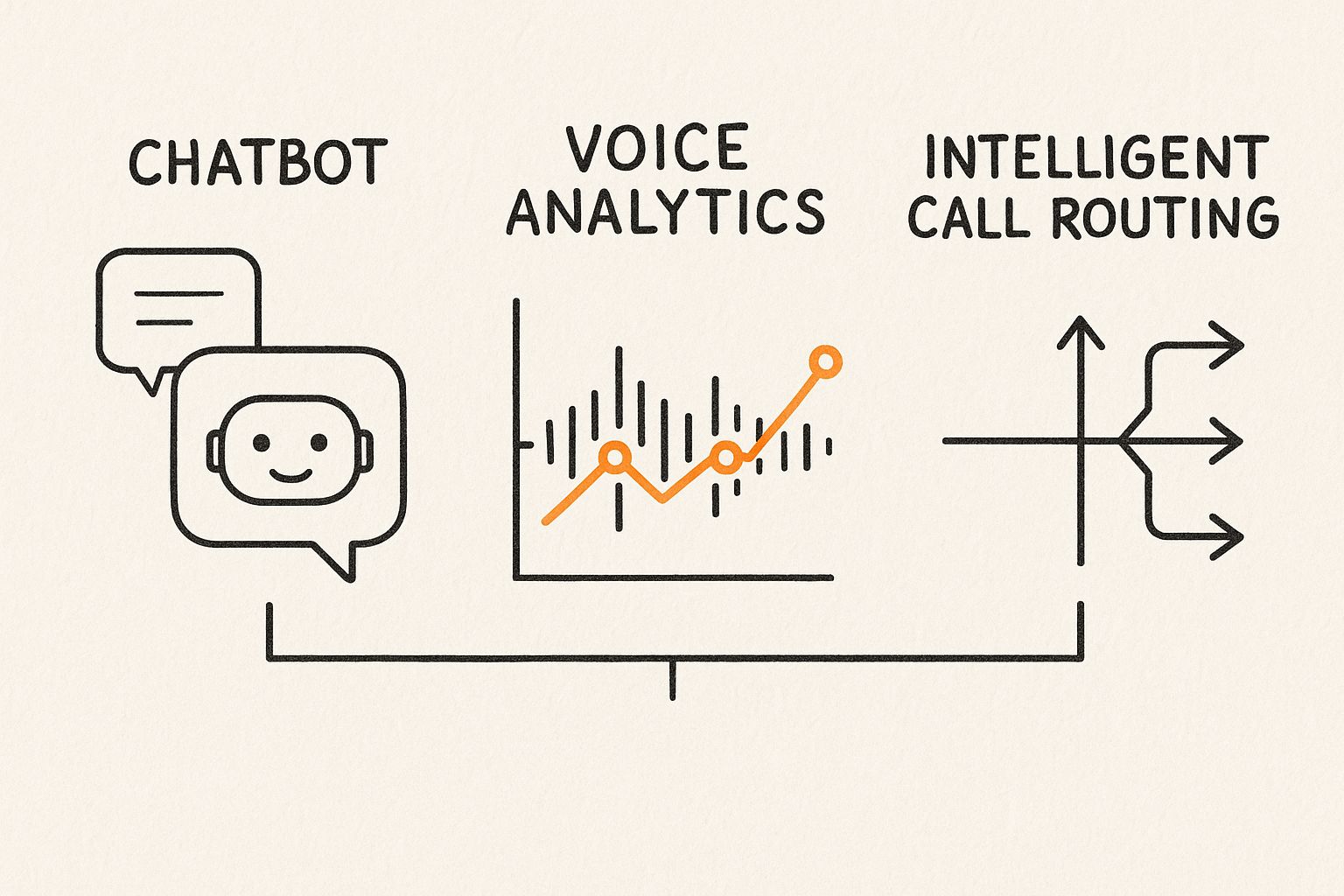
Each of these pieces works with the others to automate the simple stuff and dig up deeper insights. This frees up your team to focus their brainpower on the trickier, more human-centric customer problems.
Intelligent Virtual Agents and Smart Routing
The most obvious feature you'll encounter is the Intelligent Virtual Agent (IVA). Don’t think of this as just a basic chatbot. An IVA is more like a super-efficient digital employee at your front desk. It can juggle a huge volume of common questions—scheduling appointments, checking on an order, or answering FAQs—all without needing a human to step in. That 24/7 availability is a game-changer for cutting down wait times.
Working hand-in-glove with the IVA is smart call routing. In the old days, routing was dumb. It just sent a caller to whoever was free next. Now, AI listens to a caller's request in real-time, figures out what they need based on their words or past interactions, and sends them directly to the agent with the exact skill set to fix their problem. The first time. This single feature massively boosts first-contact resolution and stops customers from getting bounced around in frustration.
These tools are quickly becoming the new normal. Gartner predicts that by 2025, a whopping 80% of companies will be using AI-powered chatbots in their contact centers.
So, what does this actually look like in practice? Here’s a quick breakdown of the key AI features and the real-world value they bring to your business.
Key AI Features and Their Business Impact
| AI Feature | What It Does | Primary Business Benefit |
|---|---|---|
| Intelligent Virtual Agent (IVA) | Handles common, repetitive customer inquiries 24/7 without human help. | Slashes wait times and frees up human agents for more complex issues. |
| Smart Routing | Analyzes a caller's needs and directs them to the best-suited agent. | Increases first-contact resolution, leading to happier customers. |
| Agent-Assist | Provides real-time information and guidance to agents during calls. | Reduces agent training time and ensures consistent, accurate answers. |
| Sentiment Analysis | Gauges customer emotion by analyzing tone of voice and word choice. | Helps agents de-escalate tough situations and tailor their approach. |
| Predictive Analytics | Uses historical data to forecast future customer behavior and needs. | Allows for proactive service, turning your contact center from reactive to strategic. |
As you can see, each feature builds on the last to create a smarter, more efficient system that helps both your customers and your team.
Agent-Assist and Real-Time Coaching
Contact center AI also acts as a powerful sidekick for your human agents through agent-assist tools. Picture this: an agent is on a tough call. As the customer explains their problem, the AI is listening in, instantly fetching the right articles from your knowledge base and popping them onto the agent's screen.
This kind of real-time backup has a huge impact.
- No more searching: Agents don't have to put people on hold while they scramble for answers.
- Total consistency: The AI delivers the same accurate, approved information every single time.
- Faster onboarding: New hires can get up to speed in record time with a digital expert whispering in their ear.
Some of the more advanced platforms even provide real-time coaching. If an agent starts talking too fast or forgets to mention a critical compliance point, the AI can send them a discreet prompt. This is way more effective than going over call recordings days after the fact. It’s a massive leap forward from the clunky automated menus of the past. If you want a refresher on that older tech, you can learn more about its predecessor, IVR, in our article.
AI-powered agent-assist doesn't replace human skill; it amplifies it. By handling the rote task of information retrieval, it frees up agents to focus on empathy, critical thinking, and building customer rapport.
Sentiment Analysis and Predictive Analytics
Finally, AI brings a much deeper level of emotional intelligence with sentiment analysis. By picking up on a customer's tone of voice, choice of words, and even the pauses between them, the system can get a read on their mood. Are they happy? Neutral? Getting frustrated? This gives agents the cues they need to shift their approach and defuse a tense situation before it blows up.
Then there's predictive analytics, which takes things a step further. By crunching historical data, the AI can start to anticipate what a customer might need next. For instance, it might flag a customer who just had a service call as likely to call back with a follow-up, automatically bumping them to the front of the queue. This kind of proactive thinking transforms your contact center from a reactive fire-fighting unit into a strategic partner in the customer's journey.
The Business Case for Investing in AI
It’s one thing to understand the tech, but connecting the dots between fancy features and real-world business results is where the rubber meets the road. The decision to bring contact center AI solutions into your business isn’t just about looking modern—it’s a strategic investment with a clear, compelling return.
This move directly tackles the most stubborn challenges service-based businesses face: sky-high operational costs, agent burnout, and revenue slipping through the cracks. For a growing business, every dollar and every customer interaction is critical. This is where intelligent automation becomes your key to unlocking some serious savings.
Dramatically Lower Operational Costs
Think about the usual expenses that pile up in a traditional contact center. You’ve got agent salaries, endless training hours, and the cost of keeping the lights on for a round-the-clock team. AI jumps in and automates the most repetitive, time-sucking tasks, which lets a smaller, more focused team get way more done.
Picture a busy towing company that gets slammed with calls after hours. Instead of paying for overnight dispatchers, an AI assistant can handle that initial intake. It gathers the crucial details and sends out drivers for all the standard requests.
This means you can:
- Slash labor costs by automating work that used to need a human.
- Scale your capacity to handle sudden call spikes without frantically hiring temps.
- Allocate your resources smarter by letting AI manage the routine stuff, freeing up your skilled team for the real emergencies.
The financial impact here is huge. Taking a moment to calculate your potential cost savings can be a real eye-opener, showing you just how fast this kind of tech pays for itself.
Empowering Your Human Agents
There’s a common myth that AI is coming to take everyone’s job. The reality? Its greatest strength is making your people better at theirs.
When AI handles the mundane, your human agents are free to use their empathy and critical thinking on the complex situations where they’re needed most. This doesn’t just boost performance; it creates a much more rewarding work environment. For a deeper dive, it’s worth exploring AI's role in empowering customer support teams.
Think of AI as a co-pilot. It’s there providing real-time information, offering guidance, and even analyzing sentiment during calls. This reduces agent stress, helps prevent burnout, and shifts their role from simple call-takers to true customer advocates.
Investing in AI is investing in your team. It removes the frustrating, repetitive work, allowing agents to focus on high-value conversations that build customer loyalty and drive satisfaction.
This human-centric approach delivers real, measurable gains in efficiency. Recent data shows companies using generative AI have seen a 14% increase in issues resolved per hour. On top of that, they’ve also seen a 9% reduction in the time agents spend on each interaction.
Ultimately, the business case is crystal clear. When you automate intelligently and empower your team, you’re building a more efficient, resilient, and customer-focused operation. That translates directly to better customer loyalty, a healthier bottom line, and a serious competitive edge.
How to Implement Your First AI Solution

Jumping into the world of contact center AI solutions feels like a huge step, I get it. But you can make it manageable—and incredibly effective—by following a simple game plan. The trick is to start small, prove the idea works, and then build on that success. This way, you get real results fast without overwhelming your team or your budget.
Think of it like trying out a new recipe. You wouldn't immediately cook a giant feast for a hundred guests. You'd make a small test batch first to get the flavors right. The same logic applies here. Kick things off with a focused pilot project that solves one specific, high-impact problem.
For most service businesses, the perfect starting point is automating the answers to your most common questions. You know the ones—the repetitive queries that eat up your team's time but don't require deep thinking, like "What are your hours?" or "Do you service my neighborhood?"
Choosing the Right AI Partner
Picking the right technology partner is probably the most important decision you'll make in this whole process. Not all AI is built the same, and the company you choose will make or break your results. As you start looking around, keep a few key things in mind, especially for a small or medium-sized business.
You need a solution that was built for a business like yours, not some massive corporation. Here’s what really matters:
- Ease of Integration: How easily does this thing plug into the tools you already use, like your CRM or scheduling software? A great partner makes this painless, no IT department required.
- Scalability: The right tool grows with you. It should handle ten calls a day now and a thousand calls a day later without needing a complete overhaul.
- Model Sophistication: Don't be afraid to ask about the AI models they use. Can it understand your industry's slang, handle different accents, and tell when a customer is getting frustrated?
- Transparent Pricing: Stay away from confusing contracts packed with hidden fees. Pay-as-you-go models are usually a great fit for SMBs because you only pay for what you actually use.
A great AI implementation isn't just about the tech—it's about the partnership. You want a provider who actually understands your business challenges and offers the support you need to hit your goals and see a real return on your investment.
Preparing for a Smooth Launch
Once you've picked your partner and your pilot project, it’s time to get your house in order for a smooth rollout. This part is just as critical as the technology itself. First up, clean up your data. The AI learns from your past call logs and customer info, so the more organized that data is, the smarter your AI will be from the get-go.
Next, get your team on board. Frame this new tool not as their replacement, but as a digital assistant that’s going to make their jobs easier. Show them exactly how it works and how it will take routine calls off their plate, freeing them up to handle the more complex, valuable conversations. If you're looking to dive deeper into the different options out there, exploring various types of AI call center software is a great next step.
What to Expect from AI in the Future
If you're thinking about contact center AI solutions, you're not just solving today's headaches. You're setting your business up for what comes next. The technology is already moving past simple automation and into a whole new territory of proactive, almost psychic, customer engagement.
Imagine an AI that doesn't just answer questions but knows what a customer will ask before they even type it out. That’s the promise of hyper-personalization. Your system sees their history, understands their needs, and gets ahead of the conversation. We're also seeing the rise of AI that flags potential problems and lets you reach out to solve them before they turn into angry calls.
This isn't just a niche idea; it's a massive shift. The global call center AI market is exploding, with some forecasts predicting it'll hit $12.8 billion by 2033. You can dig into the specifics in the latest market growth analysis.
The future of customer service is predictive, not reactive. AI is becoming the new standard for exceptional engagement, and businesses that adopt it early will build a powerful, lasting competitive advantage.
Down the line, the most advanced generative AI will manage conversations so nuanced they feel completely human—only faster and more efficient. It's about making every single interaction count.
Common Questions About Contact Center AI
Whenever I talk to business owners about bringing AI into their contact centers, the same few questions always pop up. It's totally understandable. This stuff can seem complicated, so let's cut through the noise and tackle the big ones.
Is AI Too Expensive for a Small Business?
This is probably the biggest myth out there. People hear "AI" and immediately see giant dollar signs, thinking it's only for the huge corporations with deep pockets. That used to be the case, but not anymore.
Modern AI tools, especially the ones built on a Software as a Service (SaaS) model, have completely changed the game. Instead of a massive upfront investment, you're looking at a manageable monthly subscription. It's a pay-as-you-go world now, which means you only pay for what you actually use. This turns AI from a scary capital expense into a predictable operational cost with a surprisingly fast return.
Will AI Replace My Human Agents?
Nope. The goal isn't replacement; it's augmentation. Think of AI as the ultimate sidekick for your team, the one that handles all the grunt work so your stars can shine.
AI is brilliant at taking on the endless, repetitive tasks that clog up the phone lines. This frees up your human agents to handle the tricky, high-value conversations where their expertise and empathy really make a difference.
Honestly, this shift almost always leads to happier employees. Your team gets to focus on more meaningful work, which is great for morale and even better for keeping your best people around. Meanwhile, your customers get faster answers for simple things and better help for complex ones. It’s a win-win.
How Difficult Is System Integration?
Another common worry is that you'll have to rip out everything you've built to make AI work. Good news: most modern AI platforms are designed to play nice with the tools you already rely on, like your CRM or helpdesk software.
Reputable providers know you can't afford a ton of downtime, so they build their platforms with easy integration in mind. They offer pre-built connectors and simple APIs for the most popular business software. Plus, they usually provide a ton of support during the setup process, so you're not left trying to piece it all together by yourself.
Ready to see how an AI assistant can handle your calls 24/7 without breaking the bank? Discover how Marlie Ai can capture every lead and book more jobs for your business. Learn more at https://www.marlie.ai.
