

For a small business, every single missed call is a missed opportunity. Think of a call handling service as your professional front desk—the one that makes sure every potential customer is greeted by a real, helpful person, even when you're halfway up a ladder or deep in client work. It’s an investment in capturing the leads you’d otherwise lose.
Why a Call Handling Service Is a Game Changer
Picture a busy contractor on a roof or a consultant laser-focused on a critical project. The phone rings. What do they do? Drop everything and risk safety or quality, or let it go to voicemail and risk losing a brand-new client? This is a daily dilemma for small business owners, where any inbound call could be the next big project.
A professional call handling service solves this problem for good. It’s not just an answering machine; it's a strategic partner dedicated to representing your brand with the same care you would. This service ensures that no matter when a customer calls—day, night, or during a holiday rush—they connect with a real person ready to help.
The Immediate Impact on Revenue and Professionalism
The biggest benefit is turning would-be losses into real, tangible gains. When customers can't reach you, a surprising number won't bother leaving a message. They'll just call your competitor. Capturing these calls immediately boosts your lead flow and, as a result, your revenue.
This visual really drives home the direct link between managing your calls well and actually growing your business.
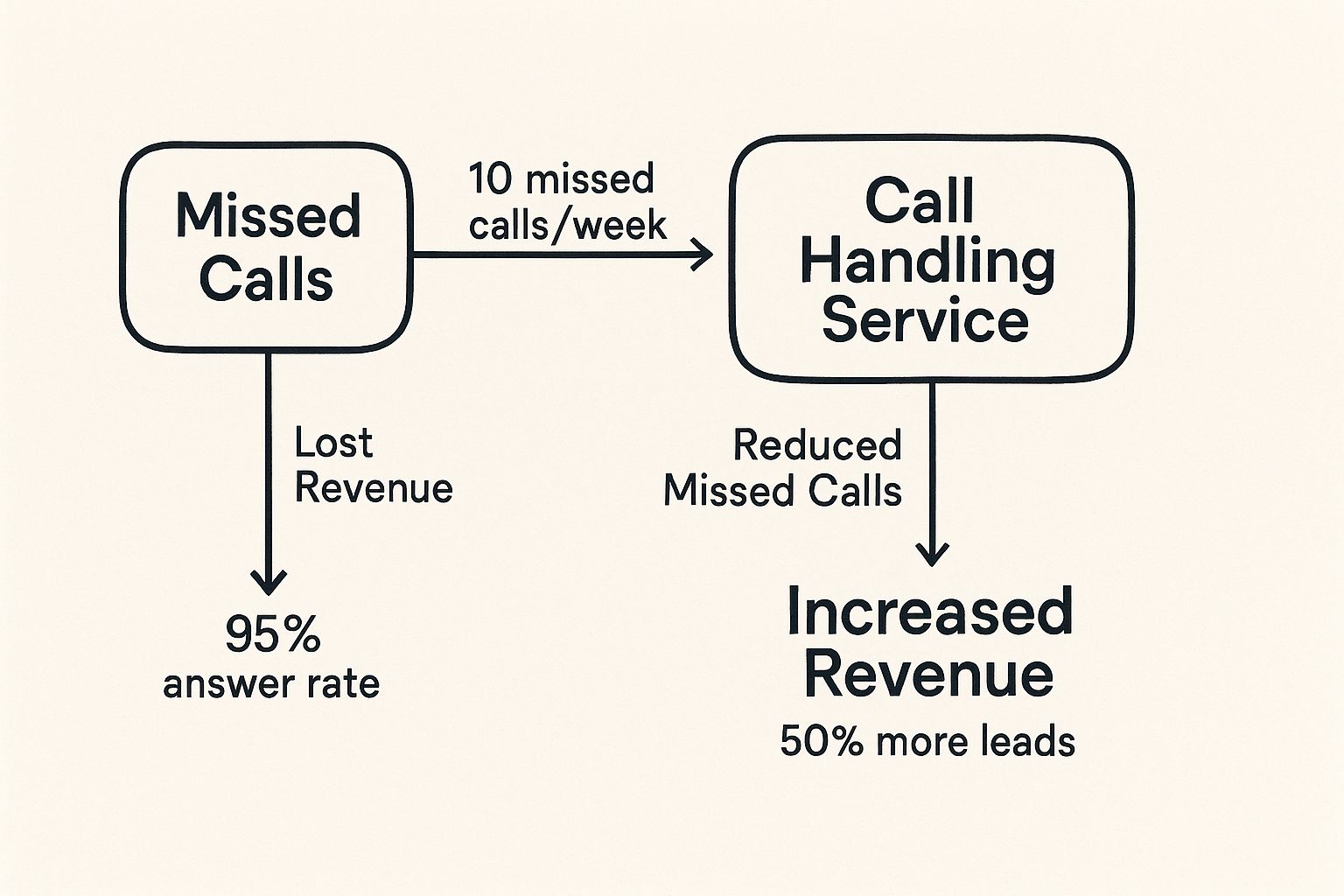
As you can see, simply having a service that can maintain a high answer rate can dramatically increase how many leads you capture. It turns those missed opportunities into measurable growth.
Beyond the money, a call handling service seriously elevates your brand's image. A prompt, professional, and helpful response builds instant trust and credibility. It makes your business feel more established and reliable, which is a massive advantage in a competitive market. You get to project the image of a larger, more organized company without the crushing overhead costs.
Freeing Up Your Most Valuable Asset
At the end of the day, the most significant advantage is getting your time back. As a business owner, your focus should be on your core operations—the work that actually makes you money and moves the needle. Getting bogged down by constant phone interruptions is just plain inefficient and stressful.
By delegating call management, you reclaim valuable hours every single week. This frees you up to concentrate on bigger-picture tasks, improve the service you're delivering to current clients, and maybe even find a better work-life balance—all while knowing your customer communication is in expert hands.
To get a clearer picture of the financial upside, you can dig into our guide on how to calculate cost savings from an answering service. This shift from just reactively answering calls to proactively engaging with customers is what truly makes a call handling service a game-changer for any growing business.
What a Call Handling Service Actually Does
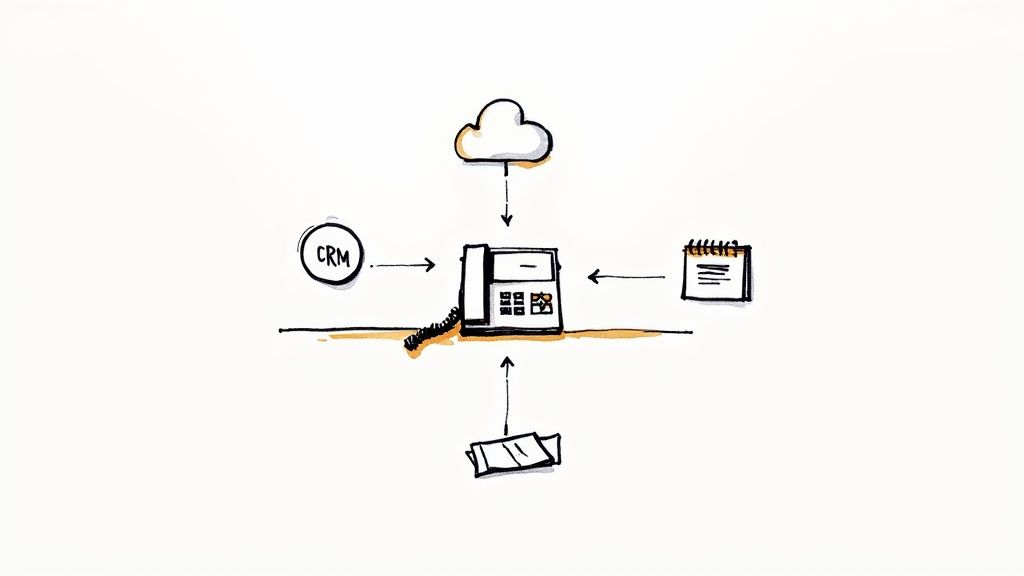
So, what are we really talking about when we say call handling service? It’s easy to picture someone just answering your phone, but that’s barely scratching the surface. The reality is much more powerful.
Think of it less like an old-school switchboard operator and more like a smart, remote front desk for your entire business. It's a dedicated team that doesn't just stop the phone from ringing—they make sure every single caller has a professional, helpful experience, all backed by some clever tech and genuinely skilled people.
This service becomes a true extension of your company. It means that whether you're up on a roof, deep in a client meeting, or finally taking a day off, your business is still open, responsive, and ready to capture every opportunity that comes your way.
Beyond Simple Message Taking
The old image of an answering service is someone scribbling a name and number on a notepad. Modern call handling has evolved far beyond that. These services are now active partners in your day-to-day operations, handling tasks that directly boost your bottom line and keep customers happy.
They aren't just passive message-takers anymore. They're proactive problem-solvers, following your exact instructions to manage all sorts of customer interactions.
This is where the line between a basic answering service and a comprehensive call handling solution becomes incredibly clear. To see just how different they are, it's worth understanding the fundamentals of a traditional service and how it's changed. You can get the full picture in our guide on what an answering service is.
A modern service is equipped to handle so much more, including:
- Lead Qualification: Agents use your custom questions to figure out if a caller is a hot lead ready to buy or someone just kicking the tires. This saves you from chasing dead ends.
- Appointment Scheduling: They can sync up with your calendar and book appointments directly for quotes, consultations, or service calls. No more back-and-forth emails.
- Basic Customer Support: They can answer common questions like your business hours, give directions, or even walk customers through simple troubleshooting steps you've provided.
- Order Processing: For businesses that sell products, agents can securely take simple orders and payment information right over the phone.
By taking these routine—but absolutely critical—tasks off your plate, a call handling service frees you up to focus on the high-value work that only you can do. It’s about optimizing your entire business, not just answering the phone.
The table below breaks down the key differences between a basic service and what a full-featured call handling partner brings to the table.
Answering Service vs Call Handling Service Comparison
| Feature | Basic Answering Service | Comprehensive Call Handling Service |
|---|---|---|
| Primary Function | Take messages, forward calls | Manage end-to-end customer interactions |
| Agent Role | Passive message-taker | Proactive problem-solver and brand representative |
| Lead Management | Basic contact info collection | Lead qualification, CRM data entry, and follow-up scheduling |
| Scheduling | Forwards requests for you to handle | Direct integration with your calendar to book appointments in real-time |
| Customer Support | Limited to business hours/location | Answering FAQs, providing basic support, and resolving simple issues |
| Business Integration | Minimal; acts as a simple gatekeeper | Deep integration with CRM, scheduling software, and operational workflows |
| Impact on Business | Prevents missed calls | Drives revenue, improves customer satisfaction, and increases efficiency |
As you can see, the scope is worlds apart. One catches calls, while the other actively helps you run and grow your business.
The Technology That Makes It All Work
So how does this all happen so seamlessly? It’s a smart blend of technology and human expertise. Your business line is forwarded to the service. When a call comes in, the agent’s computer screen instantly lights up with a profile of your company.
This "screen pop" gives them everything they need: your custom script, answers to frequently asked questions, and key business details. This immediate access lets them greet callers as if they were sitting in your office, delivering a consistent and branded experience every time.
Many services take it a step further by integrating directly with your CRM software. This means new caller info can be automatically logged, and existing customer records can pop up instantly, making for a much more personal and efficient conversation.
The Human Element in a Digital Age
While the tech is the backbone, it’s the people who make it truly work. The quality of a call handling service lives and dies by its agents. These aren't just call center drones; they are trained professionals skilled in customer service, empathy, and quick thinking. They take the time to learn your company's tone and values so they can represent you authentically.
This human touch is non-negotiable. Even in our digital world, when a customer has an urgent issue, over half of them still want to resolve it by talking to a real person on the phone. With customer satisfaction in the U.S. hovering around 73%, professional, empathetic service is what sets great businesses apart.
Ultimately, a call handling service combines smart technology with skilled people to become a powerful asset for your business. It ensures every call is an opportunity—to book a job, qualify a lead, or just make a customer feel heard and valued from the very first hello.
Key Features That Drive Business Growth

It’s one thing to know what a call handling service does in theory. It's another thing entirely to see how its features translate into actual business growth. These aren't just bells and whistles; they're tools built to solve the real problems that keep small business owners up at night—from capturing leads after you've gone home to making your sales process run like a well-oiled machine.
Think of each feature as a building block. Piece by piece, they help you build a more efficient, profitable operation. Let’s break down the ones that make the biggest impact and see how they can expand your business, one professionally answered call at a time.
Constant Availability Creates More Opportunities
Let's be honest, the traditional 9-to-5 workday is dead. Your potential customers don't stick to a schedule. Someone with a burst pipe at 10 PM or a homeowner browsing for quotes on a Sunday morning isn't going to wait for your office to open. They’ll just call the next person on the list.
This is where 24/7 availability turns into a growth engine.
- Capture Every Lead: A round-the-clock service means you never miss a call. After-hours inquiries become scheduled jobs or qualified leads waiting for you first thing in the morning.
- Enhance Customer Support: For your existing customers, knowing they can reach a real person in an emergency builds incredible trust. It shows you're reliable, and that kind of loyalty is priceless.
By simply being "open" when your competitors are sending calls to voicemail, you've already given yourself a massive advantage.
Streamlining Operations With Appointment Scheduling
One of the biggest time-sucks for any service business is the endless game of phone tag just to book an appointment. It’s a frustrating dance that pulls you away from the actual work and can easily cause a promising lead to give up and move on.
A call handling service with integrated appointment scheduling puts an end to that chaos. The agents get access to your calendar and can book jobs directly based on the rules and availability you set.
This isn't just about convenience; it directly shortens your sales cycle. A caller who is ready to buy can be booked on the spot. All the friction is gone, and in a single phone call, they go from a curious prospect to a confirmed customer on your schedule.
Using Data to Make Smarter Decisions
How do you know which of your marketing dollars are actually working? Are those Google Ads driving valuable calls, or is your local flyer doing the heavy lifting? Without data, you’re flying blind. This is why call analytics and reporting are so critical.
A top-tier call handling service gives you the raw data: call volume, peak call times, call duration, and even where your callers are coming from. This information is a goldmine for making smarter business decisions.
To prove the value of a call handling service, you need to look at key performance indicators like call tracking metrics. These insights show you where to put your marketing budget for the best return and help you understand your customers on a much deeper level.
Deeper Integration for a Personalized Touch
For a call handling service to be truly effective, it has to feel like a seamless part of your team, not some disconnected third party. That happens through integrations with the tools you already use every day, especially your Customer Relationship Management (CRM) software.
When a call comes in, CRM integration lets the agent instantly see the caller's history with your business. That context is powerful. It allows for a personal conversation that makes the customer feel seen and valued, not like just another ticket number. After the call, all the notes and outcomes are logged right back into the CRM, keeping your records perfectly up-to-date without you lifting a finger.
The call handling industry is huge, with around 17 million agents working in contact centers globally. As technology advances, the real game-changer is service quality. Yet, in 2023, organizations only hit about 55% of their digital improvement goals, which tells you there's a big gap between having tools and using them well.
These features are what separate a basic answering service from a true growth partner. For a deeper dive, check out our complete guide to call handling for business.
Choosing the Right Service for Your Business
Picking a call handling service isn't like buying software off the shelf. You're choosing a partner. You're handing over a piece of your brand to someone else, trusting them to be the first voice a new customer hears.
Get it right, and it feels like you’ve instantly expanded your team with seasoned pros. But a bad fit can create frustrating experiences for your customers and chip away at the reputation you’ve worked so hard to build.
To make a smart choice, you need to go beyond the price tag. It's all about asking the right questions and looking for specific qualities that actually match how your business operates. The goal is to find a service that doesn't just answer your phone, but actively helps you grow.
Look for Specialization in Your Field
Not all answering services are created equal. A service that’s great at booking appointments for a downtown law firm probably won’t grasp the urgency of a panicked call about a burst pipe at 2 AM. This is where industry specialization becomes a game-changer.
A partner who already knows your world speaks your language. They get the common questions, they know what info to grab, and they can tell the difference between a tire-kicker and a genuine emergency. That built-in knowledge means less time spent on training, fewer mistakes, and a much cleaner experience for your callers.
When you're talking to potential services, ask them point-blank about their experience with businesses like yours. Have they worked with other plumbers, electricians, or home service companies in your area? Their answer tells you everything you need to know.
Evaluate Their Technological Capabilities
These days, a great call handling service runs on more than just friendly agents. The tech behind the scenes is what makes everything run smoothly. You have to be sure their systems can actually talk to the tools you already use every single day.
Here’s what to look at:
- CRM Integration: Can they plug directly into your CRM to log calls and update customer files? This is what turns a generic call into a personalized, informed conversation.
- Scheduling Software Compatibility: If booking jobs is a big part of your calls, you need to know they can work with your calendar, whether it’s a simple Google Calendar or a more complex industry-specific platform.
- Reporting and Analytics: A top-notch service will give you data you can actually use—call volume, peak times, appointment booking rates. These numbers are gold for making smarter decisions.
AI is also becoming a huge piece of the puzzle. The call center AI market was valued at $1.6 billion back in 2022 and is expected to jump to $4.1 billion by 2027. It's all driven by the need for more intelligent call management.
Ask the Right Questions During Your Search
Once you’ve got a short list, it's time to dig in. The answers to these questions will separate the pros from the amateurs.
- How do you train your agents on my specific business? You’re listening for a detailed, thorough onboarding process, not a generic one-pager.
- What’s your exact process for escalating an urgent call? There needs to be a crystal-clear protocol for emergencies. No ambiguity.
- Can I listen to call recordings and see the notes your agents take? Transparency is non-negotiable. It’s the only way to ensure they’re representing your brand correctly.
- How easily can your service scale up or down with my business? Your call volume will change with the seasons. You need a partner who can flex with you.
A deep dive into their agent training and quality checks is crucial. This is how you confirm they'll act as a true ambassador for your brand. Especially if your calls are sales-focused, this guide on choosing sales call recording software offers some great pointers on what to look for.
Finding the right fit is a huge step. To get a better sense of how these services work day-to-day, our deep-dive on business telephone answering services is a great place to start.
Setting Up Your Call Handling Service

Getting a call handling service up and running is a lot less technical than you might think. Honestly, the best way to approach it is like you're onboarding a new team member. Your main goal is to give your remote receptionists all the tools and info they need to sound like they've been part of your company for years.
It all kicks off with a discovery call. This is where you'll chat with the service provider about your business, how many calls you typically get, and what you’re hoping to accomplish. This first conversation is so important—it’s how they'll tailor the service to your workflow, making sure everything clicks from day one.
From there, you get into the real meat of the setup: building out your call scripts and flows. This is where you get to decide exactly how your phone is answered every single time.
Developing Your Custom Script and Knowledge Base
A script is so much more than a simple "hello." Think of it as a playbook for your remote receptionists. It maps out how to introduce your business, what key questions to ask to see if a caller is a good lead, and how to field the usual questions. A solid script ensures every caller gets a consistent, professional experience that feels like your brand.
To really empower the agents, you'll also build out a detailed FAQ document. This becomes their go-to resource for everything—your services, pricing, hours, even the specific towns you cover. The more you put in here, the more calls they can handle on their own without having to pass the buck back to you.
Make sure your knowledge base covers these key areas:
- Service Details: Simple, clear descriptions of what you do. No jargon.
- Pricing Information: Guidelines on how to give a rough quote or explain your pricing tiers.
- Common Objections: Pre-written responses for the usual pushback or concerns you hear from customers.
- Emergency Protocols: What to do, step-by-step, when a call is truly urgent.
Configuring the Technical Details
Once the scripts are nailed down, it’s time for the technical bit, which is surprisingly straightforward. You’ll just set up call forwarding from your business line to a special number the service gives you. You can usually choose how this works—forward calls instantly, after a few rings, or only when your line is busy.
The most successful rollouts begin with a trial period. This allows you to test the service in a real-world environment, listen to call recordings, and provide feedback to fine-tune the agents’ performance before going fully live.
Finally, you need to set up a clear line of communication with your provider. A good service will give you a dedicated account manager and an easy way to update your script, FAQ, or on-call schedule. This open channel is vital for a long-term partnership, ensuring your call handling service can grow and change right alongside your business.
Figuring Out Call Handling Pricing
Choosing a call handling service is a big step, and a huge part of that decision comes down to one thing: how you’ll be paying for it. Pricing isn't a simple, one-size-fits-all deal. Different services structure their fees for different kinds of businesses and call volumes, so getting this right means you only pay for what you actually use—no nasty surprises.
Think of it like picking a cell phone plan. Are you constantly online, needing unlimited data? Or do you barely use your phone, making a pay-as-you-go plan the smarter choice? The same logic applies here. Let's walk through the common pricing models so you can find the perfect financial fit for your business.
H3: Pay-Per-Minute Billing
This is the classic model. With pay-per-minute billing, you're charged for the total time an agent is actively working on your behalf. That clock is running not just during the conversation, but also for any post-call tasks, like logging notes into your CRM or scheduling an appointment.
This approach can be incredibly cost-effective if your calls are predictable and fairly quick. But if you often deal with complex issues that lead to longer conversations, the costs can become a real wild card and add up fast.
The secret to making pay-per-minute work is knowing your average call duration. If you're just guessing, you're setting yourself up for a much higher bill than you expected. You'll want a service that provides detailed call logs to keep a close eye on your spending.
H3: Pay-Per-Call or Per-Lead
Another popular route is the pay-per-call or pay-per-lead model. Here, you forget about the minutes. Instead, you pay a simple flat fee for every single call the service answers for you. This structure is fantastic for predictable budgeting because your costs are tied directly to the number of interactions, not how long they last.
This model is a dream for businesses focused on lead capture or booking jobs. A local plumber who just needs someone to grab a customer's details and schedule a quote will find this model refreshingly straightforward.
H3: Monthly Subscription Plans
For the most stable and predictable budget, monthly subscriptions are king. You pay a single, fixed fee each month that usually covers a specific number of minutes or calls. It’s the perfect setup for businesses that have a pretty consistent call volume and want an expense that’s easy to plan for.
These plans are almost always tiered, which lets you move up as your business expands.
- Basic Tier: Usually includes a small bucket of minutes and standard features like taking messages.
- Mid-Tier: Often adds more valuable services like appointment scheduling and CRM integration.
- Premium Tier: Might come with unlimited minutes, 24/7 support, and even a dedicated account manager.
For a deeper dive into how these models stack up against each other, our complete guide on answering service pricing breaks down the costs and benefits in even more detail.
When you're comparing providers, it’s helpful to see how their pricing structures align with different business needs. Each model has its own sweet spot.
Pricing Model Breakdown for Call Handling Services
| Pricing Model | How It Works | Best For |
|---|---|---|
| Pay-Per-Minute | Billed for the total agent time used, including talk time and after-call work. | Businesses with predictable, short calls and steady volume. |
| Pay-Per-Call | A flat fee is charged for each individual call handled, regardless of its duration. | Businesses focused on lead capture and appointment setting. |
| Monthly Subscription | A fixed monthly fee for a set package of minutes or calls, often with tiered options. | Businesses with consistent call volumes who want budget predictability. |
No matter which path looks best, the goal is to find a plan that aligns with your call patterns and business goals, ensuring you get value without overpaying.
H3: Watch Out for Hidden Costs
Alright, this is important. Whichever model you lean toward, you have to read the fine print. Some providers tuck extra charges into their agreements that can really catch you off guard. Always ask about potential hidden fees before you sign anything.
Here are a few common ones to look for:
- Setup or Onboarding Fees: A one-time charge to get your account configured and their team up to speed.
- After-Hours or Holiday Surcharges: Some services will charge a premium for calls that come in outside of standard business hours.
- Charges for Extra Services: Things like patching a call through to your cell or making an outbound call for you might not be included in the base rate.
By getting a clear picture of these pricing structures and asking the right questions, you can pick a call handling service that not only helps your business run smoother but also fits your budget like a glove.
Got Questions? We've Got Answers
Even when the benefits seem crystal clear, it’s smart to have a few questions before you bring on a new service. Most small business owners I talk to have the same handful of concerns, so let's tackle them head-on.
How Do You Make Sure They Sound Like My Team?
This is the big one, right? The last thing you want is a caller feeling like they've reached a generic, disconnected call center.
Top-tier services get this, and they solve it with a really deep onboarding process. You'll sit down with them to map out custom scripts, call flows, and a complete knowledge base. We're talking everything from your business hours to the nitty-gritty details of the services you offer.
By putting in that work upfront, the receptionists become a true extension of your brand. They greet callers exactly as you would, ask the right questions, and understand what makes your business tick.
What Happens If I Suddenly Get Slammed With Calls?
Great question. One week it's crickets, the next you're running a promotion and the phone is ringing off the hook. A quality call handling service is built for exactly this kind of rollercoaster.
Think of it this way: you're tapping into a large, flexible pool of trained agents and smart call-routing tech. When a sudden spike hits, the system just absorbs it. No long hold times, no calls dumped to voicemail. You get all the power of a huge support team without any of the overhead.
Is My Customer Data Safe With Someone Else?
Handing over customer info can feel a bit nerve-wracking, but reputable services take security incredibly seriously. They have to. Their business depends on it.
They use robust security measures like secure data centers, encrypted communications, and tight access controls to keep your information locked down.
A good rule of thumb: when you're checking out potential partners, ask them directly about their security protocols and any compliance certifications they hold. A trustworthy provider won't hesitate to show you how they keep your data safe.
Can They Do More Than Just Take Messages?
Absolutely. Basic message-taking is just the beginning. A modern call handling service is more like a Swiss Army knife for your business operations.
Beyond just relaying messages, they can step in and:
- Qualify new leads using the exact criteria you set.
- Book appointments right into your calendar.
- Process simple orders and even take payments.
- Act as your front line of customer support, answering common questions on the spot.
It shifts the service from a passive answering machine to an active partner in actually running and growing your business.
Ready to stop missing calls and start capturing every opportunity? See how Marlie Ai uses a 24/7 AI phone assistant to help businesses save up to 80% on call-handling costs and book more jobs, all with a setup that takes just minutes. Discover the difference at https://www.marlie.ai.
