
An AI answering service is basically an automated system that uses artificial intelligence to handle your business’s inbound calls. Think of it as a virtual receptionist with superpowers. It can understand what people are saying, answer their questions, book appointments, and route calls—all day, every day, with zero human oversight.
Deconstructing the Modern Answering Service

To really get what this means, just picture a traditional phone receptionist. Their job is pretty straightforward: greet callers, figure out what they need, and then either connect them to the right person or give them some basic info. An AI answering service does all of the same things, just with technology instead of a person.
But this isn't your parents' clunky automated menu. Forget those frustrating "press one for sales, press two for support" loops that made old Interactive Voice Response (IVR) tech so maddening. Modern AI services are built on something much, much smarter.
The Technology Behind the Voice
At its heart, an AI answering service runs on sophisticated tech like Natural Language Processing (NLP), which gives it the ability to understand and respond to human speech. NLP is the magic that lets the AI figure out not just the words a caller says, but also what they actually mean.
This completely changes the game, turning a rigid, command-based exchange into a fluid, natural conversation. The AI can handle different accents, phrasings, and ways of speaking, which makes the whole experience feel surprisingly human.
A key distinction is that an AI answering service is designed for conversation, not just call forwarding. It's an active participant in the customer interaction, aiming to resolve issues on the first contact.
For a business, this is a seriously powerful tool for your front line. Instead of just being a gatekeeper that passes calls along, the AI becomes a problem-solver. It can handle a huge volume of common questions all at once, making sure no call ever goes unanswered.
What an AI Answering Service Can Do
What these AI assistants can do goes way beyond just picking up the phone. Depending on how they're set up and what they're connected to, they can tackle a whole range of tasks that directly help your business run smoother.
These capabilities usually include:
- 24/7 Availability: It’s always on, providing constant coverage during evenings, weekends, and holidays when your team is off the clock.
- Appointment Scheduling: It can sync directly with your calendars to book, reschedule, or cancel appointments in real-time.
- Frequently Asked Questions: The AI can instantly answer all those common questions about business hours, locations, services, or policies.
- Lead Qualification: It can gather key details from new callers to qualify them as potential leads before handing them off to your sales team.
- Intelligent Call Routing: By analyzing what a caller needs, it can figure out the best person or department to handle the call and transfer it without a hitch.
This is a massive leap forward from the old models. If you want to see just how far we've come, our guide on what an answering service is gives you a good look at how these services have changed over the years. The AI-powered version is simply the next logical step—a smarter, more efficient, and scalable solution for today’s businesses.
Why Your Business Needs an AI Answering Service
The most obvious benefit of an AI answering service is the cost savings, and while that’s a great starting point, it’s not the whole story. The real value is far deeper—it’s about fundamentally changing how your business operates for the better. This isn't just about trimming expenses; it's about building a smarter, more resilient company that puts customers first.
This technology delivers on that promise by excelling in three key areas.
First and foremost, it’s about the customer experience. We live in an on-demand world, and every missed call is a potential customer walking away. Making someone wait on hold? That's a surefire way to send them straight to your competition. An AI assistant guarantees every call gets picked up in seconds, day or night.
Think about it. A potential client calls your office after hours with a simple question. Instead of hitting voicemail and immediately Googling your competitor, they get a helpful, intelligent answer on the spot. That single interaction builds instant trust and captures a lead that would have otherwise vanished.
Boost Your Operational Efficiency
Next up is the massive boost in efficiency for your team. Most businesses find that a huge chunk of their calls—often 60-80%—are for the same handful of routine questions. Think: "What are your hours?" "Can I confirm my appointment?" "What's the status of my order?"
These calls are necessary, but they’re a huge time sink for your skilled employees who could be focused on much bigger things. By letting AI handle these repetitive queries, you free up your people to tackle complex problems, close high-value sales, or build real relationships with customers. It's like giving your A-team a dedicated assistant to handle all the noise so they can focus on what they do best.
An AI answering service doesn’t replace your team; it empowers them. It filters out the repetitive tasks, letting your human experts handle the conversations that actually need a human touch—the ones requiring empathy, nuance, and critical thinking.
This isn’t just a theory; you can see the impact in the numbers. Businesses that bring in this tech see a dramatic increase in issues resolved per hour. Why? Because every call that now reaches a person is one that genuinely needs their expertise.
Gain a Lasting Competitive Edge
Finally, putting an AI answering service to work gives you a serious competitive advantage, especially if you’re a small or mid-sized business. It completely levels the playing field. Suddenly, you can offer the kind of 24/7, enterprise-grade service that used to be reserved for giant corporations with sprawling call centers.
This also means your business is always ready to grow. Get a sudden spike in calls from a new marketing campaign? No problem. Expanding into a different time zone? The AI is already there. You can scale your operations instantly without the headache and overhead of hiring and training more staff.
To see how this fits into the bigger picture, just look at the key hospitality technology trends shaping customer service. The entire industry is moving toward intelligent automation because it just works.
By 2025, some predictions suggest that AI systems could handle as much as 95% of all customer interactions. Companies already adopting generative AI are seeing a 14% jump in issues resolved per hour and a 9% drop in call handling time. By embracing this technology now, you’re not just keeping up; you’re getting ahead. To see exactly what this could mean for your bottom line, you can calculate cost savings with AI assistants and plug in your own numbers.
Key Features of a Modern AI Answering Service
When you start looking into AI answering services, you quickly realize they aren't all created equal. There's a world of difference between a clunky, automated phone menu and a truly intelligent virtual assistant. A modern service isn't just a call-forwarding machine; it’s an active, smart member of your team.
So, what should you look for? A few key features separate the genuinely useful platforms from the rest, turning a simple tool into a powerhouse for customer happiness and smoother operations.
Intelligent and Natural Call Routing
Forget the frustrating "press one for sales, press two for support" menus we've all come to hate. A top-tier AI answering service uses intelligent call routing to understand what a caller needs through a normal, natural conversation. The AI actually listens to the caller's request and figures out the best person or department to handle it, instantly.
For example, if someone calls and says, "I need to talk to someone about an invoice," the AI picks up on the keyword "invoice" and sends the call straight to your billing department. This kind of seamless transfer cuts out all the extra steps and dramatically lowers customer frustration. Callers get to the right place on the first try.
This image really breaks down the different kinds of AI systems you'll run into.
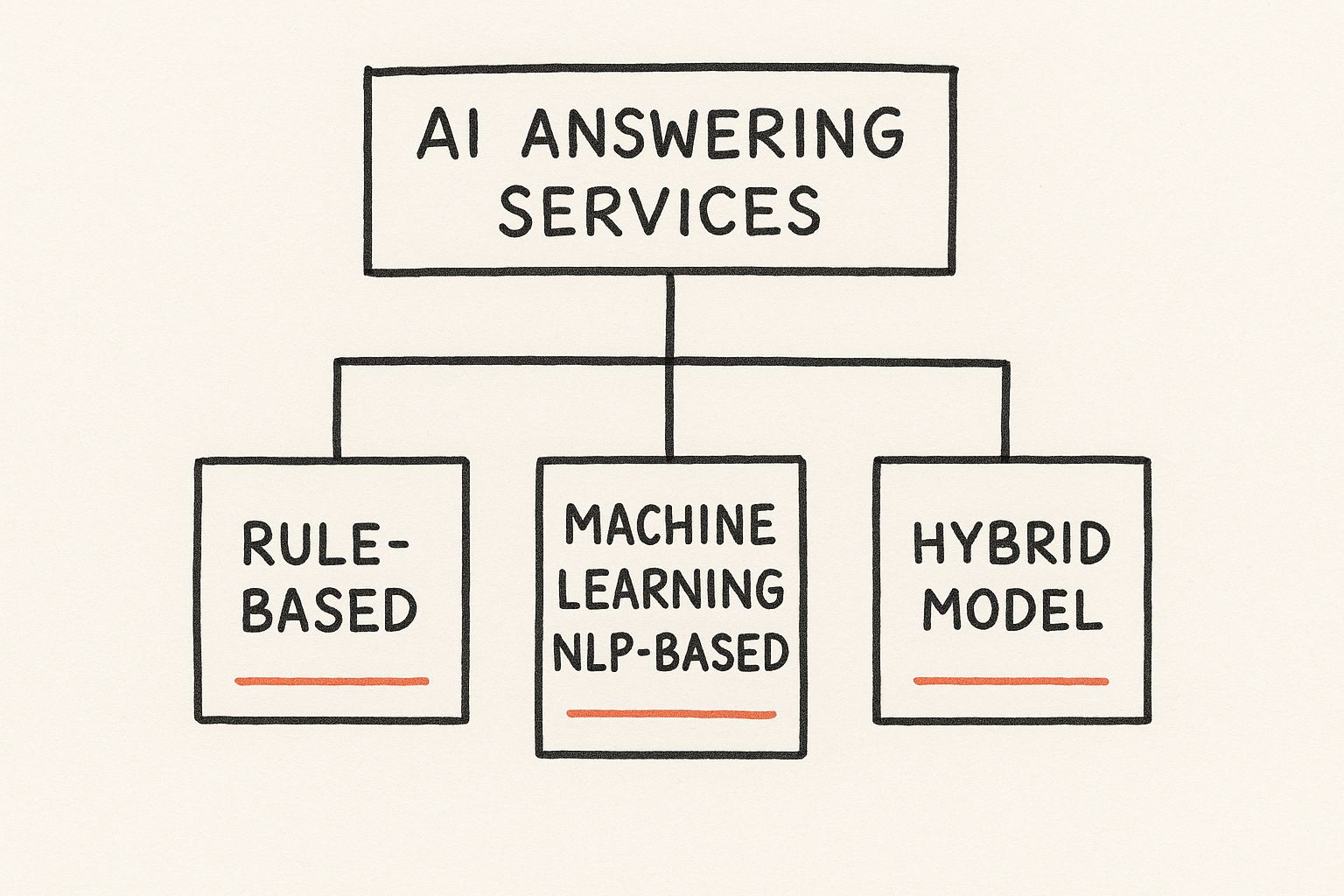
As you can see, these systems have evolved from simple rule-based models to much more advanced NLP and hybrid solutions, with each step up offering a more human-like conversational ability.
Seamless CRM Integration
One of the most powerful features you can get is CRM (Customer Relationship Management) integration. When your AI answering service connects to your CRM, it completely changes the game, turning every call into a personalized experience. The AI can instantly pull up a caller's history, past conversations, and account details.
This allows the AI to greet returning customers by name, bring up their last order, or understand their issue without the caller having to explain everything from scratch.
- For your sales team: The AI can log new leads directly into the CRM, along with notes from the initial call.
- For your support team: The AI can pull up a customer's entire support ticket history to give your agent context before they even say hello.
This kind of integration doesn't just make customers feel seen and valued; it gives your team the info they need to solve problems faster and more effectively.
Natural Language Processing and Sentiment Analysis
The engine behind any advanced AI answering service is Natural Language Processing (NLP). This is the technology that lets the AI understand human speech in all its messy glory—including slang, different accents, and weird phrasing. A system with strong NLP can figure out the intent behind someone's words, not just the words themselves.
A powerful AI doesn't just hear what a customer says; it understands what they mean. This ability to grasp context and sentiment is what elevates the interaction from a robotic script to a genuinely helpful conversation.
Going a step further, some systems also use sentiment analysis to read a caller's emotional state. By picking up on frustration or urgency in a person's tone of voice, the AI can prioritize the call or route it to a specialist trained in handling tough situations, making sure sensitive issues get the care they need.
24/7 Appointment and Schedule Management
For any service-based business, being able to book appointments around the clock is a huge advantage. A key feature of modern AI answering services is their ability to plug directly into your company's calendars.
This lets the AI handle all the tedious scheduling work for you:
- Book new appointments: A caller can ask for a time, and the AI will check your calendar and book it on the spot.
- Reschedule existing appointments: Customers can easily change their bookings without ever needing to talk to a person.
- Send automated reminders: The system can fire off text or email reminders automatically, which is a massive help in cutting down no-shows.
Automating these administrative tasks frees up your staff and ensures you never miss a chance to fill your schedule. You can check out a full rundown of what's possible by exploring our AI answering service features. It basically means your business is always open for bookings, even long after you've locked the doors for the day.
Comparing AI Answering Service Features
To really see the difference, it helps to put the old and new side-by-side. The jump from a basic Interactive Voice Response (IVR) system to a modern AI service is pretty stark.
| Feature | Basic Automated System (IVR) | Advanced AI Answering Service |
|---|---|---|
| Call Routing | Rigid, number-based menus ("Press 1 for…") | Understands natural language to route calls based on intent |
| Customer Interaction | Limited to keypad inputs and simple voice commands | Holds natural, two-way conversations with callers |
| Personalization | Generic, one-size-fits-all responses | Accesses CRM data for personalized greetings and context |
| Scheduling | Typically requires human hand-off | Fully automates booking, rescheduling, and sending reminders |
| Data Collection | Minimal; may log call times and numbers | Captures detailed call transcripts and customer sentiment |
| Availability | 24/7, but with very limited capabilities | 24/7 with a wide range of complex task-handling abilities |
This table highlights just how far the technology has come. What used to be a simple call-directing tool is now a sophisticated system that can handle complex, nuanced interactions that genuinely help your business and your customers.
How AI Answering Services Perform in the Real World
The real magic of an AI answering service happens when you stop talking theory and start looking at how it actually performs in the wild. Across all sorts of industries, businesses are putting this tech to work—not just to answer calls, but to solve real, nagging problems that hit their bottom line.
When you see it in action, you start to understand how an AI assistant stops being a tool and starts becoming a core part of the team. Let's look at how three very different businesses—a real estate agency, a healthcare clinic, and an e-commerce brand—are using AI to get ahead.
Real Estate Never Sleeps (and Neither Does AI)
For any busy real estate agency, a missed call isn’t just an inconvenience; it’s a lost opportunity, plain and simple. Buyers are notorious for calling after hours or on weekends when they're driving around looking at properties. If that call goes to voicemail, odds are they're just dialing the next number on the list.
The Problem: A mid-sized agency was bleeding potential leads. Their agents couldn't possibly be on call 24/7 to field questions and book viewings. By the time they could return a voicemail, the prospect had often already scheduled a tour with a competitor.
The AI Solution: They brought in an AI answering service to be their after-hours front line. The AI was fed all the details on their active listings.
- When a potential buyer called, the AI could instantly answer questions like, "How many bathrooms does the property on Elm Street have?" or "Is there a virtual tour I can see?"
- Crucially, it could also tap into the agents' calendars to schedule property viewings right then and there, firing off confirmations to both the buyer and the agent.
- The AI also grabbed the caller's info and noted the property they were interested in, automatically creating a fresh lead in the agency's CRM.
The Outcome: Within three months, the agency captured 20% more qualified leads without adding a single person to the payroll. Agents could finally focus on what they do best—showing properties and closing deals—knowing that no opportunity would slip through the cracks when they were off the clock.
Streamlining Patient Care in Healthcare Clinics
Healthcare clinics are in a constant battle with administrative overload. The sheer volume of appointment reminders, prescription refill requests, and basic questions about hours or insurance can easily swamp the front desk, pulling focus away from actual patient care.
The Problem: A local medical clinic was struggling with a high rate of patient no-shows, which threw schedules into chaos and hurt revenue. At the same time, their staff was spending huge chunks of the day on repetitive phone calls, creating long hold times for patients who had more pressing issues.
In healthcare, efficiency isn't just about saving money—it's about improving patient access to care. Automating routine tasks ensures that a patient with a critical health concern can get through to a person faster.
The AI Solution: They integrated an AI answering service to take over routine patient communications. The system was set up to handle a few specific, high-volume tasks.
- Automated Appointment Reminders: The AI called patients two days before their appointment to confirm, even giving them the option to reschedule right on the call.
- Prescription Refill Line: Patients could call a dedicated line, leave their name and prescription details with the AI, and the request would be securely routed to the pharmacy team.
- FAQ Handling: The AI fielded all the common questions about location, hours, and accepted insurance plans, keeping the main phone lines clear.
The Outcome: The results were immediate. The clinic slashed its patient no-show rate by over 30%. The front desk staff got back an estimated 10-15 hours per week, which they could now spend providing better in-person service and handling more complex patient needs.
Boosting Loyalty for E-commerce Brands
In the world of online retail, customer service can make or break you. When a customer has a question about an order, a slow or unhelpful response can sour their opinion of your brand for good. The most common questions—"Where's my order?" and "How do I make a return?"—can absolutely flood your support channels, especially during busy seasons.
The Problem: A growing e-commerce brand's small support team was drowning in calls about order status and returns. This created painful response times, frustrated customers, and a growing number of negative online reviews.
The AI Solution: The brand put an AI answering service in place that plugged directly into its shipping and order management software. When a customer called, the AI could verify who they were using their phone number or order ID. It could then give them instant, accurate shipping updates or walk them through the return process, even emailing them a return label while still on the call.
The Outcome: The brand successfully automated over 60% of its inbound calls. This instant support dramatically improved customer satisfaction and led to a 15% increase in repeat purchases from customers who had a great service experience.
How to Choose and Implement Your AI Service
Jumping into the world of AI can feel like a big step, but choosing and launching an AI answering service is surprisingly straightforward when you have a plan. It’s less about picking the flashiest new tech and more about finding the right fit for your specific business challenges.
The real goal is to find a partner and a platform that solves today's problems and can actually grow with you down the road.
This whole process starts with a simple, honest look at your own operations. Where are the biggest communication breakdowns you face every day? Are you bleeding leads after hours? Is your front-desk staff totally swamped with the same repetitive calls? Pinpointing your main objective is the single most important first step you can take.
Start by Assessing Your Business Needs
Before you even glance at a single vendor, you need to define what success actually looks like for your business. Think of this as drawing up the blueprint for your ideal solution. If you skip this part, you risk paying for a bunch of features you’ll never use or, worse, picking a service that doesn’t solve your core problem.
Get started by asking a few key questions:
- What's the main problem we need to solve? Is it capturing after-hours leads, automating appointment scheduling, or just filtering out the endless spam calls?
- What’s our daily call volume? Are we talking ten calls a day or a hundred? This will have a huge impact on pricing and the kind of plan you need.
- What specific tasks do we want to automate? Get granular here. Make a list of the top 3-5 repetitive questions that tie up your team's time.
- What software are we already using? Your AI service becomes infinitely more powerful if it can plug right into your current CRM, calendar, or scheduling tools.
Having clear answers to these questions will make your search for a vendor incredibly efficient. You’ll be able to quickly weed out the services that don't make sense and zero in on the ones that do.
Evaluating Vendors and Their Technology
Once you know exactly what you need, you can start checking out potential providers. The market for AI-powered communication is blowing up, driven by the massive demand for better customer experiences.
In fact, the global call center AI market was valued at around $2.00 billion in 2024 and is expected to rocket to $7.08 billion by 2030, according to data from Grandview Research.
When you’re comparing your options, look beyond the price tag. Dig into the technology itself and the support they offer.
A great AI answering service should feel like a natural extension of your team. It needs to be reliable, easy to manage, and capable of handling real-world customer conversations with grace.
Look for a provider that offers a simple setup process and pricing that doesn’t require a PhD to understand. You shouldn’t need a team of engineers just to get your system up and running. A smooth implementation is just as important as the tech itself—it really sets the stage for your long-term success.
For a deeper dive into this space, our complete guide on AI call center software offers a much broader look at the technologies available.
Planning a Smooth Rollout
Implementation is where your plan finally comes to life. A successful launch is about more than just flipping a switch; it requires some thoughtful prep and clear communication with everyone on your team.
Here's a simple roadmap for a launch that doesn't cause any headaches:
- Train the AI with Your Data: Feed the AI your company’s specific information. This means FAQs, business hours, service details, and a clear script for how you want calls to be handled.
- Set Up Integrations: This is a big one. Connect the AI to your essential tools, like your scheduling calendar or CRM, to unlock the true power of automation.
- Communicate with Your Team: Make sure your staff understands how the new system works. Explain which calls the AI will handle and exactly when it will hand a caller over to a human.
- Test and Refine: Before going fully live, run some test calls. This is your chance to catch any weird quirks and fine-tune the AI’s responses for clarity and accuracy.
- Inform Your Customers: Think about adding a brief, friendly message on your website or in your on-hold recording to let customers know you’ve found a new, faster way to handle their calls.
Common Questions About AI Answering Services
Jumping into any new technology kicks up a lot of questions, and an AI answering service is no different. It's totally normal to wonder about security, cost, and what this all means for your team.
Let's walk through some of the biggest questions business owners have before they make the switch. Getting clear on these points is the key to feeling good about your decision. This isn't just about adding tech for the sake of it—it's about finding something that actually solves problems and helps your business grow.
Will an AI Service Replace My Human Employees?
This is usually the first thing on everyone's mind, and the answer is almost always a hard no. The goal of an AI answering service isn't to replace your people, but to make them better. Think of it as a super-efficient assistant that handles all the repetitive, high-volume stuff that bogs your team down.
A huge chunk of inbound calls are for simple, routine things. By letting AI take care of those, you free up your skilled employees to focus on the high-value work—the tricky customer problems, the nuanced sales calls, and the conversations that build real relationships. That's where humans shine.
An AI answering service turns your team from information clerks into expert problem-solvers. It cuts through the noise so your people can apply their talent where it truly matters.
Instead of cutting jobs, this kind of tech makes existing roles more interesting and impactful. Your team gets to move beyond reading from a script and do more meaningful work that actually drives growth.
Is My Customer Data Safe with an AI Service?
Data security is everything. Any AI provider worth your time will treat it as a top priority. When you're looking at different options, you absolutely have to find a vendor who can prove they're serious about protecting sensitive information.
Keep an eye out for key compliance certifications that apply to your industry. Things like:
- HIPAA for healthcare.
- GDPR if you deal with data from anyone in the European Union.
- SOC 2 for general data security and privacy standards.
A trustworthy partner will use strong encryption for all your data, both when it's moving (in transit) and when it's being stored (at rest). Don't ever be shy about asking direct questions about their security measures and data policies. Your customers' trust is on the line.
How Much Does an AI Answering Service Cost?
The price tag on an AI answering service can really vary depending on what you need and how many calls you get. There’s no single, one-size-fits-all cost. But most companies structure their pricing in a few common ways, which makes it easier to compare apples to apples.
You’ll usually run into one of these models:
- Per-Minute or Per-Call: You pay a flat rate for each minute the AI is on the phone or for each call it handles. This is great for businesses with unpredictable call volume.
- Tiered Monthly Plans: These give you a set number of minutes or calls each month for a fixed fee. If your call traffic is pretty steady, this often offers the best bang for your buck.
- Custom Enterprise Pricing: Big companies with very specific needs might need a custom plan with special features and dedicated support.
It's important to look past the monthly bill and think about the return on your investment. We break down these models in our complete guide to answering service pricing, which can help you figure out the real value you'll get from captured leads and a more efficient team.
Can AI Truly Understand Complex Customer Needs?
Modern AI is shockingly good at understanding natural language. It can pick up on context, identify key phrases, and figure out what a caller really wants with impressive accuracy. It’s a pro at handling all the standard stuff, like booking appointments or giving order updates.
But maybe its greatest strength is knowing its own limits. A well-built AI answering service is programmed to recognize when a call is too complex, sensitive, or emotionally charged for a machine. In those moments, it doesn't just hang up. It seamlessly and intelligently transfers the call to a human agent, making sure the customer always gets the help they need.
Ready to see how an AI assistant can transform your business communications? Marlie Ai provides a 24/7 AI phone assistant that ensures you never miss a call and never overpay to answer one. Learn more and get started today!
